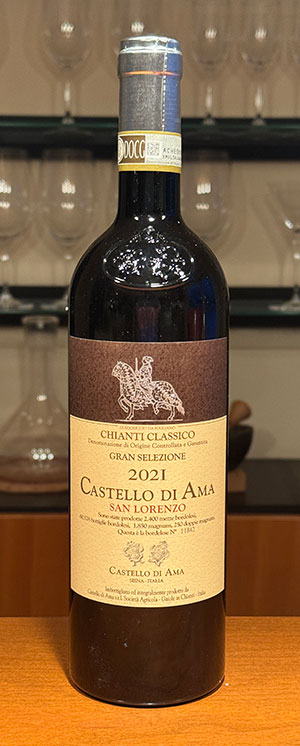
Castello di Ama Chianti Classico

Castello di Ama Chianti Classico Click here for tasting notes.

Castello di Ama San Lorenzo Chianti Classico Gran Selezione 2021

Castello di Ama is located in the small historic village of Ama, in the municipality of Gaiole in Chianti, between Florence and Siena in Tuscany.

The settlement of Ama dates back to Etruscan times, and is first mentioned in medieval documents.  Over the centuries it evolved from a fortified “casale” to a proper castle.

By the 1970s the estate had fallen into disuse. In 1976 four Roman families (Sebasti, Tradico, Carini and Cavanna) bought the property to revive and restore the vineyards and winery.

In 1982, a young agronomist named Marco Pallanti became the enologist/winemaker, marking a turning point. His vision, plus that of  current CEO Lorenza Sebasti (daughter of one of the founding families) shaped Castello di Ama’s modern identity

Over the decades, the estate expanded: from the original  approximately136 acres [55 hectares]. Today there are about 185 acres [75 hectares] of vineyards, plus olive groves and estate buildings.

Beyond winemaking, Castello di Ama is unique among Tuscan estates because it embraces art: starting in the late 1990s, they initiated a contemporary-art project integrating site-specific works by internationally known artists throughout the estate. Many describe Castello di Ama as a place where wine, history, landscape, and art meet.


Terroir, Vineyard, & Winemaking Philosophy

The vineyards of Castello di Ama lie at relatively high altitude for Chianti: between 1378 and 1739 feet [420 and 530 meters] above sea level. Soils are limestone-clay (and in some plots chalky/schyist), and the exposure and altitude help produce grapes with good acidity, structure, and “freshness” — which supports elegance and aging potential.

The estate emphasizes care in viticulture: vineyard parcels are close to the winery (to minimize time from harvest to cellar), and they pay close attention to clonal selection and replanting over time to maintain vine health and grape quality.

Castello di Ama was among the early adopters in the region of more modern winemaking techniques (e.g. use of French oak barrels back in the early 1980s), which influenced the style and quality of their wines.

The estate also embraces sustainability. It’s committed to organic practices, and more recently has taken steps including renewable energy (solar) and certification to ensure environmentally and socially responsible operations.

Castello di Ama San Lorenzo Chianti Classico Gran Selezione 2021

Vines used for “Ama” are relatively young (around 10 to 12 years old), and planted at high density (about 5,200 vines per 2.4 acre or hectare). The wine is named after the picturesque San Lorenzo valley viewed from the estate’s eighteenth-century Villa Pianigiani and Villa Ricucci. The historic vineyards include Bellavista, Casuccia, San Lorenzo, and Montebuoni.

This Castello di Ama Chianti Classico is a blend of 96% Sangiovese and 4% Merlot.  It is a bright medium-opaque ruby in the glass, but it’s unassuming appearance only hints at what is to come.  The nose features black cherry and strawberry.  These continue on the palate, plus notes of violet and red currant. There are strapping but well-integrated tannins, balanced by fresh acidity. The texture is mouthfilling, with a harmoniously long finish. ABV is 13.5%

Back to blog posts: https://winervana.com/blog/

Cecchi Wines

Cecchi WinesWine is Sunlight, Held Together by Water

In 1893, Luigi Cecchi became a professional wine taster. Although widespread in other parts of Europe, the craft of “palatista (taster)” was still unknown in Italy. However, Cecchi believed that by approaching Italian wines with professionalism and organization, people in Italy as well as elsewhere would be able to recognize the quality of the wines produced.

In the early 1900s, Luigi’s son Cesare joined him in business, founding the “Cecchi” label, hoping to prosper both at home and abroad. Luigi, the founder’s grandson, was the key figure during the time of third-generation innovation and expansion. With him, the Cecchi brand distinguished itself in the domestic wine industry thanks to new technologies, a search for new territories, and an intuition for business.

Today fourth-generation Andrea and Cesare Cecchi lead the company with undiminished enthusiasm. These two brothers have focused their attention on productive sustainability and on the ability of the wine produced to express its territory of origin.
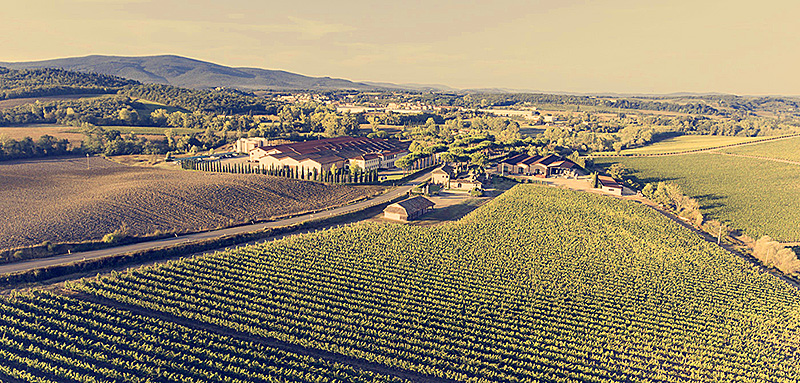
 

In Tuscany’s Maremma Toscana DOC, on the upper third of Italy’s western coast, virgin forests that border with ancient churches and enchanting villages are the prevalent backdrops to slopes on which the grapevines grow. It is a unique environment where the Cecchi family works with the natural cycles of the seasons. Respecting the ecosystem has accompanied the growth of the winery, and today a minimal environmental impact is an ongoing goal.

At Cecchi, “sustainability” takes on a real and proactive character driven by three well-defined policies: the defense and improvement of winery lands, agriculture, and environment; recycling; and using new technology that allows for the minimization of energy consumption and natural resources necessary for production. Water was one of the first natural resources the winery was concerned about. This explains the longtime presence of an innovative system of constructed wetlands for the treatment of wastewater from the winery centers in Chianti and of the Maremma, providing natural water flows and a safeguard for the environment.

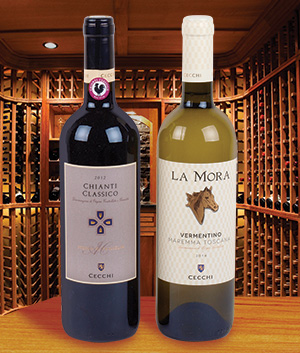
Cecchi La Mora Vermentino 2014

Mora means “horse” in Italian, a tribute to the cattle-herding cowboys that historically lived in the Maremma region. This lemon-hued wine offers a nose of flowers and sweet citrus. This sense continues on the palate, adding just a hint of white peach. La Mora is light and approachable, with a short finish.

This wine will go nicely with Baked Oysters with Oil and Parsley, Fricasseed Chicken with Egg and Lemon, or Sauteed Snapper with Mushrooms.

Cecchi Chianti Classico 2012

This Sangiovese is dark garnet in the glass. It opens with a solid cherry nose and a hint of earth and spice. The flavor profile features tart plum, cocoa, and cinnamon, supported by smooth tannins and ending in a medium-long finish.

Enjoy this Italian with Fava Beans with Artichokes and Peas, Rabbit with Rosemany and White Wine, or Tuscan Meat Roll with White Wine and Porcini Mushrooms.

www.cecchi.net/en

Back to blog posts: winervana.com/blog/