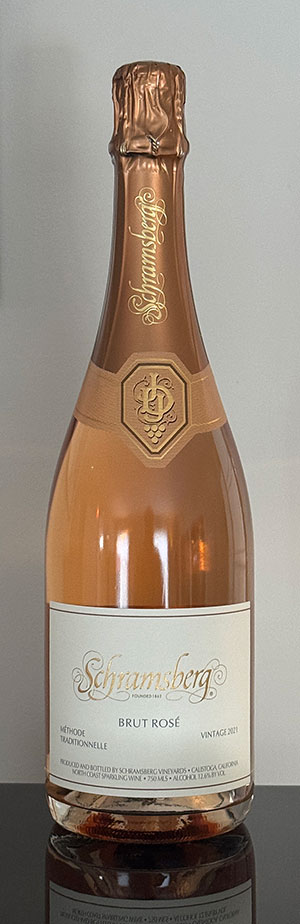
Schramsberg Brut Rosé 2021

Schramsberg Brut Rosé 2021. Click here for tasting notes.

Schramsberg Rosé

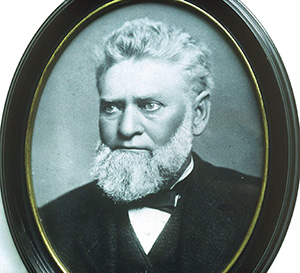
Jacob Schram
Jacob Schram

Jacob Schram, a German immigrant, bought 200 acres on Mt. Diamond in Napa valley in 1862 and planted 30,000 vines. He had Chinese laborers dig Napa’s first hillside caves for wine aging and storage.  His winery, Schramsberg, gained fame after the author Robert Louis Stevenson wrote about it in his 1883 book, The Silverado Squatters. The wine became so popular that the 23rd President of the United States, Benjamin Harrison,  served it in the White House at official functions.

After Schram died in 1905 the property languished until Jack and Jamie Davies purchased it in 1965. They decided to focus on making sparkling wine in the Champagne style using the traditional “méthode champenoise,” (aka “méthode traditionnelle”) to great success.

Their 1965 Blanc de Blancs would be the first commercial use of Chardonnay in American sparkling wine.

Reviving the Harrison tradition, every President since Richard Nixon has featured the company’s sparkling wine at the White House or some official celebration.

For example, in 1972 their sparkling “Blanc de Blancs” wine was served as part of the “Toast to Peace” during the visit by then-President Richard Nixon to China — a symbolic and historic diplomatic moment.

The winery preserves a large portion of forested land on the estate, and from the beginning of the Davies’ ownership they adopted sustainable and preservation-oriented practices — both for the land and the winemaking legacy.

Jamie and Jack Davies

In 1996, Hugh Davies, the youngest son of Jack and Jamie Davies joined the winery full-time. Hugh had earned a master’s degree in enology from the University of California, Davis. Hugh, coincidentally was born in 1965, the year that the Davies family purchased the Schramsberg property. The winery was added to the National Register of Historic Places in 1998.

Jack Davies died in the spring of 1998 and in 2008, Jamie Davies also died. Today, Hugh Davies serves as CEO of Schramsberg.

Schramsberg Winery. Photo: Cassie Musgrove
The Schramsberg cave. Photo: Lynn Splendid Light

Schramsberg Brut Rosé 2021

This is a sparkling rosé, made in the traditional Champagne method. Base wines are fermented, then a second fermentation happens in the bottle. After that, the wine is aged on its lees (dead yeast cells) for a period to develop complexity, fine bubbles, and balanced flavors.

The wine is a blend of 73% Pinot Noir and  27% Chardonnay. This combination lends the Brut Rosé both fruit-forward character (from Pinot Noir) and structure/spice/length (from Chardonnay).

Some small lots of the Pinot Noir are fermented in contact with their skins (a “skin-contact” or limited maceration for rosé) to pick up subtle color and additional depth — then all lots are blended, gently pressed, and treated carefully during winemaking. The aim is a wine that is “fruitful, complex and dry”, with brightness and elegance — capable of being versatile with food or standing alone as an apéritif.

This rosé pours a lovely salmon color in the glass.  It has a relatively fine and very lively mousse. The nose offers up mouthwatering fresh berries.  The palate features tart cherry, raspberry, a hint of yeast, some unexpected citrus, and zippy acidity. There is a nicely balanced dryness, sometimes uncommon in rosés. It wraps up with a clean refreshing finish. ABV is 12.6%.

Pair this sparkler up with seafood — lighter fish like salmon or halibut; maybe even sushi, shrimp or other shellfish. Its acidity and freshness complement seafood nicely. The winery itself suggests pairing with dishes ranging from “sushi, salmon, and rock-shrimp” to a board of cheeses, fresh fruit, etc.   Also consider lighter meats or poultry, salads, fresh summer dishes, and fruit-based desserts (red-berry tarts, fruit salads).

Back to blog posts: winervana.com/blog/

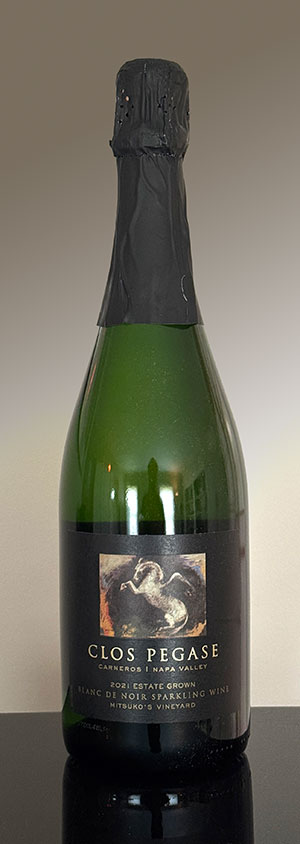
Clos Pegase Blanc de Noir

Clos Pegase Blanc de Noir 2021
Clos Pegase Blanc de Noir 2021 Click here for tasting notes.

Disclaimer: I’ve been a member of the Clos Pegase wine club for years, so this post is hardly impartial.

Clos Pegase was founded by the late Jan Shrem in 1983 on a 50-acre vineyard near Calistoga in Napa Valley. He was born in Colombia in 1930 to Jewish-Lebanese parents, and spent his childhood in Jerusalem and his early adolescence back in Colombia.

A romance with a Japanese woman named Mitsuko led him to Japan, where they were married in 1960. They stayed 13 years, and during that time Shrem established a book distribution company that sold English-language encyclopedias, and books on engineering and art.

After Shrem sold this operation, he moved with his wife and two sons to spend time in Italy and France, where he continued with publishing and book distribution ventures. While there, he began collecting art and learning about wine. He studied enology at the University of Bordeaux.

Continue reading “Clos Pegase Blanc de Noir”

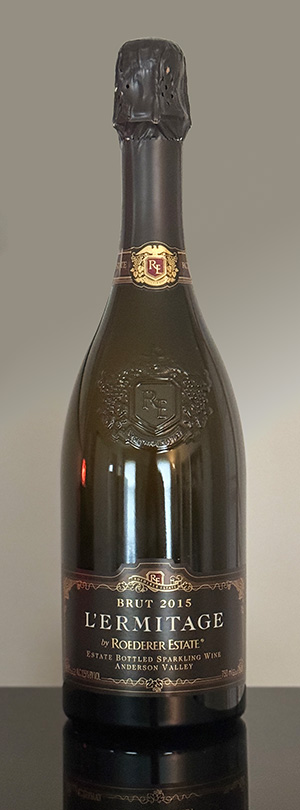
Roederer L’Ermitage

Roederer Estate L'Ermitage Brut 2015
Click here for tasting notes.

Roederer Estate L’Ermitage Brut 2015

Louis Roederer [Road-ur-ur], a distinguished champagne producer situated in Reims, France, traces its origins back to 1776, when it began as Dubois Père & Fils. While its early days were marked by still wine production, the focus soon evolved to embrace the art of crafting fine champagnes. The business underwent a transformation under the stewardship of Louis Roederer in 1833 when he not only inherited but also renamed the company for himself.  He boldly ventured into international markets, focusing particularly on Russia. This endeavor gained him immense recognition, including from Tsar Nicolas II, who appointed Louis Roederer as the official wine provider to the Imperial Court of Russia.

Created in 1876, the wine made for Nicolas’ grandfather, Alexander II, was the first Cuvée de Prestige (Prestige Cuvée) of Champagne and is called Cristal, referring to the unusual clear glass of the bottle. The Tsar had pointed out to his sommelier that the design of a standard champagne bottle made the beautiful color and effervescence of champagne invisible to the eye. He therefore instructed Roederer that his personal cuvée be served in bottles made of transparent crystal glass with a flat bottom (allegedly to foil the insertion of explosives in the indentation by would-be assassins) to remedy this defect. Thus was Cristal born, and the first notion of a premium cuvée. For more than a century, the appearance of the patented Cristal bottle has remained unchanged. After the fall of the Russian monarchy in 1917, Roederer decided to continue producing Cristal and to market it internationally, and it remains one of the world’s most sought-after champagnes in the world.

Continue reading “Roederer L’Ermitage”

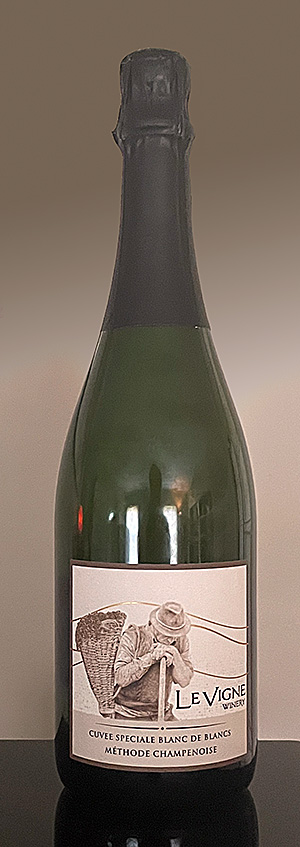
Le Vigne Blanc de Blancs

Le Vigne Cuvee Speciale Blanc de Blancs
Le Vigne Cuvee Speciale Blanc de Blancs Click here for tasting notes.

Le Vigne Cuvee Speciale Blanc de Blancs

Le Vigne Winery, translating to “The Vineyard” in Italian, stands as a testament to the Filippini family’s rich heritage and commitment to traditional winemaking. For close to a century, Le Vigne has dedicated itself to crafting exceptional wines that reflect the distinct characteristics of both the vineyard and the vintage.

The Filippini family’s connection to the Paso Robles region dates back to the early 1960s, when Sylvia Filippini’s family acquired the property that would later become Le Vigne Winery. Initially focused on hay and cattle farming, the landscape underwent a significant transformation in 1982 with the planting of the first grapevines. This marked the beginning of Paso Robles’ evolution into a prominent wine region, driven by its unique soils, climate, and coastal influences.

Chardonnay and Cabernet Sauvignon were among the initial varietals planted. The grapes from the estate quickly gained acclaim among local producers, prompting the Filippini family to venture into winemaking in 1989. A state-of-the-art winery was established in 1995, accompanied by additional vineyards in 1998. The winery expanded its portfolio to include Merlot, Syrah, Sangiovese, and Cabernet Franc, alongside the original plantings of Cabernet Sauvignon and Chardonnay. Small blocks of Grenache, Petite Sirah, Malbec, and Tannat were also introduced.

Continue reading “Le Vigne Blanc de Blancs”

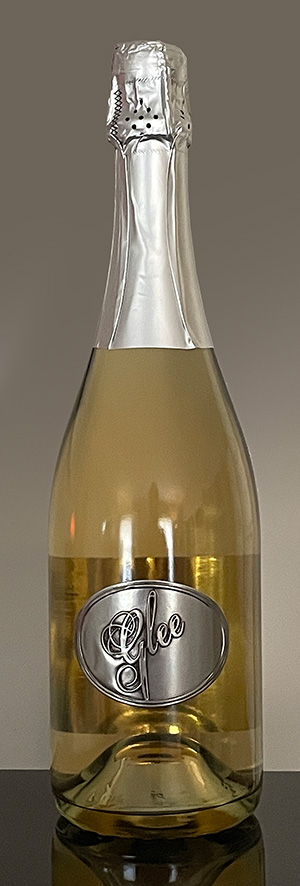
Glee Euphoria Blanc de Noir

Glee Euphoria Blanc de Noir California Sparkling Wine
Glee Euphoria Blanc de Noir California Sparkling Wine. Click here for tasting notes.

Glee Euphoria Blanc de Noir California Sparkling Wine

For reasons I don’t understand, the producer of this sparkling wine, Sapphire Hill, decided to hide behind the Glee moniker.  There is nothing on the bottle to link Glee and Sapphire Hill, but it was easy enough to locate them.

Sapphire Hill Winery, a family-run boutique winery, has been operating in Sonoma County since 1989. It is located on the original homestead of Lucy and Levi Grove who acquired 120 acres in 1869 from Captain John Cooper, a sea captain, merchant, and cattle rancher who originally hailed from New England. He was granted the El Molino Ranchero by General Vallejo, his father in law, who founded Sonoma and is remembered today as a great American who contributed a great deal to California both before and after statehood. His life is essentially the history of 19th century Sonoma and his influence is still evident in 21st century Sonoma.

The only remaining original structure on the property is the homestead chimney made from rocks taken from the Russian River.

Initially, Sapphire Hill began as a 38-acre vineyard located just outside of Sebastopol.  Original winery partners Tim Meinken (winemaker), Anne Giere, John Hall. and Denice Engstrom planted Chardonnay and Pinot Noir and later Syrah. At first, the grapes were sold to Rodney Strong, Sonoma-Cutrer, La Crema, and Murphy Good Estate Winery. The partners launched their own label in 1997 using estate-grown grapes, and in 2002 built the actual winery and opened a tasting room in Healdsburg, a charming town situated at the convergence of three renowned grape-growing regions: Alexander Valley, Dry Creek Valley, and the Russian River Valley. This strategic location allowed the winery to procure grapes from these esteemed valleys and establish a reputation for crafting award-winning Cabernet Sauvignon, Chardonnay, Pinot Noir, and Zinfandel.

Continue reading “Glee Euphoria Blanc de Noir”

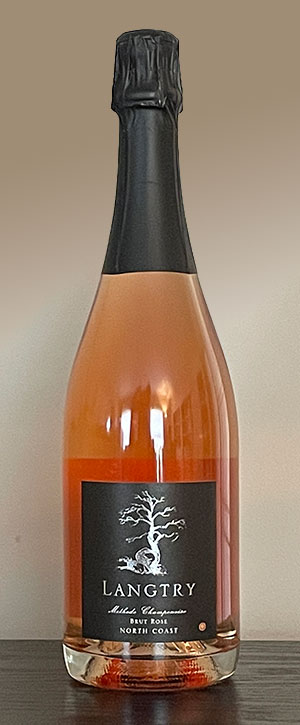
Langtry Brut Rosé

Langtry Brut Rosé
Langtry Brut Rosé Click here for tasting notes.

Langtry Brut Rosé

The Guenoc Valley in California is east of San Francisco, and just south of the far eastern edge of the East Bay.  Situated in Lake County, grapes were planted there in 1854, and as soon as 1884 it hosted 600 acres under vine.  Its fertile fields attracted a number of individuals who dabbled in wine to a greater or lesser extent, including the legendary actress Lillie Langtry.

The 23,000 acre (9,300 ha) Guenoc Valley is a small inland alluvial fan of Arroyo Seco and Conejo loam soils which are isolated from surrounding areas by rocky ridges. Hot days are common in the region and over-ripening is a constant concern. The area also has very cool nights, making it a Climate Region III.  The Guenoc Valley AVA was approved in 1981.

Lillie Langtry was born Emilie Charlotte Le Breton in 1853 to William Le Breton, a Church of England minister and his wife, Emilie Davis Martin Le Breton.  Lillie was the only daughter in the family of six sons. Her father was a very handsome and cultured man; her mother as beautiful as her daughter would become. They lived on the on the Isle of Jersey, one of the islands that lie in the English Channel . Continue reading “Langtry Brut Rosé”

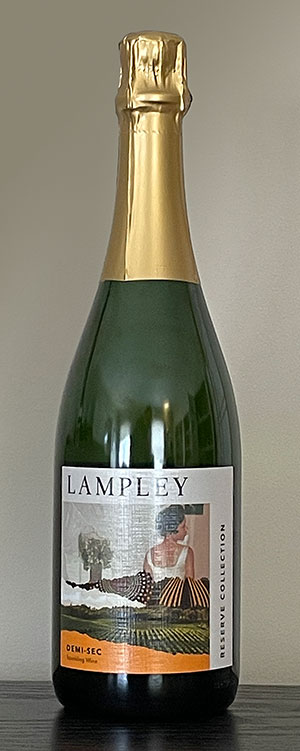
Lampley Reserve Demi-Sec

Lampley Reserve Demi-Sec
Click here for tasting notes.

Lampley Reserve Demi-Sec

The founder and proprietor of Lampley Reserve is Illinois-native Chrishon Lampley, a remarkable African American woman, and the first in the Midwest to go national with a wine brand. She is also one of the less than 1% of wine industry negociants, vineyard owners, or winery owners who are black females in the traditionally Euro-centric, white, male-dominated world of wine. A rarity, to say the least.

Building on over 20 years’ of experience in the wine industry, Lampley launched Love Cork Screw wines in 2013 with six varietals. The operation has since sold more than one million bottles of wine. Still not satisfied, Lampley also offers brand extensions like five wine-scented candles, as well as the new eponymous Lampley Reserve label just now coming to market. On a mission to reinvent how we think about and experience wine, Lampley is also passionate about leveraging her platform to mentor budding entrepreneurs and pave the way for more inclusivity and opportunity for women of color in wine and beyond.

Lampley credits her never-give-up mentality to her father’s entrepreneurial spirit and her mother’s tenacity. Now that her Love Cork Screw portfolio of eight varietal wines, which feature bold, untraditional labels like “Head Over Heels” and “We’re Movin On Up,” are firmly established, Lampley is turning to her new collection of wines called Lampley Reserve. Continue reading “Lampley Reserve Demi-Sec”

Cline Nancy’s Cuvee

As you enter Sonoma county from the south on California 121, one of the first wineries you encounter is Cline Cellars, and there could hardly be a better introduction to the Carneros AVA.

Even as a young teenager, Fred Cline learned to make wine from his grandfather, Valeriano Jacuzzi (yes, he of the hydrotherapy tub, as well as many other innovations). With a $9000 inheritance from Valeriano, in 1981 Cline founded the eponymous Cline Cellars in Oakley, California.

Continue reading “Cline Nancy’s Cuvee”