Acquaviva Winery

Acquaviva Winery
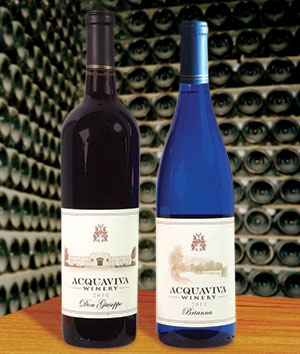
Acquaviva Don Giuseppe 2010 and Acquaviva Brianna 2011

Acquaviva Winery

Although the address is officially in Maple Park, Illinois, Acquaviva Winery and Bistro is on a very rural stretch of Illinois Route 38, 60 miles due west of Chicago. The faux-Italianate building incongruously appears, mirage-like, as you approach.

As a child, owner Vito Brandonisio would visit his grandfather’s small vineyard in Acquaviva delle Fonti in Bari, Italy. The lessons and memories formed there carried through to adulthood as he became an amateur winemaker.

In 2002, Brandonisio fulfilled a lifelong dream of having his own wine estate when he purchased 40 acres in Maple Park, naming it Acquaviva in honor of his homeland and his grandfather. Determined to produce his wines from indigenous local grapes, here he planted such hardy Midwest varietals as Prairie Star, Brianna, Chardonel, Marechal Fosh, and Frontenac, types largely unknown even to seasoned wine connoisseurs.

Acquaviva Winery & Ristorante

By 2007, it was time to build a winery to make use of the maturing grape vines. This 20,000 square foot facility is to the north across Route 38 from the estate acreage, and in addition to the winery itself (housed on the basement level), it includes a tasting room, the bistro, a retail market, and private party facilities. Tours are available by reservation; a fee of $10 to $30 is charged, depending on tour selected.

Acquaviva encapsulates the American experience. Brandonisio is Italian, of course, his grapes are American, and his current winemaker, Sergio Benavides, is Chilean.

Acquaviva Brianna 2011

Personally, I’m not a fan of sweet wines with the dinner entrée. However, I realize many others don’t share my position (white zinfandel, anyone?). This Brianna is almost completely colorless in the glass. The nose features scents of peach and honeysuckle. It is indeed sweet, with flavors of pineapple, peach, and a hint of apricots.

Although not a true dessert wine, Brianna can convincingly fill in as one. This would pair nicely with Sweet Pastry Fritters, Almond Cake, or Mixed Berry Pizza.

Acquaviva Don Giuseppe 2010

This red blend is made entirely of Illinois grapes, although the varieties are not specified. It is surprisingly grapey on the nose, but fear not, this is no Concord.

This wine was barrel-aged for twelve months. The color is dense purple, and it has good legs. On the palate, it is quite approachable and well-balanced, with understated tannins that add just enough structure. The dominant flavors are dark berries, cedar, and a hint of black pepper, not unlike a Zinfandel, although there is none in the blend.

For dinner, go classic with Spaghetti and Meatballs, Chicken Cacciatora, or try Braised Pork Chops with Tomatoes, Cream, and Porcini Mushrooms.

acquavivawinery.com/

Back to blog posts: winervana.com/blog/
Pillar Box Winery

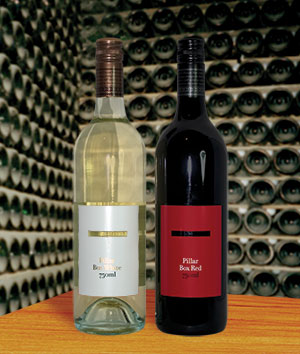
Pillar Box Red and Pillar Box White

Pillar Box Winery

A pillar box is what mail boxes are called Down Under as well as in England.

Pillar boxes lined the coach-driven mail routes, or ‘drives,’ established in the 1850s to provide mail service to the farmers and settlers then moving into southeastern South Australia. One such route in Padthaway was operated by Henry John Hill, and ran through property now owned by the third generation of the Longbottom family.

In 1992 Kim and Mark Longbottom decided to expand their farming operation into winemaking, and released their first offering in 1996. In a nod to the history of the mail route that once passed through the vineyards, today the family’s wine business is known as Henry’s Drive Vignerons.

The Padthaway region was once covered by the ocean. The receeding waters left behind a limestone subsoil topped by rich red loamy earth. This soil structure combines with good winter rains and mild sunny summers to make Padthaway well-suited for viticulture. The first vines were planted there in 1964, and it has come to be one of Australia’s premier wine-producing regions.

Pillar Box Red 2005

A blend of 57% cabernet sauvignon, 32% shiraz, and 11% merlot. The color is opaque purple, with a European-style flavor profile. The fruit is somewhat recessive, with nice astringency and enough tannin for structure. An excellent value, and 2005 is only the second vintage.

Pair this muscular wine with roasted or grilled beef or pork, blue cheese stuffed hamburgers, or a full-flavored, tomato sauced lasagna.

Pillar Box White 2006

A blend of 66% chardonnay, 20% sauvignon blanc, and 14% verdelho. The dominant taste is grapefruit, supported by lemon and citrus zest and racy, minerally acid. This makes for a tart, zippy, refreshing wine, ideal for this time of year. The color is pale straw yellow with a green tinge.

Try this wine with grilled or baked fish, a cheese course, shrimp on the barby (of course), or even tortilla chips and salsa.

This month’s wines are both sealed with screw caps. Screw caps have long been associated with low-quality wines. However, this has begun to change because of the perennial problem of “cork taint.” Cork taint is caused by complex chemical mechanisms triggered by the presence of microscopic fungi in the cork. Although not hazardous, cork taint does ruin the wine with a musty, wet cardboard smell and taste.

Screws caps are seen as a solution to this problem, and less tradition-bound Aussies are using them extensively on wines at every quality level. Commendable as that may be, I still prefer a cork, even if it is a well-made artificial one.

Back to blog posts: winervana.com/blog/