My favorite brandy of all time is Kelt VSOP Tour du Monde. Just a few years ago, it was selling for $40 a bottle; now it’s $60. Brands like Martell, Hennessy, Courvoisier, and Hardy have suffered similar inflation. Capitalism at its finest. Regardless, all of them are too expensive for me to drink on a regular basis. For that, I need a good cheap brandy under $30. American producers include Paul Masson, Christian Brothers, Korbel, and E&J Gallo. And there are readily-available European offerings such as St. Rémy from France, Hartley from Italy, Pedro Domecq from Mexico, and Veterano from Spain.
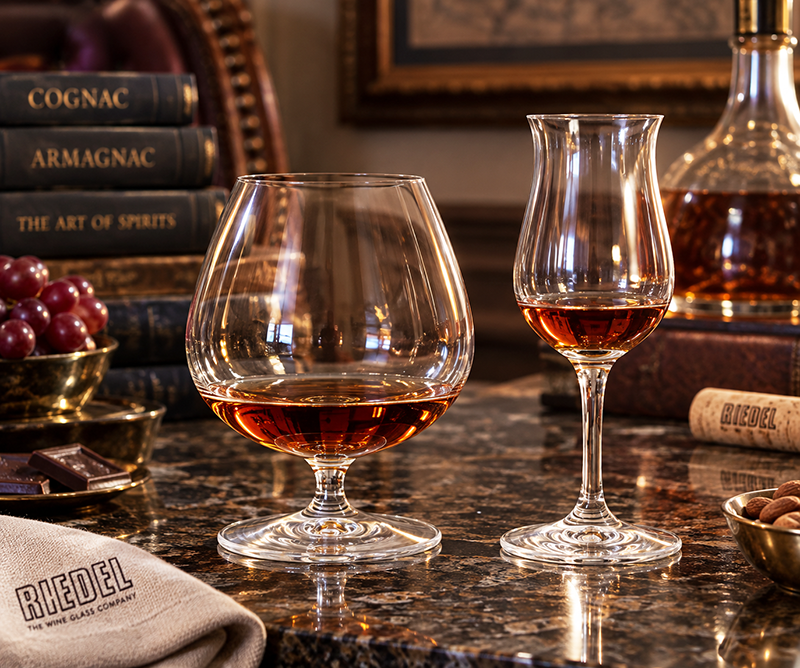
Riedel of Austria, famous for its varietal-specific stemware, makes both of these glasses, and both are intended for use with brandy and its variants Cognac, and Armagnac. How is this possible? They could hardly be more different.
The glass on the left is the iconic brandy snifter, as instantly recognizable as a martini glass. Its large balloon bowl is intended to display as much of a brandy’s aroma as possible. And the wide bottom is intended for cradling in the palm of your hand, warming the brandy to further enhance the nose.
The glass on the right, although named by Riedel specifically for Hennessey Cognac, is suited for any brandy, Cognac, or Armagnac, and is the one preferred by connoisseurs and professionals. The bowl still allows for appreciating the aroma, without accelerating the evaporation like a snifter can, and the tulip shape concentrates it. A similarly-sized and -shaped wine glass can work nearly as well.
While I enjoy stemware like this, as always my advice is to use whatever you like. As far as I’m concerned, if you don’t have to slurp your beverage directly off the counter you’re good to go.
A note about brandy vs. Cognac: brandy is a liquor distilled from wine and aged in wood. (Brandy can be made from fruits other than grapes as well, but that’s a story for another time.) Cognac is brandy that specifically comes from the town of Cognac and the delimited surrounding areas in western France. (The one which has the most favorable soil and geographical conditions is Grande Champagne.) So, all Cognacs are brandy, but not all brandies are Cognac. For more detail on brandy and Cognac, click here.
Kelt Commodore Cognac. For tasting notes, click here.
Kelt Commodore
Until the early 1900s Cognac was shipped in barrels. The long sea voyages had a profound effect on the quality of the Cognac. When Cognac started to be shipped in bottles, many felt something had been was lost. Hoping to recapture that quality, Estonian-born Swedish entrepreneur Olev Keltes established the Kelt Cognac company in 1987. He began his career with the study of the distillation of Cognacs as well as madeira, rum, and aquavit. It was this study that led him to rediscover the lost secret that quality improved in spirits that were aged in barrels on a long trip at sea . It is this maturation at sea that sets Kelt apart from other Cognac houses.