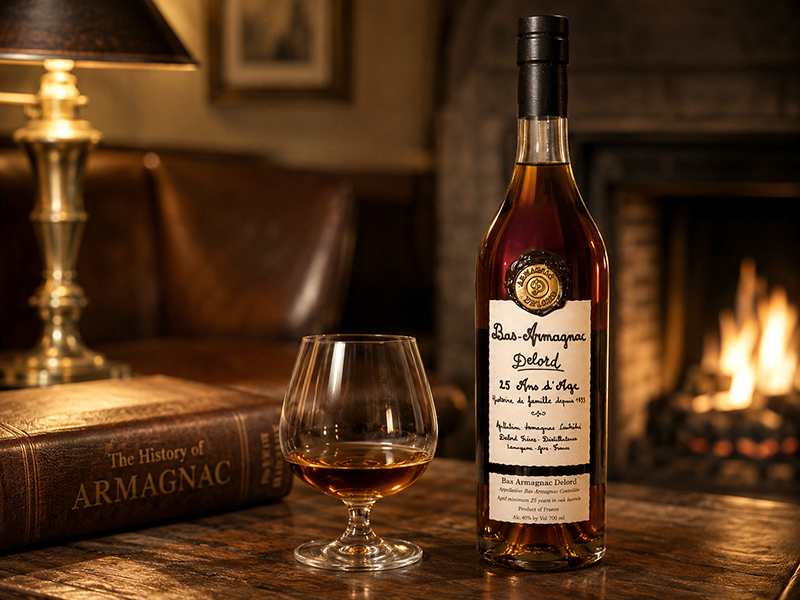
Delord Armagnac

[optin-monster slug=”dyggmnxh4lyvm7kl5rn3″ followrules=”true”]

Delord Bas-Armagnac 25 Ans d'Age
Delord Bas-Armagnac 25 Ans d’Age. Click here for tasting notes.

Delord Bas-Armagnac 25 Ans d’Age

Delord grows grapes, makes wine, distills, ages, blends, and bottles Armagnac in the tiny village of  Lannepax, in the Bas-Armagnac appellation. And unlike some producers whose “family tradition” has become mostly marketing hype, the Delord family remains directly involved. The current operation represents the fourth generation.

The family history

The story begins in 1893 with Prosper Delord. He was a distillateur ambulant — a traveling distiller. He moved his Armagnac still from farm to farm, distilling the acidic white wines of local growers into eau-de-vie. Armagnac historically had a strong tradition of itinerant distillers, and Prosper came directly from that culture.

In 1932, Prosper’s sons Gaston and Georges Delord established Delord Frères in Lannepax. They became growers, distillers, and merchants, and eventually exported Bas-Armagnac as far as the United States. Jacques Delord, Gaston’s eldest son, assumed control of the operation in 1963. He was joined by his brother Pierre 10 years later. In 2001 Sylvain and Jérôme Delord, Jacques’ sons, entered the company. Sylvain became particularly involved with production, tasting, and blending, while Jérôme concentrated more heavily on the sales and marketing side. In 2020, Sylvain and Jérôme acquired the  historic Galaubas estate, comprising about 75 hectares [185 acres] of organic land, including approximately five hectares  [12 acres] of vines, plus a manor house, cellar, and outbuildings. It was renovated and reopened in 2022.

From left to right: Jérôme Delord, Jacques Delord, and Sylvain Delord.
The Galaubas manor house.
Where Delord sits in Armagnac

Bas-Armagnac is generally considered the most prestigious of the three Armagnac production areas, the others being Ténarèze and Haut-Armagnac. The sandy, acidic soils characteristic of much of Bas-Armagnac tend to produce eau-de-vie prized for fruit, perfume, and finesse, rather than simply power.

The vineyard

The house currently describes a 66-hectare [163 acre] vineyard divided among seven parcels around Lannepax, six hectares [15 acres] of which are organic. The grape composition is Ugni Blanc 58%, Colombard 16%, Folle Blanche 14%, and Baco 12%. Delord harvests and vinifies the four varieties separately, and having all four traditional varieties gives its cellar master a substantial palette for blending.

Delord’s two distillation systems

Delord employs both traditional continuous Armagnac distillation and double distillation, and is one of the few Armagnac houses practicing both methods.

The classic Armagnac still is a small continuous copper column still known as an alambic armagnacais. Unlike Cognac’s double pot distillation, the wine passes continuously through the apparatus. Armagnac’s official trade body estimates that roughly 95% of Armagnac is produced by this type of continuous still.

The Sier still dating to 1900.
The Sier still dating to 1900. Photo: Divino.

Traditional continuous Armagnac distillation tends to retain considerably more congeners than highly rectified spirits. Those compounds provide material that evolves dramatically during decades in oak.

Delord also has two double-distillation stills. These produce fruitier, somewhat cleaner eau-de-vie that the house generally directs toward its younger Armagnacs.

The two double-distillation stills.
Aging

Delord says its cellars contain more than 1,400 barrels plus roughly a dozen oak foudres [ large vats]. Young spirit initially encounters relatively active oak. As sufficient wood extraction occurs, the eau-de-vie can be moved into progressively older barrels.

Eventually, continued oak aging stops improving the spirit. At that point extremely old Armagnac is transferred to glass bonbonnes [demijohns]. Delord keeps these in the traditional cellar area called the Paradis [Paradise].

The vintage library

Unlike Cognac, vintage-dated Armagnac is relatively common. A vintage Armagnac represents eau-de-vie distilled from wine from a specified harvest year. Delord holds vintages stretching from the modern era back into the early 20th century.

Delord Bas-Armagnac 25 Ans d’Age

This brandy it as a blend of Armagnacs made from all four of Delord’s grape varieties and aged more than 25 years. Delord starts the eau-de-vie in new French oak with a strong toast, then moves it into progressively less active barrels described as “semi-exhausted” and eventually “exhausted.”

It pours a rich dark brown in the glass.  There are aromas of wood and vanilla on the nose, with a bit of spice.  On the palate, it delivers smoothness befitting its age, dried apple, prune, vanilla, toffee, cocoa, and sweet spice. There is a noticeable dry, tannic oak component, especially toward the long finish. The ABV is the usual 40%. I don’t drink a lot of Armagnac, but this one delivers. 

Listen to my podcast about brandy, Cognac, and Armagnac here.

A note about brandy vs. Cognac: brandy is a liquor distilled from wine and aged in wood. (Brandy can be made from fruits other than grapes as well, but that’s a story for another time.) Cognac is brandy that specifically comes from the town of Cognac and the delimited surrounding areas in western France. (The one which has the most favorable soil and geographical conditions is Grande Champagne.) So, all Cognacs are brandy, but not all brandies are Cognac. For more detail on brandy and Cognac, click here.

Back to blog posts: winervana.com/blog/