Boutari Winery

Boutari WineryIt’s Greek to Me

If you’re a fan of Greek food, and the wines that go with them, you have probably already sampled a few bottles from the ubiquitous house of Boutari, the world’s number-one selling Greek wine.

The Boutari Company was established in 1879 by Yiannis Boutari in Naoussa on 124 acres, making it one of Greece’s oldest purveyors of fine wine. With decades of experience and business acumen, it is one of the top wineries in Greece. Boutari wines are exported to over 45 countries and have won over 370 medals in international wine competitions.

Boutari was the first and only Greek winery to ever win the award “European Winery of the Year” from Wine Enthusiast, after evaluating its performance in winemaking over time.

Although a producer with a long tradition, Boutari isn’t bound by it. They have embraced modern international winemaking techniques, such as the use of stainless steel, cold-temperature fermentation, and French-oak barrel aging. They strive to get the most from both indigenous Greek and French grape varieties.

The extensive Boutari holdings are comprised of six wineries in Greece: Naoussa, Santorini, Peloponissos, Crete, Goumenissa, and Attica, and one winery in Southern France, near the city of Limoux. Each winery has its own distinct personality, influenced by the architecture and the atmosphere of the particular region within which it is located.

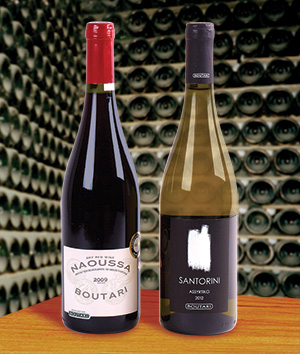
Boutari Santorini Assyrtiko 2012

The island of Santorini, located in Greece’s Aegean Sea, is a defunct volcanic caldera, and home to some of the oldest vineyards in Greece (at upwards of 300 years).

First comes this wine’s quite pale yellow color in the glass. Next up is a relatively closed nose, with delicate hints of ripe melon. But then things get interesting, with flavors of mango, apple, and grapefruit. There’s a crisp, racy acidity with a suggestion of lemon zest.

This island-born wine practically demands to be paired with seafood, such as Porgies with Avgolemono Sauce, Squid in Wine, or Baked Lobster Tails with Feta, but something like Chicken Breasts in Phylo would be delicious as well.

Boutari Naoussa 2009

This wine hails from Bourtari’s original winery in Naoussa, on the southeastern foothills of Mount Vermio in the northern Macedonia region, about thirty miles northwest of the Aegean Sea. The soils are calcium-rich marl (clay loam), and dampened by abundant rainfall.

Made from 100% Xinomavro, the premier red-wine grape of Greece, Naoussa is all about dry, tart, dark cherry, which dominates in the color; on the nose, which also includes the aromas derived from ageing, cinnamon, and wood; and on the palate. Support comes from a nice acidity and soft, medium-grained tannins. To get the most from this bottle, let it breathe for about 30 minutes, and don’t serve it too warm (i.e. not above 65º F).

Enjoy a glass (or two) of Naoussa with a classic Souvlakia, Pork with Green Olives, or Moussaka with Artichokes.

www.boutariwinerysantorini.gr/

Back to blog posts: /winervana.com/blog/
Kourtaki Retsina of Attiki

Kourtaki Retsina of Attiki
Kourtaki Retsina of Attiki Click here for tasting notes.

Kourtaki Retsina

The Greek wine even Greeks won’t drink. At least, all of the Greek-Americans I know won’t.  And my local Greek restaurant recently quit carrying Kourtaki Retsina of Attiki (the only retsina they had), citing a total lack of demand from their customers. Quite a bold move, considering Retsina is routinely called the “iconic wine of Greece” and is ingrained in the food and drink culture of the nation.

And a reluctance which I don’t understand.  I’ve been enjoying Retsina for decades, although I will admit it’s in part because of Retsina’s origin story.   More on that in a moment.   The traditional grape for Retsina is Savatiano with Assyrtiko and Rhoditis sometimes blended in. Modern Retsina is made following the same winemaking techniques of white wine, with the exception of small pieces of Aleppo pine resin (!) being added to the must during fermentation. It is this pine resin that gives Retsina its name, as well as its unique flavor profile.  The resin exudes an oily film on the surface of the fermenting liquid;  after racking, the wine is clarified and the solids and surface film are removed.

Nowadays, much less resin is used than traditionally called for. Such wines lack the pungent “whiff of turpentine” of old.  Indeed, it seems to me the resin content goes down every year.  Frankly, I miss that resin punch, and even as producers seemingly try to make the wine more accessible, fewer people are willing to try it.  Even so, it is considered an ideal accompaniment to such flavorful Greek dishes as saganaki, pastırma or garlic dips, which are often consumed as appetizers.

But why add pine resin in the first place?  Isn’t this a gross adulteration, easily remedied?  In ancient Greece, long before the advent of the barrels and bottles we take for granted today, earthen wine jars and amphorae were sealed with pine resin to protect the contents from oxidation.  Some of this inevitably flavored the wine.  So much for the historical record.

But the legend is far more interesting.  It centers on the siege of Greece by the Romans in the second century B.C.  As the invaders plundered everything that came their way, the beleaguered Greeks were determined to deny them the wine.  “You will take our freedom . .  but you will not enjoy our wine!” they reportedly cried.  It was deliberately tainted with the now-famous pine resin, and in fact the Romans refused to drink it.  Once the war was over and the Greeks had prevailed, however, it was time to celebrate.  But, all of the available wine had been dosed with pine resin.  What to do?  Well, drink it anyway, of course, and acquire a centuries-long taste for it!

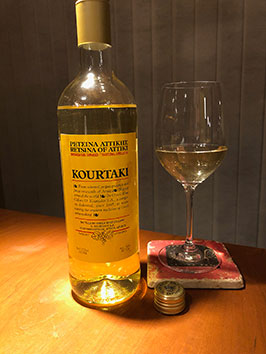
Kourtaki Retsina of Attiki

This Kourtaki Retsina of Attiki  is lemonade-yellow in the glass.  The nose features, predictably, a delicate and pleasant pine scent.  On the palate, this  recedes, allowing flavors of grapefruit and lemon to come through.  This crisp wine has a lively acidity, with just a hint of bitterness on the finish.

Enjoy (yes, enjoy!) this Retsina with dolmades, porgies with avgolemono sauce, or chicken souvlakia.

Return to blog posts: https://winervana.com/blog/