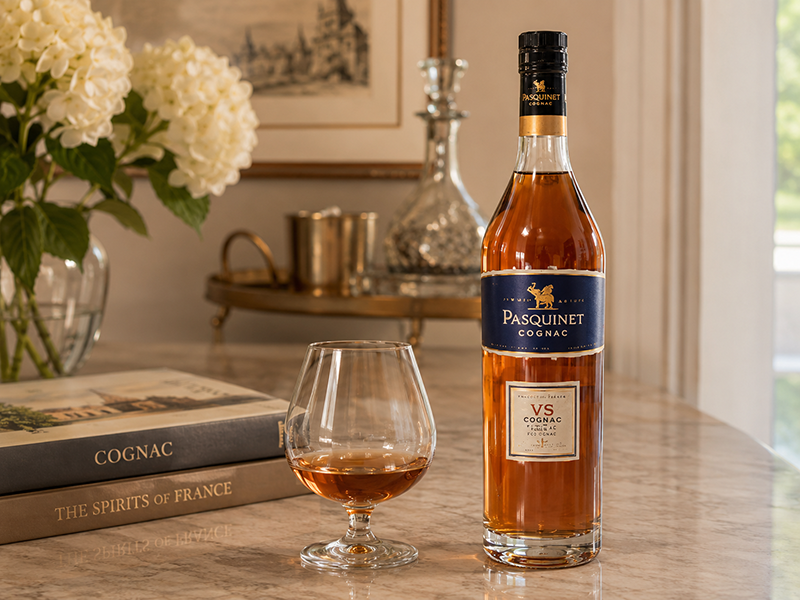
Pasquinet VS
Pasquinet is a family-rooted Grande Champagne producer/distiller based at Domaine du Foucaudat in Juillac-le-Coq, with estate vineyards, its own distilling tradition, old stocks, and a history stretching back well before the Pasquinet brand itself was created. The primary terroir is Grande Champagne, Cognac’s premier cru, with an estate size of about 22 hectares (54 acres).

Pasquinet says Domaine du Foucaudat has been a family wine property since 1860. The modern Cognac operation, however, is associated with Jean Ricard, born January 23, 1906, in France’s eastern Pyrenees. He originally ran a successful renovation/construction business. Work on several Cognac houses brought him to the region, where he became fascinated with distillation. He subsequently acquired Domaine du Foucaudat and spent years learning and refining the craft of distillation.

After World War II, Jean’s children Gilbert and Jeannette Ricard took over the family business. In 1943 they created the Pasquinet Cognac trademark, describing it as a symbol of strength and renewal following the war. The brand apparently enjoyed enough success in France and elsewhere in Europe that the family constructed a substantial bottling and packaging facility next to the estate.

The next generation was Patrick Ricard, who assumed control in 1985. Interestingly, Patrick had previously worked as a dealer in antiques and fine art. Pasquinet credits his aesthetic interests with influencing both the house’s presentation and its approach to Cognac.

Then came Nicolas Ricard. After working internationally in Europe and South America, Nicolas returned to the family operation and has represented the new generation since 2012.

The Domaine du Foucaudat estate is just south of Segonzac, essentially ground zero for Grande Champagne Cognac. Grande Champagne is prized for its highly chalky soils and eaux-de-vie that can be extraordinarily floral and fine, but often require prolonged maturation before reaching their potential.

Is Pasquinet an estate Cognac or a négociant? Both, apparently. Pasquinet owns Grande Champagne vineyards and distills Cognac at Domaine du Foucaudat. But it also operates within a commercial structure associated with Euro-Négoce, whose address is itself listed as Le Foucaudat in Juillac-le-Coq. So I would not assume every bottle of Pasquinet consists exclusively of grapes grown on their 22 hectares unless the particular bottle makes that claim, which the VS does not.

Pasquinet VS Cognac
The house says this VS is assembled from selected eaux-de-vie traditionally distilled and aged in Limousin oak for approximately two to four years. It presents a medium golden amber in the glass. The nose delivers fresh fruit, particularly orange peel, and vanilla. These continue on the palate, plus some young oak, honied sweetness and a peppery finish. Very approachable, and suitable for both sipping neat and cocktails. The ABV is the usual 40%.
Listen to my podcast about brandy, Cognac, and Armagnac here.
A note about brandy vs. Cognac: brandy is a liquor distilled from wine and aged in wood. (Brandy can be made from fruits other than grapes as well, but that’s a story for another time.) Cognac is brandy that specifically comes from the town of Cognac and the delimited surrounding areas in western France. (The one which has the most favorable soil and geographical conditions is Grande Champagne.) So, all Cognacs are brandy, but not all brandies are Cognac. For more detail on brandy and Cognac, click here.
Back to blog posts: winervana.com/blog/
