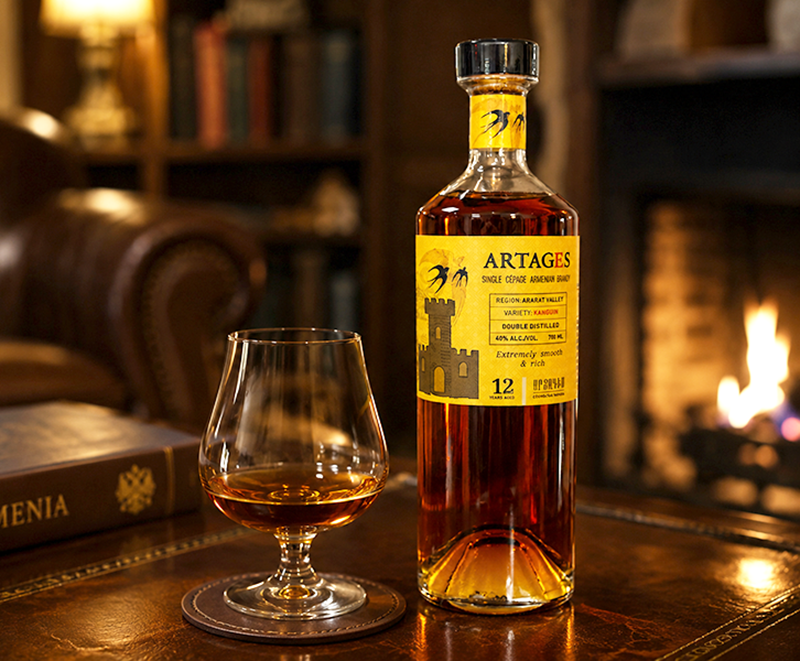
Artages Brandy

Artages Single Cépage Armenian Brandy
Artages Single Cépage Armenian Brandy. Click here for tasting notes.

Artages Single Cépage Armenian Brandy

Artages is made by the Yerevan Brandy Company [YBC], that did more than any other to define what Armenian brandy means, first within the Russian Empire, then the Soviet Union, and now internationally. It has roughly 140 years of institutional ancestry, exceptionally deep stocks, control over grape procurement and distillation, indigenous grape varieties, a distinctive oak regime, its own cooperage, and a highly developed blending culture.

Yerevan Brandy Company is based  in Yerevan, overlooking the Hrazdan River. Its sole great international brand is ARARAT. It is now wholly controlled by the French beverage conglomerate Pernod Ricard.

Yerevan Brandy Company

The beginning: Nerses Tairyan

Nerses Tairyan (also rendered Tairian/Tairyants), an Armenian merchant, had already established wine production on the site of the old Yerevan Fortress. His relative Vasily Tairov, an important viticultural scientist, encouraged him to make brandy using French methods. Tairyan installed Charentais-type copper stills imported from France and began brandy production in 1887. Around 1899 he leased the enterprise to the enormous Russian drinks concern N.L. Shustov & Sons, owned by Nikolay Shustov, which subsequently purchased it.

Nerses Tairyan
Nerses Tairyan
The Shustov era

Shustov was one of Imperial Russia’s great alcoholic-beverage companies and possessed distribution and marketing capabilities Tairyan couldn’t approach. Under Shustov, Yerevan brandy became an important prestige product throughout the Russian Empire, Armenian brandy was widely called коньяк / konyak, and this usage survived domestically long after the term “Cognac” became rigorously protected internationally.

Nikolay Shustov
Nikolay Shustov
Revolution and nationalization

After the Russian Revolution and political upheaval in Armenia, the brandy enterprise was nationalized. An especially interesting episode involves Mkrtich Musinyants, who according to YBC history protected valuable stocks of old spirits during the revolutionary disorder. Those stocks later made it possible to resume high-quality production.

Mkrtich Musinyants
Mkrtich Musinyants
Markar Sedrakyan

Markar Sedrakyan (sometimes Margar Sedrakyan) is probably the most important individual in the history of Armenian brandy after Tairyan. He joined the enterprise in 1937, after studying at the Yerevan Agricultural Institute. Sedrakyan became the great Soviet Armenian master blender. YBC credits him and his school of blending with creating or developing many of the expressions that still define ARARAT.

His significance is difficult to exaggerate. He effectively established a recognizable house style for premium Armenian brandy: intensely aromatic, rich in dried fruit, sweet spice and chocolate, with substantial oak influence and a generally rounder, sweeter-seeming profile than traditional Cognac.

The modern YBC operation

YBC contracts directly with approximately 4,000 Armenian grape growers. In 2013, YBC purchased an extraordinary 35,000 tonnes [38,580 US tons] of grapes. That gives you some sense of the scale.

Distillation

YBC employs distillation equipment derived from the Charentais tradition, but its current process uses steam heating rather than direct-fire heating. YBC specifically argues that steam distillation allows it to preserve the character of Armenian grape varieties. Regional distilleries do a significant portion of this work.

Steam distillation
Typical steam distillation. Photo: vigreentech.com.
The water

For dilution/blending YBC uses water from the Katnakhbyur spring [meaning “Milk Spring” in Armenian]. The company attributes this practice to Sedrakyan, who supposedly preferred this natural spring water to ordinary distilled/demineralized water. Whether the mineral composition produces an enormous sensory effect is debatable, but it is a genuine component of YBC’s production identity.

Artages Single Cépage Armenian Brandy

Artages is YBC’s upscale label. The company opened its reserve stocks—its “Treasury of brandy spirits”—to allow the Artages project to select and blend unusually old eau-de-vie. “Single Cépage” means that every eau-de-vie in the blend comes from the same grape variety, in this case Kangun [aka Kangoun or  Kangoon], one of Armenia’s principal brandy grapes. But, instead of being treated primarily as large-scale raw material, it is here being used to craft an artisanal spirit.

The narrow-shouldered bottle is supposedly modeled after the sample bottles used by cellar masters, the utilitarian bottles into which small quantities of maturing brandy would be drawn for evaluation. The stopper is oak and carries a swallow motif. The swallow represents freedom, movement, and the brand’s idea of exploring new territory.

cellar masters' cognac sampling bottles.

This brandy is composed of eau-de-vies at least 12 years old that were double distilled and aged in Caucasian oak.  It pours a nice golden amber in the glass.  The relatively delicate nose features stone fruit, flowers, and vanilla.  These continue on the palate, plus a good deal of cinnamon.  The finish is relatively short and a bit hot, rather surprising for a 12-year-old spirit. The ABV is the usual 40%.

Although I enjoyed this brandy, I liked this Armenian brandy more, and it is only 65% of the cost of the Artages. I have found that when it comes to brandy, older isn’t always better, but it is more expensive.

For more detail on the history of Armenian brandy, and how it is similar to but distinct from Cognac, click here.

Back to blog posts: winervana.com/blog/