Wyoming Whiskey

Wyoming Whiskey

Wyoming Whiskey

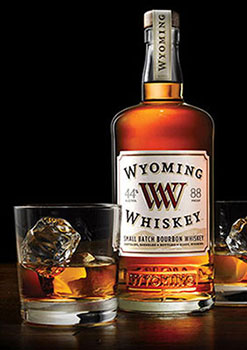
Small batch whiskey, we have been told, is a welcome trend. The Mead family first came to Wyoming in 1890 as ranchers. While subsequent generations have endeavored in law, politics, and extreme skiing, Sam Mead is leading the fifth generation toward renown as a premier whiskey producer. Wyoming Whiskey products include four varieties. Small Batch Bourbon Whiskey is a traditional bourbon whiskey that is dark amber in color and smooth to the taste buds. Flavors that can be detected include brown baking spices, vanilla crème, caramel, and cinnamon.

By Spirits Contributor Neal Kotlarek

www.wyomingwhiskey.com

Back to blog posts: winervana.com/blog/

Cuervo Reserva de la Familia Tequila

Cuervo Reserva de la Familia Tequila

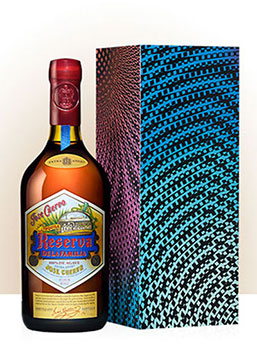
Cuervo Reserva de la Familia is the world’s first extra-añejo tequila. It is drawn from the Cuervo® family’s private reserve collection of tequilas, relying on a family recipe handed down over ten generations.  Each bottle is numbered, dated, and sealed in wax. All by hand. The tequila is made using only the flavorful inner portion of hand-selected blue agave plants harvested at peak maturity after seven to twelve years of growing in the field.  After distillation, it is aged in French and American oak barrels for a minimum of two years, although the final blend includes tequila from reserves as old as 30 years. Definitely not for shots or margaritas, Reserva de la Familia is best served in a snifter, allowing for full appreciation of its flavors and aromas of rich oak, toasted almonds, vanilla,  and cinnamon. There is a long and velvety finish. At about $170 per 750ml bottle, this is a rare treat for most of us, but worth it if you can swing it. Cuervo commissions a different well-known Mexican artist each year to design the wooden presentation box Reserva de la Familia comes in, so the current offering won’t match this photograph.

reservadelafamilia.com/

Back to blog posts: winervana.com/blog/

Cuvaison Winery

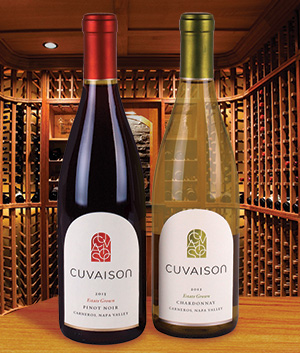
Cuvaison Chardonnay and Pinot Noir

Cuvaison Winery

Established in 1969, Cuvaison (French for maceration, the period of time grape juice spends in contact with the skins and seeds) is an estate vineyard and winery that produces primarily Chardonnay and Pinot Noir, both grown exclusively in the Carneros AVA on the northern end of both Sonoma and Napa. When the winery was founded, the Carneros region was little known for grape growing, and much of the acreage was pastureland. But, the area’s cool bay breezes and frequent fog are ideal for wine, and it is now home to thirty-one wineries and an equal number of growers.

Cuvaison is certified sustainable under the Napa Green designation, meaning they have been recognized for their work in reducing the impact on the environment. The winery is 85% solar powered; they have invested in a water recirculation/conservation program (quite critical as California often suffers from severe drought); and they started a cork recycling program where wine club members and neighboring wineries bring their popped corks to be ground for repurposing.

Steve Rogstad, yet another graduate of UC Davis’ viticulture and enology program, has been winemaker since 2002. While working on a six-month post-graduate internship in Beaujolais, Steve discovered that, “Working with just one varietal and tasting fifty different wines from one region, I really started to understand the concept of terroir. It made an impression that lasts to this day.” The experience also taught Rogstad how to isolate and work with small wine lots, a practice that is at the core of his winemaking philosophy. In addition to Cuvaison, Rogstad has worked at such well-known wineries as La Crema, Saintsbury, Rombauer, Spring Mountain, and Clos Pegase.

Cuvaison Estate Chardonnay 2012

This Chardonnay is over half of Cuvaison’s yearly production, so a lot is riding on what’s in the bottle. 20% of this Chard saw new French oak for eight months. There was about 60% malolactic conversion, but it is not overly buttery or lacking in varietal characteristics. It presents a pale yellow in the glass, understating the fulsomeness to come. On the nose, you are greeted with aromas of honeysuckle, honeydew melon, and sweet citrus. These continue on the well-balanced palate, plus the addition of crisp stone fruit such as white peach, apricot, and nectarine.This is supported by a nice lemon/lime acidity.

Enjoy this wine with Smoked Shellfish Quesadillas with Fresh Corn Salsa, Cool Honeydew-Mint Soup, or Shrimp Kabobs with Lemons and Bay Leaves.

Cuvaison Estate Pinot Noir 2013

This Pinot Noir is classically transparent ruby in the glass. It features a light, silky mouthfeel, and the nose offers subtle hints of grass, green herbs, and berries. The palate bursts with raspberry, strawberry, fresh cherry, and cola. These flavors are complemented with balanced acidity and round, understated tannins.

This wine would pair nicely with Tomato and Onion Tart, Summer Vegetable Calzone, or Nut-Crusted Trout with Romesco Sauce.

www.cuvaison.com/

Back to blog posts: winervana.com/blog/

Migration Wines

Click here for tasting notes.

Migration Sonoma Chardonnay and Sonoma Pinot Noir

Duckhorn Portfolio is the umbrella corporation of an expanding wine mini-empire. First came the flagship Duckhorn Vineyards, established in 1976 by Dan and Margaret Duckhorn to pioneer and feature premium Napa Merlot. (Duckhorn has a “second growth” label named Decoy, as well.) Next came Paraduxx in 1994, specializing in Zinfandel-based blends. This was followed by Goldeneye, which began making Pinot Noir in 1996.

Continue reading “Migration Wines”

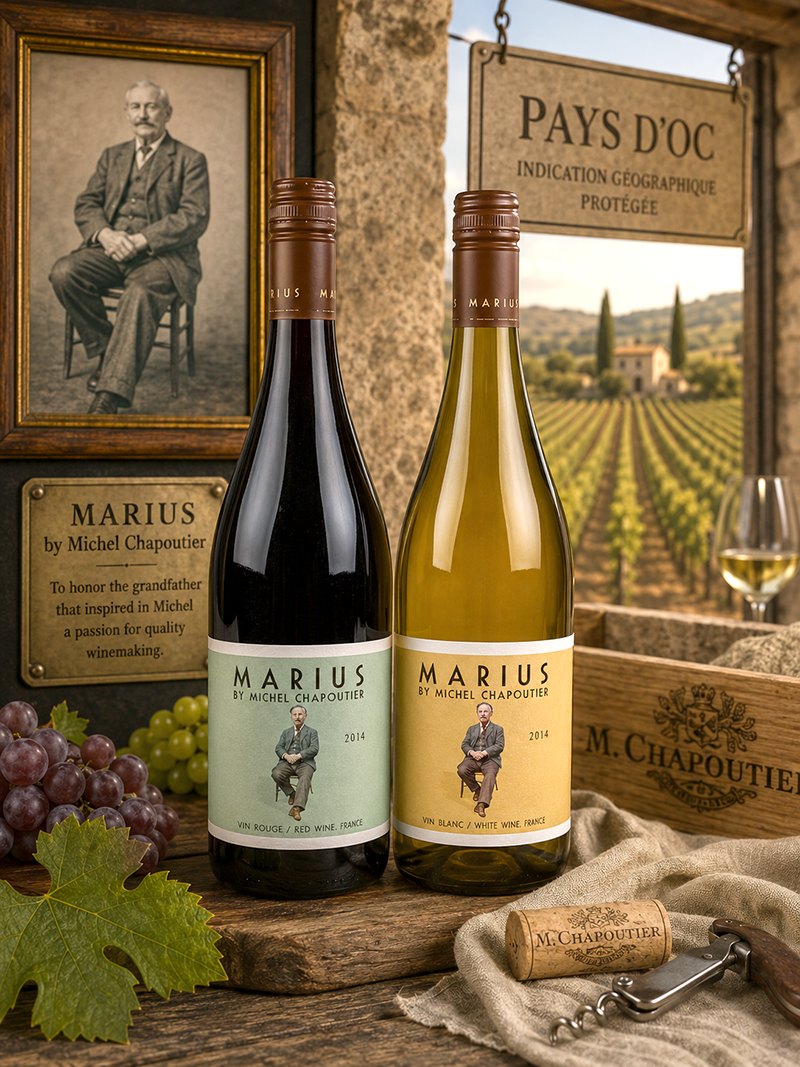
Marius by Michel Chapoutier

Marius Rouge 2014 and Marius Blanc 2014
Marius Rouge 2014 and Marius Blanc 2014 Click here for tasting notes.

Marius Wine

Languedoc-Roussillon (often called “the Languedoc”) is a historical coastal region in southern France, extending from Provence to the Pyrenees Mountains and the border with Spain. It’s now part of Occitanie. The area is a major wine producer, with Vin de Pays d’Oc and sparkling Crémant de Limoux among its best-known varieties. The regional capital, Montpellier, is home to a well-preserved medieval quarter.

Continue reading “Marius by Michel Chapoutier”

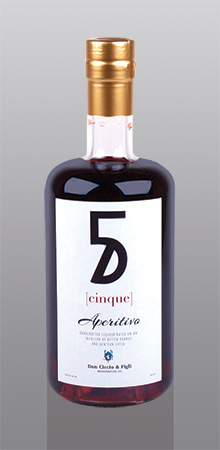
Cinque Aperitivo

 Cinque Aperitivo
Cinque Aperitivo

Cinque Aperitivo

As you cocktail mavens may be aware, aperitivos and amaros are currently having a moment in bars across the U.S. The rest of you are probably asking, “A what and a what?”

An aperitivo (in Italian) or apéritif (in French) is a light alcoholic drink taken before a meal to stimulate the appetite, and is therefore usually dry rather than sweet. An amaro (Italian for “bitter”) is an Italian herbal liqueur that is commonly drunk as an after-dinner digestif. It usually has a bittersweet and sometimes syrupy flavor.

Cinque is an aperitivo created following a traditional recipe developed in 1929. It is based on an infusion of 12 selected roots and herbs, highlighted by bitter orange and gentian lutea, selected for its bitter root (the overall bitterness level is an approachable “medium”). It’s perfect for fans of Campari and Aperol looking for something a bit different.

Although Cinque is labeled to look as Italian as possible, and the parent company, Don Ciccio & Figli, has roots to the Old Country going back as far as 1883, it is in fact produced in Washington, D.C.

Here’s a sample recipe: 1 oz. gin, 1oz. Cinque Aperitivo, 1 oz. amaro, a splash of soda, and a dash of lemon bitters. Stir well and serve on the rocks with an orange twist and sweet cherry as garnish. Salute!

www.donciccioefigli.com/cinque-aperitivo

Back to blog posts: winervana.com/blog/
Black Stallion Cabernet Sauvignon

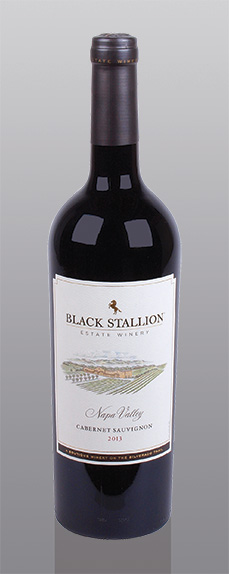
Black Stallion Cabernet Sauvignon 2013
Black Stallion Cabernet Sauvignon 2013. Click here for tasting notes.

Black Stallion Cabernet Sauvignon

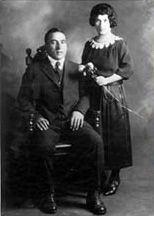
In 1894, Gaspare Indelicato was born in the small village of Campobello di Mazara in the province of Trapani, Sicily. In 1911, at the tender age of 16, he emigrated by himself to the United States through Ellis Island, New York, as many European immigrants of the time did.

Eventually, Gaspare found his way to Manteca, California, about 75 miles east of San Francisco, in the agriculturally-rich San Joaquin Valley, where the climate reminded him of his homeland. There he met and married his wife Caterina Luppino. In 1924, Gaspare and his brother-in-law Sebastiano made a bold decision to purchase a 68-acre dilapidated dairy farm, planted grapes, and shipped them by train to home winemakers in Chicago and and the Northeast during Prohibition. (Although technically illegal under the Volstead Act that delineated Prohibition, home winemaking was very rarely prosecuted, since the law was vague about it, and the government had its hands full dealing with bootleggers and organized crime surrounding alcohol.)

Continue reading “Black Stallion Cabernet Sauvignon”

Tangley Oaks

Tangley Oaks
Tangley Oaks Pinot Noir and Chardonnay. Click here for tasting notes.

Tangley Oaks Wines

Négociant [nay-goh-SYAHN] is the French word for “dealer” or “merchant,” and is used in wine circles to denote an individual or company that negotiates, sells, and ships wine as a wholesaler. Traditionally, négociants have often handled all aspects of wine production except the actual farming, including purchasing grapes, making the wine, blending, bottling, and shipping. In some transactions, there is another intermediary: a courtier or “wine broker,” who helps establish the price paid by a négociant to a small producer. Some of the better known French négociants are Barton & Guestier, Calvet, Cordier, Moueix, and Sichel.

Continue reading “Tangley Oaks”

Anselmi Wines

Anselmi San Vincenzo 2013 and Anselmi Capitel Foscarino 2013

Anselmi Wines

Roberto Anselmi is a legend of north Italian winemaking, a charismatic, motorbike-riding rebel whose uncompromising quality-over-quantity approach has helped redefine the wines of the Veneto through his insistence on higher standards.  It has earned him the title, “the conscience of Soave.”

Anselmi produces crisp white wines from the indigenous Garganega (gahr-GAH-neh-gah) grapes. Garganega is known for its distinctive lemon and almond flavor profiles.

These two summer sippers are characteristic of his work.

Anselmi San Vincenzo 2013 is grown on 110 acres in the Monteforte area of northern Italy. Light straw in color, with scents of minerals, lemon/lime, apricot ,and yellow apple. It is medium-bodied and dry.

Anselmi Capitel Foscarino 2013 comes from 24 acres of vineyards on south-facing slopes 1,140 feet above sea level at the top of the Foscarino Hill.  Light straw-gold in the glass, opening to vibrant aromas of tropical fruit, citrus, and honey. Its medium to full body features flavors of fresh apples, peach, and lime underscored by mineral notes.

For both of these wines, the soil is volcanic tuff, a type of rock made of volcanic ash ejected from a vent during an eruption. Following ejection and deposition, the ash is compacted into a solid rock in a process called consolidation.  Over time, the tuff is broken up with grass undergrowth.

The vines are trained using the horizontal spurred cordon method. In earlier times, this method was common for training grapes on house façades. Foliage and fruit grow from one or two horizontal, strictly trained arms or cordons. Unilateral cordons (1 angle) and bilateral cordons (T-shape) are possible; the vertical main trunk usually remains without foliage.

www.terlatowines.com/brands/italy/anselmi/san-vincenzo

www.terlatowines.com/brands/italy/anselmi/capitel-foscarino

Back to blog posts: winervana.com/blog/

HALL Wines

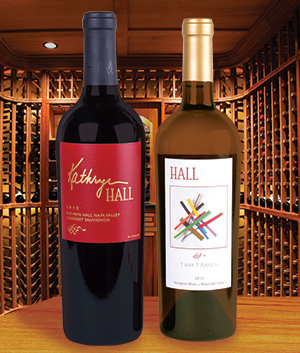
Hall WinesKathryn Walt Hall has a most impressive curriculum vitae. To touch on just a few of the high points, she is the proprietor of HALL Wines and WALT Wines [family businesses she has been involved with for over thirty years], was assistant city attorney in Berkeley, California, worked as an attorney and businesswoman in Dallas, Texas, and has served on numerous non-profit and institutional boards, with an emphasis on issues related to social care and mental health. From 1997 to July 2001, Ms. Hall served as the United States Ambassador to Austria. In the midst of this, together with her husband Craig she has raised four children.

HALL wines hail from five estate vineyards: Sacrashe (Rutherford), Bergfeld (St. Helena), Hardester (Napa Valley), Atlas Peak Estate, (Atlas Peak), and T Bar T Ranch (Alexander Valley). From these 500 acres come classic Bordeaux varietals: Cabernet Sauvignon, Merlot, and Sauvignon Blanc. In each vineyard, small-vine farming is employed to produce low-yield, high-concentration fruit.

Continue reading “HALL Wines”

Partida Tequila

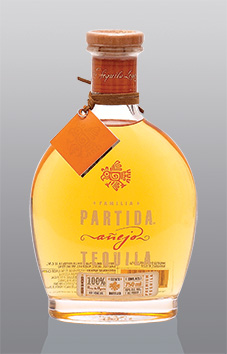
Partida TequilaPartida Tequila is one of only a few remaining authentic estate-produced and estate-bottled tequilas, made in the heart of Mexico’s historic Tequila region.

Partida uses only 100% pure blue agave, which is far less common than many realize. The agave plants see seven to ten years from seedling to harvest, so that they mature fully. (Some tequila brands are content with half that time.) After the agave is slow-cooked, the resulting liquid is distilled twice.

Partida Blanco goes directly to the bottle from the still. It features aromas of grilled pineapple and plums. The taste continues with pineapple, plus toasted coconut and black pepper.  It inishes with agave and fresh herbs.

Partida Reposado is aged for six months, making for a pale golden color and a taste with hints of spicy oak and vanilla. The medium body has cocoa and dried cherry notes. Finishes with a long mineral fade. Great vitality and balance, and my favorite of the three.

Partida Añejo sees 18 months in barrel (rare even among premium brands). It is golden amber in color, with aromas of almonds, dried cherries, and spices. The dryish medium body delivers soft honey, delicate herbs, cocoa, and clove. Finishes with a touch of wood and toffee.

For the extremely well-heeled, Partida Elegante Extra Anejo is also available.

It would be criminal to slam any of these tequilas as shots (although you can do that if you insist). Savoring them in a brandy snifter would be far more appropriate. Arriba! Andalay!

www.partidatequila.com/agegate.php?r=%2F

Back to blog posts: winervana.com/blog/
Sanford Winery

Sanford Pinot Noir and Chardonnay.
Sanford Pinot Noir and Chardonnay. Click here for tasting notes.

Sanford Pinot Noir and Chardonnay

Sanford, the first winery in Santa Barbara wine country, was established when the Sanford & Benedict vineyard was planted in 1971. Botanist Michael Benedict and his friend Richard Sanford were committed to finding a cool-climate location with just enough heat accumulation to ripen, but not over ripen, wine grapes. A place where they could plant and grow grapes and craft wines, where they hoped the quality might equal the best of Europe.

Continue reading “Sanford Winery”

Dry Creek Vineyard

Dry Creek VineyardDry Creek Vineyard

Dry Creek Vineyard was the first winery established in the Dry Creek Valley after Prohibition. It was founded in 1972 by David Stare, who came with an early vision to plant Sauvignon Blanc. Before his arrival, the valley was little more than a few family farms and prune orchards, but Stare was determined to start a winery inspired by those in the Loire Valley, which led to a viticultural reawakening in northern Sonoma County.

Stare soon began taking winemaking classes at UC Davis. On the weekends, he looked for vineyard land and finally discovered an old prune orchard and began planting vines. Although Sauvignon Blanc beckoned to him, several vineyard specialists advised him against planting it. “They told me Sauvignon Blanc would never grow in the Dry Creek Valley, but I knew I had to stick to what I knew was right. I was going to plant this varietal come hell or high water.” It turned out to be one of his best decisions. Over the last 40 years, the winery has also developed an international reputation for its Fumé Blanc, Dry Chenin Blanc, Chardonnay, Zinfandel, and Bordeaux varietals.

During his long career, Stare has logged many firsts. For instance, he initiated the Dry Creek Valley appellation in 1983 and was the first to label a wine with it. He was the first to release a wine using the descriptor ‘Meritage’ (1985 vintage) on the label to classify his Bordeaux-style blend.

Dry Creek is committed to a healthy and diverse ecosystem for all plants, insects, and animal life, which in turn creates a better place for grapes, with the goal of producing high-quality wines. The winery has 185 acres of vineyards within Dry Creek Valley and Russian River Valley that are 100% Certified Sustainable. While employing many sustainable practices in the vineyard, top priorities include: growing cover crops to rebuild depleted soil; composting to reduce the need for synthetic fertilizers and improve the quality of the soil; beekeeping to enhance the eco-system of the vineyard; encouraging birds of prey to adopt the vineyards to control rodent populations; and improving the local fish and creek habitat for a healthy ecosystem.

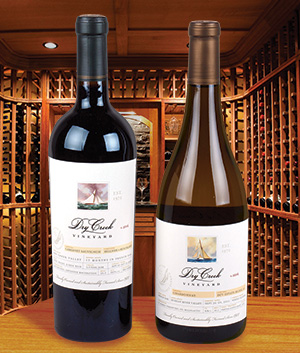
Dry Creek Vineyard Chardonnay 2016

This estate wine was partially whole-cluster pressed, and 90 percent was barrel fermented in French oak, one-quarter new. About half of the wine underwent malolactic. It starts with aromas of baked apple and apricot, cut by minerals and citrus oil. The palate features poached pear, meyer lemon and pineapple, with good balance between fruit, barrel oak, and acid.

Dry Creek Vineyard Cabernet Sauvignon 2016

This smooth and easy-sipping red is mostly Cabernet Sauvignon, with small amounts of Merlot, Petit Verdot, Cabernet Franc, and Malbec. There are hints of bell pepper and sweet fruit on the nose. The palate showcases black currant, blackberry, and cranberry. The full body is fruit forward, with juicy chewy tannins and a peppery finish. The mouth feel is even and full with no harshness.

Here’s a look at Dry Creek Vineyard Fumé Blanc and Merlot:

winervana.com/dry-creek-vineyard/

www.drycreekvineyard.com/

Back to blog posts: winervana.com/blog/