Dry Creek Vineyard

Dry Creek VineyardDry Creek Vineyard

Dry Creek Vineyard was the first winery established in the Dry Creek Valley after Prohibition. It was founded in 1972 by David Stare, who came with an early vision to plant Sauvignon Blanc. Before his arrival, the valley was little more than a few family farms and prune orchards, but Stare was determined to start a winery inspired by those in the Loire Valley, which led to a viticultural reawakening in northern Sonoma County.

Stare soon began taking winemaking classes at UC Davis. On the weekends, he looked for vineyard land and finally discovered an old prune orchard and began planting vines. Although Sauvignon Blanc beckoned to him, several vineyard specialists advised him against planting it. “They told me Sauvignon Blanc would never grow in the Dry Creek Valley, but I knew I had to stick to what I knew was right. I was going to plant this varietal come hell or high water.” It turned out to be one of his best decisions. Over the last 40 years, the winery has also developed an international reputation for its Fumé Blanc, Dry Chenin Blanc, Chardonnay, Zinfandel, and Bordeaux varietals.

During his long career, Stare has logged many firsts. For instance, he initiated the Dry Creek Valley appellation in 1983 and was the first to label a wine with it. He was the first to release a wine using the descriptor ‘Meritage’ (1985 vintage) on the label to classify his Bordeaux-style blend.

Dry Creek is committed to a healthy and diverse ecosystem for all plants, insects, and animal life, which in turn creates a better place for grapes, with the goal of producing high-quality wines. The winery has 185 acres of vineyards within Dry Creek Valley and Russian River Valley that are 100% Certified Sustainable. While employing many sustainable practices in the vineyard, top priorities include: growing cover crops to rebuild depleted soil; composting to reduce the need for synthetic fertilizers and improve the quality of the soil; beekeeping to enhance the eco-system of the vineyard; encouraging birds of prey to adopt the vineyards to control rodent populations; and improving the local fish and creek habitat for a healthy ecosystem.

Dry Creek Vineyard Chardonnay 2016

This estate wine was partially whole-cluster pressed, and 90 percent was barrel fermented in French oak, one-quarter new. About half of the wine underwent malolactic. It starts with aromas of baked apple and apricot, cut by minerals and citrus oil. The palate features poached pear, meyer lemon and pineapple, with good balance between fruit, barrel oak, and acid.

Dry Creek Vineyard Cabernet Sauvignon 2016

This smooth and easy-sipping red is mostly Cabernet Sauvignon, with small amounts of Merlot, Petit Verdot, Cabernet Franc, and Malbec. There are hints of bell pepper and sweet fruit on the nose. The palate showcases black currant, blackberry, and cranberry. The full body is fruit forward, with juicy chewy tannins and a peppery finish. The mouth feel is even and full with no harshness.

Here’s a look at Dry Creek Vineyard Fumé Blanc and Merlot:

winervana.com/dry-creek-vineyard/

www.drycreekvineyard.com/

Back to blog posts: winervana.com/blog/

Chateau Montelena

Chateau MontelenaChateau Montelena

In 1976, an Englishman who owned a wine shop in Paris hit upon the idea of holding a blind tasting pitting ten of France’s and California’s best producers against one another. He enlisted nine French wine experts as judges; the French wines included the 1970 Haut-Brion, the 1970 Mouton Rothschild, and the 1973 Domaine Leflaive Puligny-Montrachet Les Pucelles.

The famous tasting has come to be known as The Judgement of Paris. No one expected the upstart Yanks to really put up a fight against the French heavyweights. However, when the votes were tallied, the judges were shocked to discover they had awarded the top prize for the red to the 1973 Stag’s Leap Wine Cellars Cabernet Sauvignon, and top prize for the white to Chateau Montelena Chardonnay, both from Napa Valley. It was the shock heard ‘round the world, and legitimized California as a world-class wine-making region.

Chateau Montelena has seen three cycles of family stewardship. The winery was founded in 1882 by Alfred L. Tubbs, a European immigrant and entrepreneur. The original property was 254 acres of rugged, stony, and loose land just two miles north of Calistoga at the base of Mount Saint Helena. (Montelena is a contracted form of Mount Saint Helena.) By 1896 Tubbs’ winery was the seventh largest in the Napa Valley.

The Tubbs family sold the winery in 1958 to Yort and Jeanie Frank, who were looking for a peaceful spot to retire. The setting inspired Frank to excavate a lake and add landscaping to reflect the Chinese gardens of his homeland.

The modern renaissance of Chateau Montelena started under the leadership of Jim Barrett, who purchased the winery in 1972. The vineyard was cleared and replanted, and the chateau was renovated and outfitted with modern winemaking equipment, complemented by the highest-quality grapes from the Napa Valley. Shortly thereafter, Chateau Montelena stunned the wine world with its win at the 1976 Paris Tasting.

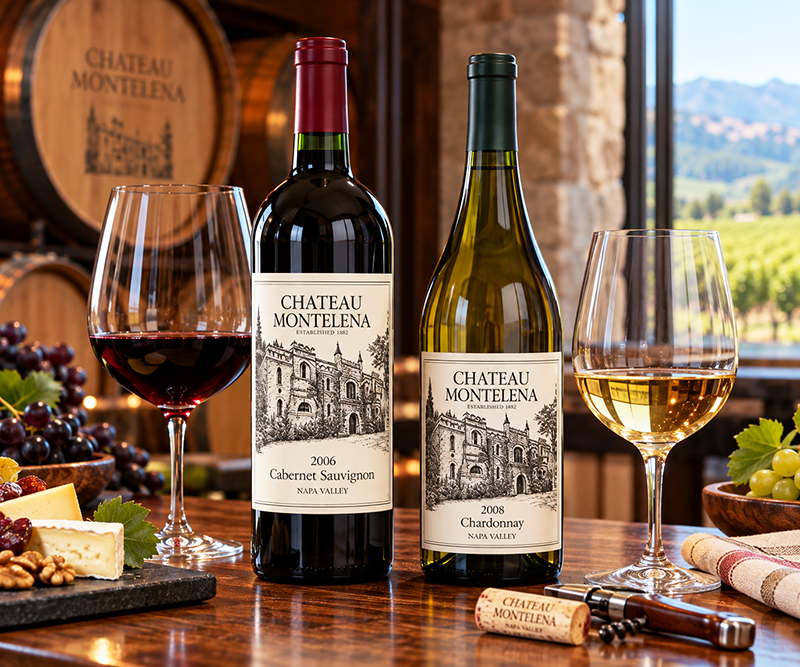
Chateau Montelena Chardonnay 2015

This wine is brilliantly clear with a golden-straw color. The nose suggests pineapple and stone fruit. On the palate, there are flavors of fresh orange zest and ginger which segues into a long and spicy finish. The wine was aged for 10 months in 100% French oak.

Serve this legendary wine with whitefish with filbert and lemon sauce, chicken Marsala, or duck with mustard and leeks.

Chateau Montelena Cabernet Sauvignon 2015

Dark ruby in color, this wine offers rich, complex aromas of fresh raspberries, strawberry jam, vanilla and black pepper. In the mouth, this wine makes a full soft round entry, after which the acid builds nicely, supporting the dominant flavor of dark stone fruit. Plenty of fine-grain tannin completes the mouthfeel, followed by a tremendous long finish.

Pair this Cabernet with beef in wine on skewers, grilled pork New Orleans, or leg of lamb in balsamic vinegar.

For a review of two earlier vintages of these wines, see:

winervana.com/chateau-montelena-cabernet-sauvignon-and-chardonnay/

montelena.com/

Back to blog posts: winervana.com/blog/

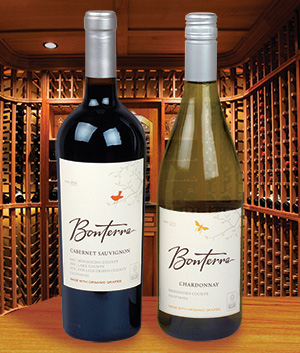
Bonterra Vineyards

Bonterra VineyardsBonterra Vineyards has been a pioneer in organic farming in California. The vines were planted in 1987, and the first wines were released in 1992, long before organic products were widely available in America. Bonterra believes that organic grapes produce the purest expressions of the varietals and land on which they are farmed.

Bonterra’s three estates (Blue Heron, McNab, and Butler) are certified Biodynamic® by Demeter, a not-for-profit with the mission of enabling successful farming in accordance with Biodynamic practices and principles.  These are simply to create and oversee a living organism which is self-contained, self-sustaining, and follows the cycles of nature. Biodynamic farming harkens back to how farms functioned centuries ago. It is a holistic view of agriculture with a high awareness of the interconnectivity among earth, plants, animals, humans, and even the moon.

There are nine Demeter-certified preparations made from herbs, minerals, and manures. These are applied to the soil and vineyards in very small doses to enhance soil fertility with increased micro-organism development and photosynthetic activity.

Yarrow, chamomile, stinging nettle, oak bark, dandelion, and valerian each play a role in strengthening, and in some cases remedying, weaknesses in the vineyards. Teas and tinctures are made from fresh or dried plants, and are sprayed to increase active regeneration on the farm.

In addition, animal “partners” play an essential role in the ecosystem. The vineyards provide chemical-free sanctuaries for bees, supported by native plants which bloom throughout the seasons. Chickens roam the rows, eating weeds and insects that can harm the vines. Their scratching and pecking aerate the soil and provide additional nutrients to the vines. December through March, around 2,000 sheep snack on the cover crops and weeds as they “landscape” the vineyards, adding beneficial fertilizer to the soil as they graze.

Bonterra  Mendocino Chardonnay 2014

This wine opens with a hint of crème brulee, followed by aromas of pineapple and citrusy lemon. The palate features flavors of green apples, pears, and citrus, supported by a clean minerality. The wine underwent malolactic fermentation in previously-used or neutral oak in order for its fresh fruit characteristics to shine through. New oak was used for just 16% of the wine to provide a vanilla note.

Enjoy this best-buy wine with seared swordfish with avocado relish and roasted broccoli, or crunchy pecan chicken with lemon ginger sauce.

Bonterra  Cabernet Sauvignon 2014

This red is very much in the European style, with relatively subtle flavors of cherries and currants. Those are present on the nose as, well, with the addition of a bit of toasted oak. The wine finishes with astringent tannins and a lingering finish.

Serve this up with grilled chicken on rosemary skewers, lamb chops with juniper berry marinade, or sirloin tips Quasimodo.

www.bonterra.com/

Back to blog posts: https://winervana.com/blog/

La Merika Wines

La Merika WinesI Took a Trip Down to
La Merika

There is a theory among some historians that America was discovered by Europeans decades, or even centuries, before Christopher Columbus by a little-known explorer named Henry Sinclair, who may have been a member of the Knights Templar. In Templar symbology ‘Merika’ is a western star toward which their ships would sail, or mounted knights would ride. It is suggested that the name La Merika (The Star) is what led to the naming of the continent America, rather than after Amerigo Vespucci, an Italian explorer who is credited with describing the New World.

The theory is based on old graveyards in Nova Scotia containing grave stones which incorporate Templar devices such as Crusader Crosses and other Masonic symbols. Although there is no surviving evidence, Sinclair may have traveled to Greenland, and perhaps as far south as present-day Massachusetts and Rhode Island.

Coincidentally, the sails of Columbus’ ships were emblazoned with the Templar Cross, which was then an emblem of Spain.

La Merika the wine is part of the extensive Delicato Family Vineyards portfolio. Family-owned and operated since the company’s founding in 1924, the third generation of the Indelicato family now control properties throughout California, but they are especially interested in the Central Coast.

I am a big fan of the Central Coast AVA, a huge viticultural area encompassing vineyards from Los Angeles to San Francisco. A wide variety of wines are produced there, and many of them are high quality and of exceptional value.

The Central Coast has one of the longest growing seasons in the world, and is influenced by proximity to the Pacific. Warm sunny days are tempered by cool, afternoon ocean breezes. The extended growing season allows for full fruit development, and, because ripening occurs at an easy pace, rich, full flavors balanced with bright acidity can emerge.

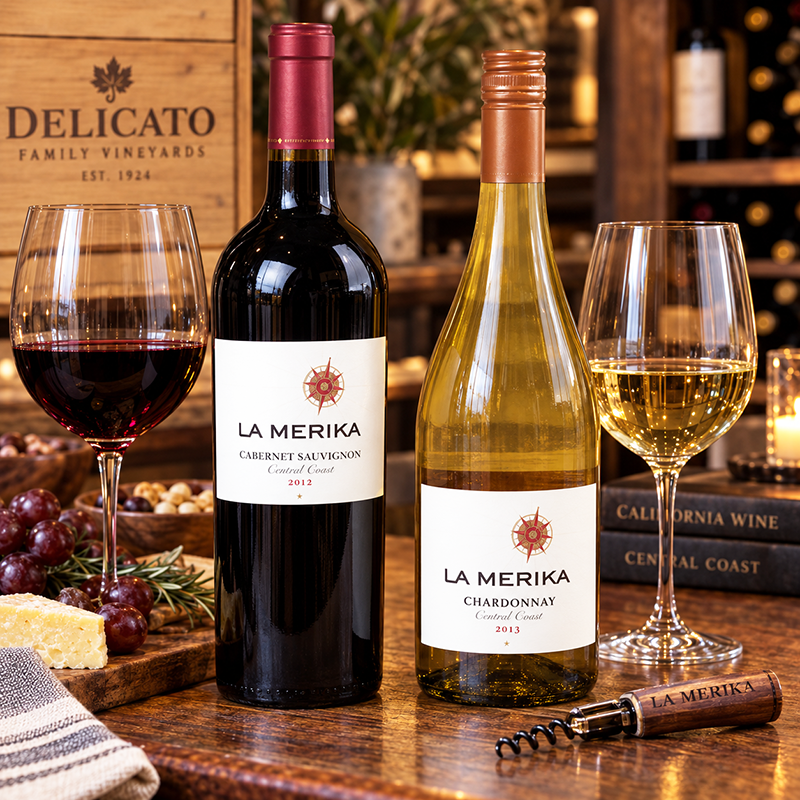
La Merika Chardonnay 2013

This wine pours nearly colorless, and then follows with aromas of citrus, honey, and green apple on the nose. Although it saw some oak, that’s barely in evidence. There are plenty of flavors of lemon/lime and grapefruit. The wine features a medium body, augmented by zippy acidity, recessive tannins, and a crisp finish. Nothing buttery or over-oaked here.

Consider matching this up with Grilled Bacon-Wrapped Trout with Green Onion Sauce, Southern Pan-Fried Chicken, or Salmon Croquettes.

La Merika Cabernet Sauvignon 2012

This Cab shows a classic inky purple in the glass. The nose features ripe plum and brown spices. On the palate, there are flavors of blackberry and black cherry plus some dark chocolate or cocoa. The tannins rather than fruit are forward here. It ends with a medium-long finish. To get the full effect, plan on letting this breathe for an hour or so. This wine spent five months in French and American oak.

This big wine can stand up to robust foods like Country Captain with Crispy Thin Onion Rings, Baked Pork Chops with Cranberries, or Garlic Braised Shoulder Lamb Chops with Butter Beans and Tomatoes.

www.delicato.com/

Back to blog posts: winervana.com/blog/

Mike Ditka Wine

The Coach Cabernet Sauvignon 2011 and The Hall of Famer Chardonnay 2012
The Coach Cabernet Sauvignon 2011 and The Hall of Famer Chardonnay 2012. Click here for tasting notes.

Mike Ditka Wine

Sports fan or not, you perhaps  have heard of Mike Ditka, immortalized as Da Coach in the “Bill Swerski’s Chicago Superfans” sketches that were a staple of the 1991 – ‘92 season of Saturday Night Live. After a career as a Hall-of-Fame NFL player, and a Super Bowl Champion coach, Ditka went on to become a restaurateur (four locations), ESPN commentator, cigar purveyor, and celebrity spokesman.

Continue reading “Mike Ditka Wine”

Amapola Creek Winery

Click here for tasting notes.

Amapola Creek Cabernet Sauvignon and Chardonnay

After a legendary career of over 45 years toiling in the vineyards of Sonoma County, Richard Arrowood opened his final winery, Amapola Creek, in 2005. Amapola is Spanish for “poppy,” and the creek that bears the name runs through the estate. When in bloom, the golden poppies line the creek and offer a lovely sight with the vineyards and mountains in the background.

Continue reading “Amapola Creek Winery”

Chateau Montelena

Chateau Montelena Napa Valley Cabernet Sauvignon 2006 and Chateau Montelena Napa Valley Chardonnay 2008
Chateau Montelena Napa Valley Cabernet Sauvignon 2006 and Chateau Montelena Napa Valley Chardonnay 2008. Click here for tasting notes.

Chateau Montelena

Steven Spurrier is an Englishman who once owned a wine shop in Paris that catered to the English-speaking expatriate community. In 1976, in order to drum up interest in his business, he hit upon the idea of holding a blind tasting pitting ten of France’s and California’s best producers against one another. He was able to enlist nine esteemed French wine experts as judges, among them Odette Kahn, editor of the influential Revue du Vin de France; and Christian Vannequé, sommelier of the three-star Parisian restaurant La Tour d’Argent. The French wines included the 1970 Haut-Brion, the 1970 Mouton Rothschild, and the 1973 Domaine Leflaive Puligny-Montrachet Les Pucelles.

The famous tasting, held May 24, 1976, at Paris’ InterContinental Hotel, has come to be known as The Judgement of Paris. Neither Spurrier, a Francophile to the core, nor anyone else expected the upstart Yanks to really put up a fight against the French heavyweights. However, when the votes were tallied, the judges were shocked to discover they had awarded the top prize for the red to the 1973 Stag’s Leap Wine Cellars Cabernet Sauvignon, and top prize for the white to Chateau Montelena Chardonnay, both from Napa Valley. It was the shock heard ‘round the world, and legitimized California as a world-class wine-making region.

George M. Taber, the Time magazine correspondent present at the time, details the event in Judgment of Paris: California vs. France and the Historic 1976 Paris Tasting That Revolutionized Wine. The story was also dramatized in the 2008 film Bottle Shock.

Thirty years later, in May of 2006, as a celebration of the original Judgement, the same wines were retasted to gauge their aging potential. The French were confident that here the weak Californians would stumble. Instead, mon dieu, they placed first through fifth. Boo Ya!

Chateau Montelena has seen three cycles of family stewardship. The first began in 1882 when the winery was founded by Alfred L. Tubbs, a European immigrant and San Fransciso entrepreneur. The original property was 254 acres of rugged, well drained, stony, and loose land just two miles north of Calistoga at the base of Mount Saint Helena. (Montelena is a contracted form of Mount Saint Helena.) By 1896 Tubbs’ winery was the seventh largest in the Napa Valley.

The Tubbs family sold the winery in 1958, at which time the Chateau and its overgrown grounds passed into the hands of Yort and Jeanie Frank, who were looking for a peaceful spot to retire. The setting inspired Frank to excavate a lake and add landscaping to reflect the Chinese gardens of his homeland.

The modern renaissance of Chateau Montelena started under the leadership of Jim Barrett, who purchased the winery in 1972. The vineyard was cleared and replanted, and the winery was renovated and outfitted with modern winemaking equipment, complemented by the highest-quality grapes from the Napa Valley. In 1972 wines were made for the first time, and shortly thereafter Chateau Montelena stunned the wine world with its win at the 1976 Paris Tasting. The winery continues today with Jim Barrett at the helm.

Chateau Montelena Napa Valley Chardonnay 2008

This Chardonnay started by being harvested at night in order to preserve delicate flavors and aromas. The wine is brilliantly clear with a golden-straw color. The nose suggests pear and tropical passion fruit. On the palate, there are flavors of juicy peach, citrus notes of pink grapefruit, honey tangerine, and starfruit, conveyed by an appealing softness. The mid-palate features an understated, nutty, oak tone which segues into an interesting long and spicy finish. The wine was aged for 10 months in 100% French barrels, 11% of which were new.

Serve this legendary wine with Morroccan Lemon Chicken, Sea Bass with Gingered Broth, Risotto with Scallops, or, if your dinner guests are French, Crow.

Chateau Montelena Napa Valley Cabernet Sauvignon 2006

Although famous for their Chardonnay, Montelena makes a number of reds as well, including this Cabernet Sauvignon. The blend is 88% Cabernet Sauvignon, 8% Merlot, and 4% Cabernet Franc.

Dark ruby in color, this wine offers rich, complex aromas of ripe dark cherry, plum, cinnamon, and tobacco, with top notes of earth and forest floor. In the mouth, this wine makes a full soft round entry, after which the acid builds nicely, supporting the dominant flavor of black currant, plus licorice and spice. Plenty of fine-grain tannin completes the mouthfeel. Nice notes of toasted oak round out the tremendous long finish. This is a very well-balanced wine that will age for ten to twelve years, if you have the patience.

Pair this Cabernet with Tenderloin of Beef with Blue Cheese, Cider-Braised Pork Medallions, or Broiled Lamb Chops.

montelena.com/

Back to blog posts: winervana.com/blog/

Charles Krug Winery

Charles Krug Winery
Click here for tasting notes.

Charles Krug Winery

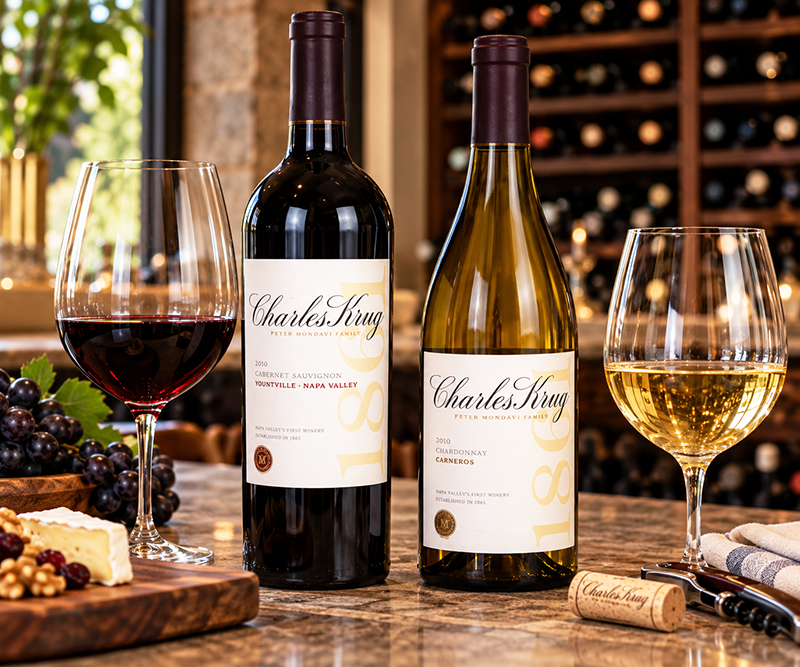
After stints as a teacher, political activist, newspaper editor, U.S. Treasury employee, and inventor, in 1861 the restless German immigrant Charles Krug established the very first commercial winery in Napa Valley.

Krug was not only a pioneer, but was innovative and inspirational as well. He became the major local winery figure of his era. He introduced the cider press for winemaking (no more foot stomping!), and carefully selected rootstocks, varietals, and vineyards, a novel approach to winemaking at the time.

Upon Krug’s death in 1892, James Moffitt became proprietor of the winery, and succeeded in keeping it open during the dark days of Prohibition. In 1943, Robert Mondavi persuaded his parents, Cesare and Rosa, to purchase the winery from Moffitt for $75,000. Robert Mondavi developed his wine career there, until he founded his own winery in 1966 and went on to become one of the greatest legends in all of California’s wine industry.

Cesare rejuvinated the winery, and reestablished it as one of Napa’s premier producers. Following Cesare’s death in 1959, Rosa ran the winery until 1976 when it was inherited by Peter Mondavi, Sr.

Innovation continued under Peter, who introduced vintage dating, cold fermentation, cold filtration, and fermentation in small French oak barrels. He was active in the affairs of the winery nearly up until his death in 2016 at the age of 101.  The operation continues under the guidance of his sons Mark and Peter Jr.

Krug Carneros Chardonnay 2010

The color of this 100% chardonnay in the glass is bright yellow with a hint of green. The nose features aromas of tropical fruit, particularly lime, and fermenting bread dough. On the palate, the citrus and peach flavors are balanced with a lively acidity. There is a surprisingly creamy mouthfeel, complemented by a lingering finish. Fermentation was 70% stainless steel and 30% barrel, so the oak is present but not overbearing.

Please your guests and yourself by serving this wine with Chicken ala Kiev, Sea Bass Stuffed with Crabmeat, or Scallops Sauteed in Garlic Butter.

Krug Yountville Cabernet Sauvignon 2010

This cabernet sauvignon favors elegance and finesse over power. The dark purple color is more transparent than inky. Black cherry dominates the nose. The taste displays the same dark fruit, abetted with cocoa and hints of tobacco and vanilla. The supple tannins help to support a relatively long finish. The blend includes 84% cabernet sauvignon, 10% merlot, 4% petit verdot, and 2% cabernet franc. Fermentation was for 20 months in French and American oak.

Enjoy this wine with Steak Diane, Ragout of Lamb, Herb-stuffed Pork Chops with Wine Sauce, or just with some honest bread and artisanal cheeses.

www.charleskrug.com/

Back to blog posts: winervana.com/blog/

Justin Vineyards

Justin Vineyards and WineryJustin Vineyards and Winery

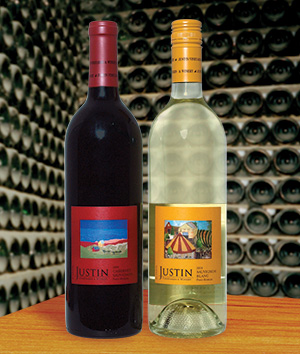
Justin Vineyards and Winery is located in Paso Robles in California’s Central Coast region. William Randolph Hearst’s famous “castle,” San Simeon, is due west over the Sierra Madre mountains.

Justin was founded in 1981 by Justin Baldwin when he planted the 160-acre property with the major grapes of Bordeaux, and the emphasis on Bordeaux-style blends and single varietals remains to this day. In addition to the estate vineyard, Justin sources grapes from thirteen affiliated growers in the area.

The winery’s three prime areas of focus are: a “left bank” Bordeaux-style blend of Cabernet Sauvignon, Merlot, and Cabernet Franc, named Isosceles, Justin’s flagship and most well-known offering; Justification, its “right bank” Merlot and Cabernet Franc cousin; and varietal bottlings of Cabernet Sauvignon and Syrah. They also produce limited amounts of Tempranillo, Zinfandel, Malbec, Petit Verdot, Port, Sauvignon Blanc, Chardonnay, and Viognier.

For these varietals, each year Justin commissions a different artist to execute the art portion of the label. The winery buildings and their surrounding vineyards are always the subject matter, the idea being that the artists’ interpretation of the winery is like the winemaker’s interpretation of the vineyard’s grapes.

In addition to the tasting room, there is also an inn and restaurant on the property.

Justin Vineyards Sauvignon Blanc 2010

This unoaked wine spent five and a half months in stainless steel before bottling. It is almost colorless, with hints of pale straw and delicate green.
The nose offers aromas of fresh peach, citrus notes dominated by ruby grapefruit, and a hint of coconut.

On the palate the wine is dry, with bright acidity, and some of the peach flavor carries over from the nose. The body has very good structure for a sauvignon blanc.

Pair this wine with Rosemary-Lemon Chicken, Crab and Shrimp Etouffee, or Broiled Scallops.

Justin Vineyards Cabernet Sauvignon 2009

After a balanced growing season and unchallenging harvest, Justin’s ‘09 Cabernet was matured for 16 months in French and American oak, 33% of it new.

In the glass, this wine is a not-quite opaque ruby red. It features aromas of black fruits, with a vanilla note from the oak. Surprisingly, there were almost no legs.

Its taste offers up red and black cherries and red currents, although the fruit is somewhat recessive, and is reflective of Justin’s preference for an old-world style, rather than what one might usually expect from the Central Coast. The wine is nicely tannic, with a medium finish.

This food-friendly wine would work well with Yankee Pot Roast, Creole Pork Chops, or Chicken Cacciatore.

justinwine.com/

Back to blog posts: winervana.com/blog/

Carmel Winery

Carmel Winery Private Collection
Carmel Winery Private Collection. Click here for tasting notes.

Carmel Winery Private Collection

The first mention of wine in the Bible appears in Genesis, chapter 9, verse 20, “And Noah began to be an husbandman, and he planted a vineyard.” The story goes on to recount some unpleasantness after Noah over imbibes, but there is no reason to go into that here. The point is, wine is as old as history itself, with some of its earliest beginnings in the Middle East. Indeed, references to wine appear hundreds of times in Scripture, through both the Old and New Testaments.
Continue reading “Carmel Winery”

Rietvallei Cabernet Sauvignon

Rietvallei Wine Estate

Rietvallei Cabernet Sauvignon

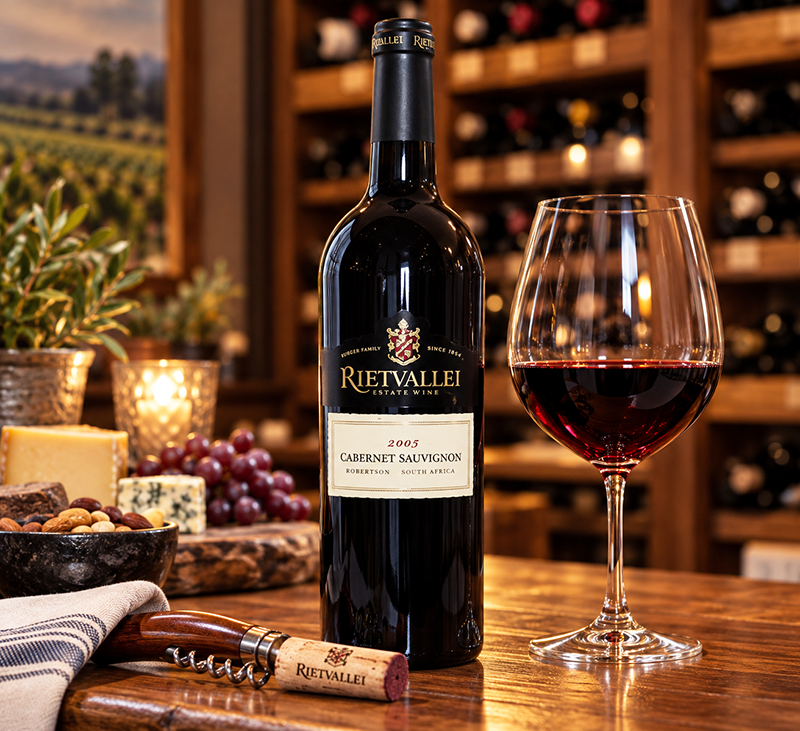
These two cabs come from the Rietvallei Wine Estate, located in the Robertson region of South Africa, outside of Johannesburg. This warm, low-rainfall area has excellent lime-rich soils, and is usually known for white wine, sherry, and brandy.

The Rietvallei Estate was founded in 1864 by the Burger family, and for many decades only produced red muscadel (also known as muscat), a sweet dessert wine. The estate’s house style was based on a recipe still to be found nailed behind the cellar door.

Today overseen by sixth generation winemaker Kobus Burger, Rietvallei began to expand its offerings a few years ago. A Chardonnay was first released in 1987, followed by a Sauvignon Blanc in 2001. The selections now include a number of other whites and reds as well.

Rietvallei Cabernet Sauvignon 2005

This easy-drinking cabernet will appeal most to those who like a lighter style of wine. Although the wine is very dark, the flavor is soft, more like a merlot than a cab. There is also a hint of sweetness as well as tartness. The aroma in the glass, or “nose,” is quite delicate. The finish is short, reflecting the low level of tannins. Enjoy this with a wide range of not too assertive foods, including fish and ‘burgers.

www.rietvallei.co.za/

Back to blog posts: winervana.com/blog/

Lot 25 Wine

Lot 25 WineLot 25 Wine

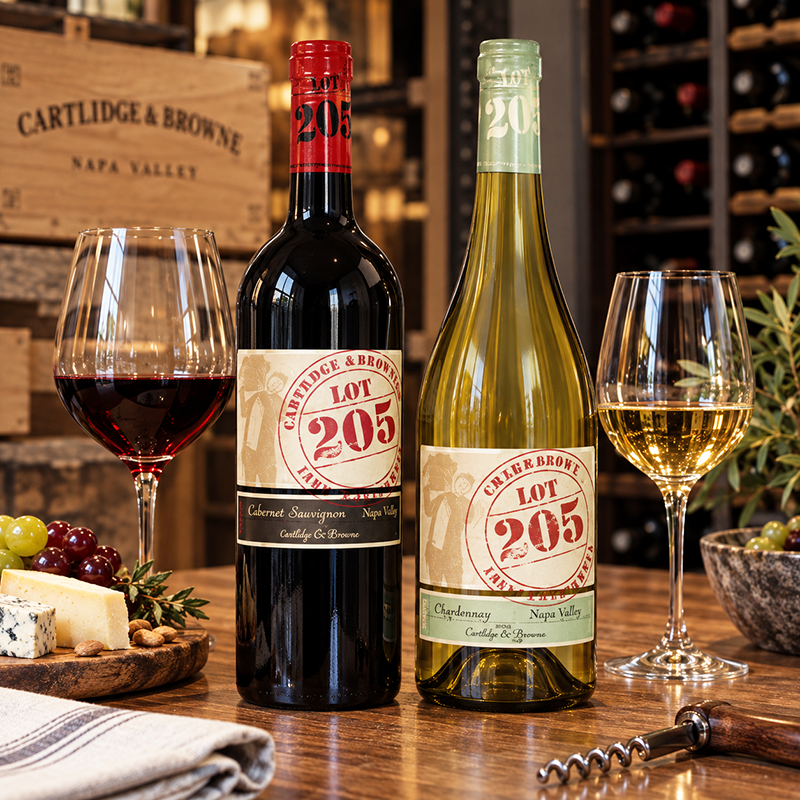
Lot 205 is the undercover label of the well-regarded Cartlidge and Browne winery. Although they acknowledge their Rabid, Manzanita Canyon, and Stratford sub-brands, Lot 205 is their secret agent, for reasons known only to them (the price points of all of these labels are approximately the same).

The name is taken from C&B’s former street address in American Canyon at the southern end of Napa Valley. The fruit, however, is sourced from growers throughout California.

Winemaker Paul Moser leans toward the French style, with an emphasis on the correct expression of the grape variety; the predominance of fruit over oak; making the wines dry and food-friendly; keeping the alcohol levels in check; and offering good value in table wines meant for everyday consumption.

Lot 205 Cabernet Sauvignon 2006

This wine is primarily Paso Robles Cabernet (82%) and Merlot (12%). The taste is fruit-forward, with dominant cherry supported by tobacco and mocha notes. It has a medium body and color, and is well-balanced by smooth, restrained tannins.

Partner this cab with jerk-rubbed chicken thighs, balsamic-marinated flank steak, and grilled lamb chops.

Lot 205 Chardonnay 2006

Although present, oak is a supporting player in this chardonnay, letting the apple, citrus, and pineapple come to the fore. It’s a bit sweeter than I expected, with a hint of butterscotch.

www.cartlidgeandbrowne.com/index.html#top

Back to blog posts: winervana.com/blog/

Jack Nicklaus Wine

Jack Nicklaus Cabernet Sauvignon and Private Reserve White.
Jack Nicklaus Cabernet Sauvignon and Private Reserve White. Click here for tasting notes.

Jack Nicklaus Cabernet Sauvignon and Private Reserve White

Even among non-players, two names in golf are widely recognized: Arnold Palmer and Jack Nicklaus, aka the Golden Bear. Nicklaus has been a wine collector for many years, but only recently decided to pursue the production of wines carrying his name, although he had been urged to do so for quite some time.

Continue reading “Jack Nicklaus Wine”