Exitus Red Wine

Exitus Bourbon Barrel Aged Red Wine

Exitus Red Wine

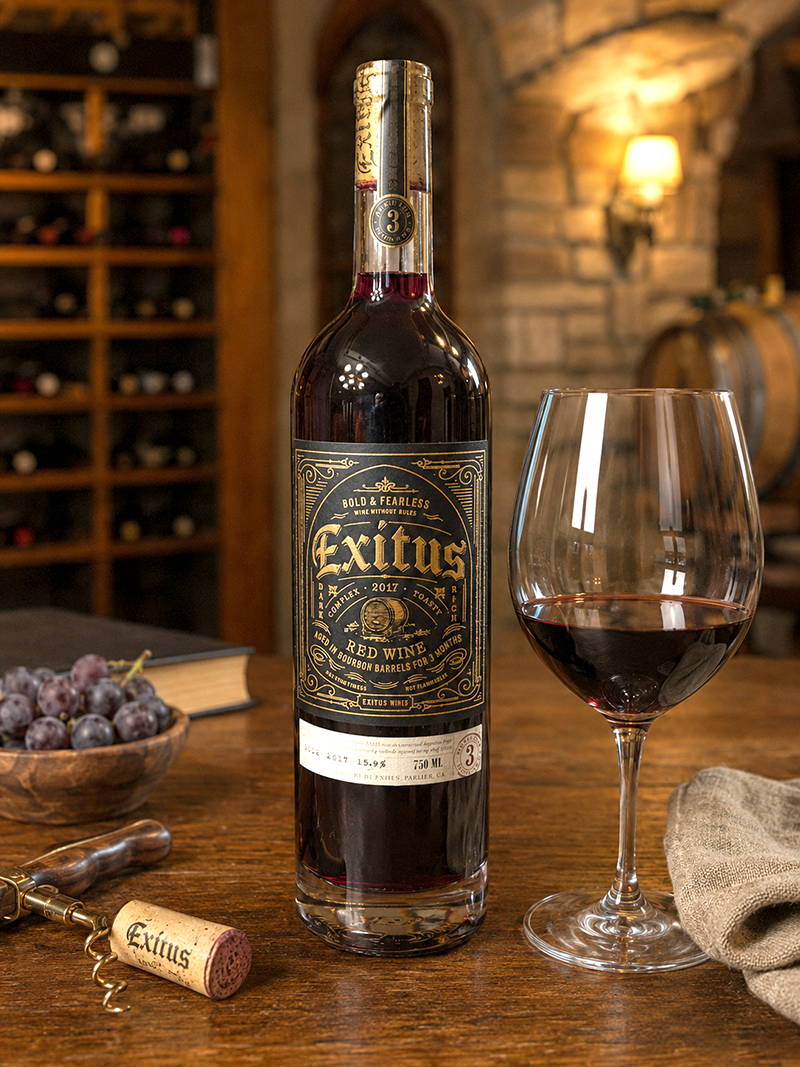
The Exitus winery is located in Parlier, California, about 20 miles southeast of Fresno. I don’t know how badass the people of Parlier are, but it’s certainly the image that Exitus is trying to cultivate. Their one current offering is Exitus Bourbon Barrel Aged Red Wine. It is fermented in the usual stainless steel. But, rather than using traditional barrels expressly made for wine, Exitus is matured for three months in charred barrels that were previously used for the production of Kentucky Bourbon. The schtick is supported by distributing the wine in clear liquor bottles.

Exitus is a blend of Zinfandel, Petit Verdot, Cabernet Sauvignon, Petite Sirah, and Merlot, sporting a robust 15.9% ABV. The wine displays a dark but bright cherry color in the glass (as well as the bottle). The alcohol is evident on the nose of the first pour, but gives way to aromas of dark berry, leather, and tobacco thereafter. After about an hour, Exitus becomes surprisingly well-behaved, with flavors of ripe dark stone fruit, dusty chocolate, and spices. Things wrap up with a bit of oak, vanilla, and balanced tannin. Interestingly, Exitus had me thinking about a glass of port for after dinner.

Try this wine with sweet and sour baby back ribs, thyme-scented pork loin with grapes and port, or sloppy joe burgers.  But do it soon.  As clever as that clear bottle is, the wine won’t age gracefully in it.

www.exituswines.com/

Back to blog posts: /winervana.com/blog/


Chapoutier Winery

Maison M. Chapoutier

Maison M. Chapoutier Winery

Thanksgiving is next week, and these two wines would be very appropriate for the holiday feast (Christmas and Hanukkah, too!)

Maison M. Chapoutier is a winery and négociant business located in Tain-l’Hermitage in the Rhône region in southeastern France. (Négociant is the French term for a wine merchant who assembles the produce of smaller growers and winemakers and sells the result under its own name.) Chapoutier produces wine from appellations across the Rhône region, in a wide spectrum of varietals, styles, and price points. The house has holdings in Portugal and Australia, as well.

Polydor Chapoutier established the business in 1879, and it has remained family-owned ever since. Yet despite its long history, by the late 1970s the winery was languishing, the wines weren’t selling, and the firm was in danger of bankruptcy.

In 1990, at age 26, Michel Chapoutier took control, after studying oenology in both France and California. In the intervening years he has transformed the winery into one of the leading Rhône Valley producers. He combines the traditional and the modern, being an early advocate of organic and biodynamic winemaking. He pruned back the vineyards and boldly reduced yields from 2.6 tons per acre to 1.8 tons per acre for both red and white wines. Industrial chemicals, fertilizers, and sprays were eliminated. Grapes are now harvested by hand and only natural yeasts are used to produce unfiltered wines.

Critic Robert Parker has called Chapoutier “one of the most influential wine personalities of the last 20 years.”

Chapoutier’s wine labels are distinctive because of their inclusion of Braille writing on all labels since 1996. The information presented in Braille includes the producer, the vintage, the vineyard, the region, and the color of the wine.

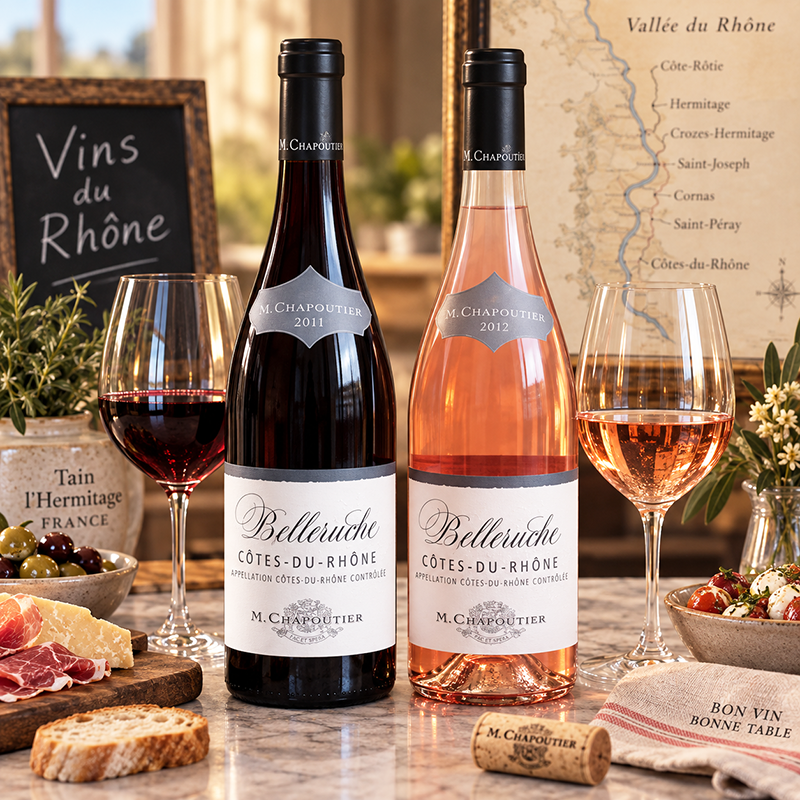
Maison M. Chapoutier Belleruche Rosé 2012

This wine is a fruit-forward blend of Grenache, Cinsault, and Syrah, with a brilliant copper-salmon color. The nose is predominantly aromas of strawberries. On the palette, expect hints of cream soda and grapefruit (yeah, it does work). There is plenty of zippy acidity, as well.

Give this wine a try with a Tomato and Onion Tart, Smoked Shellfish Quesadillas with Fresh Corn Salsa, or Shrimp Kabobs with Lemons and Bay Leaves.

Maison M. Chapoutier Belleruche Rouge 2011

Like most European wines, this lean, fruit-recessive selection is ‘food’ wine, made to drink at the dinner table, not with a pre-meal chat.

Belleruche Rouge is a blend of 60% Grenache and 40% Syrah, and was fermented and aged in vats. It is dark garnet red in the glass, with a subtle nose where no dominant aroma jumps out. The palette has an earthy quality, and features tastes of Morello cherries and black tea. The tannins offer plenty of support, but the finish is rather short.

Enjoy this wine with Wild Mushroom Soup with Blue Cheese Toasts, Beef Stew with Turnips, or Cassoulet.

www.chapoutier.com/en/

Back to blog posts: winervana.com/blog/