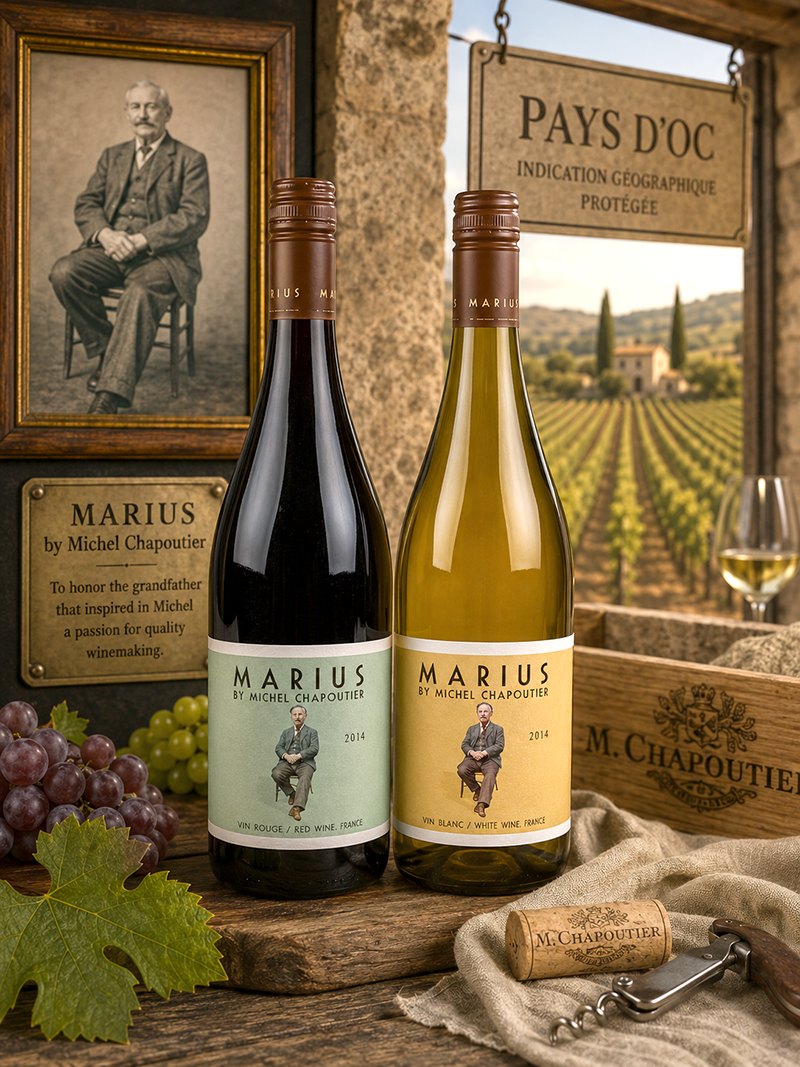
Marius by Michel Chapoutier

Marius Rouge 2014 and Marius Blanc 2014
Marius Rouge 2014 and Marius Blanc 2014 Click here for tasting notes.

Marius Wine

Languedoc-Roussillon (often called “the Languedoc”) is a historical coastal region in southern France, extending from Provence to the Pyrenees Mountains and the border with Spain. It’s now part of Occitanie. The area is a major wine producer, with Vin de Pays d’Oc and sparkling Crémant de Limoux among its best-known varieties. The regional capital, Montpellier, is home to a well-preserved medieval quarter.

Continue reading “Marius by Michel Chapoutier”

Yatir Winery

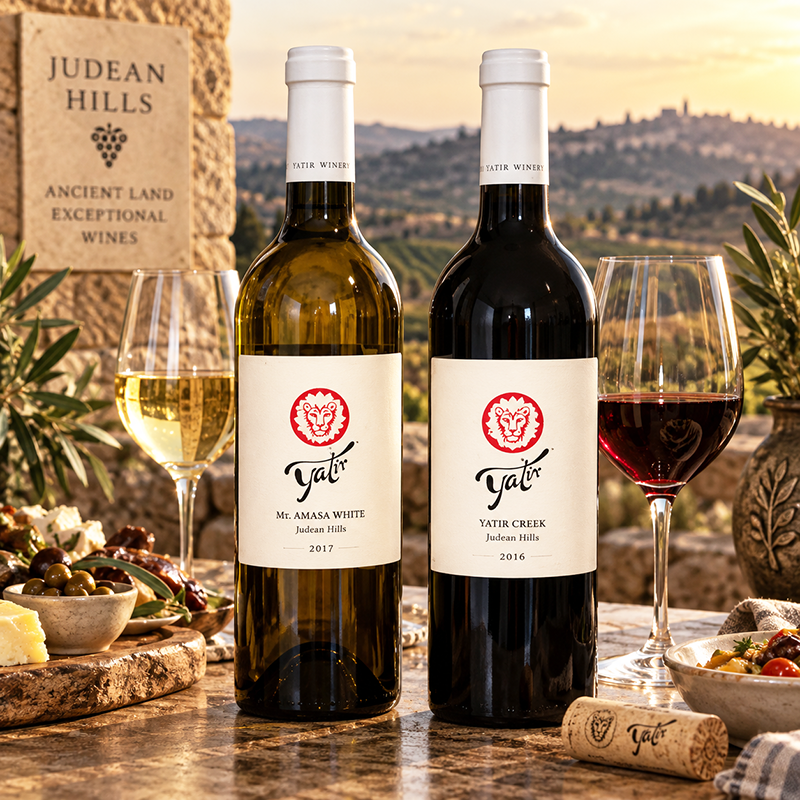
Yatir Creek 2016 and Yatir Mt. Amasa White 2017
Yatir Creek Red 2016 and Yatir Mt. Amasa White 2017. Click here for tasting notes.

Yatir Creek 2016 Red Blend and Yatir Mt. Amasa White Blend 2017

The Yatir region in the Judean Hills has produced grapes for winemaking since the ancient days of the Judean kingdom.  A large Jewish settlement existed in this region between the periods of the destruction of the Second Temple to the inception of the Islamic period.
Although the Israeli wine industry is 2,500-years-old, winemakers from this area of the Negev have only relatively recently been drawing critical and commercial acclaim.

David Ben-Gurion was the primary national founder and the first Prime Minister of Israel, which he led from 1948 until 1963 (with a short break in 1954-55).  He had a quixotic dream of making the Negev region in the south bloom and blossom.  When he decided to plant a forest in the area, he consulted with experts to guide him through the process. After numerous discussions and assessments, the agronomists determined that the region, which was predictably dry and warm, was unsuitable for planting trees. Ben-Gurion had other plans in mind however.  “Replace the experts!” he demanded.  A forest was in fact established, and it has gone on to become one of Israel’s largest . It was named after the Levite biblical city of Yatir, whose ruins remain within. The site serves as a “green lung” and a hiking site, as well as an experimental model for innovative methods for combating desertification. The Yatir Winery vineyards were planted as part of that effort.

Yatir Winery was established in 2000 as a joint venture between local growers and the Carmel Winery, who recognized the potential of the Yatir region. The Yatir Winery was built at the foot of the Israelite Tel Arad Fort (an archeological site), 10 minutes away from the vineyards.

Yatir Winery’s first wine was released in 2004, and today the winery produces 150,000 bottles. Over the years, this desert winery has become a symbol of the region.

Yatir’s  growers and winemakers are committed to excellence every step of the way – from growth and cultivation to harvest, fermentation, aging, and bottling – employing the most cutting-edge technology and equipment available to the industry today.

The vineyards of Yatir Winery are planted at an altitude of up to 900 meters [3000 feet] above sea level, and are scattered across various locations in the forest. The plots in these vineyards have varying soil compositions, with different slants and angles. The climate is characterized by cool, breezy mornings, dry days, cold nights (even at the peak of summer) and snowy winters. The soil is well-drained limestone, chalk, and clay that ensures low yields.

“We are proud to be planting in vineyards from an ancient region, where wine presses existed more than 3,000 years ago,” said Yaakov Ben Dor, Yatir Winery’s general manager.

“Although Israel’s winemaking tradition is ancient, the current industry is still young.  Israel has been widely recognized as capable of producing world-class wines, and growth is happening fast. We are pleased by the exciting potential of the region,” reported Etti Edri, Yatir’s export manager.

According to Eran Goldwasser, who oversees Yatir’s vineyards and production, “At Yatir Winery we are integrating state-of-the-art winemaking and technology within a man-made forest in the heart of the desert, to produce award-winning wines.  Though it seems unlikely, this area in Israel provides an excellent environment for wine making.  Due to Israel’s warm Mediterranean climate, the grapes have no trouble ripening.  As the vines age, yields will decrease, and our wines will become more nuanced.”

Yatir Creek Red Blend 2016

This blend of 76% Syrah, 12% Tannat, and 12% Malbec is plum red in the glass.  The nose offers aromas of rhubarb, cherries, cassis, and a hint of green olives. The palate presents flavors of recessive fruit, coca, and cigar box.  The  tannins feature a slightly salty and pleasantly bitter finish.  The wine was aged  for 12 months in large oak barrels,  and aged in the bottle for two years.

I suggest serving this wine with Moroccan chicken with preserved lemons and olives; souvlakia (skewered lamb) with grilled vegetables; or sghenna (a one pot meal for the Sabbath).

Yatir Mt. Amasa White 2017

With an unusual blend of 52% Chenin Blanc, 39% Viognier, and 9% Roussanne, this  white displays a pale golden-greenish hue.   The aromas hint at grapefruit and actetone (which disappears after chilling).  That grapefruit is joined by peach, and pear on the palate.  There is a soft mouthfeel and balanced acidity.  The wine was fermented and aged for five months in a combination of concrete amphorae (a growing trend internationally), oak barrels, and stainless steel vats.

Yatir Mt. Amasa White would go well with Libyan fish tangine; sea bass with olives and roast tomatoes; or saffron chicken and mussels.

Or, if you’re not an observant Jew, you could do as I did and make a lobster and champagne risotto.

winervana.com/lobster-and-champagne-risotto/

These wines join other Yatir products, including Yatir Mount Masa Red (which is a best seller), Yatir Rose, Yatir Peti Verdo, and the flagship wine, Yatir Forest.

yatirwinery.com/en/

Etti Edri [left], Yatir Winery’s export manager and Israel’s Ambassador Dani Dayan [right] with bottles of Yatir wines.
These wines are “kosher for Passover.”  This certification requires handling and processes unique to these types of wine.Kosher wine is grape wine produced according to Jewish dietary law (kashrut). To be considered kosher, Sabbath-observant Jews must supervise and sometimes handle the entire winemaking process, from the time the grapes are crushed until the wine is bottled. Any ingredients used, including finings, must be kosher as well. Wine that is described as “kosher for Passover” must have been kept free from contact with chametz, such as grain, bread, and dough.

To ensure the kosher status of the wine it must be overseen by a Jewish authority who supervises the kashrut status of the producer. Generally, this supervisor will physically tip the fruit into the crush and operate the equipment. Once the wine emerges from the process, it can be handled in the normal fashion.

Here’s some more information on kosher wines:

winefolly.com/review/myths-facts-kosher-wine/

Back to blog posts: winervana.com/blog/

Gordon Brothers Tradition

Gordon Brothers TraditionGordon Brothers Tradition

Jeff Gordon (no, not that Jeff Gordon) is a fourth-generation farmer, born and raised in Washington state. Although tied to the land, Gordon realized early on that affection wasn’t enough, and was shrewd enough to take a Bachelor’s degree in Agriculture in 1971.
By 1977, Jeff and his brother Bill were growing potatoes on 130 acres of rented farmland. Several years later, Jeff’s attention to the local microclimate and rich volcanic soil of southeastern Washington’s Columbia Valley led the Gordon family to take the then-audacious step of planting wine grapes on a sagebrush-covered slope overlooking the Snake River. Much to the amusement of local fellow farmers, Jeff made a bold decision to plant red grape varietals. “As far as everyone was concerned, the Columbia Valley was Riesling country. That was all there was to it. We thought red grapes would work. We took a chance. It was the right thing to do.”

Gordon Brothers Tradition 2003

This wine is a blend of 47.6% Cabernet Sauvignon, 47.6% Merlot, and 4.8% Syrah (all from estate-grown grapes). After pressing and fermentation, the wine aged in oak for a total of 40 months.

Tradition is a jewel-like ruby in the glass. The nose features hints of cinnamon and clove. The velvety mouth-feel is complimented by restrained flavors of dark cherry and chocolate, and moderate tannins.

This very food-friendly wine will pair well with autumnal meats such as roast duckling with soy sauce and cloves, or braised lamb shanks.

Back to blog posts: winervana.com/blog/

Casa Lapostolle

Casa LapostolleBetween the Mountains
and the Deep Blue Sea

If you’re looking for good value in wine, head for the Chilean section of your local wine shop.

Winemaking was established in Chile in the mid-sixteenth century by Spanish missionaries, and for 300 years wine production was based on the Pais grape they carried. In 1851, French wine experts arrived, and with them the more familiar European grape varieties. And now, even with over 400 years of experience, and free of the twin scourges of Prohibition and phylloxera, Chile has yet to attain its full potential.

This promise continues to attract winemakers from around the world. One of the French concerns is the Marnier Lapostolle family, founders and owners of the famous orange liqueur Grand Marnier, as well as other spirits. Lapostolle was established in 1994, with the goal of creating top-quality wines using French expertise and the unique terroirs of Chile.

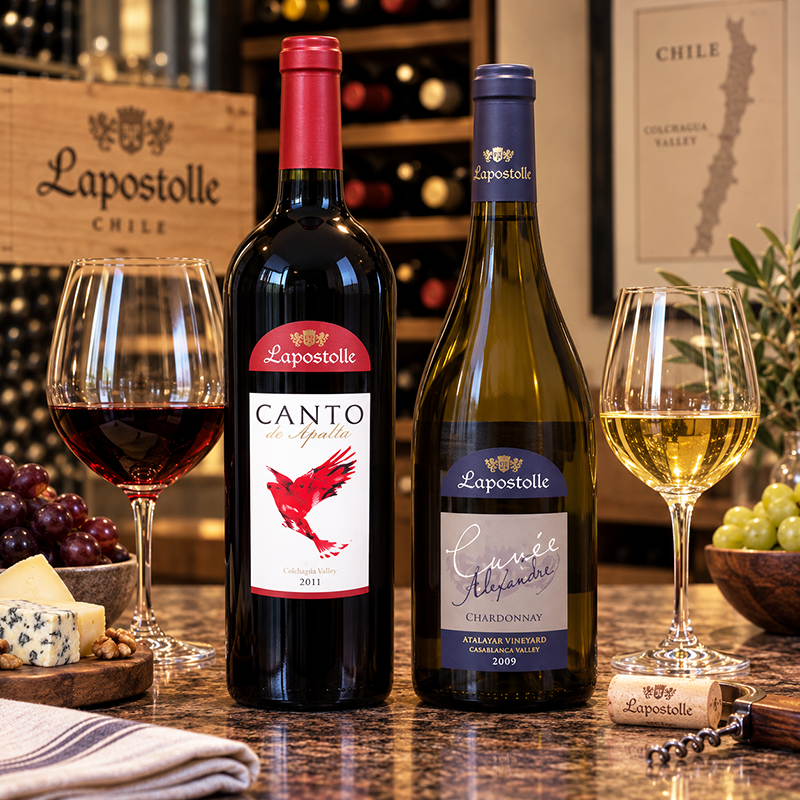
Casa Lapostolle Cuvee Alexandre Chardonnay 2009

The home of this wine is the Atalayas vineyard in the Casablanca Valley, in the Coastal Cordillera, 47 miles west of Santiago. Atalayas was originally planted in 1997, and enjoys cool coastal winds and a low annual rainfall. 100% of Atalayas vineyard is under organic and biodynamic agriculture management.

This is the rare white that will benefit from thirty minutes or so of ‘breathing’ before pouring. While you’re waiting, admire its bright lemon-yellow color and nose of citrus and melon. This wine suggests grapefruit on the palate, which is supported by its zippy acidity. There is oak, but it is well integrated and in a secondary role. Look for a hint of crème brûlée on the finish. Fermentation was on 68% new and used French oak, as well as 32% stainless steel. 20% of the total underwent a further malolactic fermentation.

This wine would go nicely with Braised Snapper and Mussels, Shrimp in a Picante Sauce, or Chicken à la Chinita.

Casa Lapostolle Canto de Apalta 2011

The horseshoe-shaped Apalta vineyard is located 124 miles southwest of Santiago, 42 miles away from the Pacific Ocean, between the Andes mountain range and the Coastal Cordillera. The first vines in Apalta were planted in 1920, and some of these were transplants that had originally been brought from France at the end of the 19th century. Apalta is also 100% under organic and biodynamic management.

“Song of Apalta” is a Bordeaux-style red blend that was born from the relationship between Carmenère, Merlot, Cabernet Sauvignon, and Syrah. All fermentations were made with wild yeasts and minimal intervention on the part of the winemaking team.

Here’s a food-friendly wine that is also good for quaffing. It is rich garnet in the glass, with delicate legs. The nose shows spice and eucalyptus, as well as black and red fruits. The body is light in the mouth, with flavors of ripe red berries and figs. These are backed up by medium tannins and a surprising amount of acidity. The wine has a medium-length finish.

Serve with Roast Beef in a Black Pepper Crust, Leg of Lamb with Pistachios, or Lemon Veal Chops.

www.colchaguavalley.cl/en/2012/07/lapostolle-presenta-canto-de-apalta/

Back to blog posts: winervana.com/blog/

Portugese Red Table Wine

Portugese Red Table WinePortugese Red Table Wine

In the 1970s, Portugese rosés such as Lancers and Mateus were the height of sophistication to many young wine drinkers: “It’s imported, and comes in a fun bottle!” With age comes wisdom, and these wines were eventually abandoned for the justifiably famous fortified wines of Portugal, Port and Madeira, produced by many ancient and famous houses.

Much less well-known is Portugal’s status as a producer of both red and white table wine, ranking in the world’s top ten in production.  With a population of just 10 million, but top five in per capita consumption, much of that wine is sipped by the thirsty Portuguese.

Continue reading “Portugese Red Table Wine”

Carmel Winery

Carmel Winery Private Collection
Carmel Winery Private Collection. Click here for tasting notes.

Carmel Winery Private Collection

The first mention of wine in the Bible appears in Genesis, chapter 9, verse 20, “And Noah began to be an husbandman, and he planted a vineyard.” The story goes on to recount some unpleasantness after Noah over imbibes, but there is no reason to go into that here. The point is, wine is as old as history itself, with some of its earliest beginnings in the Middle East. Indeed, references to wine appear hundreds of times in Scripture, through both the Old and New Testaments.
Continue reading “Carmel Winery”
Hook and Ladder Winery

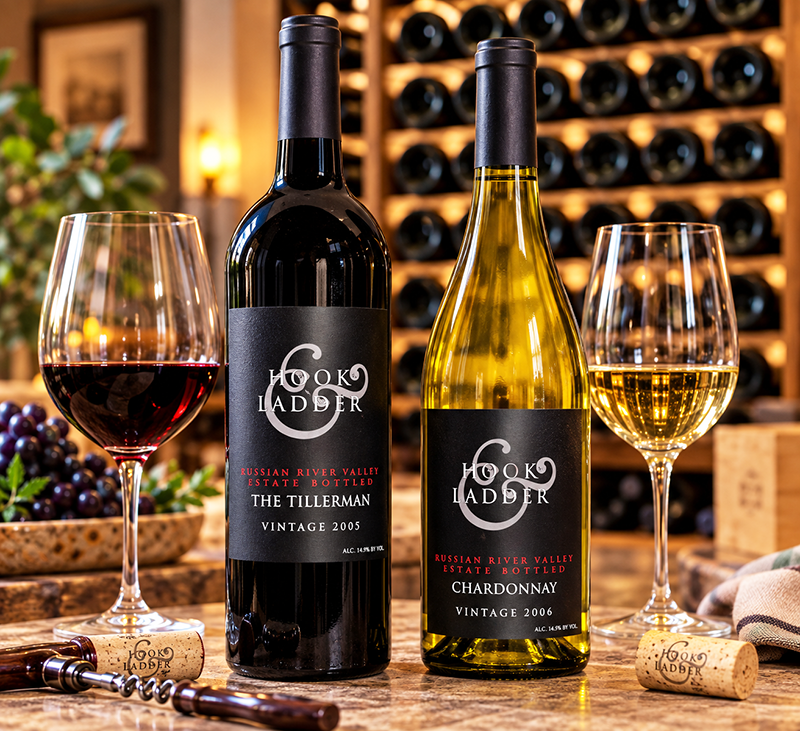
Hook & Ladder The Tillerman 2005 and Hook & Ladder Chardonnay 2006

Hook and Ladder Winery

Looking toward his eventual retirement, in 1970 San Francisco firefighter Cecil De Loach bought 24 acres of old-vine Zinfandel in the Russian River Valley of Sonoma County. For six years De Loach worked the acreage part time, selling grapes to other producers, as neophyte winemakers often do. In 1976 De Loach released his first wine, 1,000 cases of a vintage 1975 Zinfandel, and in so doing became one of the first Russian River wineries.
After a 16-year career, De Loach retired from the San Francisco Fire Department in 1982. But this allowed him to work the winery full time, and over the next two decades he grew production to 250,000 cases annually. Not only was he one of Sonoma county’s wine pioneers, during this time he was also extremely active as a promoter and advocate of Sonoma wines.

Unhappily, De Loach ran into financial difficulties in the late 1990s, and filed for bankruptcy in 2003. (The De Loach label continues, however, having been purchased by the Boisset family of Burgundy, France.)

Hook and Ladder winery

He could have called it quits at that point, but De Loach postponed his retirement yet again. In 2004 he founded Hook & Ladder Winery, the name an obvious nod to his first career as a firefighter, having been a tillerman steering the rear wheels of a hook and ladder fire truck. (He was forced to leave his eponymous label behind because a non-compete agreement prevents his own name from ever again appearing on a wine bottle, a testament to his stature in the Sonoma wine industry.)

Still in the Russian River Valley today, De Loach now works 375 acres in the cool climate there, with his wife, son, grandson, and granddaughter all employed at Hook & Ladder.

Hook & Ladder The Tillerman 2005

A single-vineyard blend of 46% Cabernet Sauvignon, 19% Cabernet Franc, 18% Merlot, and 17% Sangiovese. Plenty of ripe fruits, with a supporting cast of cassis, spice, cedar, and leather. A somewhat short finish. After decanting for an hour, serve with pork satay and peanut dipping sauce, or prime rib paired with madeira sauce.

Hook & Ladder Chardonnay 2006

This wine is a very light yellow-green, pale almost to the point of being colorless. Fermented in a combination of stainless steel and seasoned French oak barrels to retain its crisp acidity. The tart citrus flavors are balanced with just a hint of oak from the not-new barrels. (Oaky, buttery chardonnays are on the wane, I for one am sorry to report.) This chard features bright but delicate aromas of just-ripe apple, pear, and mango. Good now, but should be more appealing in warmer weather. Would contrast nicely with richer seafood such as truffled lobster risotto or rosemary-roasted salmon.

hookandladderwinery.com/

Back to blog posts: winervana.com/blog/

Lasseter Family Winery

Lasseter Family WineryUn Travail d’Amour

John and Nancy Lasseter are long-time francophiles, and over the years have traveled extensively in France. It was there that they developed their appreciation of and fondness for Old-World style wines.

It was with some irony then that in 1993 they moved to Sonoma (with Napa, the very heart of “New World” style wines) and began dabbling in amateur winemaking. In 2002, they went all-in when they purchased a badly neglected local winery and 27-acre vineyard property.

This sad state of affairs allowed them to start from scratch, however. The land was restored to natural habitat and good health. The vineyards were converted to 100% organic farming practices, supported by a natural eco-system that includes beehives, owl boxes, and insectaires. A new eco-friendly winery building was completed in 2011.

In addition to wine, the Lasseters have a passion for the arts, and they try to bring an artistic sensibility to the winemaking. They commissioned local painter Dennis Ziemienski to create the label art. They consider their winemaker, Julia Iantosca (one of only a handful of female winemakers), to also be an artist in the way she uses her skills to handcraft the signature blends favored by the Lasseters.

Lasseter Family Winery is a genuine boutique operation. The total production of the four wines currently available is just 1445 cases. It is truly a labor of love.

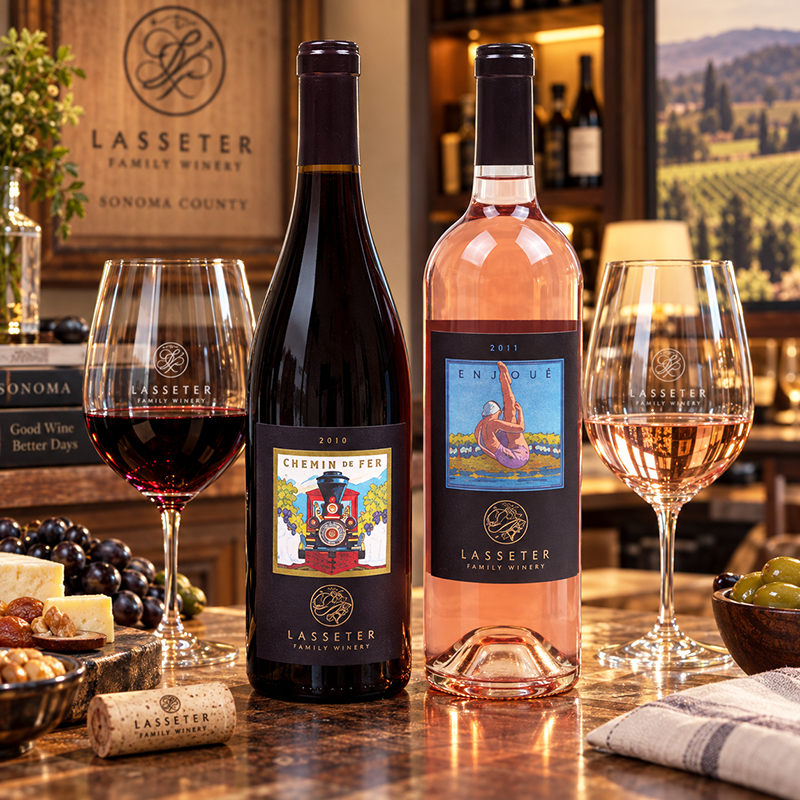
Lasseter Enjoué 2011

None of my friends like rosés, but I’ve never understood why. What’s not to like? They routinely offer delightful color, plenty of flavor, and great versatility. And so it is with this Lasseter Enjoué (meaning joyful, playful, etc.)

The pale salmon-pink color comes from using red grapes (in this case, Grenache, Syrah, and Mourvédre, the classic Rhone GSM trio, sourced from the seven-acre Justi Creek Block) in a white-wine style. Both the nose and the taste suggest strawberry, ruby grapefruit, and lime. There is plenty of acidity, so it will work with a wide variety of foods.

Dine al fresco and enjoy a bottle of Enjoué with Coquilles St. Jacques, Tuna with Wine, Tomatoes, and Herbs, or Pork and Veal Pâté.

 Lasseter Chemin de Fer 2010

All aboard! ‘Chemin de Fer’ is French for railroad, and the name recalls a memorable train trip the Lasseters took through southern France many years ago. Although in different proportions, this wine is made with the same Justi Creek Block GSM as is the Enjoué, showing just how varied winemaking can be.

In the glass, Chemin de Fer is transparent ruby in color. The nose features aromas of dark cherry and spice. True to the Lasseters’ preference for an Old-World style, on the palate the wine is dry and lean, with flavors of dark fruit. Structure is provided by plenty of acid and tannins, and the wine has a long smooth finish. Be sure to decant this wine and give it up to two hours to breathe.

Couple Chemin de Fer with Chicken Sautéed with Herbs and Garlic, Coq au Vin, or Pan-broiled Steak.

www.lasseterfamilywinery.com/

Back to blog posts: winervana.com/blog/

Craggy Range Winery

Craggy Range Winery

Craggy Range Winery

Although wine production started in New Zealand as early as 1819, that nation of beer drinkers didn’t really start to get serious about it until the mid 1960s, time-wise much like California. Real success didn’t come until the early ‘80s, however, with the varietal New Zealand has become famous for, sauvignon blanc. The first release to get wide attention was the 1979 from Montana Wines (New Zealand’s biggest wine maker) and an even more compelling product followed from Cloudy Bay Vineyards in 1985, finally putting “the land of the long white cloud” on the world’s wine-making map.

In 1876 the Ngaruroro River in the Hawkes Bay region severely flooded and changed course, leaving behind a large new tract of gravelly soil. At first, the plan was to turn this infertile ‘wasteland’ into a quarry. Before that project got underway, however, local winemakers claimed the land as their own and began planting vines.

Terry Peabody and Steve Smith established Craggy Range in Hawkes Bay in 1997, recognizing the area’s potential to deliver first-rate wines. Their goal was to make single-vineyard wines – wines that are true expressions of the vineyard’s terroir.

Peabody handles the ‘front office’ at Craggy Range, while Smith is the senior winemaker and certified Master of Wine. Decanter magazine and Wine and Spirits magazine have named him as one of the fifty most influential people in the world of wine.

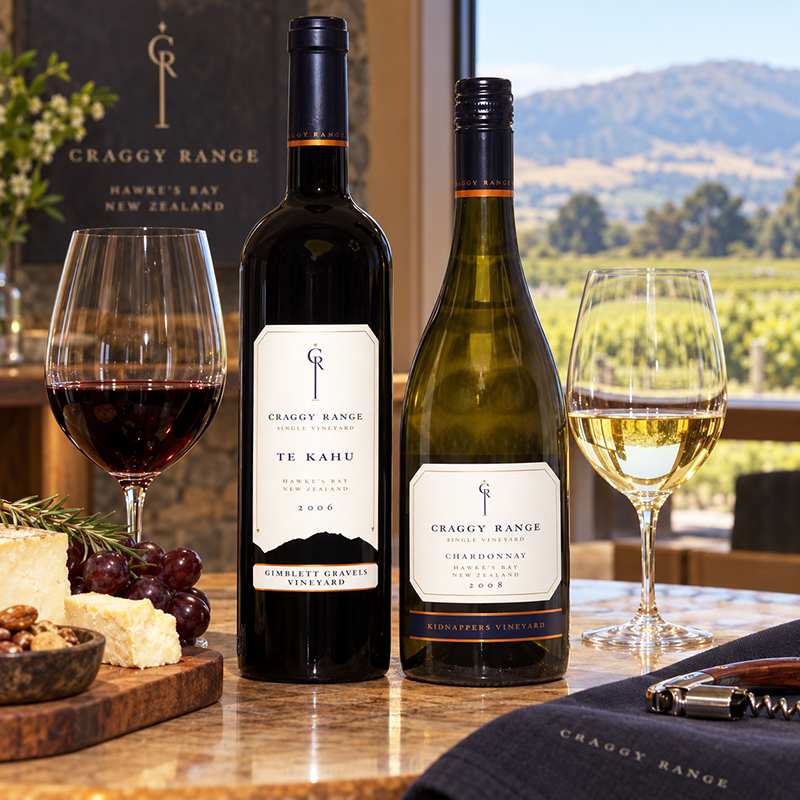
Craggy Range Winery Chardonnay 2008

Kidnappers Vineyard is located on the Hawkes Bay coastline at Te Awanga where the climate is warm and sunny and the soil is predominantly clay loam.
This wine introduces itself with a very pale straw color and lemony nose. The citrus notes continue on the palate, abetted by tastes of mineral and oyster shell. The finish suggests clove and grapefruit.

This wine would pair well with Grilled Scallops with Raspberry-Thyme Beurre Blanc, Lemon-Basil Basated Shrimp, and Mixed Grill of Summer Vegetables.

Craggy Range Winery Te Kahu Proprietary Red 2006

Te Kahu means The Cloak in the native Maori language. Legend has it that the mists rolling down the valley are the cloak of a beautiful maiden laying at the feet of her lover, the fallen giant Te Mafa.

This lean, restrained wine is a classic Bordeaux blend of 58% Merlot, 22% Cabernet Sauvignon, 15% Cabernet Franc, and 5% Malbec, and is very much in the European style. The bouquet offers notes of dark plum, blueberry, cedar, and a hint of oak. The palate adds elements of earth and dusty cocoa powder supported by moderate tannins. The finish is relatively short.

Let this wine breathe for at least two hours, then serve with Paprika Chicken or Braised Lamb Shanks with White Beans.

www.craggyrange.com/

Back to blog posts: winervana.com/blog/

Ernie Els Big Easy Wines

Ernie Els Big Easy Wines

Ernie Els Big Easy Wines

Welcome to another installment in my series on golfers’ wine projects.  This time the focus is on Theodore Ernest “Ernie” Els, known as “The Big Easy” due to his imposing physical stature along with his fluid, seemingly effortless golf swing.

Els launched his winery in 1999 in Stellenbosch, South Africa [predictably, since he’s a native]. With award-winning winemaker Louis Strydom at the helm, they produced the maiden 2000 vintage of Ernie Els, a ‘classic’ Bordeaux blend. This impressive facility is now home to eight different Els selections.

Wines of varying quality have been made in South Africa for over 350 years. Stellenbosch, in the country’s southwestern Coastal Region, is one of the oldest and most highly regarded growing districts. It is similar to a Mediterranean climate, with an average rainfall of around 25 inches per year. The soils largely consist of clay, with the deeper soils having a considerable amount of granite, just the sort of difficult land that quality grape vines prefer. The majority of the vineyards at Ernie Els Wines are north-facing, with the rows running in an east-west direction, resulting in the optimal utilization of sunlight. In summer, the vineyards’ close proximity to the Atlantic Ocean provides cool sea breezes that moderate temperatures, extending the ripening period.

Ernie Els Big Easy White 2011

Yes, Els rather cheekily labeled these wines after his nickname. This wine is 100% Chenin Blanc, with no oak aging whatsoever. The wine is pale gold, and the nose is delicately perfumed. The prominent flavor is grapefruit, with a hint of almond and spice. There is plenty of acid, complementing the grapefruit flavor profile, with the finish featuring some of grapefruit’s bitterness, as well.

Match this wine with New Orleans-style Barbecued Shrimp, Chicken Clemençeau, or Cheese Soufflé.

ernieels.com/wines/wine-portfolio/big-easy-by-ernie-els-chenin-blanc/

Ernie Els Big Easy Red 2010

This red blend is 60% Shiraz and 20% Cabernet Sauvignon, with the balance Mouvedre, Grenache, Cinsaut, and Viognier (with the exception of the Cab, this is a typical Bordeaux blend). It is dark purple in the glass, with a rather boozy nose. It was barrel aged for 12 months in 80% French and 20% American oak.
The palate is dense and full bodied, with plenty of tannins. Earthy flavors of black cherries, coffee, and chocolate predominate, and are smoothly integrated. A hint of cocoa on the finish delivers a slight bitterness that is less welcome than it is in the Big Easy White.

Serve this red with Steak and Truffled Mashed Potatoes, Grilled Chicken wth Watermelon Relish, or Garlic Pork Roast.

ernieels.com/wines/wine-portfolio/big-easy-by-ernie-els-red-blend/

Back to blog posts: winervana.com/blog/

Deerfield Ranch Winery

deerfield ranch wineryDeerfield Ranch Winery

Sonoma County is situated between Napa County to the east, and the Pacific Ocean to the west. Sonoma has over 175 wineries, second only to the somewhat more famous Napa in number of U. S. wineries.

The Sonoma Valley AVA [American Viticultural Area] is in the southeast corner of Sonoma County, and is home to Deerfield Ranch Winery. This boutique winery is owned and operated by the affable and effusive Robert Rex. He makes the wine, and his wife PJ manages the business side. Many wineries today tout themselves as “small, family-run,” but this one truly is.

Deerfield Ranch is a certified organic producer, even now still one of the few in Sonoma County, with an annual output of about 15,000 cases.

Trained as a chemist, in 1972 Robert was given a winemaking kit by then-girlfriend PJ in appreciation for keeping her finicky Alfa Romeo running. That first Zinfandel won Best of Show at the California State Fair, and Robert soon left the chemistry lab in favor of the wine cave.

Robert is an enthusiastic proponent of the art of blending wines, and says, “Making wine is like gourmet cooking. We start with the finest ingredients. By drawing from 26 vineyards we get grapes from appellations where varietals grow the best. We allow the grapes to fully vine ripen, and use the most gentle production techniques. We make wine by hand in small lots; the wines are clean, have very low histamine and sulfite levels, so that they produce no headaches or allergic reactions.”

Deerfield Ranch Winery Los Chamizal Chardonnay 2009

This pale-gold elixer opens with delicate aromas of honey and apricot. The French white oak in which it was barreled for 10 months is present in the taste, but plays a subtle supporting role to the balanced acidity and flavors of green apple, fresh mint, and grapefruit.

Try this wine with Sauteed Black Sea Bass with Red Peppers, Grilled Herbed Salmon with Shrimp, or Chicken Burgers with Chive Sauce.

Deerfield Ranch Winery Red Rex 2006

Showcasing Robert Rex’s ideas about blending, Red Rex is 40% Cabernet Sauvignon, 23% Syrah, 19% Merlot, 7% Sangiovese, 5% Malbec, 4% Cabernet Franc, and 2% Petit Verdot. The ratio is on the bottle, but you’re unlikely to get the same results if you try the recipe at home!

After harvest, the wine was barrel aged for 36 months in 75% French and 25% American oak. Red Rex is nearly opaque without being cloudy, with a nose of dark cherries, berries, and spice box. On the palate, the wine tends toward a leaner French style; there is a medium-weight feel, with flavors of the same cherries and berries, complemented by black pepper and minerals, then ending in a medium finish.

This is Deerfield’s most popular wine; enjoy it with Boeuf Bourguignon, Hamburger au Poivre with Red-Wine Sauce, or Pork Chops Milanese.

www.deerfieldranch.com/home.html

Back to blog posts: winervana.com/blog/

Clos du Bois Wine

Clos du Bois Marlstone 2005 and Clos du Bois Calcaire 2007
Clos du Bois Marlstone 2005 and Clos du Bois Calcaire 2007. Click here for tasting notes.

Clos du Bois Wine

Although it sounds French, the Clos du Bois [klow doo bwa] winery is definitely American. Clos du Bois was founded in 1974 by Frank Woods, who planned on simply naming his new winery “Woods Vineyard.” His children, who were studying French at the time, suggested “Clos du Bois” instead, which loosely translates to “enclosure in the woods.”

Continue reading “Clos du Bois Wine”