
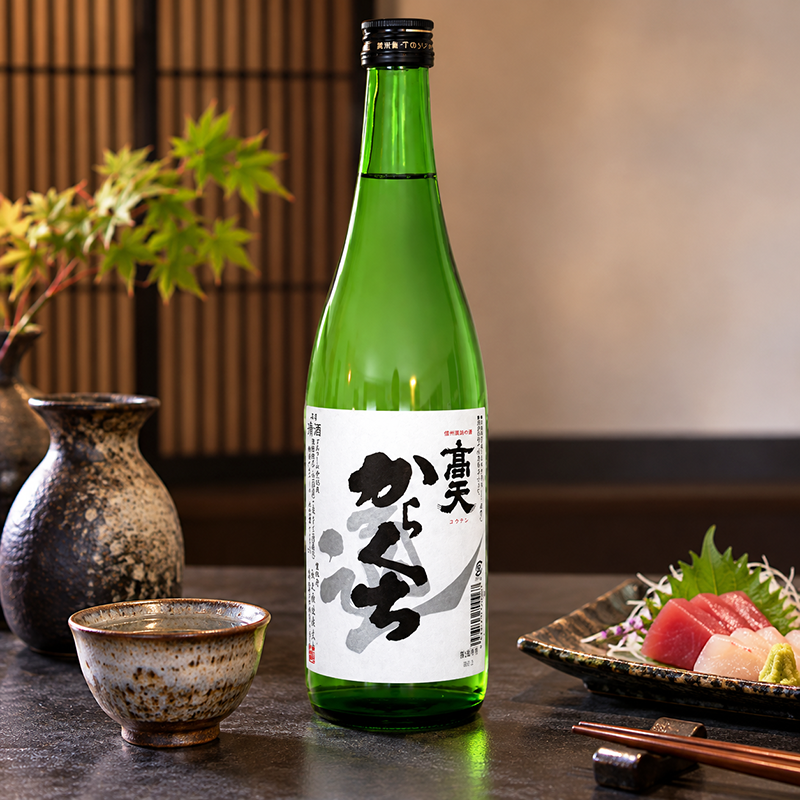
Karakuchi Tsu Saké
Takaten Shuzo is a historic, family-run Japanese sake brewery founded in 1871 in Okaya, Nagano Prefecture. Its Karakuchi Tsu is a traditional, dry, food-friendly sake that emphasizes the flavor of rice rather than the floral and fruity aromas associated with many premium ginjo sakes.
There is an interesting distinction in the name: the brewery is commonly called Takaten in English, although its Japanese name, 髙天, is also rendered as Koten or Kouten. The sake itself is called Karakuchi Tsu (辛口 通), roughly meaning “Dry Saké for Connoisseurs.”
Saké is often called rice wine, but this is a misnomer. While it is an alcoholic beverage made by fermentation, the production process more closely resembles that of beer, and it is made from grain (rice, of course), not fruit. To make saké, the starch of freshly steamed glutinous rice is converted to sugar and then fermented to alcohol. Once fermented, the liquid is filtered, heated, and placed in casks for maturing. Sakés can range from dry to sweet, but even the driest retain a hint of sweetness.
The brewery: 155 years of sake making
Takaten was established in 1871 by Mikinosuke Takahashi in the city of Okaya, near Lake Suwa, in the mountainous heart of Japan’s Nagano Prefecture.
The brewery’s name comes from the Buddhist posthumous name of an ancestor, Koten Ryokyo Zenjomon, reflecting the family’s respect for its heritage.
One of the most significant events in the brewery’s history occurred in 1928, when Takaten became the first Nagano sake producer to receive the prestigious Honorary Prize at Japan’s National Saké Competition. This helped establish Nagano’s reputation as an important saké-producing region.
In 2014, the company was recognized by Nagano Prefecture as one of its distinguished century-old businesses.
A brother-and-sister operation
An especially interesting aspect of the brewery is its family management.
The current family arrangement places the brewing responsibilities with the sister, while her brother manages the business. The brewery identifies this as the first time in its long history that a brother and sister have jointly maintained the operation.
Karakuchi Tsu Saké
This is a futsushu, Japan’s everyday saké classification, rather than a junmai ginjo or daiginjo. But, futsushu is not necessarily inferior saké. It is a broader category with fewer production restrictions, and some traditional breweries devote considerable attention to making excellent everyday saké.
Karakuchi Tsu is specifically intended as a saké that complements food and remains enjoyable throughout a meal.
This is a restrained, understated, crystal-clear brew with a delicate, largely neutral aroma.. The very subtle palate has a medium-dry body with a clean, dry character. The finish is short but crisp and refreshing.
For serving, the brewery recommends room temperature most strongly, but also endorses chilled, gently warmed, and hot service. Begin at approximately 65°F, taste it, then warm a second small serving to around 105°F. I highly suggest the latter, as much more of the rice’s rounder savory character emerges after this slight warming.
This is an unobtrusive accompaniment to food, although those seeking complexity or distinctive character may find it rather unremarkable. Pair it with grilled mackerel, yakitori, shrimp tempura, pork tonkatsu, and, of course, sushi.
Its 65% rice-polishing ratio means 35% of the outer portion of each grain has been removed (a relatively modest polishing level compared with highly polished premium saké), the ABV is 15%, and the saké meter value* is +5.
*The SMV (Saké Meter Value) measures the density of saké relative to water, and is the method for gauging the dryness or sweetness of saké. The higher the SMV, the drier the saké. The range is from -15 (sweet) to +15 (dry),
Top of page: https://winervana.com/blog/