Schramsberg Brut Rosé 2021

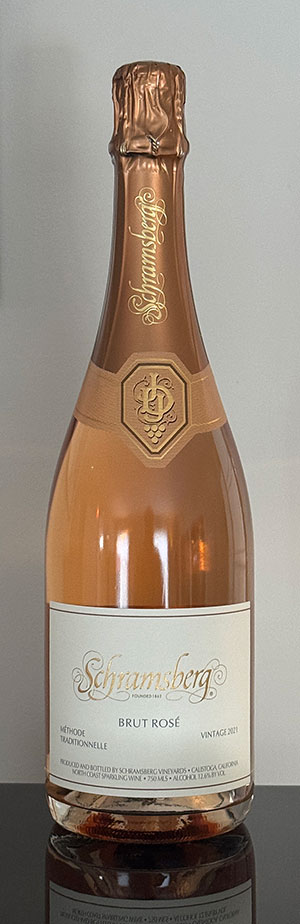
Schramsberg Brut Rosé 2021. Click here for tasting notes.

Schramsberg Rosé

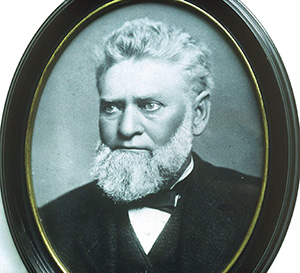
Jacob Schram
Jacob Schram

Jacob Schram, a German immigrant, bought 200 acres on Mt. Diamond in Napa valley in 1862 and planted 30,000 vines. He had Chinese laborers dig Napa’s first hillside caves for wine aging and storage.  His winery, Schramsberg, gained fame after the author Robert Louis Stevenson wrote about it in his 1883 book, The Silverado Squatters. The wine became so popular that the 23rd President of the United States, Benjamin Harrison,  served it in the White House at official functions.

After Schram died in 1905 the property languished until Jack and Jamie Davies purchased it in 1965. They decided to focus on making sparkling wine in the Champagne style using the traditional “méthode champenoise,” (aka “méthode traditionnelle”) to great success.

Their 1965 Blanc de Blancs would be the first commercial use of Chardonnay in American sparkling wine.

Reviving the Harrison tradition, every President since Richard Nixon has featured the company’s sparkling wine at the White House or some official celebration.

For example, in 1972 their sparkling “Blanc de Blancs” wine was served as part of the “Toast to Peace” during the visit by then-President Richard Nixon to China — a symbolic and historic diplomatic moment.

The winery preserves a large portion of forested land on the estate, and from the beginning of the Davies’ ownership they adopted sustainable and preservation-oriented practices — both for the land and the winemaking legacy.

Jamie and Jack Davies

In 1996, Hugh Davies, the youngest son of Jack and Jamie Davies joined the winery full-time. Hugh had earned a master’s degree in enology from the University of California, Davis. Hugh, coincidentally was born in 1965, the year that the Davies family purchased the Schramsberg property. The winery was added to the National Register of Historic Places in 1998.

Jack Davies died in the spring of 1998 and in 2008, Jamie Davies also died. Today, Hugh Davies serves as CEO of Schramsberg.

Schramsberg Winery. Photo: Cassie Musgrove
The Schramsberg cave. Photo: Lynn Splendid Light

Schramsberg Brut Rosé 2021

This is a sparkling rosé, made in the traditional Champagne method. Base wines are fermented, then a second fermentation happens in the bottle. After that, the wine is aged on its lees (dead yeast cells) for a period to develop complexity, fine bubbles, and balanced flavors.

The wine is a blend of 73% Pinot Noir and  27% Chardonnay. This combination lends the Brut Rosé both fruit-forward character (from Pinot Noir) and structure/spice/length (from Chardonnay).

Some small lots of the Pinot Noir are fermented in contact with their skins (a “skin-contact” or limited maceration for rosé) to pick up subtle color and additional depth — then all lots are blended, gently pressed, and treated carefully during winemaking. The aim is a wine that is “fruitful, complex and dry”, with brightness and elegance — capable of being versatile with food or standing alone as an apéritif.

This rosé pours a lovely salmon color in the glass.  It has a relatively fine and very lively mousse. The nose offers up mouthwatering fresh berries.  The palate features tart cherry, raspberry, a hint of yeast, some unexpected citrus, and zippy acidity. There is a nicely balanced dryness, sometimes uncommon in rosés. It wraps up with a clean refreshing finish. ABV is 12.6%.

Pair this sparkler up with seafood — lighter fish like salmon or halibut; maybe even sushi, shrimp or other shellfish. Its acidity and freshness complement seafood nicely. The winery itself suggests pairing with dishes ranging from “sushi, salmon, and rock-shrimp” to a board of cheeses, fresh fruit, etc.   Also consider lighter meats or poultry, salads, fresh summer dishes, and fruit-based desserts (red-berry tarts, fruit salads).

Back to blog posts: winervana.com/blog/

Roederer L’Ermitage

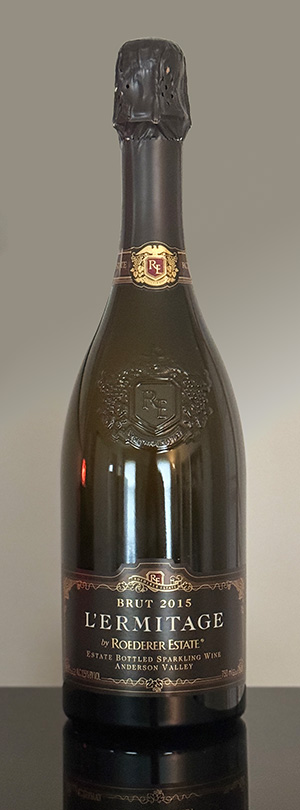
Roederer Estate L'Ermitage Brut 2015
Click here for tasting notes.

Roederer Estate L’Ermitage Brut 2015

Louis Roederer [Road-ur-ur], a distinguished champagne producer situated in Reims, France, traces its origins back to 1776, when it began as Dubois Père & Fils. While its early days were marked by still wine production, the focus soon evolved to embrace the art of crafting fine champagnes. The business underwent a transformation under the stewardship of Louis Roederer in 1833 when he not only inherited but also renamed the company for himself.  He boldly ventured into international markets, focusing particularly on Russia. This endeavor gained him immense recognition, including from Tsar Nicolas II, who appointed Louis Roederer as the official wine provider to the Imperial Court of Russia.

Created in 1876, the wine made for Nicolas’ grandfather, Alexander II, was the first Cuvée de Prestige (Prestige Cuvée) of Champagne and is called Cristal, referring to the unusual clear glass of the bottle. The Tsar had pointed out to his sommelier that the design of a standard champagne bottle made the beautiful color and effervescence of champagne invisible to the eye. He therefore instructed Roederer that his personal cuvée be served in bottles made of transparent crystal glass with a flat bottom (allegedly to foil the insertion of explosives in the indentation by would-be assassins) to remedy this defect. Thus was Cristal born, and the first notion of a premium cuvée. For more than a century, the appearance of the patented Cristal bottle has remained unchanged. After the fall of the Russian monarchy in 1917, Roederer decided to continue producing Cristal and to market it internationally, and it remains one of the world’s most sought-after champagnes in the world.

Continue reading “Roederer L’Ermitage”

Langtry Brut Rosé

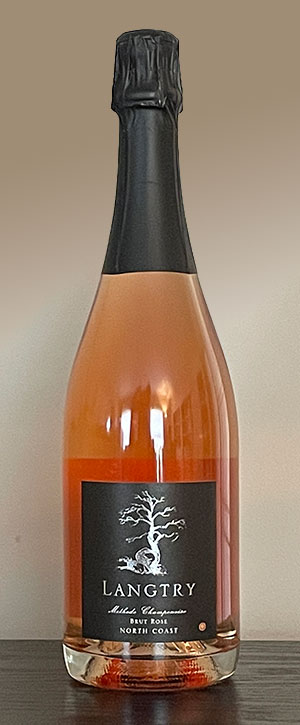
Langtry Brut Rosé
Langtry Brut Rosé Click here for tasting notes.

Langtry Brut Rosé

The Guenoc Valley in California is east of San Francisco, and just south of the far eastern edge of the East Bay.  Situated in Lake County, grapes were planted there in 1854, and as soon as 1884 it hosted 600 acres under vine.  Its fertile fields attracted a number of individuals who dabbled in wine to a greater or lesser extent, including the legendary actress Lillie Langtry.

The 23,000 acre (9,300 ha) Guenoc Valley is a small inland alluvial fan of Arroyo Seco and Conejo loam soils which are isolated from surrounding areas by rocky ridges. Hot days are common in the region and over-ripening is a constant concern. The area also has very cool nights, making it a Climate Region III.  The Guenoc Valley AVA was approved in 1981.

Lillie Langtry was born Emilie Charlotte Le Breton in 1853 to William Le Breton, a Church of England minister and his wife, Emilie Davis Martin Le Breton.  Lillie was the only daughter in the family of six sons. Her father was a very handsome and cultured man; her mother as beautiful as her daughter would become. They lived on the on the Isle of Jersey, one of the islands that lie in the English Channel . Continue reading “Langtry Brut Rosé”

H. Billiot Brut Rosé

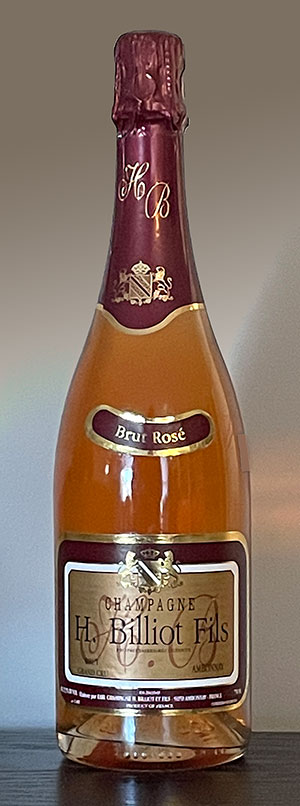
H. Billiot Brut Rosé
Click here for tasting notes.

Ambonnay, one of the top five Grand Crus in Champagne, is located in the heart of the Côte des Noirs, on the southern slopes of the Montagne de Reims. Its hillsides are renowned for the richness of their Pinot Noir and Chardonnay, the two essential Champagne grapes.

In 1896  Eugene Billiot, a miller by profession in Ambonnay, purchased five acres of land and planted vines. The grapes were sold to major Champagne brands throughout the region.  Today, the grape varieties of the vines are around 75% Pinot Noir and 25% Chardonnay.

Champagne Billiot was established in 1937 by Louis Billiot as more of a side hustle than a real Champagne house.  But after the war, his son Henri founded Champagne H.Billiot & Fils at 1 place de la Fontaine in the center of the village to realize his dream of becoming a winemaker rather than just a grower.  Henri was succeeded by his son Serge, and now fifth-generation Laetitia runs the operation.

Current production is about 32,000 bottles a year, with all of the work being done by the family. Continue reading “H. Billiot Brut Rosé”