Aperture Red Blend 2022 Review

Aperture Red Blend. <a href="#taste">Click here for tasting notes.</a>
Aperture Red Blend. Click here for tasting notes.

Aperture Cellars is a Sonoma County winery that combines Bordeaux-inspired winemaking with California’s generous fruit character. Its reputation rests largely on Cabernet Sauvignon, Bordeaux varieties, and carefully constructed red blends. The winery’s Aperture  Red Blend 2022 is particularly interesting because Aperture aims for wines that deliver richness and concentration without sacrificing structure, freshness, or balance.

The winery and its background

Aperture Cellars was founded by winemaker Jesse Katz, who developed his winemaking skills through work in California and abroad, including experience at prestigious estates.

Photo of winemaker Jesse Katz. Photo: Wine Business
Jesse Katz. Photo: Wine Business

His father is the renowned photographer Andy Katz, whose photography inspired the winery’s name and visual identity. The concept of an aperture—the opening through which light enters a camera—connects photography with the art of winemaking.

Jesse Katz has established himself as one of the most accomplished winemakers of his generation, earning recognition on Forbes’ 30 Under 30 list, Wine Enthusiast’s 40 Under 40 Tastemakers, and Wine Spectator’s Rising Star designation. He also made winemaking history by producing the first California Malbec to receive a perfect 100-point score.

His impressive credentials include experience at some of the world’s most prestigious wineries, among them Château Pétrus in Bordeaux, Screaming Eagle and Robert Foley in Napa Valley, and Viña Cobos in Argentina. Beyond his distinguished résumé, Katz has earned a reputation for skillfully managing challenging vintages, producing wines that retain their balance, structure, and character even when growing conditions are less than ideal as they were in 2022.

In 2016, Aperture Cellars acquired a historic 42-acre vineyard in Healdsburg, California, establishing what would become the Aperture Estate. The property, where grapevines were first planted in 1912, is now home to a 24,000-square-foot, state-of-the-art winery and a 4,000-square-foot hospitality center, both designed by Signum Architecture.

Photo of the Aperture Cellars hospitality center.
The Aperture Cellars hospitality center. Photo: bloomberg.com
The estate’s striking architecture reflects Aperture’s commitment to environmental sustainability while celebrating the connection between winemaking and photography. Inspired by the aperture of a camera, the buildings feature dramatic angles, clean lines, and abundant natural light. The result is a distinctive architectural expression of the creative partnership between  Jesse Katz and his father.
Photo of the interior of the Aperture Cellars hospitality center.
Interior of the Aperture Cellars hospitality center. Photo: bloomberg.com

Aperture’s winemaking philosophy emphasizes selecting vineyard sites that allow each grape variety to express its character. The wines tend to be polished, concentrated, and approachable, but are intended to retain the acidity and tannic structure necessary for complexity..

Aperture Red Blend 2022

The 2022 vintage is a particularly interesting composition because Malbec, rather than Cabernet Sauvignon, is the leading variety. The blend is Malbec 36%, Cabernet Sauvignon 35%, Merlot, 24%, Petit Verdot 3%, and Cabernet Franc 2%, an unusual composition for a California Bordeaux-style blend. It was aged for 18 months in 50% new French oak. The wine was bottled unfined, unfiltered, and without acidification.

The wine is a not quite opaque garnet. The nose offers plum, blueberry and a bit of cherry.  These continue on the palate, plus some cocoa, bolstered by snappy acidity and cozy tannins. There is a little sweetness on the entry, This increases somewhat as the bottle is emptied, but never gets out of control. The finish is medium long. Production was approximately 8,470 cases. ABV is 14.5%.

Serving at 62–65°F and giving it approximately 45 to 60 minutes in a decanter. A grilled ribeye, roast lamb, or beef tenderloin with a red wine reduction would make an excellent accompaniment.

Aperture web site

Anchored Roots “The Summit” 2018 Review

Anchored Roots "The Summit" Red Blend 2018.
Anchored Roots “The Summit” Red Blend. Click here for tasting notes.

Anchored Roots “The Summit” 

Eric and Amy Gale are the owners and sole full-time employees of Anchored Roots, Door County, Wisconsin’s newest winery, founded in 2020.

The couple make an ideal front-of-house/back-of-house duo. Amy grew up in Milwaukee, with hospitality at the forefront of her career path. Her initial focus was event planning, from non-profit fundraisers and catering, to corporate events and weddings. This was followed by experience in tasting room management at Airfield Estates in Prosser, Washington.

Continue reading “Anchored Roots “The Summit” 2018 Review”

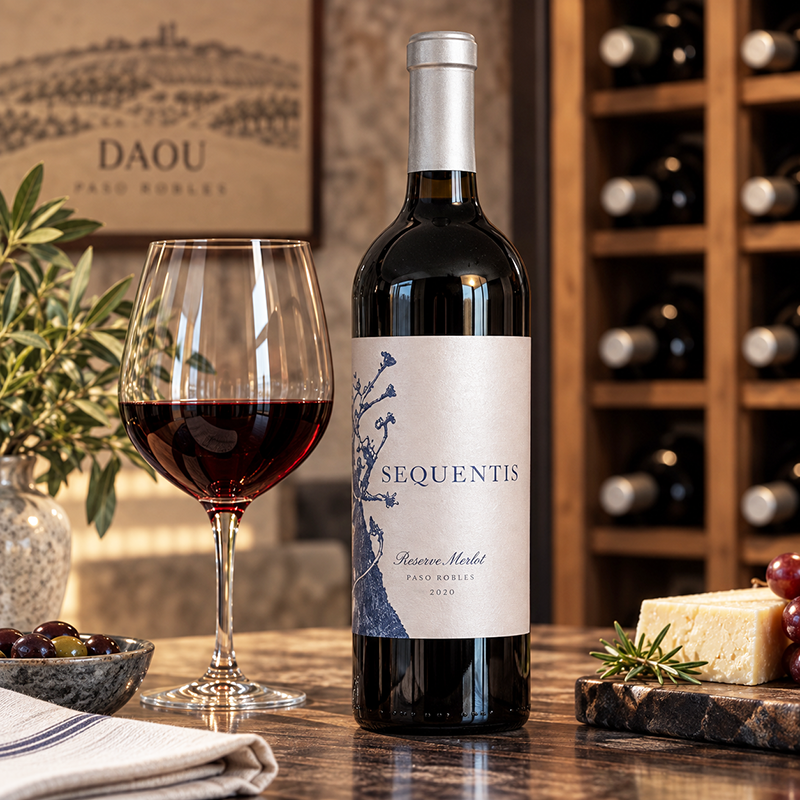
Sequentis Reserve Merlot 2020 Review

Daou Sequentis Reserve Merlot 2020 <a href="#taste">Click here for tasting notes.</a>
Daou Sequentis Reserve Merlot. Click here for tasting notes.

Daou Sequentis Reserve Merlot 

In the vast tapestry of California’s wine country, the story of Daou Family Estates stands out as a unique and compelling chapter. Born from the dreams of brothers Daniel and Georges Daou, this family-owned winery in Paso Robles has become a force to be reckoned with in the world of Cabernet Sauvignon and Bordeaux-style wines.

Continue reading “Sequentis Reserve Merlot 2020 Review”

Simon Creek Winery

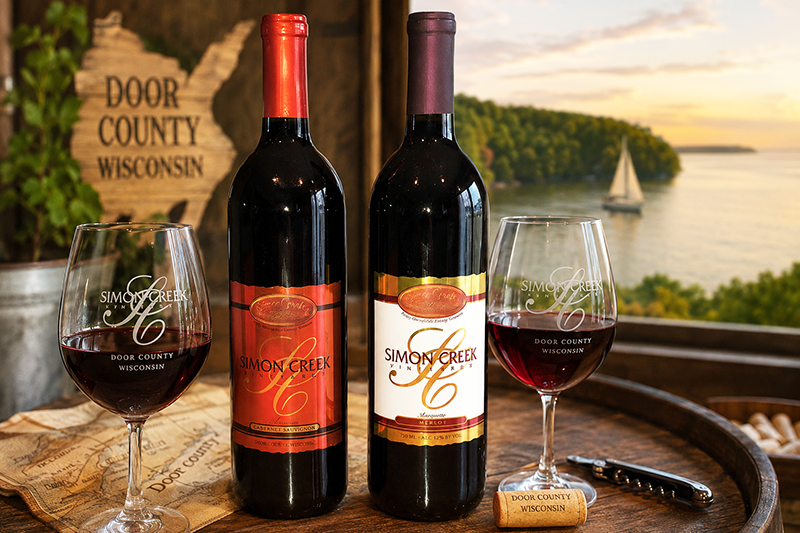
Simon Creek Cabernet Sauvignon NV and Simon Creek Merlot NV.
Simon Creek Cabernet Sauvignon NV and Simon Creek Merlot NV. Click here for tasting notes.

Simon Creek Winery

Wisconsin native Thomas J. (Tim) Lawrie had a 26-year career in the U.S. Army, including two tours in Vietnam as a combat officer, and was awarded the Purple Heart. He served as an Army Infantry Airborne soldier before finally retiring with the rank of Colonel. After which, he was almost universally referred to as, “The Colonel,” a somewhat surprising affectation for a Northerner, I think. As with most military personnel, he had assignments throughout the country, including California, where he acquired an interest in wine and wine production. Continue reading “Simon Creek Winery”

Lockwood Vineyard

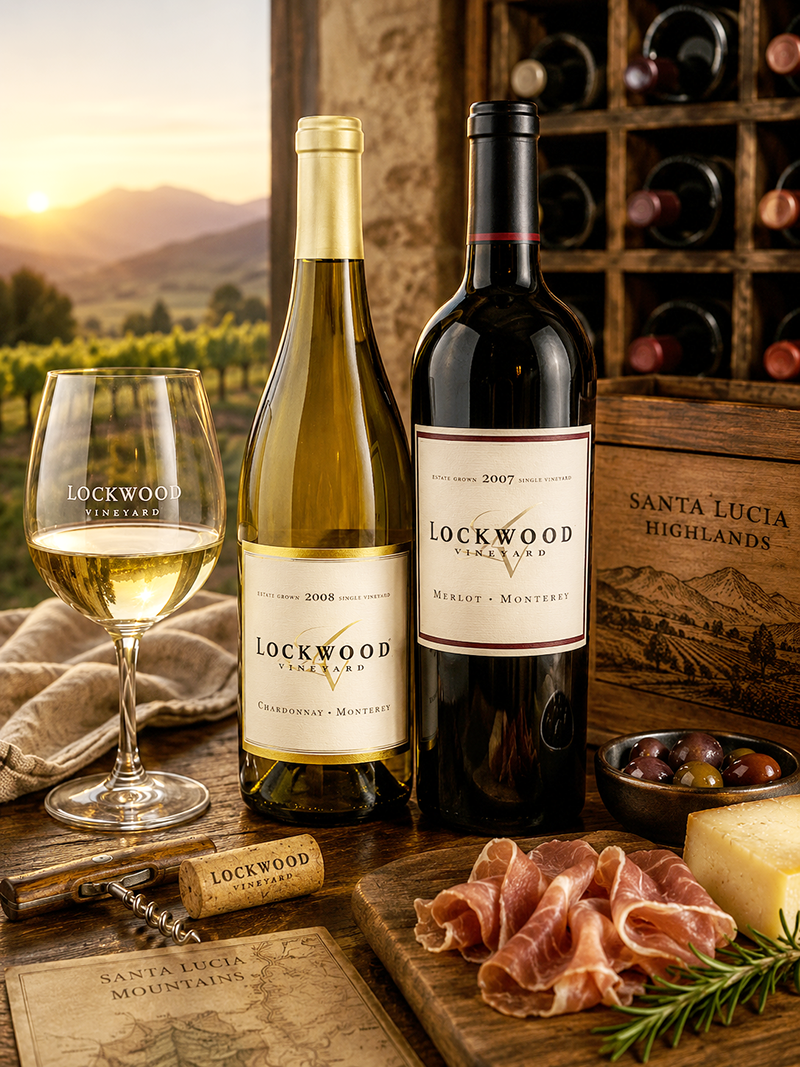
Lockwood Monterey Chardonnay 2004 and Lockwood Monterey Merlot 2002,
Lockwood Monterey Chardonnay 2004 and Lockwood Monterey Merlot 2002, Click here for tasting notes.

Lockwood Vineyard was founded in 1989 by Paul Toeppen, Phil Johnson, and Butch Lindley as a single, contiguous, 1,850-acre vineyard (one of the largest premium estate vineyards in the world) located in southern Monterey County, not far from Monterey Bay. Lockwood exclusively produces “estate” wines. This means that all of their wines come from grapes grown in their own vineyards, and are then fermented, matured, and bottled at the winery on-site.

Nestled at the base of the Santa Lucia mountains, the vineyard soil consists of “shaly loam,” a well-drained, calcareous “chalk-rock” found in only two small areas of Central California. Because the soil has a low nutrient and mineral content, the vines must work hard for survival. In the hands of a skilled winemaker, this struggle of the vines can result in some of the best and most interesting wines.

Such a winemaker is Thane Knutson, who was born and raised on the plains of Oklahoma. He took a degree in International Business from the University of Oklahoma, while he made wine in his dorm room closet and worked in the cellar of a local winery in Slaughterville, Oklahoma.

Thane Knutson
Thane Knutson

After college, Knutson moved out to Napa Valley and interned at Cakebread Cellars.  He then spent two years at Hess Collection Winery as the laboratory technician before joining Raymond Vineyards just two weeks before current Lockwood Vineyard owner Jean-Charles Boisset made his entrance.  At Boisset Collection, Knutson was promoted from Laboratory Technician, to Enologist, and finally to Lockwood Winemaker.

Knutson’s experience with Hess and Raymond inspired his passion for cool weather varietals and innovative winemaking.

Lockwood Monterey Merlot 2002

Sideways notwithstanding, this wine shows that a well-made Merlot can be flavorful and satisfying. This one opens with aromas of strawberry, raspberry and cherry.  It features plenty of concentrated fruit supported by touches of  mint, spice, pepper, and soft tannins.  It is deep purple in color and has a moderately long finish.

Pair with not-too-spicy pork or poultry dishes.

Lockwood Monterey Chardonnay 2004

Looks can be deceiving; although very pale in the glass, this wine greets you with aromas of green apple, citrus, and mineral notes.  It is extremely well balanced on the palate, with flavors of honeysuckle and passion fruit. That hint of initial sweetness quickly yields to a firm acidity and a restrained French oak backbone.

lockwoodvineyard.com/

Back to blog posts: winervana.com/blog/

Sonoma Vineyards

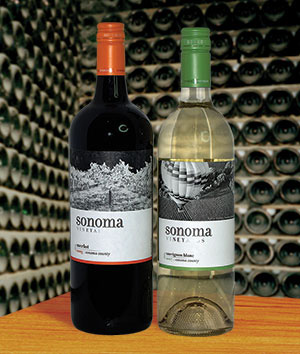
Sonoma Vineyards Sauvignon Blanc and Merlot

Sonoma Vineyards

Tom Klein graduated from Stanford Graduate School of Business in 1979, and established a career as a management consultant. In 1985, Klein received an assignment to evaluate the business of Rodney Strong Vineyards. He liked what he saw, and in 1989 he and his family purchased the winery.

Continue reading “Sonoma Vineyards”

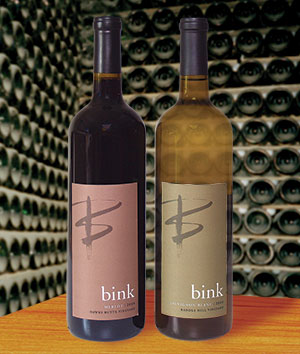
Bink Wines

Bink Wines

The unusually-named Bink Wines is owned and operated by two women, which is also rather unusual (but becoming less so).

Fourth-generation-Californian Cindy Paulson grows the grapes, while also maintaining her day job as an environmental engineer (she earned a doctorate in environmental engineering at Colorado University at Boulder). Her farming philosophy is deeply rooted in sustainable practices, coming from her environmental background and love of the outdoors.

Deb Schatzlein makes the wines. This Connecticut native is known as a fun-loving free spirit; her grandparents set the mold early, making gin in their bathtub during Prohibition. She has degrees in chemistry (with an early career as a chemical engineer) and biology, and has taken extensive coursework in viticulture and enology.

And that name? It’s a contraction of ‘black ink,’ the color characteristic of their red wines.

Bink Randle Hill Vineyard Sauvingon Blanc 2008

This all-stainless-steel 100% Sauvignon Blanc is unfiltered. Consequently, this pale-yellow wine can pour out cloudy, without the crystal-clear appearance most consumers expect. To avoid this, let the bottle rest upright for an hour or so, and decant carefully. Or, if you insist on transparency, you could pour it through a paper coffee filter; unorthodox, and it may strip out some of the flavor nuance, but it works.

This wine’s birthplace, the 13-acre Randle Hill Vineyard, is certified organic, and yielded a small production of 350 cases.

The wine opens with delicately sweet honeysuckle and mango flavors, which then lead to a body featuring grapefruit notes and a supportive minerality.

Serve with Red Chile-Honey Glazed Salmon, BBQ Marlin with Avocado Vinaigrette, or Rum-Brown Sugar-Glazed Shrimp with Lime and Cilantro.

Bink Hawks Butte Merlot 2006

The Hawks Butte vineyard is part of the Yorkville Highlands Appellation, and is located mid-way between the small California towns of Yorkville and Boonville. It is 1200 feet above sea level and 35 miles inland from the Pacific coast. The rocky soils and southern exposure of the vineyard make for high-quality but low-yield vines, providing only enough juice to make 150 cases of this wine.

It was aged for 22 months in 30%-new and 70%-old oak barrels.
As is to be expected of Bink, the color is deep garnet in the glass. The nicely full palate features black currant and stone fruits, supported by somewhat forward tannins and some spice. This Merlot is an excellent value.

Enjoy this substantial wine with Balsamic-Marinated Flank Steak, Asian-Spice Rubbed Pork Chops, or Burgers with Cheddar Cheese and Horseradish Mustard.

Unfortunately, Bink Wine closed permanently in 2017. There is now a totally unrelated Bink Winery in Australia. 

Back to blog posts: winervana.com/blog/