
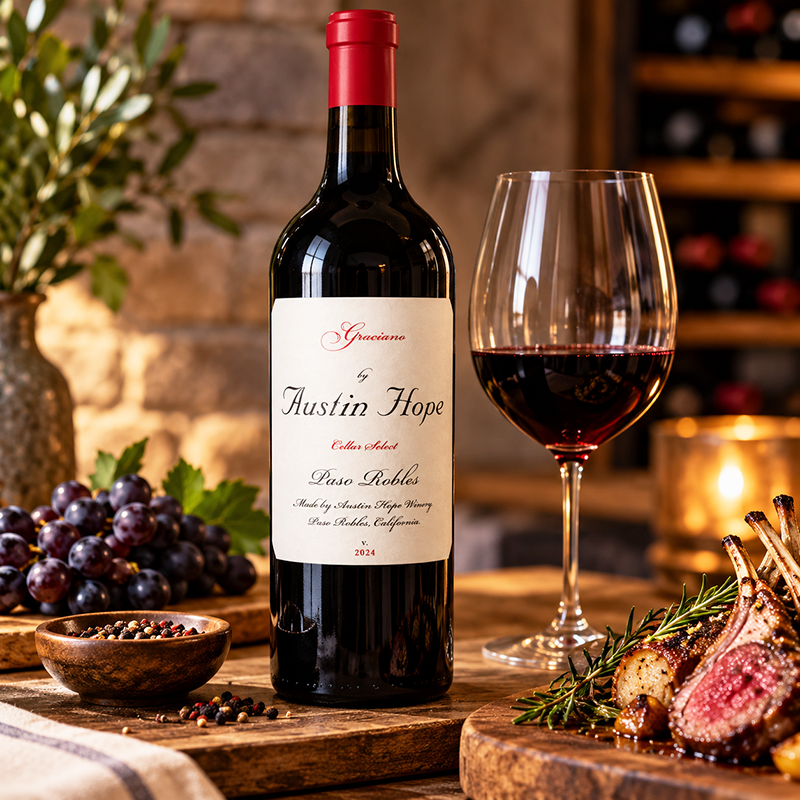
Austin Hope Graciano is an unusual Paso Robles red made from a Spanish grape variety rarely encountered in California. Part of Hope Family Wines’ limited-production Cellar Select collection, it offers concentrated dark fruit, vibrant acidity, and substantial tannins. Its origins involve a vineyard planting mistake that turned into a fortunate discovery.
Throughout the 1980s and 1990s, the Hope family grew grapes for various wine producers. In the 1980s, the Wagner family, owners of Napa Valley’s Caymus Vineyards, turned to the Hope family to source Cabernet Sauvignon grapes for their Liberty School label. Thus began a long-lasting partnership between the two families.
Since that beginning, in Paso Robles specifically and throughout the region generally, Hope Family Wines has built long-standing relationships with over 50 growers. They coordinate with farmers to carefully limit crop yields to ensure concentrated flavors.
In 1996,the Hopes acquired Liberty School from the Wagners. Also in 1996, they launched Treana Winery with Chris Phelps serving as winemaker.
At about this same time, while studying fruit science at California Polytechnic State University, San Luis Obispo, the Hope’s son Austin spent some time working in Napa Valley under Caymus winemaker Chuck Wagner. This opportunity solidified his decision to pursue winemaking for his family. He became the head winemaker in 1998, and has held the position ever since. Since taking the lead as president and winemaker, Hope has helped Hope Family Wines grow from producing around 20,000 cases per year to over 300,000 cases per year.
In 2000, the family started a limited-production label, Austin Hope (surprise!), focused exclusively on Rhone varietals grown on the family’s estate vineyard, based on the calcareous loam, marine sediment, and dense clay soil of the Templeton Gap, which has the coolest microclimate in Paso Robles. It closely matches the climate of the Rhône Valley in France, as well as Napa’s acclaimed Rutherford district. The winery’s now-mature vineyards produce Cabernet Sauvignon, Syrah, Merlot, Mourvèdre, and Grenache.
In 2008, the winery introduced Candor Wines, a multi-vintage label focusing on Zinfandel and Merlot wines with fruit sourced from family-owned vineyards in Santa Barbara, Paso Robles, and Lodi. It introduced its second multi-vintage blend, named Troublemaker, in 2010.
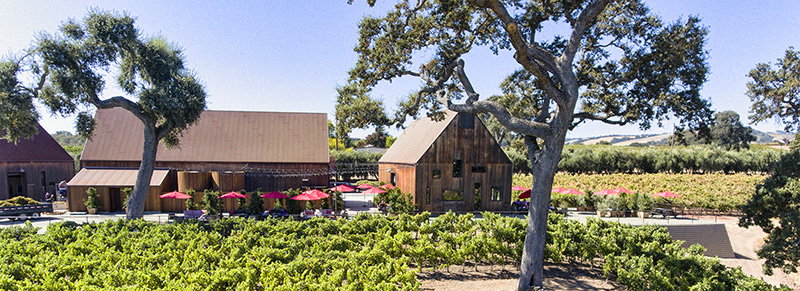
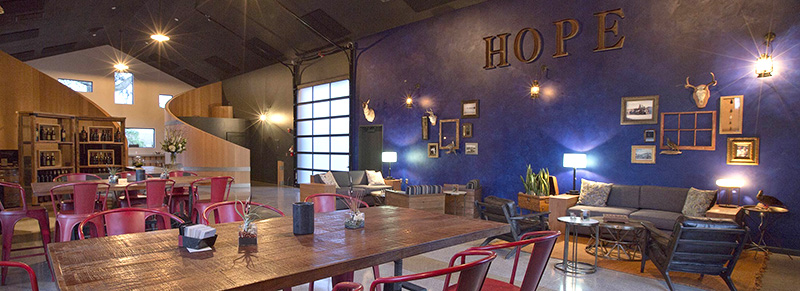
Hope Family Wines is committed to sustainable growing practices that promote vine health, improve wine quality, and ensure that growers remain profitable. Spraying is only done when necessary, and never after August first. The number of tractor passes is kept to a minimum, protecting the integrity of the root structures and avoiding compacting the soil. The winery works actively to promote best practices in the vineyards of growers they partner with. They use the self-assessment tools put together by the Wine Institute and the California Association of Winegrape Growers to gauge progress and identify areas for improvement over time.
Austin Hope Graciano 2024
Graciano is a high-quality red-wine grape grown in the Rioja and Navarra regions of Spain (aka Morrastel in France). Its sparse yields, however, are causing it to lose popularity among growers in both nations. It is even more uncommon in California.
In Paso Robles, some vineyards had been planted with what growers believed was Mourvèdre, only to discover later that the vines were actually Graciano. Hope Family Wines calls this the “happy accident.” Austin Hope liked what he found enough to begin making varietal Graciano, and it developed into one of the winery’s small-production Cellar Select wines.
This wine pours a deep, saturated ruby-purple, nearly opaque at the core, with a youthful violet edge. The nose opens with violets, black cherry, ripe blackberry, with a hint of violets, followed by dark plum. These continue on the palate, especially the black cherry. The naturally assertive acidity gives it considerable lift, with a modest vanilla/oak sweetness underneath. There are plenty of solid tannins. The finish is long and smooth, with black cherry, plum, pepper, and spice lingering after the fruit recedes. If opening a young bottle, definitely give it some air—perhaps 45 to 90 minutes in a decanter. The ABV is 14.5%.
Pair this delicious wine with lamb chops, grilled skirt steak, duck, pork with a dark fruit or pepper preparation, beef short ribs, or Spanish-style dishes involving chorizo and smoked paprika.
https://www.hopefamilywines.com/
Back to blog posts: https://winervana.com/blog/