
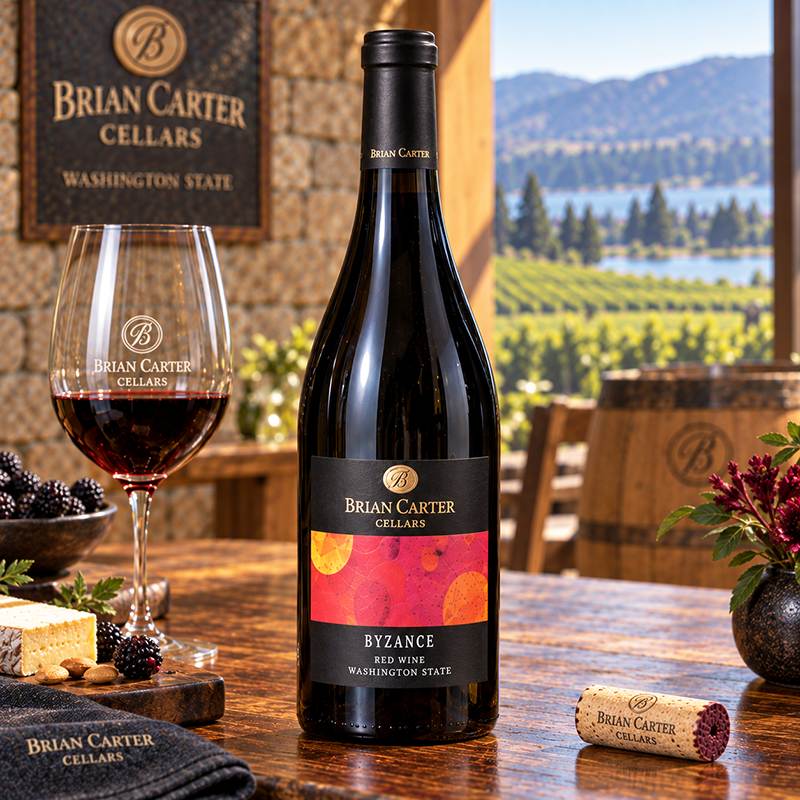
Brian Carter Cellars Byzance 2014
“I came into the field of wine [at a young age], not because my parents were wine drinkers, but because I was given a microscope when I was 12 years old. I heard about these things called yeast, and I wanted to see what they looked like under a microscope. I was told if you want to look at yeast you have to start a fermentation. So I picked some blackberries, fermented the wine, took a sample, and brought out my microscope — and there they were — the little yeast. I’ve been having those yeast work for me ever since.” — Brian Carter
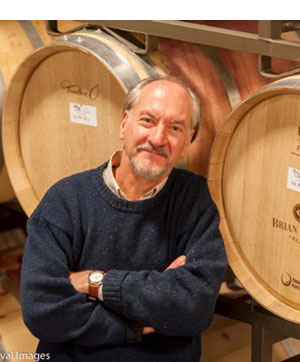
A charming tale of a precocious young scientist, no? There was just one small problem: before he got to actually inspect the yeast, during a robust fermentation that first blackberry wine exploded in his mother’s kitchen. “There was a big stain on the ceiling for a couple of years, until it finally got painted,” Carter admitted. History hasn’t recorded whether that chore fell to Carter or someone else.
Born in New Mexico, Carter grew up in Corvallis, Oregon. Those initial studies with his microscope led to him to taking an undergraduate degree in microbiology from Oregon State. While there, he also took an independent study course on winemaking that involved visiting some of the Willamette Valley’s first wineries.
The next stop, as it is for many winemakers, was the University of California at Davis. After a few years of apprenticeship, Carter’s 1983 Cabernet Sauvignon beat a 1983 Chateau Lafite-Rothschild at a 1986 blind tasting at Windows on the World restaurant in New York City.
Carter would go on to become one of the leading lights of Washington state’s nascent wine industry.
As a consultant, he helped launch a number of wineries, including Silver Lake, McCrea and Camaraderie. He was the first winemaker for Hedges Cellars. And he partnered with Harry Alhadaf to start Apex in 1990.
By 1997 it was finally time to start making wines under his own name, and he established Brian Carter Cellars in Woodinville, Washington. He released his first wines in 2000 with a production of just 80 cases. At Brian Carter Cellars, he has exclusively focused on classic European-style blends, taking inspiration from France, Italy, Spain, and Portugal. Indeed, the vanity license plate on his Prius reads “BLENDS.”
Accolades (some of them, anyway)
Carter is the only three-time winner of Grand Prize at the (now defunct) Pacific Northwest Enological Society (aka Seattle Enological Society) Competition. Carter was twice touted as “Winemaker of the Year” by Seattle Magazine. He was the Honored Vintner at the 2007 Auction of Washington Wines, and he received the prestigious Industry Service Award from the Washington Association of Wine Grape Growers. In 2015, Wine Press Northwest selected Brian Carter Cellars as its Washington Winery of the Year, In 2018, the Northwest Wine Summit named Brian Carter Cellars as the Winery of Distinction. The Washington Winegrowers Association honored Carter with the 2020 Grand Vin Award, recognizing him for “his significant impact and the contributions he has made to the Washington wine industry during the past 41 years.”
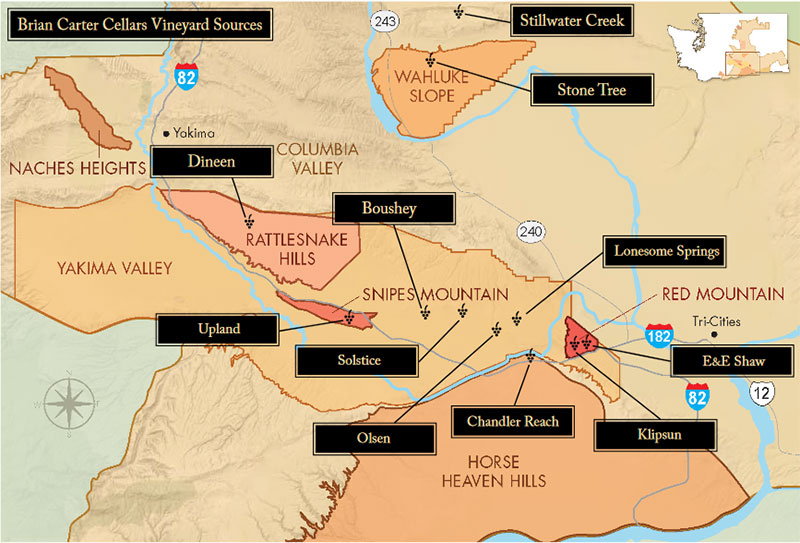
The Vineyards
the Art of Blending
Carter asserts that he didn’t set out to be a blender, but rather, the approach came from his knowledge of science and agriculture, and one that grew into a true passion. In fact, ” A Passion for the Art of Blending” is a trademark of the winery. He noted, “I find the blending process to be the most artistic part of the winemaking process, and the most fun!” In 2006, Carter released his full line of blended wines, and Brian Carter Cellars became the first winery in Washington dedicated exclusively to producing blends. Also, Carter enjoys giving his selections whimsical names.
Brian Carter Cellars Byzance 2014
Byzance, aka Byzantium or Byzantion, was an ancient Greek city in classical antiquity that became known as Constantinople in later antiquity and Istanbul today. Or, the label on the bottle says Byance is French for “luxurious.” Two translations on the interwebs came up with De Luxe and Luxeux instead.
Inspired by the reds of France’s southern Rhône Valley, this wine is composed of 54% Grenache, 24% Syrah, 15% Mourvedre, 4% Counoise, and 3% Cinsault. Both of the latter are often used in French blends.
The blend spent 22 months in large ( 500L) French oak barrels, of which 20% were new and 80% were neutral (used). It is a semi-transparent garnet, with medium aromas of dark fruit. The palate features blackberries, dark cherries, and a hint of herbes de Provence, complemented by plenty of acidity and tannins, but all is in excellent balance. It wraps up with a medium finish. The ABV is 14.5%, and 316 cases were produced.
Back to blog posts: winervana.com/blog/