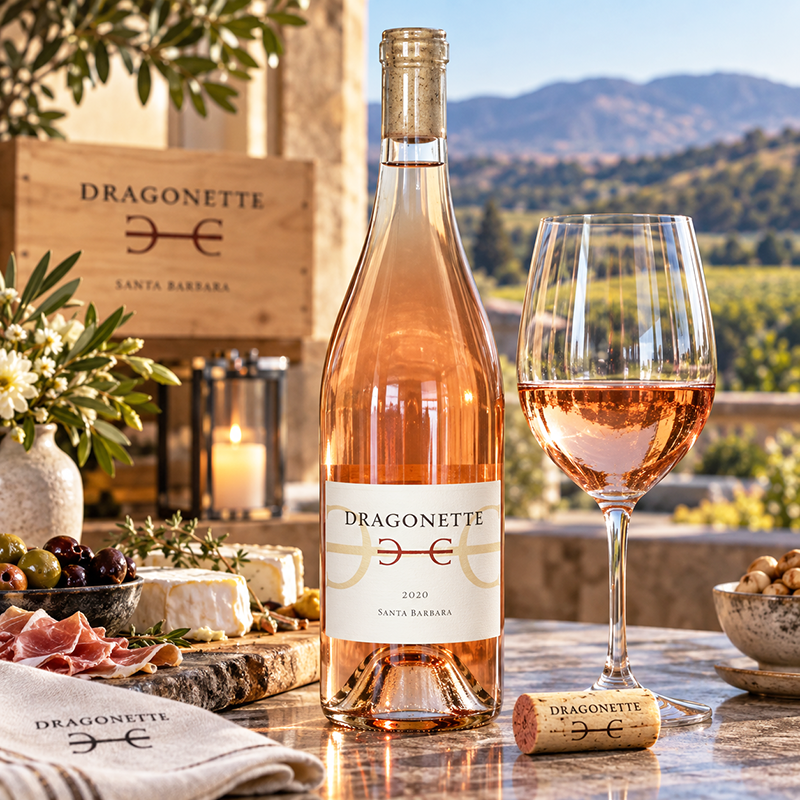
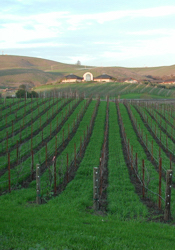
The brothers Dragonette (John, the elder, and Steve, the younger) and close friend Brandon Sparks-Gillis, after having met and worked together at Wally’s, a renowned wine shop in Los Angeles, founded Dragonette Cellars in 2005. They did so in the climatic and soil diversity of the wild, windy, and remote northern Santa Barbara County.
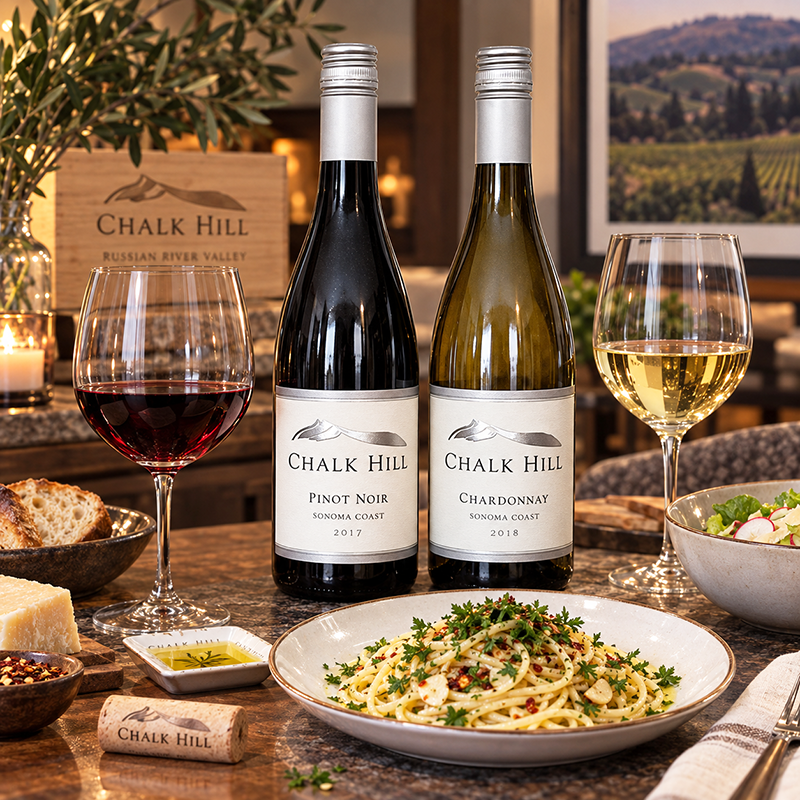
I’m obviously a wine enthusiast, and with my wife will drink all or most of a full bottle of wine with dinner just about every night. However, you may enjoy less wine with your meals. If so, consider 375 mL half bottles. They are also handy if you want a red and your companion wants a white, like the two shown here. Half bottles are also convenient for picnic outings. And, empty half bottles are great for storing leftover wine; just fill the half bottle as close to the top as you can, reseal it (easily done if the closure is a screw cap), and park it in the refrigerator.
Saké is often called rice wine, but that is a misnomer. While it is an alcoholic beverage made by fermentation, the production process more closely resembles that of beer, and it is made from grain (rice, of course), not fruit. To make saké, the starch of freshly steamed glutinous rice is converted to sugar and then fermented to alcohol. Once fermented, the liquid is filtered, heated, and placed in casks for maturing. Sakés can range from dry to sweet, but even the driest retain a hint of sweetness.
You can read more about the history of saké and the specifics of its production here.
Kiku-Masamune Saké Brewing was founded in 1659, when Japan was ruled by Ietsuna, the fourth Tokugawa shogun. Unusual among saké producers, Kiku-Masamune’s entire product line is classified as dry.
Things began when the Kano family built a saké brewery at their residence. At the time, the Nada region in Kobe, Japan, where they lived, had not yet become well known for its saké, but the subsequent popularity in Tokyo of saké from Osaka and Kyoto, known as kudarizake, led to a rapid surge in demand for saké from the Nada area.
During the Meiji period (1868 to 1912), Jiroemon Kano, the eighth head of the family, pioneered improvements in technology and other initiatives to increase the quality of their saké in the service of the ideal of “doing whatever it takes to create a better saké.” It was during this period that the Kiku-Masamune brand was registered as a trademark.
From the Meiji period to the Taisho period (1912 to 1926), the company increased overseas exports and served as a purveyor to the Imperial Household Agency, an arm of the government of Japan in charge of state matters concerning the Imperial Family, and also the keeping of the Privy Seal and State Seal of Japan.
The brewery managed to survive the hardships of the tumultuous Showa period (1926 to 1989), which included the rise of militarism in Japan; Japanese aggression in China and elsewhere in east and southeast Asia; World War II and Japan’s defeat; and the post-war struggle to rebuild, which ultimately succeeded, and spectacularly so.
Just four years after the end of the war, a 1949 opinion survey conducted in six of Japan’s largest cities by a brewing-industry newspaper asked respondents to identify the saké brands they preferred to sell and the brands that they believed offered a particularly high level of quality. Kiku-Masamune took top place in three cities and led in the overall results. The company Is headquartered in Kobe, Japan, where it began, with four additional branch offices.
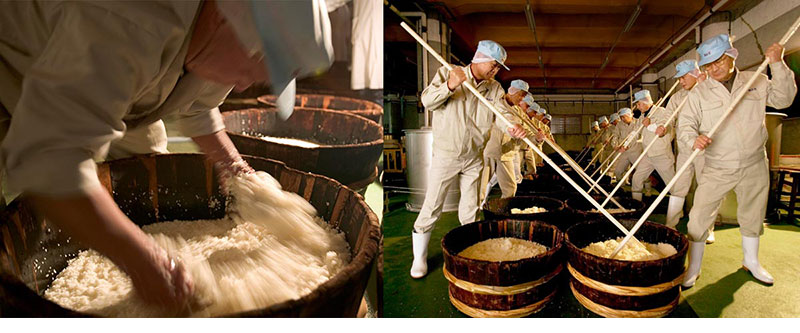
Kiku-Masamune uses one of the oldest production regimens, called “kimoto.” This approach originated during the Edo period in the late 17th century. In the kimoto method, a combination of rice, water, and koji (the mold that drives fermentation) is added to small tubs and then mashed into a paste by brewers using a special pole. This is done with two workers to a tub, standing at opposite ends and alternating sides as they stir. In this ancient tradition, the brewers sing rhythmic songs in order to work in unison and keep the poles from clashing. Some songs are from whatever brewing guild the toji (Master Brewer) belongs to, and some are specific to the brewery itself. Due to the fact that this approach, which takes four weeks from start to finish, consumes about twice as much time and effort as other methods, only a very few of the more than 1,000 saké breweries in Japan employ it.
Three Ingredients
At its most basic, only three ingredients are needed to make saké: water, rice, and koji. Because of this simplicity, the kinds of water and rice play major roles.
Miyamizu is well water drawn from a particular area beneath Nishinomiya City, and is one of the reasons Nada saké became nationally famous. This water contains almost no iron, yet is rich in minerals such as calcium, potassium, magnesium, and phosphorus. The mineral content provides nutrition for the koji as well as a variety of other microbes, and drives a robust fermentation.
Kiku-Masamune has long used only Yamada-nishiki brewer’s rice . This rice, grown specifically for saké, is characterized by a larger grain size than normal rice varieties, low protein content, and a soft consistency that allows the koji to more easily penetrate the rice.
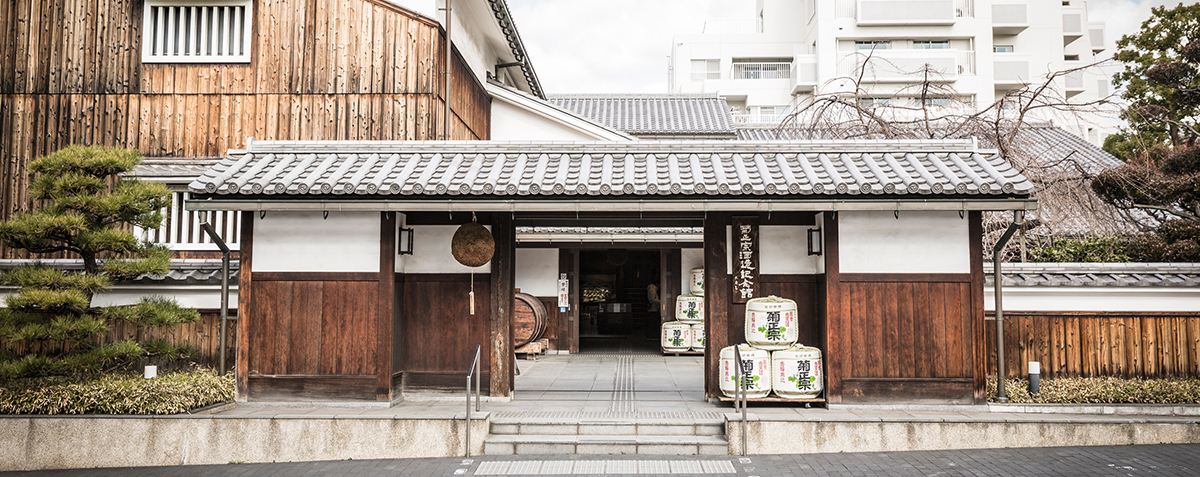
The Kiku-Masamune brewery.
Kiku-Masamune Junmai Taru Saké
Saké classified as Junmai has no added alcohol. Until recently, at least 30% of the rice used for Junmai saké had to be milled away, but Junmai no longer requires a specified milling rate.
Taru saké is matured in barrels made of Yoshino cedar. Ideally, the saké is drawn from the barrel and bottled just as the resulting cedar aroma reaches its peak.
Two tokkuri bottles are on the upper right. The wooden box is called a masu and is made of cedar. It is a traditional saké cup.
A tokkuri is traditionally used for serving. The saké is transferred from the original bottle to the tokkuri, then poured in the drinking vessel. The tokkuri can be immersed in warm water for heating; the bit of twine at the neck is used to pull the bottle out of the warm-water bath. The Kiku-Masamune Taru Saké bottle imitates a tokkuri. This saké is also available in the more-usual tall green bottle.
Both in the nose and on the palate, this crystal-clear saké predominately features aromas and flavors of melons. There is less cedar character than I expected (disappointingly), and it is nicely dry. The mouthfeel is smooth and approachable. It can be served chilled, which I recommend, at room temperature, or at Nurukan temperature (about 113 degrees F.). ABV is 15%.
The SMV (Saké Meter Value) measures the density of saké relative to water, and is the method for gauging the dryness or sweetness of saké. The higher the SMV, the drier the saké. The range is from -15 (sweet) to +15 (dry), and this one comes in at +5.
A winemaker, Nicole Walsh of Ser Winery, recently recommended a wine to me. And I thought, “If a winemaker recommends someone else’s product, it must be worth seeking out.” That wine? Hedges Family Estate Red Mountain Syrah.
Saké, the national alcoholic beverage of Japan, is often called rice wine, but this is a misnomer. While it is a beverage made by fermentation, the production process more closely resembles that of beer, and it is made from grain (rice, of course), not fruit.
To make saké, the starch of freshly steamed glutinous rice is converted to sugar and then fermented to alcohol. Once fermented, the liquid is filtered and usually pasteurized. Sakés can range from dry to sweet, but even the driest retain a hint of sweetness.
In 1711, the Manryo brewery, was established by the first Chobei Osakaya of the Osabe family in Imazu, Nishinomiya City, Hyogo Prefecture. This is a significant saké production region , and the head office is still located there. The famous water found here is known as Miyamizu, groundwater originating in the Rokko mountain system. The region is also ideal for rice production, including Yamada-nishiki, a renowned saké rice.
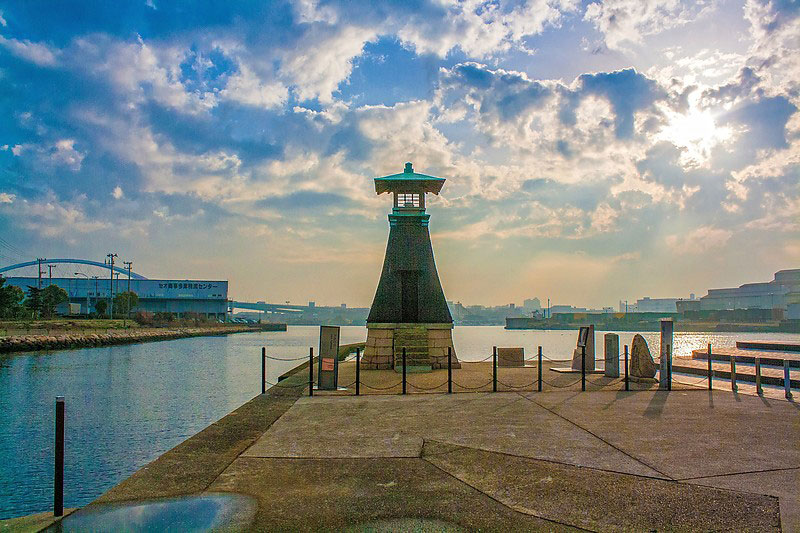
In 1810 the fifth-generation owner of Manryo built a lighthouse to help guide home the ships that had delivered Manryo’s products to Edo, as Tokyo was then known. The Imazu lighthose has been an important cultural edifice in Nishinomiya ever since. In 1984 it underwent an extensive restoration.
The Imazu lighthouse.
In 1884 the company was rebranded from Manryo to Ozeki. The name originates from the world of sumo wrestling, where the grand champion was originally known as the Ozeki (now the second highest rank). Additionally, odeki is Japanese for ‘good job.’ Because it sounds similar to ozeki, this was intended to motivate the production of good saké. As sumo was becoming popular in the late 19th century, it exemplified many of the ideas that were considered important for success, including strenuous hard work and technical skill. Ozeki aimed to build the brand through these concepts, just like winning sumo wrestlers try to do.
Ozeki’s facilities were destroyed by fire due to a WWII air raid in 1945, but were rebuilt following the end of the war. In 1966, Ozeki introduced a saké vending machine, something we will never see in the United States! They entered the U.S. market in 1979 by establishing Ozeki San Benito Inc. in Hollister, California. The company celebrated 300 years in business in Japan in 2011,
Ozeki Karatamba Saké
Like my wines, I prefer my sakés to be dry. Karatamba is one of the driest I have found, with a Sake Meter Value* of +7. The ABV is 15.5%, and the polish rate** is 70%.
Karatamba (Dry Wave) is brewed and bottled in Japan. It is a honjozo saké. This classification, one level up from the most basic, is made with better-quality rice, and a higher proportion of the alcohol is produced during fermentation rather than being added (a characteristic of honjozo). Also, Karatamba attains its dryness level by the added alcohol; it would be difficult to do so without it.
Predictably, this saké is crystal clear. The nose offers up melon and lychee. These continue on the palate (without the tartness) plus some caramel richness and perhaps a hint of maple syrup. It has a round smooth mouthfeel ending in a pleasant soft finish.
*An important gauge of saké is the SMV (Saké Meter Value). This measures the density of saké relative to water, and is the method for determining the dryness or sweetness of saké. The higher the SMV, the drier the saké. The range is -15 to +15.
**The rice used in saké is called “saka mai” in Japanese, and it is not the same type of rice used for eating. The grains are larger than food rice, contain more starch, and less protein and fat. The rice is first milled, aka “polished,” to remove the outer layer that could cause off-flavors in the finished product. Typically, this will be 25 to 70%, but I have heard of exotic sakés with 99% starch removal! Not surprisingly, the more the rice is milled, the more expensive the saké becomes.
When I profile a wine, I like to start with the story of the producer, and then get into the wine itself. I couldn’t find much about this offering, which is just as well as it is low-quality plonk.
Keith Rütz’s first career track was in the fashion industry. He was the proprietor of two trendy clothing boutiques located near the UC Berkeley campus. To search out the latest styles, he frequently travelled to both London and Paris. It was in France where he began to develop his love of Burgundy and interest in wine generally.
There are many ways to buy wine: at a wine shop or liquor store, at a grocery store, or through a winery’s wine club, among others. There is another option that I use on occasion. These are online “flash sites” that offer one or even a few different bottles for sale per day, at discounts of around 15 to 70%, often with free shipping if you place a minimum order, which tends to be three to six bottles and varies with the price. How do they do this?
The winery approaches the site (or vice versa), looking to sell some wine that the winery has not been able to sell as quickly as they would like. The winery may be stressed by lack of cash flow, not enough storage space, or some other unknown.
They agree on a price that enables the site to sell the wine at well below retail.
The site buys all (or most) of the available stock.
The site then offers the wine at a discounted price, often substantially so.
Many years ago, while driving through Sonoma County, Arturo Keller and his wife Deborah came upon a piece of property overlooking the Petaluma River with a tremendous view and expansive terrain. Keller, a passionate antique car collector and native of Mexico, purchased the 50-acre parcel in 1982. He soon had a paved road built that wove about the property to serve as his own miniature racecourse. Keller also recognized the potential of the property as a grape-growing site, and in 1989 the La Cruz Vineyard was began.
Over time, Keller added more acreage, and planted Pinot Noir, Syrah, Viognier, and Pinot Gris, and began making wine for family and friends. Keller soon called on his youngest daughter, Ana, who had studied chemistry at the University of Mexico, to become the nascent winery’s winemaker.
Keller Estate released their first wines in 2001, an estate Chardonnay and Pinot Noir. The name ‘Keller Estate’ pays homage to the Keller family’s Swiss heritage, since the word ‘keller’ is cellar in German.
Ana also started a sister brand, Casa Wines, which are sourced exclusively from the family’s La Cruz Vineyard. Casa Wines produces Chardonnay, Pinot Noir and a red blend.
Keller Estate has completed the California Sustainable Winegrowing Program. The winery utilizes a natural water source, promotes local wildlife to live on the property, and is home to thousands of newly planted trees. The vines are all grown sustainably and organically.
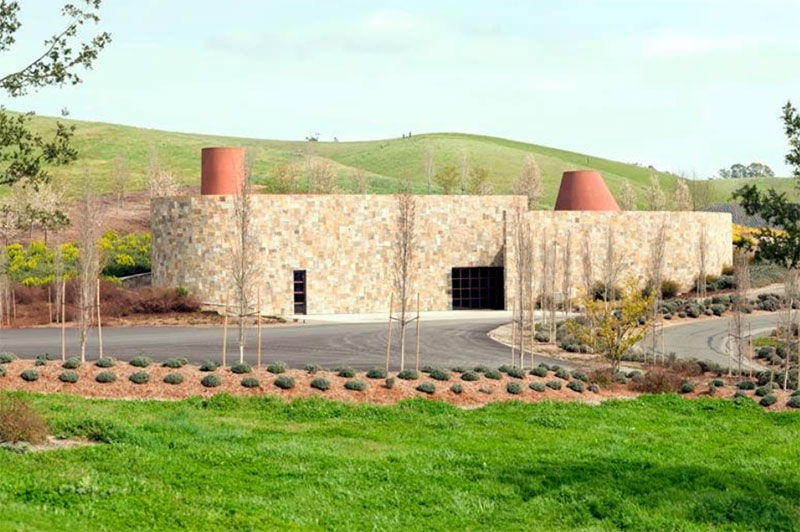
The Keller Estate Winery
The Winemakers
Ana Keller – Estate Director and Winemaker
Raised in Mexico, Ana’s first exposure to wine came early in life when she spent her holidays in France’s Loire Valley harvesting grapes. “When my father asked me to join him in establishing Keller Estate, I was overjoyed,” she related. “We have accomplished much of what we initially set out to do, and it’s up to me to continue to make sure our quality never fluctuates.”
She holds degrees from both the University of Mexico (biopharmaceutical chemistry) and a Masters in Pharmaceutical Development from the prestigious King’s College in London. While there, she took her first formal wine tasting lessons.
Keller was heavily involved in the effort to make her property part of the AVA (American Viticultural Area) called the Petaluma Gap AVA.
“When you consider what the winds of the gap do to the area and to the grapes themselves, it seems to be a no-brainer. The winds force our (Pinot Noir) grapes to develop thicker skins and that in itself changes the equation.”
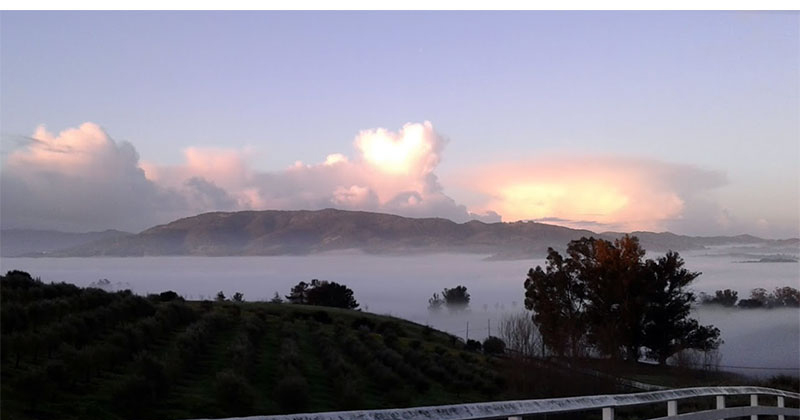
The fog-shrouded Petaluma Gap
Keller devotes 100 percent of her time to Keller Estate, and confided that her parents are still active in the business as well. “Whenever my father is available, he sits in on our meetings and tastings. He is still quite active and his passion for cars takes up a great deal of his time. He cares a great deal about the winery since it is still a relatively small family operation.”
Julien Teichmann – Winemaker
Born in Goettingen, Germany, Julien Teichman joined Keller Estate in 2018. His passion for fermentation began with an internship at a brewery. He next spent some time in Florence, Italy where he had his first contact with winemaking and vineyards. Julien then earned a degree in winemaking from the Weincampus Neustadt in Germany.
Julien traveled the world working harvests and finally came to the United States in 2013, where he spent time at Kosta Brown and Merry Edwards before joining Keller Estate. He espouses a profound respect for the vineyard, and a holistic approach to farming and winemaking.
About the Vineyard
The Keller Estate La Cruz Vineyard features an intricate stone cross sculpture that boldly stands over the vines, and was named to represent the family’s Mexican heritage.
The majority of the La Cruz Vineyard, where Keller Estate grows all of their Chardonnay, Syrah, Pinot Gris, and slightly over half of their Pinot Noir, resides on the lower hills of the property. The soils here are multi-layered, mineral-laden clays there were once San Pablo Bay seabeds. This mineral character comes through in the wines and is very much a part of the Keller Estate’s unique terroir.
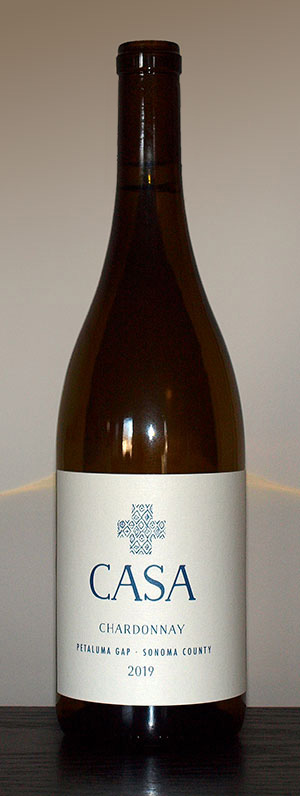
Keller Estate Casa Chardonnay 2019
To start with, this bottle was sealed with a synthetic plastic cork. Not the worst one I’ve ever encountered (although the one in the second bottle was harder to get out than the first), but I’m just not a fan. I’m fine with manufactured corks, where cork is ground up, treated to prevent cork taint, and then reconstituted as closely as possible to the bark itself. But failing that, I’ll take a screw cap over a plastic stopper any day.
Moving on to the wine. The fruit was sourced from the Keller Estate’s La Cruz Vineyard, in the Petaluma Gap region of the Sonoma Coast. The wine was fermented in both barrels and stainless steel. This 100% Chardonnay is very pale yellow in the glass. The moderately aromatic nose features grapefruit and honeydew. These are on the palate as well, with moderate but bright acidity and mineral notes. Although it saw some oak aging, the result is subtle at best. 1,600 cases were produced, and the ABV is 14.2%.
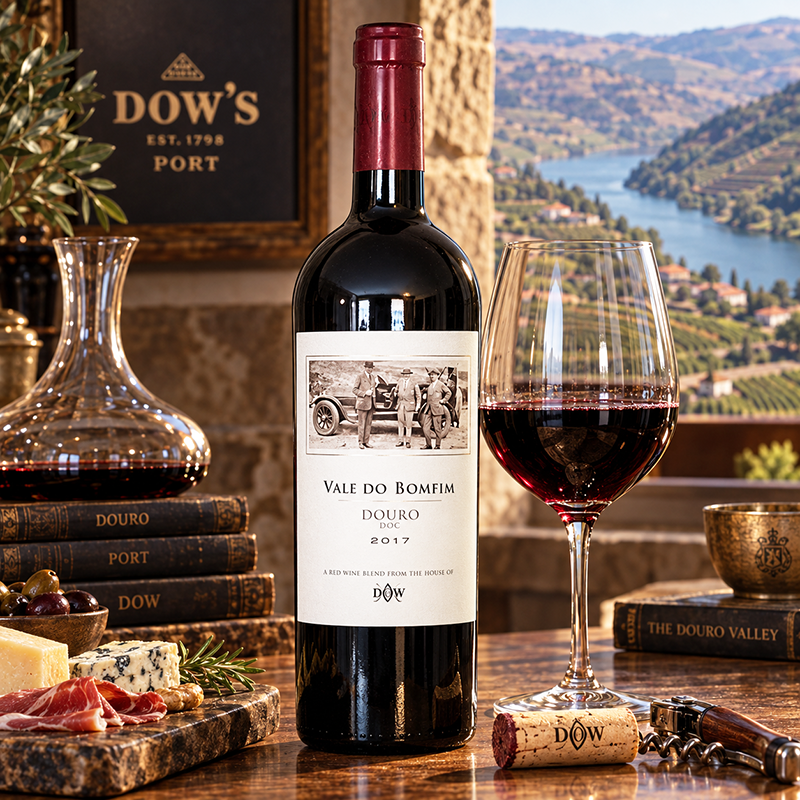
In the 1970s, Portuguese rosés such as Lancers and Mateus were the height of sophistication to many young wine drinkers: “It’s imported, and comes in a fun bottle!” With age comes wisdom however, and these wines were largely abandoned for the justifiably famous fortified wines of Portugal, Port and Madeira, produced by many ancient and famous houses.
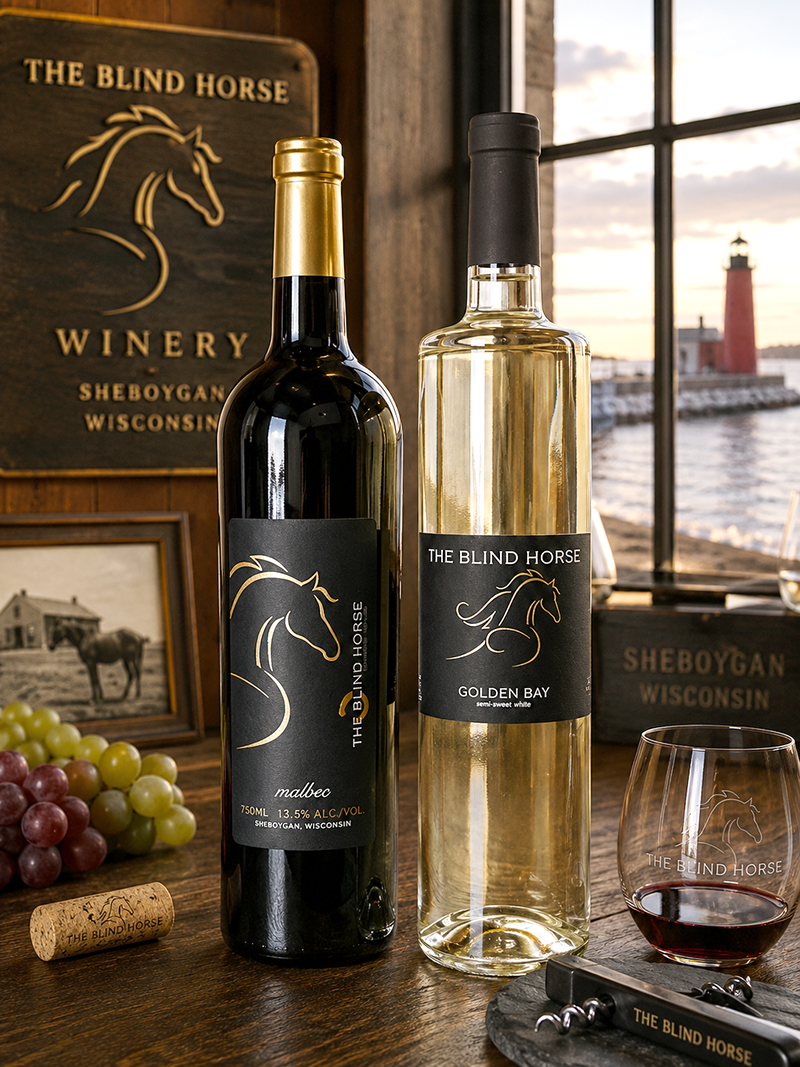
Bob Moeller retired at age 56 after a lucrative career as a roofing contractor in Sheboygan, Wisconsin. As he was relaxing and ruminating on a beach in Clearwater, Florida, one afternoon, this thought came to mind, “If I continue to do this, I’m going to die.”
When it comes to a martini, I roll hard-core old style. Pimento stuffed olive. Just a few drops of vermouth. Shaken, not stirred. Gin and glass straight out of the freezer. And, that gin is almost always Bombay Sapphire.
L. to R.: Disctrict 7 Chardonnay, Scheid Vineyards Sauvignon Blanc, and Ryder Estate Pinot Noir Rosé. Click here for tasting notes.
Today is Earth Day, first held on April 22, 1970. An ideal moment to examine Scheid Family Wines, a producer deeply committed to earth-friendly practices (an enthusiasm shared by more and more winemakers every year, fortunately).’
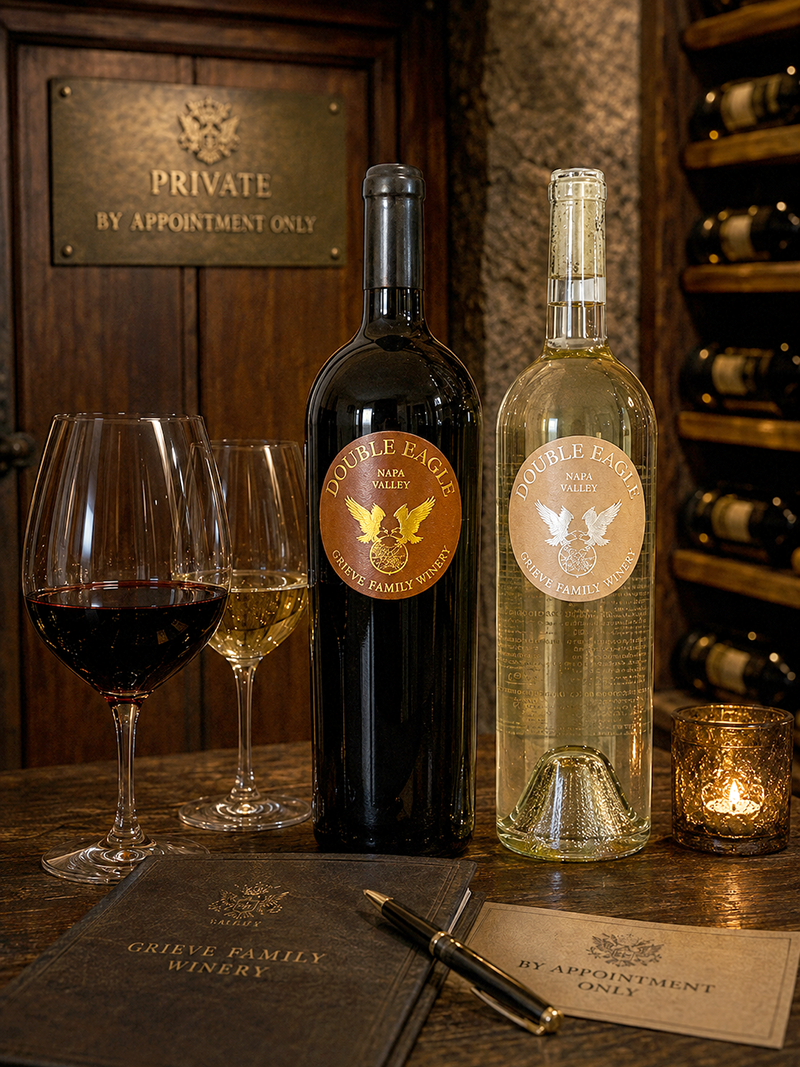
Grieve Family Winery Double Eagle Red Wine 2018 and Grieve Family Winery Double Eagle Sauvignon Blanc 2018. Click here for tasting notes.
Grieve Family Winery Double Eagle
The Grieve Family Winery is located in a secure and undisclosed location in Napa Valley. It is not open to the public, and tastings are offered exclusively to wine club members by appointment only. Remarkably, there is no access from Napa Valley itself; the rare visitor must navigate a long, winding dead-end road that begins in Sonoma Valley. The following dossier is the information that agents Mulder and Scully have been able to assemble so far about the operation.
Can you make wine in Arizona, of all places? You sure can. In fact, wine is made in every single one of these United States.
In the 1600s, missionaries brought grapevines to the deserts south of Tucson to make communion wine (surprise!). Henry Schuerman established the state’s first known commercial winery near Sedona in the late 1880s.
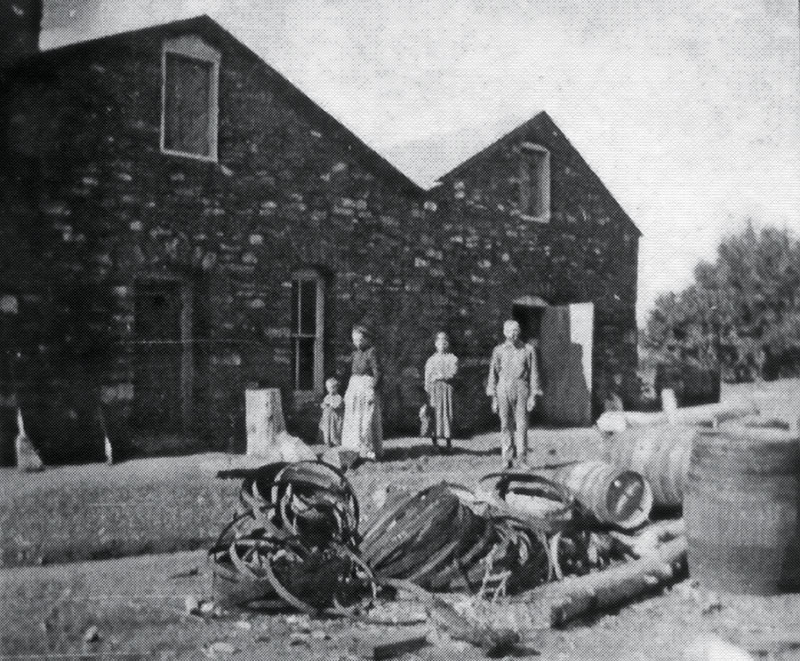
Although he had never been a farmer, he eventually planted an orchard on 160 acres that he had acquired. In addition to apples, peaches, apricots, pears, and quinces, in recognition of his Germanic roots he planted a vineyard. 76 acres of Zinfandel to be exact.
The Schuerman Winery was located near to what is now Red Rock State Park in Sedona. Photo courtesy of Sedona Historical Society.
For 25 years, the Schuerman Winery sold Zinfandel throughout Arizona. Then came New Year’s Day 1915, when, by popular vote, the good citizens of the infant state of Arizona instituted a total ban on alcohol (predating national Prohibition by five years). And that was the end of that.
At least for a while. In the 1970s, as Americans’ interest in wine was beginning to grow, a soil scientist named Gordon Dutt got a grant to study water retention in southern Arizona, and happened to learn that grapes might grow well in the Sonoita area. Dutt founded Vina Sonoita Vineyards, then advocated to change state laws to allow vintners to sell on a large scale once again. Today, Arizona’s 110 licensed wineries gross over $56 million per year.
One of those wineries is Lightning Ridge Cellars, founded by husband-and-wife team Ann and Ron Roncone in 2004. Both began with engineering careers in San Francisco in the early 1980s. At the time, it was quite unusual for a woman to be in such a male-dominated field. It’s not all that common even today.
They also both shared an Italian heritage, and growing up in Italian families there was always wine on the table as a matter of course. Even during her work as an engineer, Ann was drawn to winemaking as a hobby. “Wine was just a drive, and I wanted to try my hand at making some,” she said. “So, I got a kit. A five-gallon bucket, a can of concentrate, and parts.”
Rather than relying on that concentrate, an easy intro for novices, she bought 200 pounds of Zinfandel grapes and handcrafted her first wine from that fruit. She soon planted vines on the property that she owned with Ron, and continued to make wine while working as an engineer. Her growing thirst for knowledge led her to the University of California – Davis, the renowned college for viticulture. “I took every single course that I could,” said Ann.
For two weeks every September for the next four years, Ann took a “vacation” and worked as a cellar rat at various wineries in the Bay area. “I would show up for work and semi flatbeds filled with grapes that needed processing would show up,” she recalled. “It was a rag-tag little group but it was really fun, and it was amazing to get that hands-on experience.”
By 2002, Ann told her husband that that she wanted to be a winemaker full time. He was cautious about the decision, but agreeable. The idea of doing so in northern California was quickly squashed, due to the high prices they encountered for land . But, at the beginning of his career Ron had completed his graduate work at the University of Arizona in Tucson, and knew the area well. They learned that the Sonoita-Elgin region was designated as an American Viticultural Area (AVA) which gave it credibility, although at the time there were just three wineries in the area.
Once relocated, in 2004, Ann and Ron purchased a 20-acre property at 5,100 ft. elevation in Sonoita. They then planted their first grapes: Montepulciano, Primitivo (aka Zinfandel), Malvasia Bianca, Muscat Cannelli, and Aglianico. “It was a little unnerving because no one in Sonoita-Elgin had these grapes growing at the time,” said Ann.
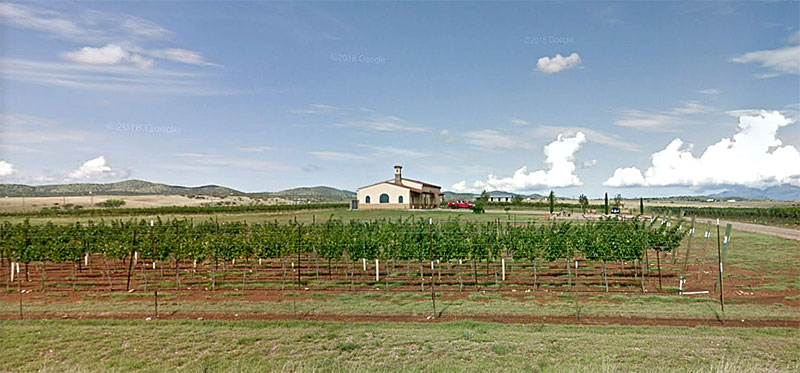
The Lightning Ridge winery and estate vineyard.
Rather than beginning production immediately, Ann wanted to open Lightning Ridge Cellars with estate wines (not a particularly cost-effective plan). So, they patiently waited. On Halloween 2009, they finally opened their tasting room.
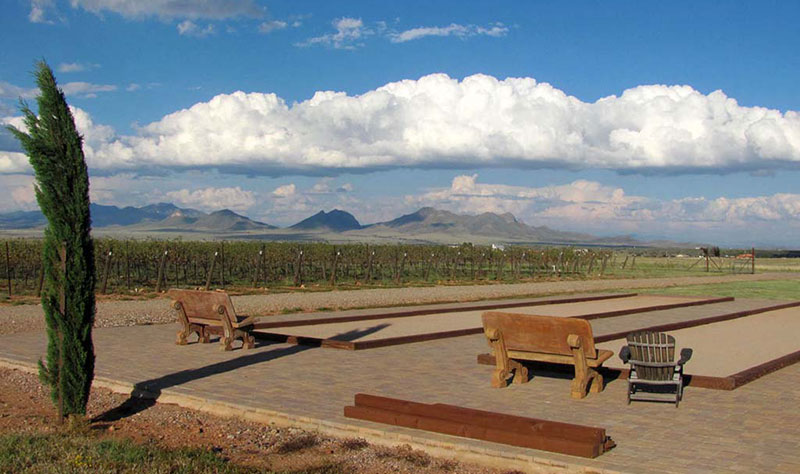
The very-Italian bocce ball court.
Their vineyard only sees about 18 inches of rain each year, most of which falls from July to August during Arizona’s monsoon season, so the need to draw water from a well is imperative.
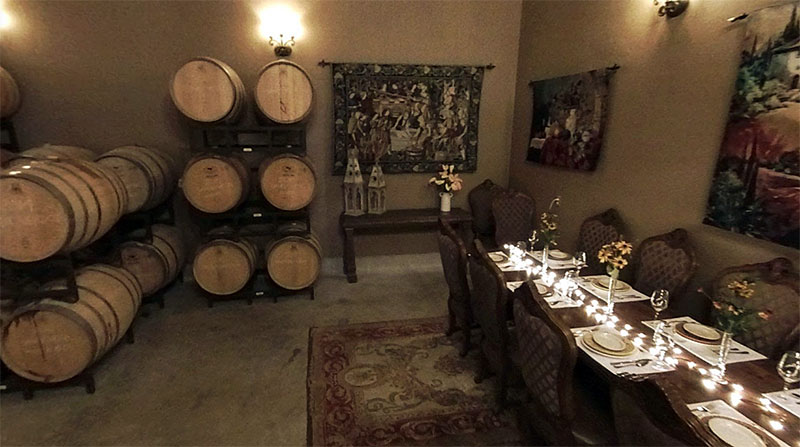
The banquet hall and barrel room.
Lightning Ridge Cellars Montepulciano 2018
Montepulciano is widely planted throughout Italy, especially in the southeastern regions. This 100% Montpulciano was sourced from the Lightning Ridge estate vineyard in Sonoita, and is Lightning Ridge’s flagship varietal. “A lot of Italian [grapes] are warm-weather varietals, and man, they love it here,” Ann shared. She added that Sonoita’s 5,000-foot elevation can bring April frosts, so late-budding Montepulciano fares well in the area.
This wine was aged for 30 months in 50% new European and American oak barrels. A dark opaque brick red, it is moderately aromatic, featuring bright red fruit and cola notes. The smooth palate offers raspberry, red plum, cranberry, and spice, especially white pepper. There is a little bit of Madiera-like raisin flavor as well. There is good supporting acidity. Because the tannins are quite moderate, drink this young, as its aging potential is limited. Production was 190 cases. ABV is 14.4%.
Lightning Ridge Cellars Graciano 2018
Graciano [grah-see-YAH-no Sp. grah-THYAH-no] hails from the Rioja and Navarra regions of Spain. This selection is an outlier in the Lightning Ridge portfolio, as the varietal is not Italian, and, although sourced from Sonoita, the fruit comes from a third-party grower.
It follows Ann’s 100% varietal credo. The wine spent two years in 30% new European and 60% neutral oak barrels. It is a semi-transparent garnet, and is lightly aromatic. Those aromas include boysenberries and leather. The palate features rather recessive fruit, some cocoa, zippy acidity, and well-balanced tannins. Ann made 90 cases. ABV is 14.9%.