
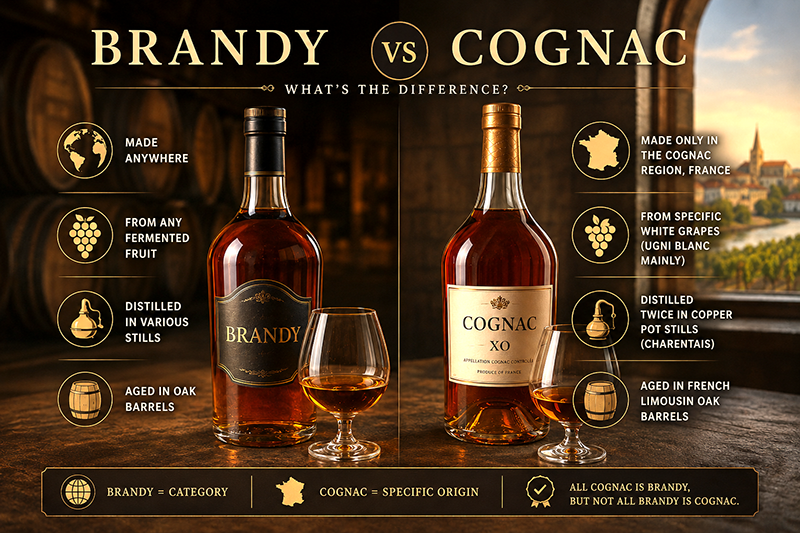
 Brandy vs. Cognac
Cognac is a type of brandy, but brandy is the much larger category. The simplest analogy is: Cognac is to brandy what Champagne is to sparkling wine.
What exactly is brandy?
Brandy is a spirit distilled from fermented fruit, most commonly grapes. The word comes from the Dutch brandewijn, meaning “burned wine”—wine concentrated by distillation.
Most of what we casually call brandy is grape brandy. To make it, wine is fermented, distilled into a spirit, and usually matured in oak. But “brandy” is a very broad family. It encompasses:
Cognac and Armagnac from France
Brandy de Jerez from Spain
American brandy
South African brandy
Italian and many other European grape brandies
Fruit brandies made from apples, pears, cherries, plums, etc.
Some people claim that “brandy isn’t as good as Cognac,” but that doesn’t really make sense. Cognac is brandy, and there are non-Cognac brandies capable of competing with excellent Cognacs.
What makes Cognac Cognac?
Cognac is both a town and the center of a legally defined appellation in southwestern France. To bear the name Cognac, the spirit must satisfy detailed geographical and production regulations.
The important points are:
Location. The grapes must come from the designated Cognac production area surrounding Cognac in the Charente and Charente-Maritime departments, with small portions extending beyond them.
Grapes. The dominant variety is Ugni Blanc, essentially the same grape as Italy’s Trebbiano Toscano. It’s ideal here precisely because the resulting wine isn’t particularly exciting to drink, but relatively low alcohol and high acidity make it an excellent material for distillation.
Distillation. Traditional Cognac undergoes double distillation in copper Charentais pot stills.

Timing. Distillation must be completed by March 31 following the harvest.
Aging. Cognac must spend at least two years in oak, traditionally French oak from forests such as Limousin and Tronçais.
These restrictions are one reason Cognac tends to have a recognizable family resemblance despite enormous differences among producers.
The Cognac region is divided into six growing areas, or crus:
| Cru | General character |
|---|---|
| Grande Champagne | Very fine, floral, elegant; exceptionally long aging potential |
| Petite Champagne | Similar, somewhat faster developing |
| Borderies | Floral, violet, nutty, rounded |
| Fins Bois | Fruity, supple, relatively quick maturation |
| Bons Bois | Rustic, fruity, often coastal character |
| Bois Ordinaires | More robust, sometimes maritime |
“Champagne” here has nothing to do with sparkling Champagne. It refers to the chalky soil. You’ll also encounter Fine Champagne Cognac. That means a blend containing at least 50% Grande Champagne, with the remainder Petite Champagne. Grande Champagne isn’t automatically “better.” Its eaux-de-vie simply have particularly great potential for prolonged maturation.
How Cognac is made
The basic process is fascinating because the starting wine is intentionally quite austere. Ugni Blanc grapes produce a thin, acidic wine of roughly 8 to 10% alcohol. The wine generally isn’t something you’d particularly want with dinner. It goes into a traditional copper pot still called an alambic Charentais.
The first distillation produces brouillis, roughly 27–32% ABV. That liquid is then distilled again. The distiller separates heads, heart, and tails, retaining the desirable heart known as bonne chauffe. The resulting eau-de-vie can emerge at around 70% ABV. At this stage it doesn’t taste like mature Cognac. That happens with oak and time.
Over years or decades in barrel, alcohol and water evaporate—the famous “angel’s share”—while extraction and oxidation produce vanilla, spice, dried fruit, nuts, caramelized notes and eventually the extraordinary mature characteristics Cognac drinkers describe collectively as rancio.
VS, VSOP, and XO
This is probably the most misunderstood aspect of Cognac. The designation refers to the age of the youngest eau-de-vie in the blend, not the average age.
VS — Very Special
Youngest component: at least 2 years. Usually lively, fruity, somewhat fiery and straightforward. Often excellent for cocktails.
VSOP — Very Superior Old Pale
Youngest component: at least 4 years. Usually smoother, deeper and more integrated. This is often a particularly attractive price/quality category.
XO — Extra Old
Youngest component: at least 10 years. An XO can contain eaux-de-vie far older than ten years—sometimes 20, 30, or considerably more.
XXO — Extra Extra Old
Youngest eau-de-vie: at least 14 years. (There’s also Hors d’Âge, which producers often use for extremely old, prestigious blends. Legally it sits within the XO age framework, but commercially it generally signifies something substantially older or more special.)
Although these designations are often used for brandy as well as Cognac, they only have a genuine legal meaning when applied to Cognacs. And brandy producers, especially those making cheaper expressions, frequently don’t disclose the age of their spirits.
The big Cognac houses
Four enormous houses dominate worldwide Cognac sales (that means roughly 85 to 90% of the entire worldwide Cognac market):
Hennessy — powerful, polished, rich and enormously influential.
Rémy Martin — specializes in Fine Champagne Cognac and tends toward rich fruit, elegance, and considerable maturity.
Martell — the oldest of the major houses, founded in 1715. Borderies (one of the Cognac growing regions) plays an important role in its house style.
Courvoisier — traditionally associated with a softer, floral and, fruit-forward style.
But some of the most interesting Cognacs come from smaller producers and houses such as Frapin, Delamain, Hine, Camus, Pierre Ferrand, Jean-Luc Pasquet and Vallein Tercinier.
So how is ordinary French brandy different?
If you take grapes grown somewhere outside the Cognac appellation, ferment them, and distill the wine, you can make excellent French grape brandy (if you know exactly what you’re doing). But you cannot call it Cognac. And the producer isn’t necessarily bound to Cognac’s grape varieties, geographical rules, Charentais double-pot-distillation requirements, and aging regulations.
Brandy de Jerez is a very different animal

Spanish Brandy de Jerez is particularly interesting because it illustrates just how different another premium grape brandy can be. It is matured in the Jerez region using the solera and criadera system, typically in casks previously seasoned with Sherry. Consequently, mature examples can show raisins, figs , dates, walnuts, caramel, vanilla, orange peel, and baking spices rather than the predominantly floral/fruit/rancio spectrum we associate with Cognac.
And Armagnac?
Armagnac is another protected French grape brandy, produced primarily in Gascony. Traditionally it is distilled once, often through a continuous Armagnac still, rather than Cognac’s double pot distillation. That tends to preserve more congeners (the flavor- and aroma-producing chemical compounds in a distilled spirit other than ethanol and water) and character.
Even though the majority of Armagnac uses Alambic stills, the variety of still sizes and forms can vary radically, from permanent gas-powered column stills to mobile wood-fired stills.
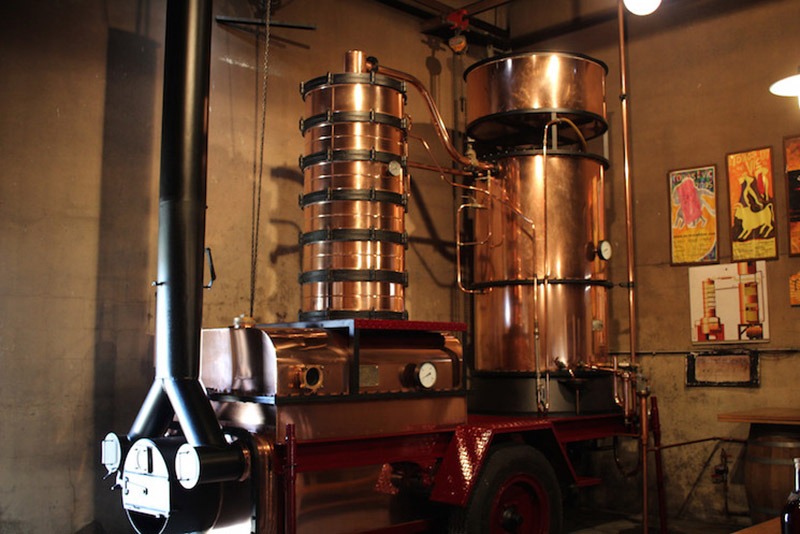
A significant amount of Armagnac is made on these mobile stills, which are wheeled up to a winery after harvest and winemaking. These stills work around the clock to produce a year’s worth of spirit, which is often accompanied by great harvest feasts and parties (with bread warmed right on the still).
Broadly speaking, Cognac is polished, elegant, floral, refined, and carefully blended. Armagnac is earthy, robust, fruity, spicy, and often rustic.
Armagnac also offers something Cognac generally doesn’t emphasize nearly as much: vintage-dated bottlings.
American brandy
American grape brandy has historically occupied a much lower rung of the prestige ladder than Cognac, partly because mass-market California brandy dominated the category. That’s unfortunate, because high-quality American producers have demonstrated that excellent brandy can be made here.
A famous example is Germain-Robin, founded in California in 1982 by Ansley Coale and Cognac-trained distiller Hubert Germain-Robin. Instead of simply copying Cognac, Germain-Robin famously experimented with California wine grapes including Pinot Noir and Colombard. The resulting brandies helped demonstrate that Cognac’s rules aren’t the only route to great grape brandy.
Does darker mean older?
Absolutely not. Color is a poor way to judge the age of a brandy. Depending upon the category and production rules, producers can make certain adjustments to achieve consistency of appearance and taste. Oak type, barrel history, and cellar conditions also dramatically influence color. Indeed, it is perfectly legal to add caramel color to both brandy and Cognac.
Does XO automatically mean better?
No. XO guarantees age, not quality. A beautifully made VSOP from exceptional vineyards and a first-rate producer can easily be more interesting than a generic mass-market XO. And an XO whose youngest component is ten years old may be very different from another XO blend whose average component is dramatically older.
Blending is central to Cognac
Unlike single-malt Scotch culture, where individual distilleries and age statements dominate the conversation, traditional Cognac culture places enormous importance on the master blender.
A major house may maintain stocks of thousands of different eaux-de-vie from different crus, vintages, ages, barrels, and cellars. The cellar master combines them to maintain a consistent house style.
Cognac doesn’t continue aging in the bottle
This is an important difference between spirits and wine. A 20-year-old Cognac bottled in 1985 is not a 61-year-old Cognac 41 years later. Once removed from the barrel, meaningful maturation essentially stops. An unopened old bottle can certainly be collectible and may preserve a style that no longer exists, but the spirit hasn’t spent those additional decades aging as it would have in oak.
How to drink good brandy or Cognac
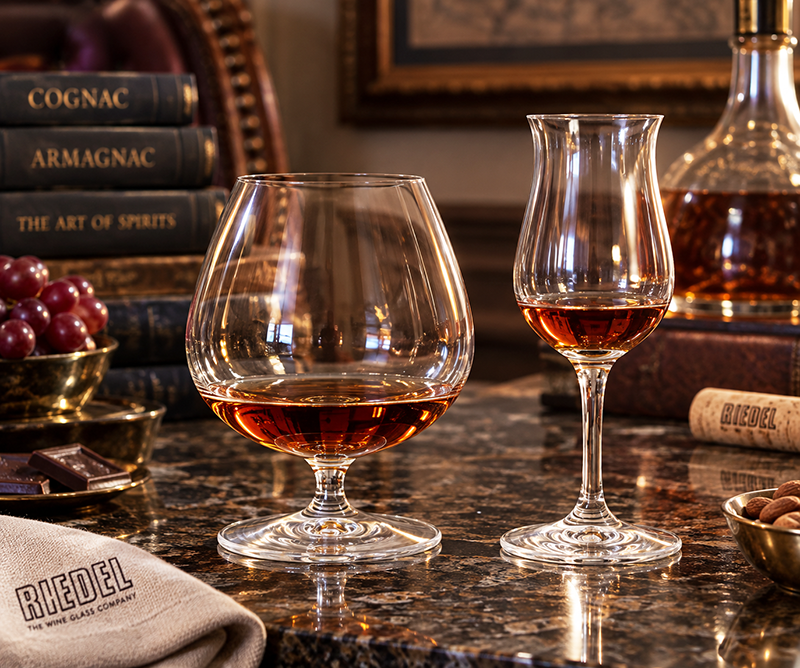
The enormous balloon snifter isn’t ideal despite being the stereotypical Cognac glass. Its huge bowl can concentrate ethanol aggressively, so a smaller tulip-shaped glass works better. Serve it around room temperature, but don’t deliberately warm the glass over a flame or heat it excessively (in the winter, I will sometimes do 10 seconds in the microwave). Excessive warmth pushes alcohol vapor toward your nose.
a final observation
Is brandy whiskey? No. As I pointed out, brandy is a spirit distilled from fruit. Whiskey is a spirit distilled from grain, most usually corn in America and malted barley in Scotland and Ireland. People who prefer brandy don’t drink much whiskey, and whiskey drinkers don’t drink much brandy. Of course in America, whiskey is much more popular.
Listen to my podcast about brandy, Cognac, and Armagnac here.
If you are specifically interested in Armenian brandy, click here.
Back to blog posts: winervana.com/blog/