
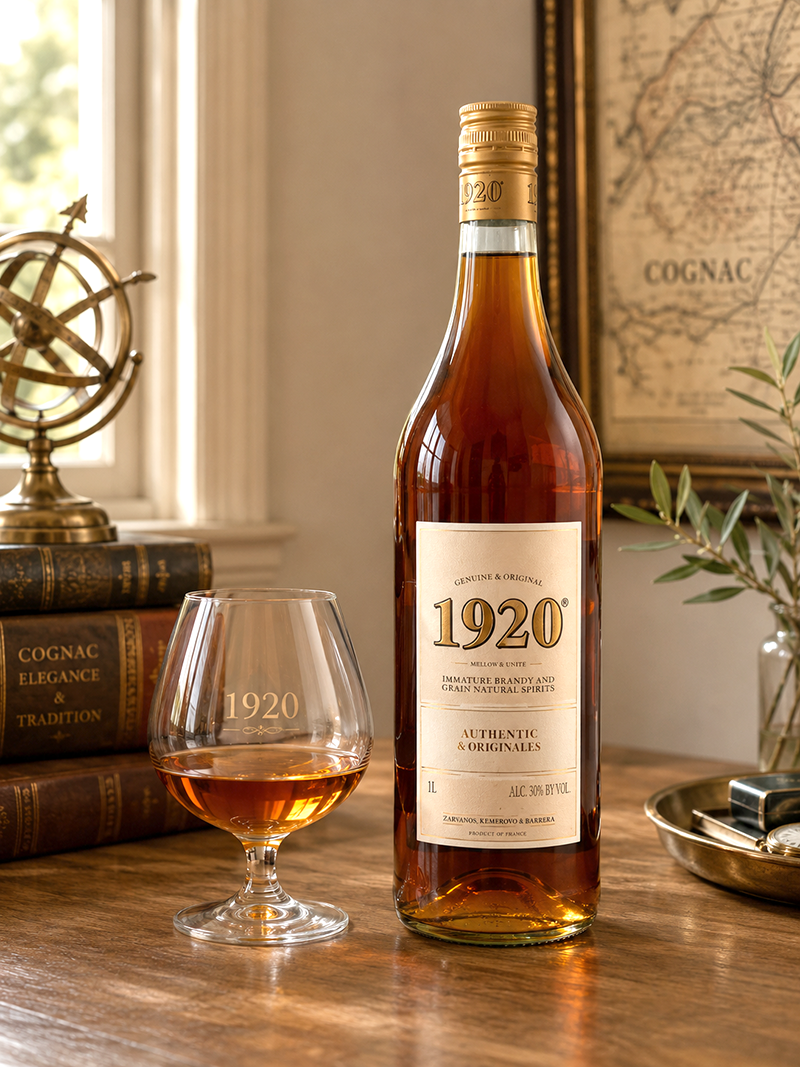
Carvalho, Ribeiro & Ferreira is one of the historic names in Portuguese wine-based spirits, and 1920 Brandy is its inexpensive, everyday brandy rather than its prestigious old aguardentes. It has a surprisingly tangled history, though—and there are some contradictory stories in circulation about exactly how the name “1920” originated.
Carvalho, Ribeiro & Ferreira (CR&F going forward) is a Lisbon wine-and-spirits merchant that evolved into one of Portugal’s best-known aguardente (literally “burning water”) houses. The historical record is a little inconsistent about the exact founding date. Wine writer João Paulo Martins gives 1888, saying Francisco Ribeiro de Carvalho founded the business and that two additional partners had joined by 1900. Modern CR&F materials use 1895 as the founding date when Francisco Ribeiro de Carvalho established himself as an exporter of wine and aguardente in Lisbon; Manuel Joaquim Ribeiro joined in 1898 and Joaquim Nunes Ferreira in 1900, producing the familiar Carvalho, Ribeiro & Ferreira name.
The original business was primarily an armazenista—essentially a wine and spirits warehouse/merchant. It bought wines and aguardentes in bulk and resold them, either branded or unbranded. In the 1930s the company was sold to five new partners who retained the established CR&F name.
By the 1960s CR&F was a major operation. The company’s history records that in 1967 production was near its peak. About four million bottles of wine were sitting in storage awaiting sufficient aging, while the company was producing roughly 400,000 liters of 1920. By comparison, only around 4,000 liters of its more prestigious Reserva aguardente were being made.
1920 Brandy
Why is it called “1920”? There are two competing versions of the history. In version one, the product entered the market in the late 1940s under the name Aguardente Velha 1920, but later Portuguese labeling regulations forced changes in terminology: Aguardente Velha 1920 → Aguardente Preparada 1920 → Aguardente 1920 → Brandy 1920.
Version two is the much more colorful Prohibition story. According to this account, a large American order for Portuguese aguardente was arranged with CR&F. The product was supposedly called Kaiser, production was undertaken using unusually advanced semi-automated techniques, and the bottles were shipped to the United States. But before it could be distributed, Prohibition took affect in 1920, and a substantial quantity was supposedly returned to Portugal where it was trapped, and CR&F subsequently adopted 1920 as the brand name in commemoration of the episode. Based on historical evidence though, this version is probably more lore than fact.
The official name of this spirit is “1920 Immature Brandy and Grain Natural Spirits.” So what does that mean? To start with, it is a Portuguese grape brandy—aguardente vínica—made by blending wine distillates and aging them in oak. But it is “immature” because it spent less than two years in barrel, although I don’t know how much less. The “Grain Natural Spirits” are essentially vodka, but I couldn’t find any information on the ratio of brandy to spirits.
In the glass this brandy is medium honey gold. But i suspect it has been colored with caramel, due to its short time in oak and dilution with grain spirits. The almost non-existent nose offers caramel and mild oak. The palate delivers vanilla, caramel, and sweet spices, with a soft, rounded texture. The finish is relatively gentle and uncomplicated, perhaps unsurprising since the ABV is an unusually low 30%. I would characterize this as a brandy with training wheels, for those just getting into the category. Not bad, but nothing to write home about either.
This brandy not quite what you’re looking for? Read my other brandy reviews here.
Listen to my podcast about brandy, Cognac, and Armagnac here.
A note about brandy vs. Cognac: brandy is a liquor distilled from wine and aged in wood. (Brandy can be made from fruits other than grapes as well, but that’s a story for another time.) Cognac is brandy that specifically comes from the town of Cognac and the delimited surrounding areas in western France. (The one which has the most favorable soil and geographical conditions is Grande Champagne.) So, all Cognacs are brandy, but not all brandies are Cognac. For more detail on Cognac, click here.
Back to blog posts: winervana.com/blog/