Yatir Winery

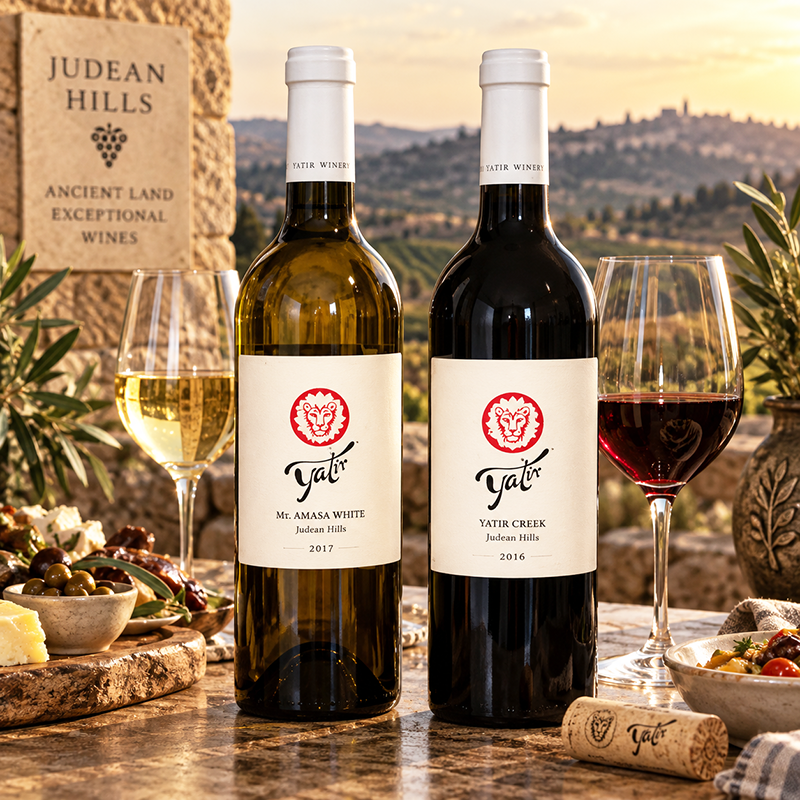
Yatir Creek 2016 and Yatir Mt. Amasa White 2017
Yatir Creek Red 2016 and Yatir Mt. Amasa White 2017. Click here for tasting notes.

Yatir Creek 2016 Red Blend and Yatir Mt. Amasa White Blend 2017

The Yatir region in the Judean Hills has produced grapes for winemaking since the ancient days of the Judean kingdom.  A large Jewish settlement existed in this region between the periods of the destruction of the Second Temple to the inception of the Islamic period.

Although the Israeli wine industry is 2,500-years-old, winemakers from this area of the Negev have only relatively recently been drawing critical and commercial acclaim.

David Ben-Gurion was the primary national founder and the first Prime Minister of Israel, which he led from 1948 until 1963 (with a short break in 1954-55).  He had a quixotic dream of making the Negev region in the south bloom and blossom.  When he decided to plant a forest in the area, he consulted with experts to guide him through the process. After numerous discussions and assessments, the agronomists determined that the region, which was predictably dry and warm, was unsuitable for planting trees. Ben-Gurion had other plans in mind however.  “Replace the experts!” he demanded.  A forest was in fact established, and it has gone on to become one of Israel’s largest . It was named after the Levite biblical city of Yatir, whose ruins remain within. The site serves as a “green lung” and a hiking site, as well as an experimental model for innovative methods for combating desertification. The Yatir Winery vineyards were planted as part of that effort.

Yatir Winery was established in 2000 as a joint venture between local growers and the Carmel Winery, who recognized the potential of the Yatir region. The Yatir Winery was built at the foot of the Israelite Tel Arad Fort (an archeological site), 10 minutes away from the vineyards.

Yatir Winery’s first wine was released in 2004, and today the winery produces 150,000 bottles. Over the years, this desert winery has become a symbol of the region.

Yatir’s  growers and winemakers are committed to excellence every step of the way – from growth and cultivation to harvest, fermentation, aging, and bottling – employing the most cutting-edge technology and equipment available to the industry today.

The vineyards of Yatir Winery are planted at an altitude of up to 900 meters [3000 feet] above sea level, and are scattered across various locations in the forest. The plots in these vineyards have varying soil compositions, with different slants and angles. The climate is characterized by cool, breezy mornings, dry days, cold nights (even at the peak of summer) and snowy winters. The soil is well-drained limestone, chalk, and clay that ensures low yields.

“We are proud to be planting in vineyards from an ancient region, where wine presses existed more than 3,000 years ago,” said Yaakov Ben Dor, Yatir Winery’s general manager.

“Although Israel’s winemaking tradition is ancient, the current industry is still young.  Israel has been widely recognized as capable of producing world-class wines, and growth is happening fast. We are pleased by the exciting potential of the region,” reported Etti Edri, Yatir’s export manager.

According to Eran Goldwasser, who oversees Yatir’s vineyards and production, “At Yatir Winery we are integrating state-of-the-art winemaking and technology within a man-made forest in the heart of the desert, to produce award-winning wines.  Though it seems unlikely, this area in Israel provides an excellent environment for wine making.  Due to Israel’s warm Mediterranean climate, the grapes have no trouble ripening.  As the vines age, yields will decrease, and our wines will become more nuanced.”

Yatir Creek Red Blend 2016

This blend of 76% Syrah, 12% Tannat, and 12% Malbec is plum red in the glass.  The nose offers aromas of rhubarb, cherries, cassis, and a hint of green olives. The palate presents flavors of recessive fruit, coca, and cigar box.  The  tannins feature a slightly salty and pleasantly bitter finish.  The wine was aged  for 12 months in large oak barrels,  and aged in the bottle for two years.

I suggest serving this wine with Moroccan chicken with preserved lemons and olives; souvlakia (skewered lamb) with grilled vegetables; or sghenna (a one pot meal for the Sabbath).

Yatir Mt. Amasa White 2017

With an unusual blend of 52% Chenin Blanc, 39% Viognier, and 9% Roussanne, this  white displays a pale golden-greenish hue.   The aromas hint at grapefruit and actetone (which disappears after chilling).  That grapefruit is joined by peach, and pear on the palate.  There is a soft mouthfeel and balanced acidity.  The wine was fermented and aged for five months in a combination of concrete amphorae (a growing trend internationally), oak barrels, and stainless steel vats.

Yatir Mt. Amasa White would go well with Libyan fish tangine; sea bass with olives and roast tomatoes; or saffron chicken and mussels.

Or, if you’re not an observant Jew, you could do as I did and make a lobster and champagne risotto.

winervana.com/lobster-and-champagne-risotto/

These wines join other Yatir products, including Yatir Mount Masa Red (which is a best seller), Yatir Rose, Yatir Peti Verdo, and the flagship wine, Yatir Forest.

yatirwinery.com/en/

Etti Edri [left], Yatir Winery’s export manager and Israel’s Ambassador Dani Dayan [right] with bottles of Yatir wines.
These wines are “kosher for Passover.”  This certification requires handling and processes unique to these types of wine.Kosher wine is grape wine produced according to Jewish dietary law (kashrut). To be considered kosher, Sabbath-observant Jews must supervise and sometimes handle the entire winemaking process, from the time the grapes are crushed until the wine is bottled. Any ingredients used, including finings, must be kosher as well. Wine that is described as “kosher for Passover” must have been kept free from contact with chametz, such as grain, bread, and dough.

To ensure the kosher status of the wine it must be overseen by a Jewish authority who supervises the kashrut status of the producer. Generally, this supervisor will physically tip the fruit into the crush and operate the equipment. Once the wine emerges from the process, it can be handled in the normal fashion.

Here’s some more information on kosher wines:

winefolly.com/review/myths-facts-kosher-wine/

Back to blog posts: winervana.com/blog/

Acquaviva Winery

Acquaviva Winery
Acquaviva Don Giuseppe 2010 and Acquaviva Brianna 2011

Acquaviva Winery

Although the address is officially in Maple Park, Illinois, Acquaviva Winery and Bistro is on a very rural stretch of Illinois Route 38, 60 miles due west of Chicago. The faux-Italianate building incongruously appears, mirage-like, as you approach.

As a child, owner Vito Brandonisio would visit his grandfather’s small vineyard in Acquaviva delle Fonti in Bari, Italy. The lessons and memories formed there carried through to adulthood as he became an amateur winemaker.

In 2002, Brandonisio fulfilled a lifelong dream of having his own wine estate when he purchased 40 acres in Maple Park, naming it Acquaviva in honor of his homeland and his grandfather. Determined to produce his wines from indigenous local grapes, here he planted such hardy Midwest varietals as Prairie Star, Brianna, Chardonel, Marechal Fosh, and Frontenac, types largely unknown even to seasoned wine connoisseurs.

Acquaviva Winery & Ristorante

By 2007, it was time to build a winery to make use of the maturing grape vines. This 20,000 square foot facility is to the north across Route 38 from the estate acreage, and in addition to the winery itself (housed on the basement level), it includes a tasting room, the bistro, a retail market, and private party facilities. Tours are available by reservation; a fee of $10 to $30 is charged, depending on tour selected.

Acquaviva encapsulates the American experience. Brandonisio is Italian, of course, his grapes are American, and his current winemaker, Sergio Benavides, is Chilean.

Acquaviva Brianna 2011

Personally, I’m not a fan of sweet wines with the dinner entrée. However, I realize many others don’t share my position (white zinfandel, anyone?). This Brianna is almost completely colorless in the glass. The nose features scents of peach and honeysuckle. It is indeed sweet, with flavors of pineapple, peach, and a hint of apricots.

Although not a true dessert wine, Brianna can convincingly fill in as one. This would pair nicely with Sweet Pastry Fritters, Almond Cake, or Mixed Berry Pizza.

Acquaviva Don Giuseppe 2010

This red blend is made entirely of Illinois grapes, although the varieties are not specified. It is surprisingly grapey on the nose, but fear not, this is no Concord.

This wine was barrel-aged for twelve months. The color is dense purple, and it has good legs. On the palate, it is quite approachable and well-balanced, with understated tannins that add just enough structure. The dominant flavors are dark berries, cedar, and a hint of black pepper, not unlike a Zinfandel, although there is none in the blend.

For dinner, go classic with Spaghetti and Meatballs, Chicken Cacciatora, or try Braised Pork Chops with Tomatoes, Cream, and Porcini Mushrooms.

acquavivawinery.com/

Back to blog posts: winervana.com/blog/

Pillar Box Winery

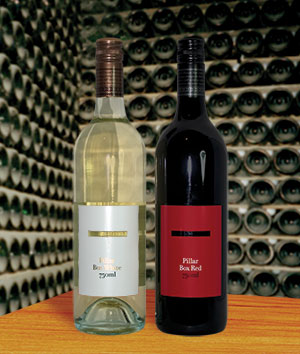
Pillar Box Red and Pillar Box White

Pillar Box Winery

A pillar box is what mail boxes are called Down Under as well as in England.

Pillar boxes lined the coach-driven mail routes, or ‘drives,’ established in the 1850s to provide mail service to the farmers and settlers then moving into southeastern South Australia. One such route in Padthaway was operated by Henry John Hill, and ran through property now owned by the third generation of the Longbottom family.

In 1992 Kim and Mark Longbottom decided to expand their farming operation into winemaking, and released their first offering in 1996. In a nod to the history of the mail route that once passed through the vineyards, today the family’s wine business is known as Henry’s Drive Vignerons.

The Padthaway region was once covered by the ocean. The receeding waters left behind a limestone subsoil topped by rich red loamy earth. This soil structure combines with good winter rains and mild sunny summers to make Padthaway well-suited for viticulture. The first vines were planted there in 1964, and it has come to be one of Australia’s premier wine-producing regions.

Pillar Box Red 2005

A blend of 57% cabernet sauvignon, 32% shiraz, and 11% merlot. The color is opaque purple, with a European-style flavor profile. The fruit is somewhat recessive, with nice astringency and enough tannin for structure. An excellent value, and 2005 is only the second vintage.

Pair this muscular wine with roasted or grilled beef or pork, blue cheese stuffed hamburgers, or a full-flavored, tomato sauced lasagna.

Pillar Box White 2006

A blend of 66% chardonnay, 20% sauvignon blanc, and 14% verdelho. The dominant taste is grapefruit, supported by lemon and citrus zest and racy, minerally acid. This makes for a tart, zippy, refreshing wine, ideal for this time of year. The color is pale straw yellow with a green tinge.

Try this wine with grilled or baked fish, a cheese course, shrimp on the barby (of course), or even tortilla chips and salsa.

This month’s wines are both sealed with screw caps. Screw caps have long been associated with low-quality wines. However, this has begun to change because of the perennial problem of “cork taint.” Cork taint is caused by complex chemical mechanisms triggered by the presence of microscopic fungi in the cork. Although not hazardous, cork taint does ruin the wine with a musty, wet cardboard smell and taste.

Screws caps are seen as a solution to this problem, and less tradition-bound Aussies are using them extensively on wines at every quality level. Commendable as that may be, I still prefer a cork, even if it is a well-made artificial one.

Back to blog posts: winervana.com/blog/