
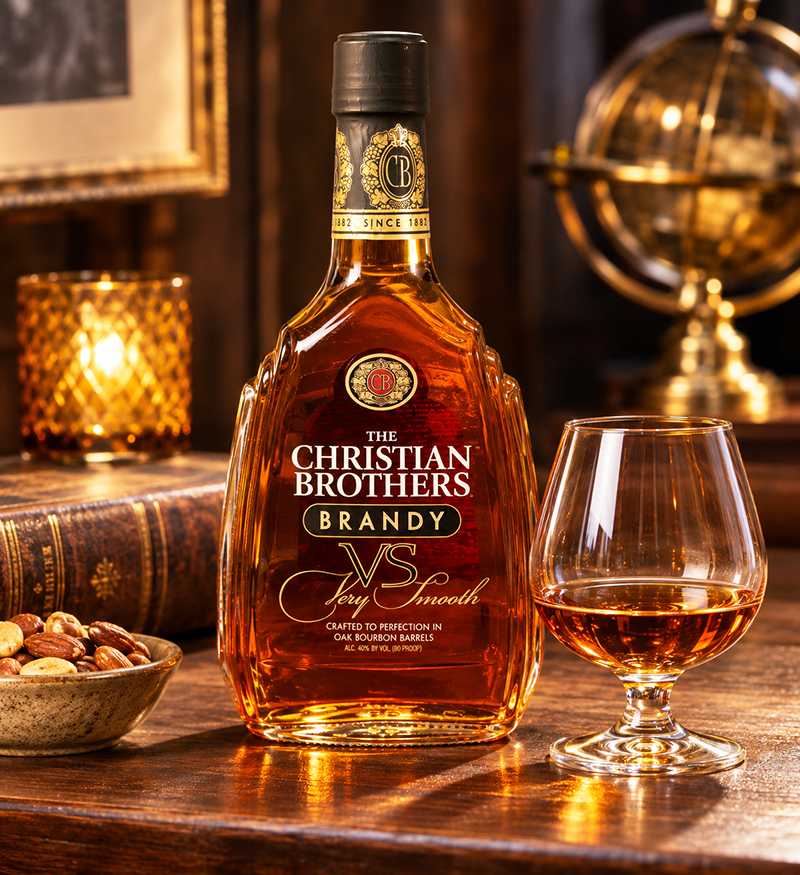
Christian Brothers VS Brandy is one of America’s longest-established brandy labels, with roots going back to 1882. Unlike Cognac, which must come from a designated region of France, this is an American grape brandy.
What makes it particularly interesting is its unusual history: it originated with a Catholic teaching order, became a major commercial brand, and eventually passed into corporate ownership.
The story behind Christian Brothers
The Christian Brothers were members of the Institute of the Brothers of the Christian Schools, a Catholic religious order founded in France in 1680 by Saint John Baptist de La Salle. The Brothers established their California winemaking operation in Martinez in 1882 and moved to Mont La Salle in Napa Valley in 1932. Their ability to produce sacramental wine during Prohibition helped sustain the enterprise
Brother Timothy Diener, one of the best-known figures in the organization’s winemaking history, helped develop and popularize Christian Brothers wines and brandies during the twentieth century. The Christian Brothers eventually became a major name in American brandy, particularly during the post-Prohibition period.
In 1989, the religious order sold its wine and brandy operations to Heublein. The brand subsequently passed through several corporate owners and is now part of the Heaven Hill portfolio. This means the brandy is produced in Bardstown, Kentucky and not by the religious order itself, although the brand retains its historic name.
How Christian Brothers VS is made
Christian Brothers brandy was originally introduced in 1940. According to the producer, It is distilled in copper pot stills, matured in used American bourbon barrels, and then aged for a minimum of two years.
What does VS mean?
In Cognac, VS means Very Special, with the youngest component aged at least two years. Here, the letters are presented as Very Smooth, emphasizing the brand’s intended drinking character. The distinction matters because American brandy is not governed by the French Cognac aging classifications.
Christian Brothers VS Brandy
This brandy pours a correct amber color, but it has been colored with caramel, so that’s not a necessarily a characteristic of the aging. Those bourbon barrels are certainly evident on the nose, as is the alcohol. That oakiness continues on the palate, plus vanilla and brown sugar sweetness. The medium finish is somewhat hot. ABV is 40%.
Although Christian Brothers VS is distilled from grapes and aged in used bourbon barrels, Heaven Hill acknowledges the addition of natural flavorings and caramel coloring. The specific flavorings are undisclosed, making it difficult to determine how much of the finished brandy’s character comes from distillation and maturation alone.
I don’t recommend sipping this brandy neat. It is much more suitable for cocktails, especially a Brandy Old Fashioned, particularly the Wisconsin style, which frequently uses American brandy rather than whiskey. I also use it for my Good Cheap Brandy blend.
This brandy not quite what you’re looking for? Read my other brandy reviews here.
Listen to my podcast about brandy, Cognac, and Armagnac here.
A note about brandy vs. Cognac: brandy is a liquor distilled from wine and aged in wood. (Brandy can be made from fruits other than grapes as well, but that’s a story for another time.) Cognac is brandy that specifically comes from the town of Cognac and the delimited surrounding areas in western France. (The one which has the most favorable soil and geographical conditions is Grande Champagne.) So, all Cognacs are brandy, but not all brandies are Cognac. For more detail on brandy and Cognac, click here.
Back to blog posts: winervana.com/blog/