
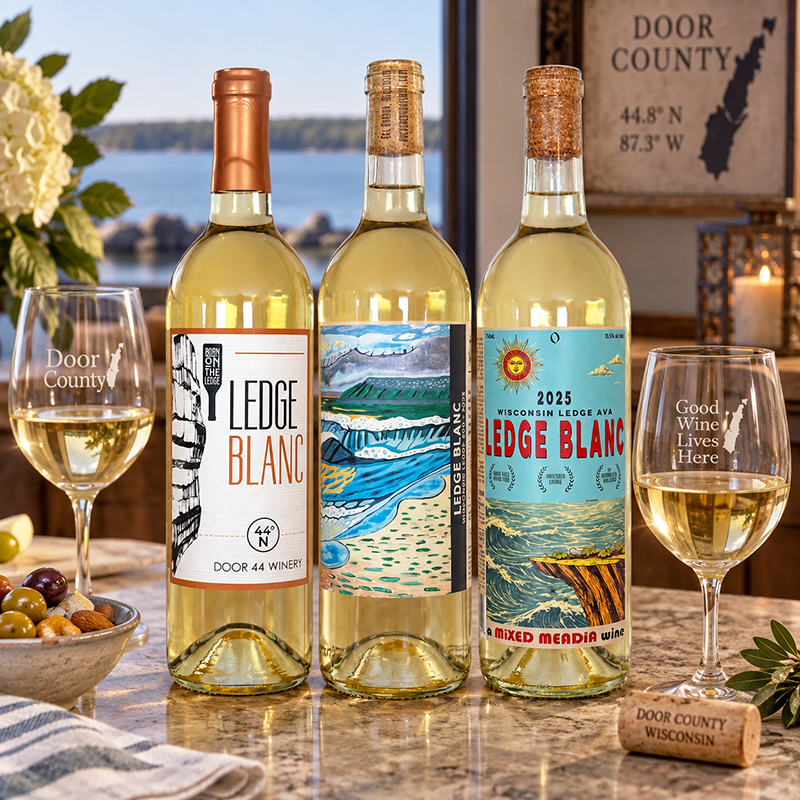
The Ledge Blanc Project
The Ledge Blanc Project is much more ambitious than simply three Door County wineries deciding to put the same name on a white wine. It is an attempt to create a signature appellation wine for the entire Wisconsin Ledge AVA—something consumers can eventually associate with northeastern Wisconsin in the way certain wine styles become identified with particular European or American regions.
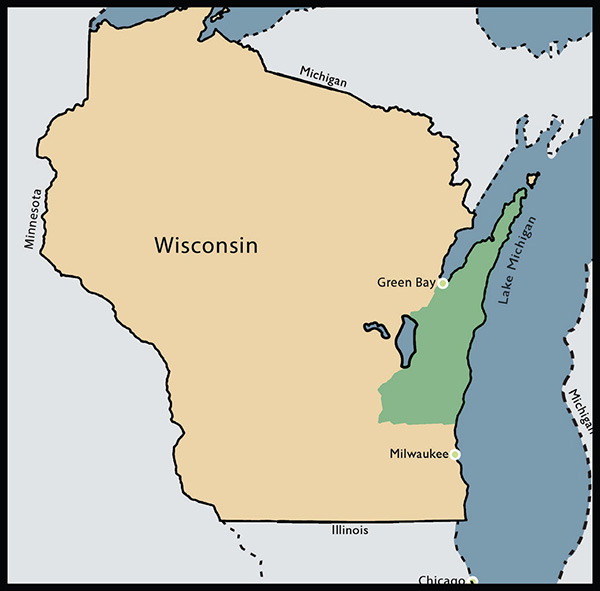
The project was established in 2023 by winegrowers in the Wisconsin Ledge AVA. The organizers say they looked at which grapes were succeeding locally and at the wines producers were already making, and recognized a common thread: bright, aromatic, fresh white wines with substantial natural acidity. Rather than inventing an arbitrary style and asking wineries to reproduce it, they attempted to codify a style that they believed was already emerging naturally from the region.
The original producers included Parallel 44, Anchored Roots, and Mixed Meadia. The project has since expanded. By the 2025 vintage, six wines passed certification, and in June 2026 the project held an “Experience Ledge Blanc” weekend at which wines from six certified producers could be tasted side by side.
What exactly is a Ledge Blanc?
A dry, crisp, aromatic white blend made entirely from grapes grown within the Wisconsin Ledge AVA and independently certified to meet the project’s varietal, stylistic, and quality requirements. The blends and winemaking can differ, but all have to stay inside the project’s boundaries.
The grape rules are quite specific. At least 55% of a Ledge Blanc must consist of one or more of five designated grapes: Itasca, Frontenac Blanc, Frontenac Gris, La Crescent and St. Pepin. The remaining of up to 45% can consist of other white hybrid varieties, provided those grapes were also grown within the Wisconsin Ledge AVA and the resulting wine remains within the established Ledge Blanc style.
The project’s argument is that cold-hardy hybrid varieties are part of the region’s identity rather than an unfortunate substitute for Chardonnay, Riesling, or Sauvignon Blanc. The hybrids are capable of surviving the winters, ripening during the relatively short growing season and retaining substantial acidity.
Instead of asking, “What famous wine can we imitate in Wisconsin?,” the organizers effectively asked, “What kind of wine does this place naturally want to make?” Their answer was aromatic white wine.
The really unusual part: the Judging
A winery can’t simply follow the recipe and put LEDGE BLANC on its label. Every vintage undergoes a blind third-party tasting by sommeliers and other wine-industry professionals. According to the project, a wine has to receive 90 points or higher out of 100 before it can carry the Ledge Blanc designation.
Why the Wisconsin Ledge AVA matters
The Wisconsin Ledge AVA was federally established in 2012. It is much larger than Door County alone and extends through 11 counties along northeastern Wisconsin and the Niagara Escarpment. In 2026, the six participating Ledge Blanc producers included wineries in Door County as well as producers in Calumet and Fond du Lac counties.
Door 44 has described the consortium’s approach as a Vintners Quality Alliance (VQA), borrowing the concept of appellation-based quality systems most prominently associated in North America with Canada.
There is an important nuance, though. The Wisconsin Ledge AVA itself is the federally recognized geographic designation. Ledge Blanc’s additional production and quality requirements are standards established by the participating producers; they shouldn’t be confused with a separate federal wine classification.
Hybrid grapes are central to the message
Ledge Blanc is also making a statement about what serious Midwestern wine can be. For years, cold-climate American hybrids have suffered from the perception that they are second-class substitutes for Vitis vinifera.
The Ledge Blanc argument is that grapes such as Itasca, La Crescent, Frontenac Blanc and St. Pepin belong here. They’re adapted to the climate, can require fewer inputs, and can produce the aromatic, high-acid white wines that the Wisconsin Ledge climate favors.
The project is still very young
The 2025 vintage represents an important expansion: six Ledge Blancs passed the blind review, and the June 2026 Experience Ledge Blanc weekend presented all six certified wines together. The three new additional wineries are Whitecap in northern Door county, and Wolf & Fox and Ziegler farther south in the AVA.
Door 44 Ledge Blanc 2024
The original Parallel 44 winery was in Kewaunee, Wisconsin, and their Door County tasting room was branded Door 44. However, in April of 2026 both the winery and estate vineyard in Kewaunee were sold, the Door 44 moniker was dropped, and the entire operation consolidated as Parallel 44.
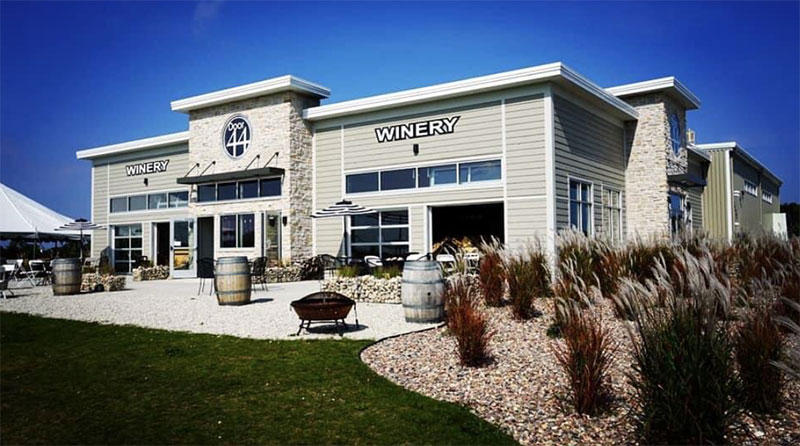
When established in 2007, Parallel 44 decided to forgo the classic European varietals we are all familiar with, knowing that the vines would struggle to even survive the harsh northern Wisconsin winters, much less thrive. So, they turned their attention to cold-climate grape varietals available for commercial planting, of which there were only a few. Most of the varietals were quite new to the world of wine and were less than 20 years old. Fruit is now sourced from the new estate vineyard in Door County, as well as from growers throughout northern Wisconsin.
This expression is a blend of 39% Frontenac Blanc, 30% La Crescent, and 31% Itasca.
This wine pours a bright lemon yellow. The nose offers melon, grapefruit, and spring flowers. On the palate, it delivers more of the same, adding some lemon as well. There is plenty of zippy acidity. The ABV is 13.1%.
Read more about Parallel 44 here.
Anchored Roots Ledge Blanc 2025
Anchored Roots practices dry farming, which simply means growing grapes without adding additional water. This requires both patience and nerve, as the grower is at the mercy of natural precipitation. They rely on Integrated Pest Management, also known as integrated pest control, a broad-based approach that integrates both chemical and non-chemical practices for economic control of pests.
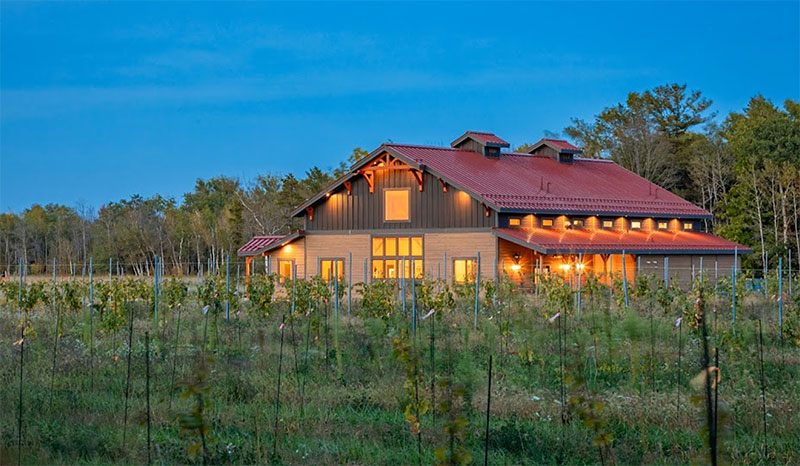
Here the blend is 81% Itasca, 11% Frontenac Blanc, and 8% La Crescent. So although legally and conceptually it’s a blend, this is really an Itasca-driven wine.
This wine also pours a very pale yellow. The nose is very delicate, and then Bam!, flavors of lime and lemon burst forth, balanced by melon and pear. After a clean entry, there is plenty of juicy acidity through the middle, and a fairly smooth transition into the finish. ABV is 12.4%.
Read more about Anchored Roots here.
Mixed Meadia Ledge Blanc 2025
Mixed Meadia approaches Ledge Blanc through its own low-intervention philosophy. Its broader winemaking program makes extensive use of indigenous fermentation.
Mixed Meadia takes grape clusters from their vineyards before the main harvest and allow them to ferment spontaneously in small containers in the vineyard. They evaluate those ferments and select successful native microbial cultures to inoculate the main fermentation.
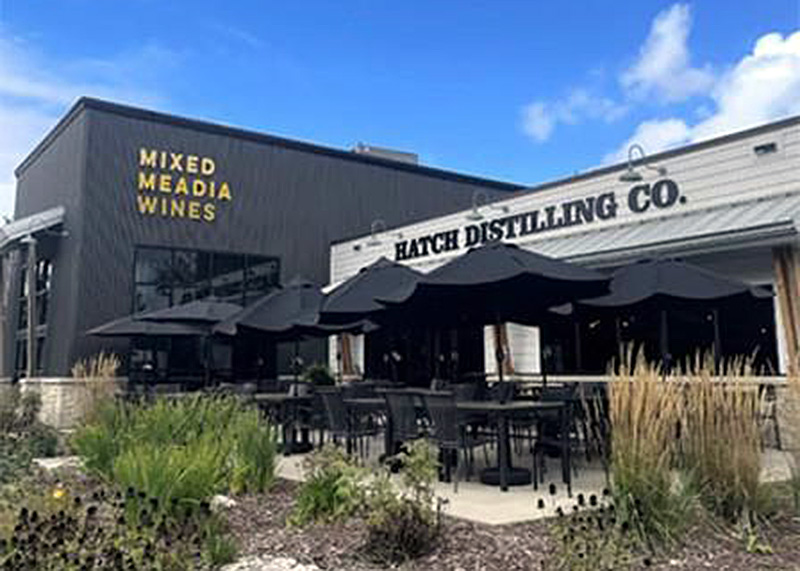
Using the most varietals of the three, this blend is 25% Itasca, 20% L’Acadie Blanc, 20% La Cresent, 15% St. Pepin, 10% Frontenac Gris, and 10% Briana.
It is a very pale yellow in the glass. There is a delicate nose of pineapple and melon. These continue on the palate, plus some pear, guava, lemon and a bit o’ honey. There is also a floral undertone. It wraps up in a short finish. Overall, a very easy sipper.
The wine is unfined and unfiltered. The ABV is 11.5%.
Read more about Mixed Meadia here.
So there you have it. One wine concept, with three distinct expressions. If you like sweeter wines, Mixed Meadia is your best bet. If you like plenty of acidity, especially to pair with richer foods, Anchored Roots is the way to go. If you are looking for something in between those two, Parallel 44 fits right in. Or do as I did, buy all three, and do your own horizontal tasting. It is both fun and instructive.
Back to blog posts: winervana.com/blog/