
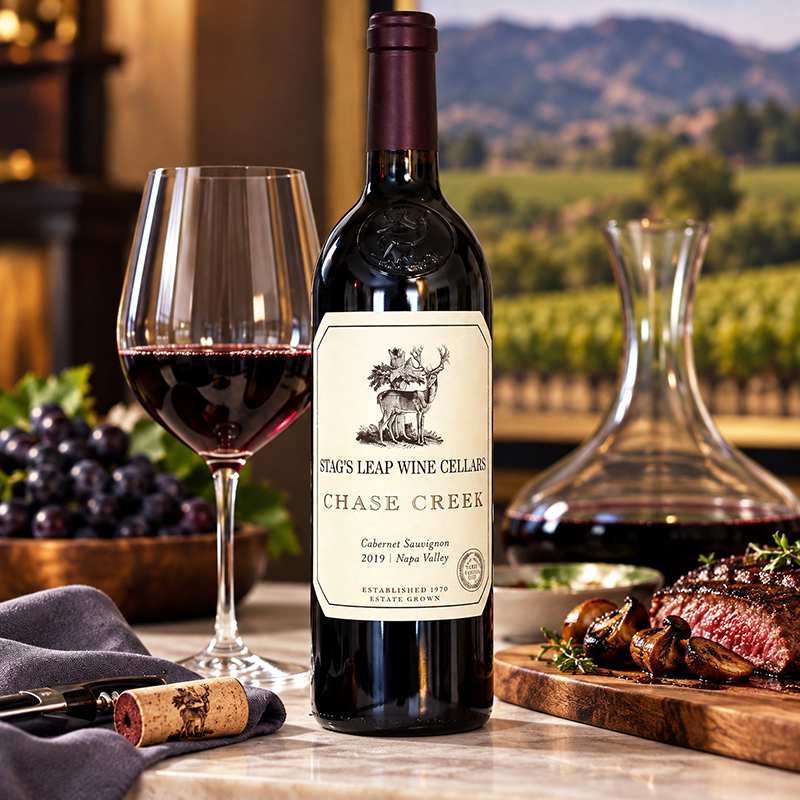
The 2019 Stag’s Leap Chase Creek Cabernet Sauvignon is an interesting and somewhat unusual offering from one of Napa Valley’s most historically significant wineries. Rather than emphasizing the sheer concentration and power associated with many premium California Cabernets, Chase Creek is intended to express the more delicate, aromatic, and elegant characteristics of the Stags Leap District.
The winery and its historical importance
Stag’s Leap Wine Cellars was founded in 1970 by Warren Winiarski, who recognized the extraordinary potential of Cabernet Sauvignon grown in the Stags Leap District.
The winery became internationally famous during the Paris Tasting of 1976, a.k.a the Judgment of Paris, when its 1973 S.L.V. Cabernet Sauvignon defeated several prestigious French Bordeaux wines in a blind tasting organized by British wine expert Steven Spurrier. The tasting pitted California wines against the finest offerings from France’s Bordeaux and Burgundy regions. The outcome sent shockwaves through the wine industry and forever altered the perception of California wine on the global stage.

The story behind Chase Creek
Chase Creek is a tributary of the Napa River that flows along the western boundary of the winery’s celebrated S.L.V. and FAY estate vineyards. Over the years, erosion and invasive vegetation had compromised portions of the creek and its surrounding ecosystem. The winery undertook a restoration project that involved removing invasive plants and reintroducing native vegetation.
Vineyard and winemaking
The 2019 Chase Creek comes primarily from Block 1 of the historic FAY Vineyard, situated between the winery’s visitor center and Chase Creek. FAY is particularly important to the winery’s history. Nathan Fay planted Cabernet Sauvignon there in 1961, when many believed the district was too cool to ripen the grape successfully. Winiarski tasted Fay’s Cabernet in 1969 and was impressed enough to pursue vineyard property nearby.
Stag’s Leap Chase Creek Cabernet Sauvignon 2019
This wine is entirely Cabernet Sauvignon, rather than a Bordeaux-style blend. It was aged for 20 months in 75% new French oak and 25% new American oak following fermentation in stainless steel.
It pours an opaque dark red. The nose offers inviting aromas of boysenberry, red currant, plums, and a whiff of alcohol. Medium-bodied, the wine has a bright texture with pleasing flavors of the same fruit, subtle tea leaf, plus toasty oak. Everything is extremely well-balanced, supported by elegant tannins. The lingering finish shows savory and spice characteristics. Decant for about 30 minutes. ABV is 14.8%.
The 2019 Stag’s Leap Wine Cellars Chase Creek Cabernet Sauvignon is an exceptionally well-balanced wine, with its fruit, acidity, and tannins in admirable harmony. It is elegant, refined, and beautifully integrated, but ultimately a bit too restrained for my taste. I would have preferred greater fruit concentration and a firmer tannic structure to give the wine more depth and authority. This wine sold for $150 at the winery. I got it for $60 from wtso.com. $60 is still spendy, but more appropriate.
Pair this with prosciutto-wrapped pork tenderloin, grilled bone-in pork chops accompanied by sautéed wild mushrooms, duck breast with a cherry reduction, herb-crusted rack of lamb, or filet mignon with a mushroom-Madeira sauce.
Note: Stag’s Leap Wine Cellars should not be confused with Stags’ Leap Winery. They are two separate Napa Valley producers with remarkably similar names. You can read about a Stags’ Leap Cabernet Sauvignon here.
Back to blog posts: winervana.com/blog/