Mossback Winery

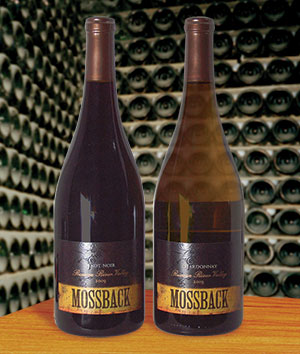
Mossback Winery Chardonnay and Pinot NoirThe Russian River AVA sits in the center of northern California’s Sonoma County, and is characterized by a generally cool climate, with sunny days bracketed by fog early and late. This encourages the slow-ripening of fruit, particularly suitable for Chardonnay, Pinot Noir, and Sauvignon Blanc, like these selections from Mossback Winery.

John Giguiere, with his wife Lane and brother Karl, started R.H. Phillips Winery in 1983 on land that was part of their family farm in the Dunnigan Hills of northwestern Yolo County, 30 miles east of the more-famous Napa. Over the course of 20 years, the Giguieres grew R.H. Phillips from a family winery of 10 acres and a few cases into a publicly-owned behemoth producing 900,000 cases of wine on 2500 acres, including the best-selling Toasted Head and EXP as well as R.H. Phillips.

When John and Lane left the company in 2005 to return to more-personalized winemaking, they were joined by Dan Cederquiest to found Crew Wine Company, which produces a variety of wines, including Matchbook.

Mossback is an old-fashioned term for “farmer,” and is an homage from the Crew trio to the farmers on which they rely to supply the fruit for their Russian River offerings.

Mossback Winery Russian River Valley Chardonnay 2009

The impression of this wine is as understated as its pale yellow color would suggest. Made in the style of a French Chablis, the wine is 80% cold fermented in stainless steel to retain acidity and as much of the character of the fruit as possible.

The delicate nose presents citrus notes, and the taste features green apples, baked honey, and a hint of melon. 1,093 cases were bottled of this 100% Chardonnay.

This food-friendly wine would pair nicely with Grilled Scallops Wrapped in Proscuitto, Grilled Salmon Burgers, or Hoisin Honey-Glazed Chicken.

Mossback Russian River Valley Pinot Noir 2009

This elegant Pinot Noir is 97% Pinot Noir with 3% Syrah added for additional structure. The fruit was sourced from three well-regarded Russian River Valley vineyards. After fermentation, the juice was aged in French oak for nine months.

In the glass, the color is a pleasing cherry red. There is almost no nose, but don’t be discouraged by that. On the palate, the fruit displays plenty of tart cherry and strawberry, supported by a bit of cream and vanilla. There is a medium finish, with no bitterness or aftertaste.

Enjoy this Pinot with Grilled Turkey Burgers with Yogurt-Cucumber Sauce, Salmon Fillets with Sesame Crust, or Vegetarian Shish Kabobs.

www.matchbookwines.com/

Back to blog posts: winervana.com/blog/
 

Truchard Vineyards

Truchard VineyardsTruchard Vineyards
Truchard Vineyards was established in 1974, when native Texans Tony and Jo Ann Truchard purchased a 20-acre parcel of land in Carneros. They transformed what was an abandoned prune orchard into a vineyard, and began selling the fruit to a local winery. Because of the difficult clay soil he had to work with, as well as a dearth of groundwater, Truchard was one of the early adapters of drip irrigation, a practice that was used in Israel for desert farming but not known in California yet. The Truchard Estate Vineyard has since grown to 400 acres, of which 280 are planted.

In 1989, the Truchards began making wine for themselves (even as Tony continued his practice as a physician), using only their estate-grown fruit. Today the winery makes 12 different wines, producing a total of 16,000 cases per year. The Truchard’s remain active at the winery even now, along with able assistance from their son, Anthony Truchard II who serves as General Manager. Their winemaker (and Milwaukee native) is Sal De Ianni. Originally a chemist, De Ianni was sufficiently drawn to wine that he took his M.S. in Enology at UC Davis. In 1998, he responded to a help wanted ad posted by the Truchards, and has been with the winery ever since.

As the most Northeastern vineyard in the Carneros region, Truchard is situated on the foothills of what becomes the Mayacama mountain range and Mount Veeder. The Truchard Estate contains a variety of soils: clay, shale, sandstone, volcanic rock and ash, and enjoys marine-moderated temperatures.

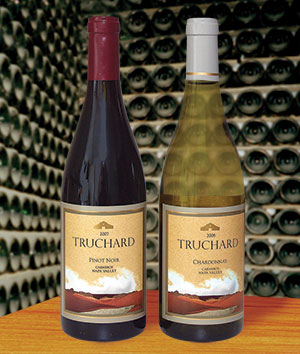
Truchard Chardonnay 2008

A light-yellow colored Chardonnay that starts with pear, citrus, and a hint of sweet banana. The palate is full bodied, with its acidity balanced by flavors of tart green apple, lime, and very light oak. The finish is dry, with suggestions of lemon pith and spice.

Try this Chard with Roasted Trout, Squid with Spinach, or Shrimp with Canellini Beans.

Truchard Pinot Noir 2007

This lean, Old World-style Pinot Noir opens with a bouquet of plum, red berry, and tea. On the palate, the wine is medium bodied and balanced, starting with a bit of sweet vanilla and moving on to spicy oak, cranberry, leather, and tobacco. The finish is dry, with delicate tannins and a hint of bitterness.

People who don’t like “fruit bombs” will enjoy this wine. This Pinot should pair well with Fried Veal Cutlets in Tomato Sauce, Peppery Beef Stew, and Meatloaf.

www.truchardvineyards.com/

Back to blog posts: winervana.com/blog/


Landmark Winery

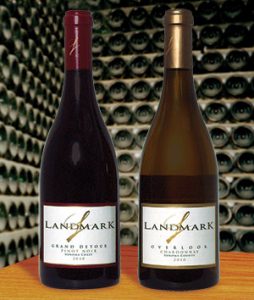
Landmark Winery Grand Detour Pinot Noir 2010 and Landmark Winery Overlook Chardonnay 2010

Landmark Winery

Since its founding in 1974 by Damaris Deere Ford, great-great granddaughter of John Deere, Landmark Vineyards has called Sonoma County home. Originally located in Windsor, California, in 1989 Landmark moved to the heart of Sonoma valley to escape the encroaching urbanization to the north.

In 1991, Landmark decided to focus primarily on Chardonnay. This effort was reinforced in 1993 when they retained the highly-regarded winemaker and consulting enologist Helen Turley, who has also worked for wineries such as Pahlmeyer, Bryant Family Vineyard, Colgin, and Blankiet. Turley is credited for being one of the first people in the early 1990s to see Sonoma’s potential for world-class wines, particularly Chardonnay. The work came together nicely in 1997, when Landmark’s 1995 Overlook Chardonnay landed a spot on the Wine Spectator’s Top 100 List, the first of seven such appearances.

Landmark sources its Chardonnay fruit from a variety of growers in Sonoma valley, allowing them to take advantage of a dozen microclimates and growing conditions. Landmark also maintains a modest 11-acre organically-farmed estate vineyard, planted to traditional Chateauneuf du Pape varietals—Grenache, Syrah, Mourvedre, Counoise, and Viognier.

Landmark Winery Overlook Chardonnay 2010

After harvest and pressing, the juice for this wine is racked into French oak barrels. There, indigenous yeasts carry out the primary fermentation. This traditional practice allows a medley of yeast species to each contribute its own unique flavor components to the wine. Next comes a second malo-lactic fermentation. The wine then spends eight to ten months in barrel sur lees, after which it is finally blended.

In the glass, this wine is a pale gold tinged with green. The nose offers aromas of grapefruit and preserved lemon. The citrus theme continues on the palate, abetted by good acidity and just enough oak to temper and mellow the flavors.
Serve this up with Chicken Breasts with Artichokes and Mustard Sauce, or Sea Bass with Gingered Broth.

Landmark Winery Grand Detour Pinot Noir 2010

This Pinot Noir shows that Landmark has a way with reds as well as whites. Grand Detour is sourced from five vineyards in the cool-climate Sonoma Coast appellation. The climate of this region allows the wine to mature at a leisurely pace to improve structure and develop tannins.

This wine is medium brick in color, with a nose of wild strawberries and plums. The taste follows through with plum and other stone fruits. There is plenty of body (especially for a pinot noir) supported by tart tannins.

Salmon en Papillote would be a classic pairing with this wine. Also consider Veal Scallopine with Lemon and Capers or Roasted Pork Loin with Apricot-Armagnac Compote.

www.landmarkwine.com/

Back to blog posts: winervana.com/blog/