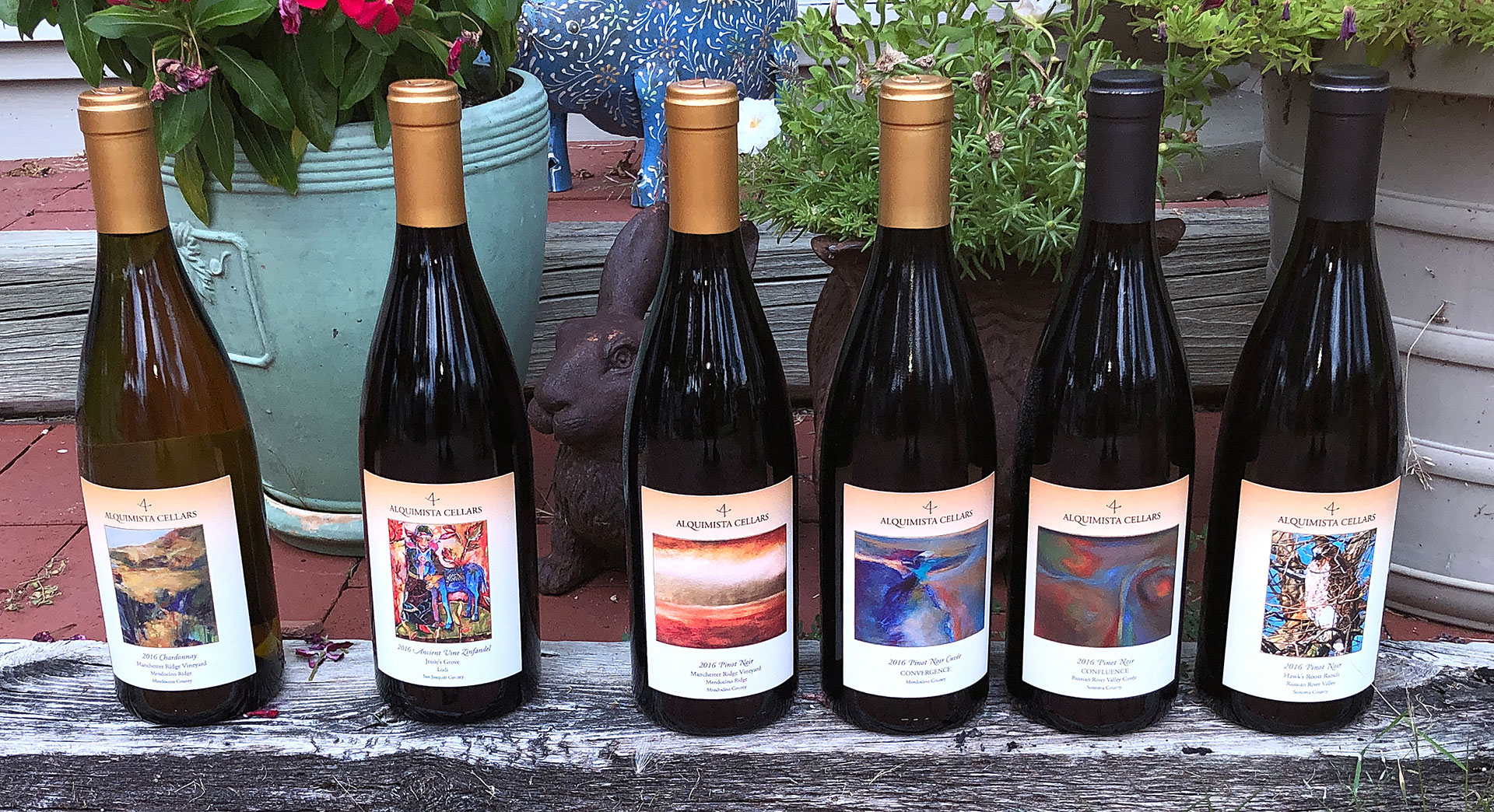
Alquimista Jessie’s Grove Ancient Vine Zinfandel

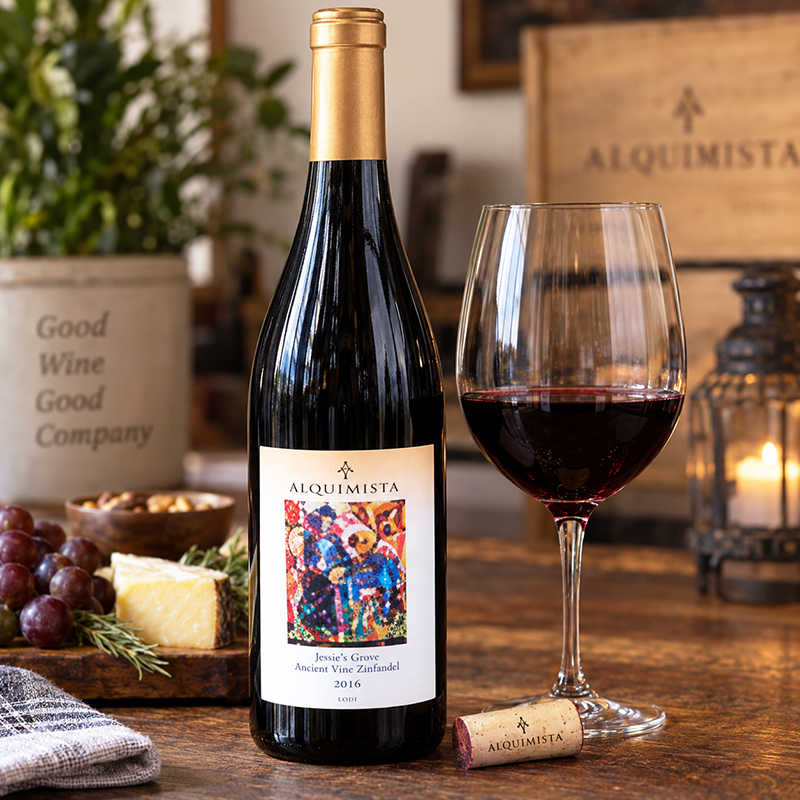
Alquimista Jessie's Grove Ancient Vine Zinfandel 2016
Alquimista Jessie’s Grove Ancient Vine Zinfandel 2016 Click here for tasting notes.

Alquimista Jessie’s Grove Ancient Vine Zinfandel 

Some winemakers and winery proprietors are born into the business. Some buy into the business. And some evolve into it. Greg LaFollette of Alquimista evolved quite successfully. He has been called a “vine whisperer,” a “cellar magician,” and a “tireless coaxer and protector of handcrafted wines.” He is one of Sonoma’s most revered winemakers, and was honored as Winemaker of the Year in 2010. He has also been tagged “Prince of Pinot” by the website of the same name.
first, a career in science

La Follette’s early years were spent as a musician. At 17, he became the bagpiper for the Queen Mary berthed in Long Beach, California. (And he plays the bagpipes to this day.)  “I wanted to be a winemaker since my teens,” admitted La Follette. “But who in Los Angeles becomes a winemaker?” Eventually he decided that neither music nor wine offered a viable way forward, and after earning degrees in Plant Biology and Chemistry, La Follette started his professional career in 1984 at the University of California, San Francisco, as an Infectious Disease  researcher specializing in HIV suppression. While there, he co-authored over a dozen papers in the field. But, he was also still feeling the pull of his early interest in the wine industry. Continue reading “Alquimista Jessie’s Grove Ancient Vine Zinfandel”

Alquimista Cellars

La Follette Cellars

Alquimista Cellars

Some winemakers and winery proprietors are born into the business. Some buy into the business. And some evolve into it. Greg LaFollette of Alquimista evolved quite successfully. He has been called a “vine whisperer,” a “cellar magician,” and a “tireless coaxer and protector of handcrafted wines.” He is one of Sonoma’s most revered winemakers, and was honored as Winemaker of the Year in 2010. He has also been tagged “Prince of Pinot” by the website of the same name.
first, a career in science

La Follette’s early years were spent as a musician. At 17, he became the bagpiper for the Queen Mary berthed in Long Beach, California. (And he plays the bagpipes to this day.)  “I wanted to be a winemaker since my teens,” admitted La Follette. “But who in Los Angeles becomes a winemaker?” Eventually he decided that neither music nor wine offered a viable way forward, and after earning degrees in Plant Biology and Chemistry, La Follette started his professional career in 1984 at the University of California, San Francisco, as an Infectious Disease  researcher specializing in HIV suppression. While there, he co-authored over a dozen papers in the field. But, he was also still feeling the pull of his early interest in the wine industry. Continue reading “Alquimista Cellars”

7 Deadly Wines

7 Deadly Cab Cabernet Sauvignon 2018 and 7 Deadly Zins Old Vine Zinfandel 2017
7 Deadly Cab Cabernet Sauvignon 2018 and 7 Deadly Zins Old Vine Zinfandel 2017. Click here for tasting notes.

7 Deadly Wines

The Phillips family has been farming in Lodi since the 1850s, and cultivating wine grapes since the early 20th century. The founders of Michael David Winery are brothers Michael and David Phillips. They released their first commercial wine in 1984 under the Phillips Vineyards label after years of growing grapes for other wineries on over 800 acres of vineyards in the Lodi AVA. The brothers are fifth-generation farmers who “raised their families in the vineyard,” and they have been joined by Mike’s son Kevin and daughter Melissa as the family continues to thrive. “We, more than most, understand the importance of leaving it better than you found it for future generations. Our family legacy and love of Lodi drive our focus on sustainability,” declared Michael Phillips.

Continue reading “7 Deadly Wines”

Cline Cellars

Cline Cellars

Cline Cellars

As you enter Sonoma county from the south on California 121, one of the first wineries you encounter is Cline Cellars, and there could hardly be a better introduction to the Carneros AVA.

Even as a young teenager, Fred Cline learned to make wine from his grandfather, Valeriano Jacuzzi (yes, he of the hydrotherapy tub, as well as many other innovations). With a $9000 inheritance from Valeriano, in 1981 Cline founded the eponymous Cline Cellars in Oakley, California.

The winery was relocated to its current location in 1991. The property is the original site of the Mission San Francisco de Solano, the 21st and final of the historic California missions. Although the mission was moved in 1823, the Cline tasting room is located in a rustic 1850s farmhouse that is original to the property, surrounded by spring-fed ponds and thousands of rose bushes. The vineyards also reflect this history, with vines ranging from 80 to 120 years old.
Cline is one of the first of the pioneering Rhone Rangers, a group dedicated to wines from the grapes of the Côtes du Rhône in France (ironic for a boy with an Italian grandfather, no?)

Cline also has been a pioneer in sustainable farming. It is the second-largest completely solar-powered winery in California. Natural cover crops are used to nourish the soils, sheep and goats roam freely as they graze on weeds, and compost teas are used as fertilizer. “We’d be considered ‘organic’ if we wanted to follow the rules of the government,“ said Cline. “We are actually more sustainable [than the law calls for] by not following their organic rules.“ He calls his methods “beyond organic.”

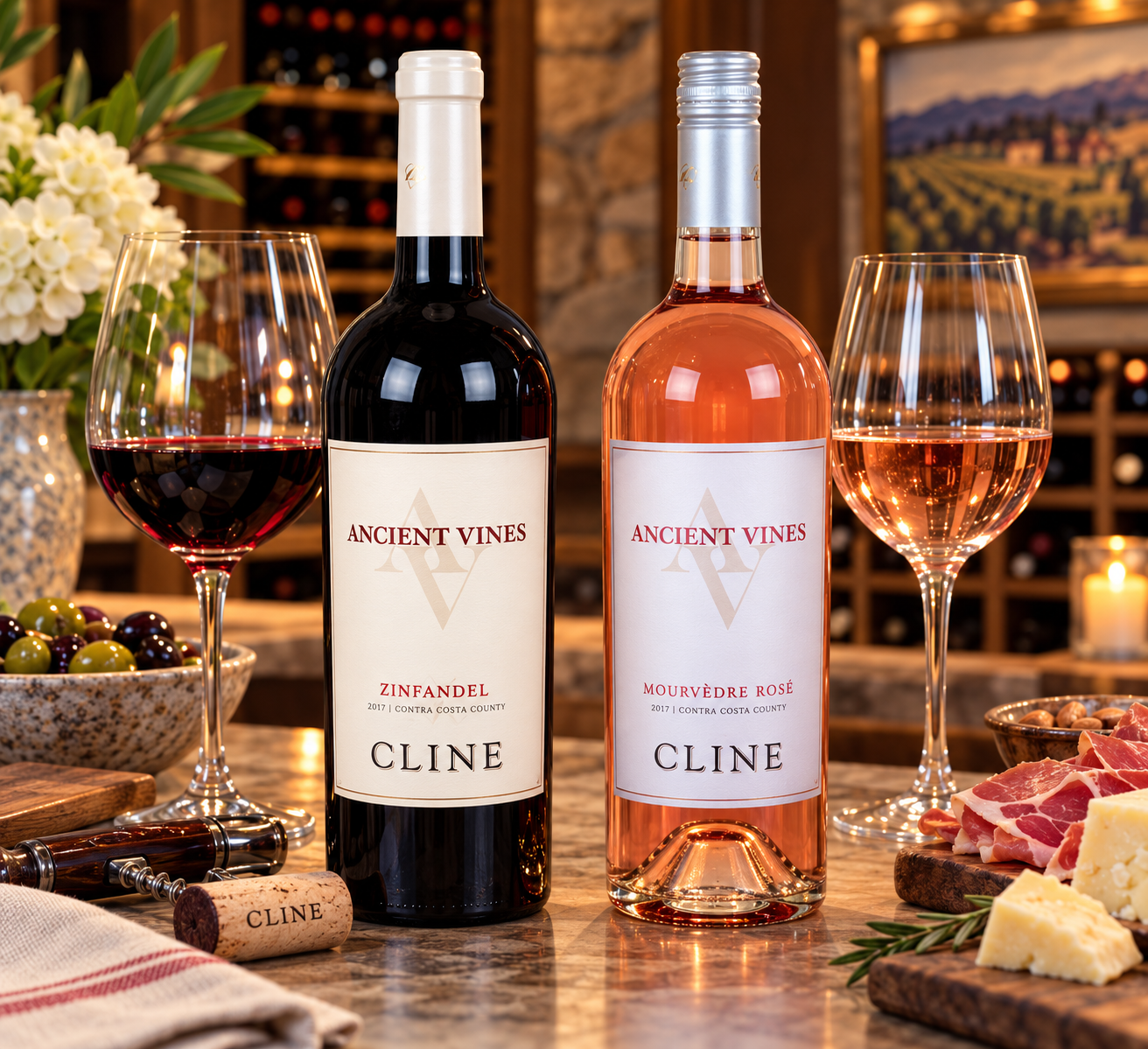
Cline Cellars Ancient Vines Mourvèdre Rosé 2017

C’mon! Don’t be afraid! Summer’s here, and what could be better than rosé? There are all kinds of dry, crisp expressions available, absolutely none like the dreaded cloying White Zinfandel of days gone by. This selection is an excellent place to start.

Fresh herb and strawberry aromas are followed by tart watermelon and just a hint of lemon peel and thyme flavors in this medium-bodied, smooth, and rather soft-textured wine.

Excellent as a well-chilled aperitif, or pair it with raw oysters, lobster Newburg, or planked salmon.

Cline Cellars Ancient Vines Zinfandel 2017

The grapes for this Zin were planted by Italian and Portuguese immigrants in the sandy, phylloxera-resistant soils of Oakley, California, more than 100 years ago. Ancient, indeed. This dusty-ruby colored wine is lively and supple, with raspberry and baked stone fruit aromas. Tart cherry predominates on the medium-full body, complemented by medium tannins, moderate vanilla oak, and just a hint of pepper.

Serve this up with venison sausage and smoked gouda pizza, Kentucky burgoo, or barbequed duck.

clinecellars.com/

Back to blog posts: winervana.com/blog/

BACA Wines

BACA Wines.
BACA Cat’s Cradle and BACA Double Dutch. Click here for tasting notes.

The eponymous Kathryn Hall Wines are known for their Cabernet Sauvignons. A second label, WALT Wines, specializes in Pinot Noir and Chardonnday. In 2016, Ms. Hall’s daughter, Jennifer Brown,  launched a third winery for the family named BACA Wines. Latin for ‘berry,’ BACA’s focus is on California Zinfandel. According to Brown, “When we set out to create the BACA brand, we had one mission in mind: to produce luxury Zinfandels that are nuanced, honest, current, and fun. We saw a gap in the market with the Zinfandel varietal, so we decided to craft a luxury Zin brand aimed at the curious and the adventuresome – while focusing on quality.”

Continue reading “BACA Wines”

Federalist Wines

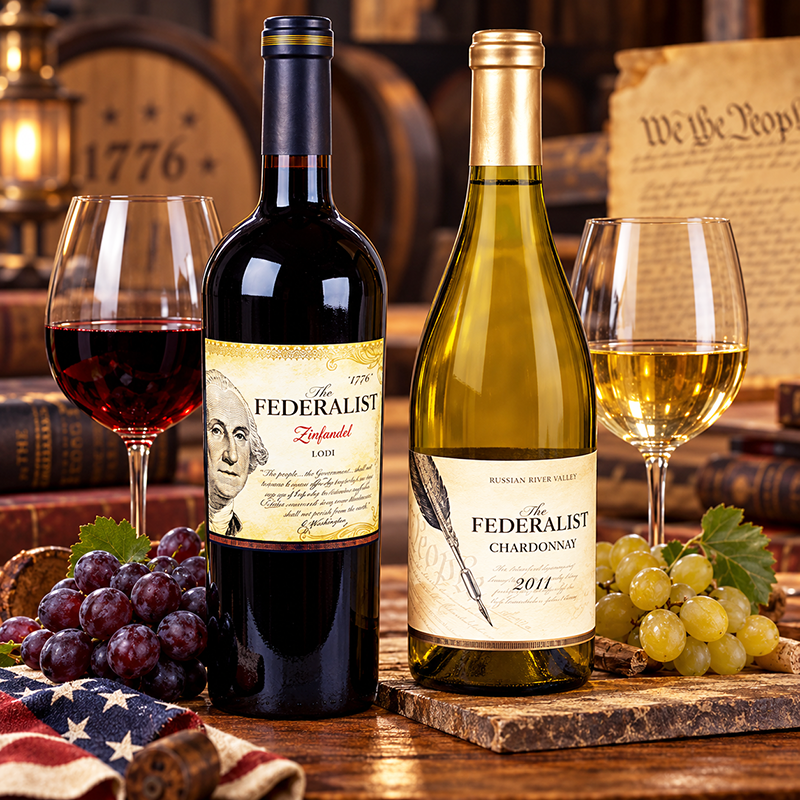
The Federalist ‘1776’ Lodi Zinfandel 2013 and The Federalist Chardonnay 2011
The Federalist ‘1776’ Lodi Zinfandel 2013 and The Federalist Chardonnay 2011. Click here for tasting notes.
The Federalist Wines

The Federalist, later known as The Federalist Papers, is a series of tracts written in support of the ratification of our nascent nation’s Constitution. The Federalists believed in strong national government, supported modernization, manufacturing, and industrial development, and the use of a tariff to fund the Treasury. (That’s the IRS, folks.) They supported a national Bank of the United States, and funding national and state debts incurred during the Revolutionary War. In foreign affairs the Federalists opposed the French Revolution, and sought a strong army and navy. Noted Federalists were: Alexander Hamilton, James Madison, John Jay, George Washington, and John Adams, the only Federalist president of the U.S.

The Federalist wines are produced by the somewhat mysterious 2Sons Winery, which is owned and managed by the Terlato Family wine empire. The vineyards and winery were founded in 1981. Three friends, John Grace, Mark Rafanelli, and Philip Staley (so why isn’t the winery named 3Sons? See? Mystery.), joined forces and purchased the site that was formerly the Alderbrook Estate. In 2000 the Terlatos were asked to develop a long-range plan to produce world-class wines and market 2Sons throughout the U. S. The Terlatos later purchased a majority share, and invested in both vineyard sources and winery to provide the winemaking team with the best grapes and equipment available. This has helped position the winery to produce single vineyard and estate wines with an on-going focus on Zinfandel.

The Federalist Chardonnay 2011

This golden Chardonnay hails from the Russian River Valley AVA’s northern end near Healdsburg, approximately 80 miles north of San Francisco. Things start out with aromas of lemon and green apple. The lemon continues on the palate, with the addition of lime and pear. All of this means a bracing acidity, of course. The oak is certainly present, adding to a round, rich mouth feel, as is just a hint of sweetness. The nicely long finish features hints of cinnamon and bitter almond.

Separate Chardonnay blocks were barrel fermented in 30% new oak and aged in barrel for nine months. 2500 cases were produced.

This food-friendly wine calls for an Artichoke and Leek Frittata, Dungeness Crab Risotto with Lemon and Parsley, or Steamed Mussels with Saffron Aioli.

The Federalist ‘1776’ Lodi Zinfandel 2013

We now travel from 80 miles north of San Francisco to 80 miles east, to the vineyards near Lodi, which produce about 18% of California’s wine grapes, more than Sonoma and Napa combined. The area is particularly hospitable to Zinfandel, a uniquely American grape, and this wine is no exception.

The nose reveals red fruits: cherry with a bit of plum. This dark-purple wine features flavors of blackberry, plum, and cinnamon. It also includes Zinfandel’s characteristic pepperiness, which some winemakers are moving away from.

Enjoy this Zin with Bruschetta with Cherry Tomatoes, Wine Braised Short Ribs with Balsamic Glaze, or Grilled Rib-eye Steaks with Roasted Garlic Butter.

federalistwines.com/american-craft-wine

Back to blog posts: winervana.com/blog/

Cline Cellars

Cline Cellars

Cline Cellars

As you enter Sonoma county from the south on California 121, one of the first wineries you encounter is Cline Cellars, and there could hardly be a better introduction to the Carneros AVA.

Even as a young teenager, Fred Cline learned to make wine from his grandfather, Valeriano Jacuzzi (yes, he of the hydrotherapy tub, as well as many other innovations). With a $9000 inheritance from Valeriano, in 1981 Cline founded the eponymous Cline Cellars in Oakley, California.

The winery was relocated to its current location in 1991. The property is the original site of the Mission San Francisco de Solano, the 21st and final of the historic California missions. Although the mission was moved in 1823, the Cline tasting room is located in a rustic 1850s farmhouse that is original to the property, surrounded by spring-fed ponds and thousands of rose bushes. The vineyards also reflect this history, with vines ranging from 80 to 120 years old.
Cline is one of the first of the pioneering Rhone Rangers, a group dedicated to wines from the grapes of the Côtes du Rhône in France (ironic for a boy with an Italian grandfather, no?)

Cline also has been a pioneer in sustainable farming. It is the second-largest completely solar-powered winery in California. Natural cover crops are used to nourish the soils, sheep and goats roam freely as they graze on weeds, and compost teas are used as fertilizer. “We’d be considered ‘organic’ if we wanted to follow the rules of the government,“ said Cline. “We are actually more sustainable [than the law calls for] by not following their organic rules.“ He calls his methods “beyond organic.”

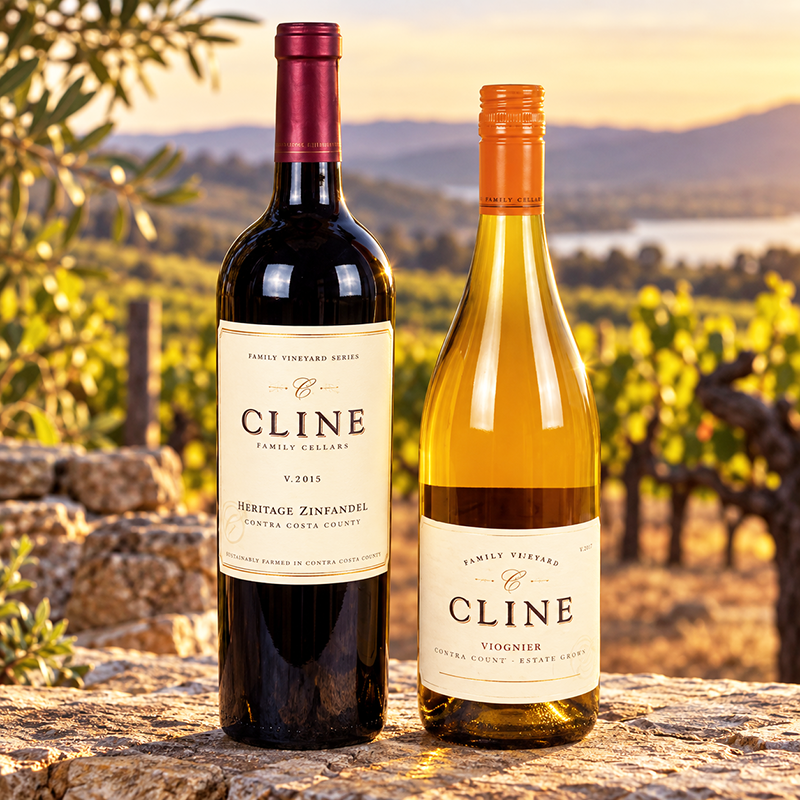
Cline Cellars Viognier 2017

Ah, Viognier [vee-oh-NYAY], such an elusive and underappreciated wine. The grapes are finicky to grow, and once vinified exhibit a wide range of floral qualities, some more delightful than others.

This expression is pale reddish-golden in the glass, with a BAM! nose of honeysuckle. This is followed on the palate by the expected flavor of peach, as well as mango and sour orange. This unoaked wine tastes dry, but has a surprising, slightly sweet finish. To enjoy its nuance, do not overchill.

Drink this tipple with braised tuna in white wine, oven-braised halibut steaks, or Provençal seafood with aioli.

Cline Cellars Heritage Zinfandel 2015

The provenance of this Zin is the 100-year-old Big Break, Live Oak, and Bridgehead vines in Oakley, which are dry-farmed in deep, sandy soil. It is crystal ruby in the glass. Flavors of cola, blueberry, and coffee greet you on the tongue. There is just a hint of Zinfandel’s characteristic pepper. The body has a nice satin quality, supported by nicely balanced medium tannins and acidity. An eminently drinkable wine.

Enjoy this red with braised pork with sweet and hot peppers, Niçoise chicken with tomatoes and black olives, or lamb with artichokes.

Back to blogposts: winervana.com/blog/

Pedroncelli Winery

Pedroncelli WineryPedroncelli Winery

Pedroncelli was founded in 1927 in Geyerserville, California, during the middle of Prohibition, and began by selling grapes to local home winemakers. After Repeal in 1933, Pedroncelli began to make their own wines in a winery that had been sidelined as a barn.

In 1949, John Pedroncelli Jr., son of the founder, made and released the label’s first Zinfandel, using fruit from vines still being harvested today, the so-called Mother Clone. The first Cabernet Sauvignon appeared in 1966.

In the late ‘70s, Pedroncelli transitioned out of the jug wines they had been making and began to focus on mainstream varietals, and the ‘80s saw the beginning of an extensive vineyard replanting effort.

Nearly 100 years later, Pedroncelli continues to be owned and operated by the founding family.

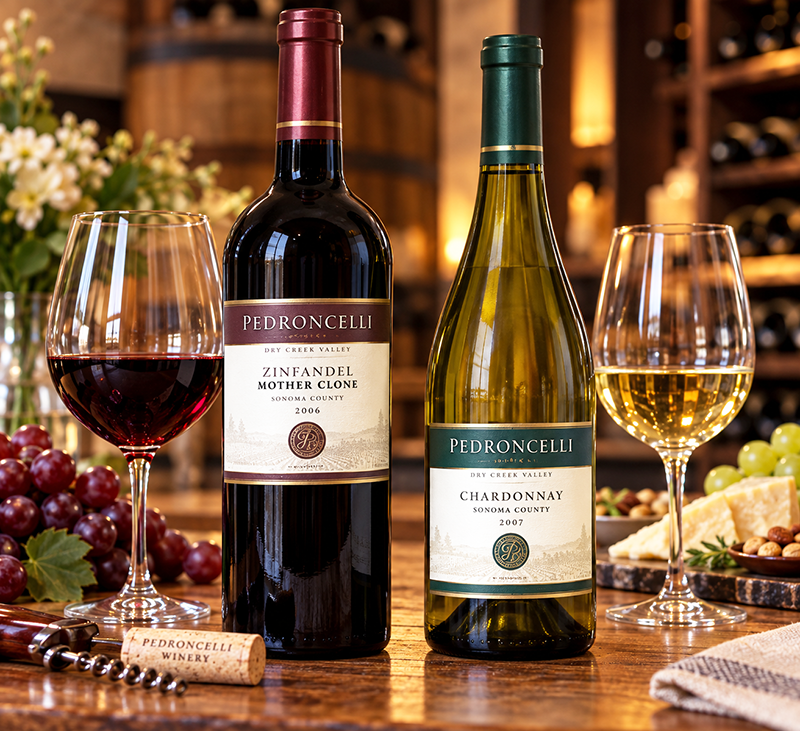
Pedroncelli Winery Mother Clone Zinfandel 2006

This straightforward Zinfandel is a clear ruby red in the glass. The taste is quite dry, even astringent, with a hint of dust. The pepper note often characteristic of Zin is present but not dominant, and is balanced by aromas of boysenberry and blackberry. The finish is moderately short. After decanting for at least an hour, pair this with just about anything from the grill.

Pedroncelli Winery Chardonnay 2007

Made from 100% Chardonnay, this wine much more resembles a Sauvignon Blanc. It has plenty of citrus tartness, balanced by undertones of melon and pear. If you’re not a fan of wood, although 30% of the wine was aged in oak it’s almost not detectable.

www.pedroncelli.com/

Back to blog posts: winervana.com/blog/