
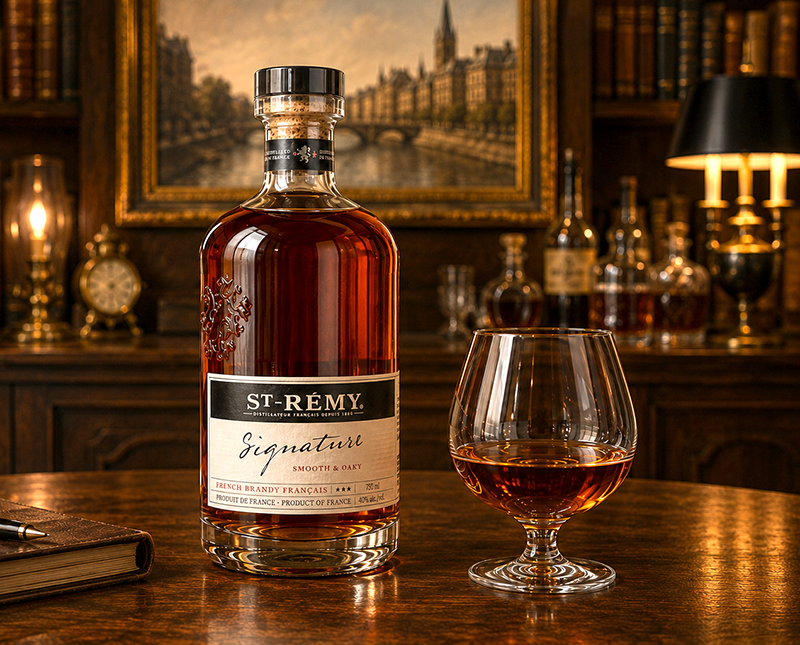
St. Rémy Signature French Brandy
Rémy Martin is one of the world’s oldest and best known Cognac brands, with selections that range, at my local liquor store at least, from the $13 St. Remy French brandy to the $9000 Rémy Martin Louis XIII Time Collection: City of Lights – 1900. (I have tried one of these, but not both.)
Rémy Martin was founded in 1724 in the Cognac region of France by Paul-Emile Rémy Martin. He was born in 1695 near Rouillac in southwestern France, the son of a vine grower. At 19, he married the daughter of a local notary, and 10 years later, in 1724, he established a Cognac trading house. On his death in 1773, the business passed to his grandson, also named Rémy, who was also the local tax collector. In time, his son inherited the business, which saw a four-fold increase in the region’s trade between 1810 and the early 1820s. In 1841, Paul-Emile-Rémy Martin (the family gave just about every male heir the same name, apparently) assumed control and oversaw even greater growth. He introduced the innovation of selling in bottles as well as the traditional casks. An early and skillful marketer, he added a logo to the bottles and cases; a centaur after Sagittarius, Martin’s zodiac sign, and registered the firm’s first trademarks in 1874. Following him, as so often happens in dynastic families, the fifth-generation proprietor nearly bankrupted the operation.
It was saved in 1927 by André Renaud, the son of a Grande Champagne grower, who was also a lawyer, a merchant, and who had been involved in E. Rémy Martin & Co. since 1910. He reduced quantity, increased quality, and applied the VSOP designation, an eighteenth century term for old Cognacs. (VSOP, like VS and XO, are traditional terms that specify the age of the Cognac, but not its quality.) By the time Renaud died in 1965, the company was selling 300,000 cases a year, and was the leader in the premium Cognac segment. Rémy Martin continued to rise under André Hériard-Dubreuil, André Renaud’s son-in-law. He constructed a modern production facility and introduced the now iconic frosted bottle for the VSOP in 1972. As they came of age, his children joined him, notably his daughter Dominique Hériard-Dubreuil who became general manager in 1988, and president two years later when Rémy Martin merged with Cointreau. (The move was controversial because the families that controlled each house had been feuding for decades.)
Rémy Martin is now one of the “big four” Cognac houses (along with Hennessy, Courvoisier, and Martell), responsible for producing most of the world’s Cognac. Rémy Martin itself sells around 2.2 million cases of Cognac annually, more than 80% of Fine Champagne Cognacs.
St. Rémy Signature French Brandy
One of the first things to know about St-Rémy Signature is that it is not a Cognac—it is a 100% French brandy.
Unlike Cognac, whose grapes must come from a defined region, St-Rémy draws on wines from many areas around France, including, the Loire Valley, Burgundy, Bordeaux, Rhône, Languedoc-Roussillon, Beaujolais, and the Champagne region.
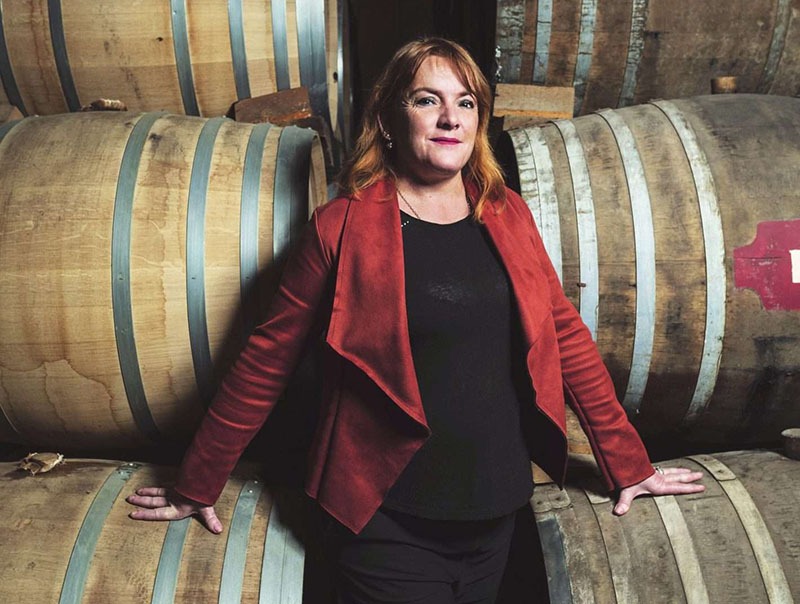
Signature debuted in 2020 when Master Blender Cécile Roudaut wanted to create what she described as “a new face for brandy.” Instead of simply releasing an older expression, she reworked the production process to appeal to drinkers who enjoy bourbon, rye, and single malt whisky.
Unlike Cognac, which must use pot stills, St-Rémy uses continuous copper column stills, producing a spirit that is generally, lighter, smoother, and more fruit-forward. And, Signature carries no age designation such as VS or VSOP (which only have real meaning for genuine Cognacs anyway).
Signature pours a clear bright amber with mahogany highlights. The nose features toasted oak and light baking spices. It is sweeter and more oak-driven than classic VSOP. The medium-bodied palate is a bit hot, and includes toasted nuts, vanilla, caramel, and gentle oak. The finish is medium-long and slightly spicy.
Like most large French brandies outside the Cognac appellation, Signature contains a modest amount of sweetness added during blending to achieve its intended house style. That contributes to its approachable, rounded character compared with many drier Cognacs. It doesn’t have the layered rancio [oxydization], dried-fruit complexity, or remarkable length of a mature Cognac, making it more approachable than profound. ABV is 40%.
Read about Remy Martin 1738 here.
This brandy not quite what you’re looking for? Read my other brandy reviews here.
Listen to my podcast about brandy, Cognac, and Armagnac here.
A note about brandy vs. Cognac: brandy is a liquor distilled from wine and aged in wood. (Brandy can be made from fruits other than grapes as well, but that’s a story for another time.) Cognac is brandy that specifically comes from the town of Cognac and the delimited surrounding areas in western France. (The one which has the most favorable soil and geographical conditions is Grande Champagne.) So, all Cognacs are brandy, but not all brandies are Cognac. For more detail on Cognac, click here.
Back to blog posts: winervana.com/blog/