Brooks Wines

Brooks Ara Riesling 2018
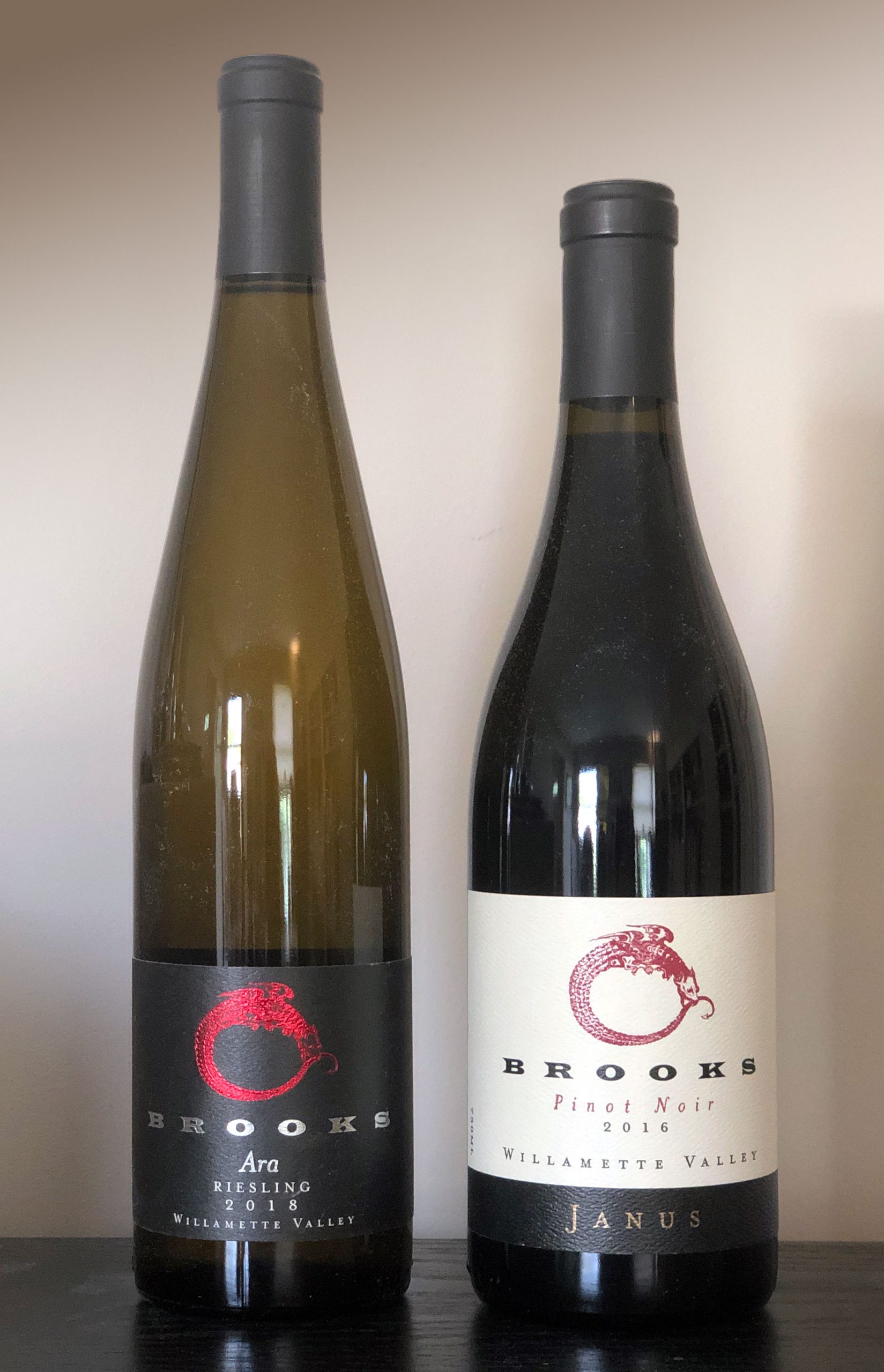
Brooks Ara Riesling 2018 and Brooks Janus Pinot Noir 2016. Click here for tasting notes.

The Brooks Winery of Amity, Oregon in the Willamette Valley was founded in 1998 by Jimi Brooks, a native of Portland and son of a pediatrician.  The winery’s production is focused on Pinot Noir and Riesling, and includes about 20 selections of each in any given year.  Brooks also dabbles in Tempranillo, Muscat, Pinot Gris, Pinot Blanc, Melon de Bourgogne (aka Muscadet),  Gewurztraminer, and Viognier, all sourced from nearby vineyards.

All of the Pinot Noirs are destemmed and cold soaked; all of the whites go straight to press. In the winery, small lot fermenters are used and the components are kept separate until right before blending. For all Pinot Noirs, all estate fruit, and most whites, fermentation is driven by only the yeasts naturally occurring on the grapes, and the coolest fermentation temperatures possible are adhered to. Finally, the reds are finished in French oak, while the whites are all made in stainless steel.
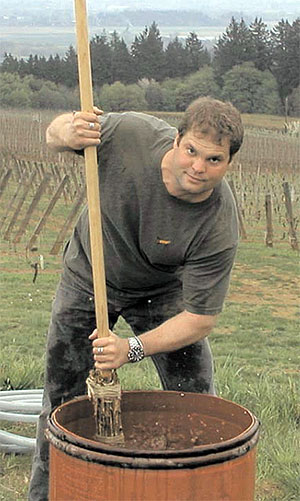
The free-spirited Jimi Brooks began his career by spending eight years throughout Europe, particularly Beaujolais, learning his craft in the vineyards and wineries there. After that sojourn, he returned to Oregon committed to a life in wine, based on his own intuition as well as holistic and Biodynamic farming practices, still a relative novelty just over twenty years ago. He continued to hone his skills with winemaking stints at Maysara and WillaKenzie Estate wineries before establishing Brooks Wines.

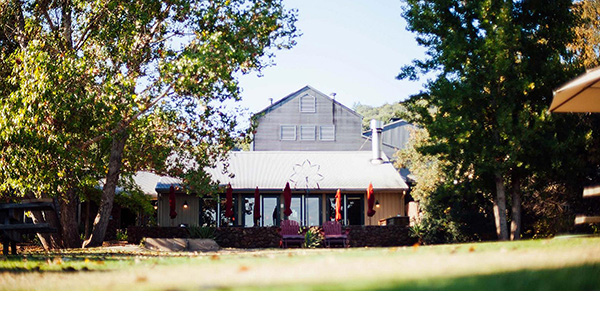
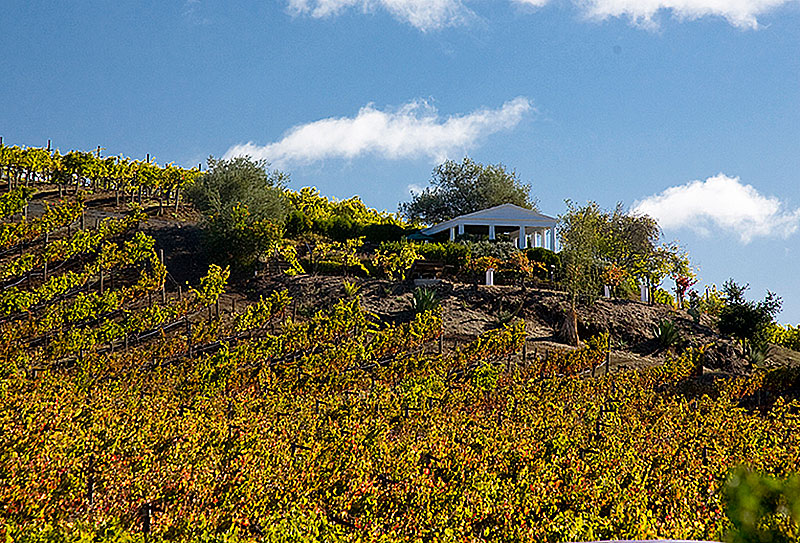
In 2008 the winery purchased the estate vineyard it had been working since 2002.  Plantings include Pinot Noir and Riesling vines that are now over 35 years old, and contribute about 30% of Brooks’ fruit. Official Biodynamic certification from Demeter was obtained in 2012.  This was followed by the opening of an entirely new winemaking facility and tasting room in 2014, which overlooks the Cascade Range and Willamette Valley.

Brooks Wines’ motto is Peace/Bread/Land/Wine.

Peace

It may seem rose-colored, but Brooks genuinely believes in kindness, inclusivity, caring, community, and social responsibility as guiding principles.

Bread

Brooks features a number of culinary experiences from cooking classes to wine and food pairing classes.. Their organic garden supplies herbs, vegetables, and cut flowers. Their eggs come from chickens on the property which are fed organically. Anything that doesn’t come directly from the grounds is sourced locally.

Land

Careful stewardship of the estate vineyard is achieved by
• Utilizing a rock garden to diffuse rain water.
• Encouraging botanical species diversity
• Protecting predator habitats
• Applying balanced crop nutrition
• Rotating cover crops
• Not using synthetic chemicals to control pests or diseases
• Utilizing mechanical weed control

Wine

Riesling is the bedrock at Brooks, and they claim to produce more of it than any other winery in America.

A bittersweet success

Behind all of this accomplishment lurks sadness and tragedy. Founder Jimi Brooks suddenly died in 2004 just before harvest at the age of 38 from the rupture of an aortic aneurysm (an abnormal bulge that occurs in the wall of the major blood vessel  that carries blood from the heart to the body). Winemakers from all over the Willamette Valley, many of them competitors, volunteered to help the Brooks family cope with his untimely death and keep the winery open. The following year the winery was bequeathed to Jimi’s son, Pascal, who was eight when his father died and became the youngest winery owner in the world.

Once the future of the operation was assured, two key figures emerged. Brooks’ friend and assistant winemaker Chris Williams ascended to full-time winemaker. Brooks’ sister, Janie Brooks Heuck, reluctantly became head of winery operations.  It’s quite the commitment; she lives in California with her husband and two children and is constantly commuting between the two states.  It is a commitment that has paid off, though.  Under her supervision the business has grown by 400%.
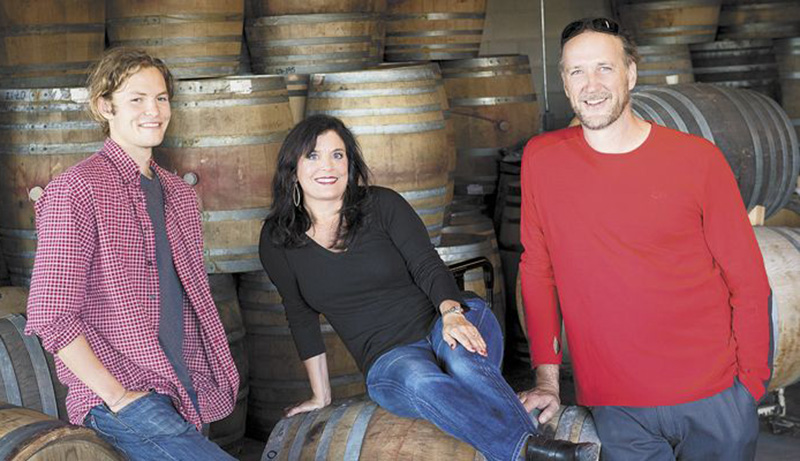
L to R: Pascal Brooks, Janie Brooks Heuck, and Chris Williams


Heuck had always had been close to her brother. “We were a year and a half a part. As adults and parents, our conversation centered around our children and his business,” Heuck said. “It’s not so much that the winery brings back memories for me, but I [continue to] learn about new stories and memories that would have been Jimi’s.”

She believes the wines are a vehicle for conveying an important message about life, about living in the moment and to the fullest, about keeping the big picture in mind. “I feel like through the wines and the experiences that people are having,” she said, “the connections and the conversations and the sharing of the Brooks story, and having it remind people of how important every day is and every moment is. I just don’t ever want that to stop. The more lives we can touch and the more times the story is told and the more it brings perspective to people, that’s the gift from this whole situation.”

If you have access to Amazon Video, the film American Wine Story profiles Jimi Brooks and a number of other winery owners drawn to the business based on sheer passion.
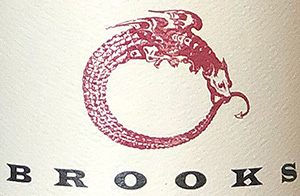
Brooks Wines’ distinctive logo is an ouroboros (or uroboros).  It is an ancient symbol depicting a serpent or dragon eating its own tail to assure its future existence. Originating in ancient Egyptian iconography, the ouroboros entered western tradition via Greek magic and mysticism. Heuck shared, “We like to talk about it symbolizing the circle of life, continuation. My brother got it as a tattoo on his left shoulder in the early ’90s. It meant so much to him that he decided to make it his wine label.”

Although Pascal remains emotionally invested in the winery and his father’s legacy, he is at the beginning of his life journey and feels the need to find his own way. Now 24 years old, Pascal is living in Paris after graduating from UC Santa Cruz in 2018 with a double major in creative writing and sustainable agriculture, an interesting pairing for sure. He has been working as a wine steward there and also doing urban rooftop farming. Following in his father’s footsteps, in 2019 he worked harvest at Domaine Dechamps, and currently is involved at Domaine Ostertag in Alsace. (Read more about a pivotal part of Jimi Brooks’ time in France here.)

Brooks Ara Riesling 2018

Brooks has staked their reputation on Riesling, so they better know what to do with it.  Happily, this expression doesn’t disappoint.  Indeed, it’s one of the most interesting Rieslings I’ve ever had.  Ara (the Altar), is a constellation. In ancient Greek mythology, Ara was the altar where the gods first made offerings and formed an alliance before defeating the Titans. This was one of the very first Rieslings Jimi Brooks made after starting his winery, and the name reflects his passion and interests in mythology and astrology.

The wine is 100% Riesling, half from the Brooks estate vineyard in the Eola-Amity Hills AVA and half from the Yamhill vineyard in the Yamhill-Carlton AVA. It is a bright lemon yellow in the glass, with aromas of lemon curd and orange blossom.  The lemon theme continues on the palate, with the addition of nectarines, Sweetarts, and apples, but the wine is definitely dry.  The flavors are well-supported by tingly acidity.   ABV is 14% and just 325 cases were produced.

Brooks Janus Pinot Noir 2016

Brooks considers this their flagship Pinot Noir, and was Jimi Brooks’ first Pinot release.  Janus was the two-faced Roman god who looked both to the past and future, a reference now to the winery’s timeline being divided by Jimi Brooks’ premature death.

This 100% Pinot Noir was sourced from 60% Brooks Estate and the remainder from seven other sites around Willamette Valley. After fermentation, it saw 18 months in French oak barrels. It is a medium purple in the glass, with a nose of rich plum, vanilla, and rose.  The palate features tart cherry, ligonberry, and black tea on the medium finish, all supported by lively acidity and balanced tannins. The ABV is 13.8% and 1000 cases were made.

www.brookswine.com/

Back to blog posts: winervana.com/blog/
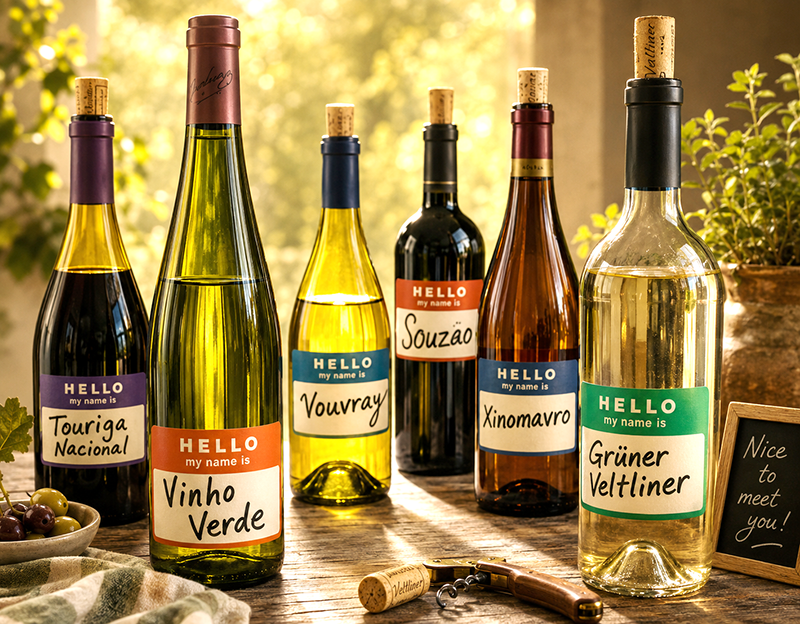
Unusual and Exotic Wines

Unusual and Exotic Wines from Around the World

Unusual and Exotic Wines from Around the World

Looking for something completely different?  Here are some grape varieties and wines from around the world to consider to really shake up your drinking experience.

Argentina

Charbono is a relatively obscure French variety, but today it is much more widely grown in Argentina, as well as Napa Valley. It is often mistaken for the more common Dolcetto grape, though genetic testing has proven that they are not related. This grape produces a dark wine that is high in both tannins and acidity.

Austria

Austria offers Gruner Veltliner, its most widely-planted varietal. Gruner’s naturally high acidity makes it one of the world’s best food wines, especially with spicy cuisine. It can be light and easy, or with lower yields and higher ripeness, it can burst with aromas of white flower and flavors of grapefruit, herbs, mineral, and fresh-ground white pepper. .

The Austrian red varietal Blaufränkisch has characteristics of both Pinot Noir and Syrah. (And it is sometimes incorrectly thought to be the same variety as Gamay.) The wines it produces are lighter-styled reds, usually with plenty of acidity. It is grown in Germany, as well, where it is usually called Lemberger.

France

Gewürztraminer is thought to have originated in Italy’s Alto Adige region, but is now mostly famously grown in Alsace, located between France and Germany. It is planted throughout other nations in Europe, as well as California, Oregon, Washington, and New Zealand. These highly fragrant and crisp wines have flavors of spices such as clove, nutmeg, and lychee. You should drink a Gewürztraminer when young; they won’t last past five years.

Picpoul is normally grown in the Languedoc-Roussillon region of France, but is also sometimes grown in Spain. It is notable for its strikingly high acidity. One reason this grape isn’t as well known as others is because it is much more likely to develop a certain kind of fungus, making it more difficult to grow. There are three varieties of Picpoul: Picpoul Noir, Picpoul Gris, and the most well-known variety, Picpoul Blanc. Piquepoul Blanc is used both for blending and for varietal wines. Red wines produced from Picpoul Noir are high in alcohol, are richly scented, but have a very pale color, which has made the variety more popular as a blending ingredient than as a producer of varietal wines.

Valdiguié also hails from the Languedoc-Roussillon region. In the 1980s, this grape experienced a boom in Napa Valley, but poor cultivation and problems with disease quickly ended that. However, recently some intrepid wine makers in the United States have been trying to save Valdiguié’s tarnished reputation. When properly cultivated and prepared, Valdiguié is a unique wine, one with distinct fruity notes and a sweet-and-sour flavor profile, with a notably low alcohol conent.

Vouvray is the largest white wine appellation of the Anjou-Saumur-Touraine region of the Loire Valley, known for its siliceous-clay and limestone-clay soils and cool climate. The wine is made from the Chenin Blanc grape, grown in the region since the fourth century. It is capable of both dry wines and elegant sparklers. In years when botrytis cinerea, the mold responsible for sweet whites, hits, harvest is delayed in order to pick the grapes at their peak ripeness to produce a rich dessert wine.

Georgia

Grown in Georgia (the country, not the state) the white varietal Rkatsiteli can drink like a Pinot Grigio. It’s also popping up in wines from New York’s Finger Lakes region, having been adopted and planted by the Dr. Konstantin Frank Winery there.

Mtsvane is like Sauvignon Blanc, but without the grassy notes that I find to be off-putting.

Kisi has been described as something between Chenin Blanc and Viognier on steroids.

Finally, Georgia’s Tavkveri is a workhorse, and the best examples are often vinified as light red wines (ala Beaujolais), with similar tangy, red-fruited, bright, and zesty characteristics.

Greece

Assyrtiko hails from the island of Santorini, where the volcanic soil produces juicy wines with good body and high acidity, great with South Asian food.

Malagousia is a rare variety grown mainly in Macedonia, with flavors of white peaches spritzed with jasmine.

Moschofilero, a pink/gray-skinned grape grown in central Peloponnese, has vibrant citrus acidity, attractive aromatics such as exotic spice and violet, and is often made as a Rosé.

Retsina, the wine I like to call “The Greek Wine Even Greeks Won’t Drink.” The traditional grape for Retsina is Savatiano with Assyrtiko and Rhoditis sometimes blended in. Retsina is made like other white wines, but with the addition of small pieces of Aleppo pine resin being added during fermentation. It is this pine resin that gives Retsina its name, as well as its unique flavor profile.

From Macedonia comes Xinomavro, Greece’s premier red grape, which typically shows characteristics of red fruit, sun-dried tomatoes, kalamata olives, and spices.

Hungary

Egri Bikaver (”Bull’s Blood of Eger”), is a vintage-dated red wine that is made mainly from the Kadarka grape. I’ve been drinking it for decades, and it is relatively widely available, but aside from Hungarians it seems as almost no one knows about it.

Italy

Sicily’s white Carricante is likened to cool-climate Chardonnays, and the red Nerello Mascalese, with its earthy, herbaceous, yet muscular notes echoes some of the wines of Burgundy.

Verdicchio is a white wine grape grown mainly in the Marches region. The wines made from it have a subtle greenish hue, are generally crisp and dry, and have a light but elegant aroma and flavors of minerals and lemon. Verdicchio traditionally comes in a green, two-handled urn-shaped bottle called an amphora.

Portugal

Grapes such as Souzao and Touriga Nacional, traditionally used to make Port, can make a classic table wine, too, that tends to be juicy and unpretentious. They are drink-me-now wines, particularly those from Douro, which stretches across north-central Spain and Portugal.

Vinho Verde comes from Portugal’s largest designated growing region. The wines made from it are slightly effervescent, can be red or white, are fresh and fruity and are meant to be drunk while still young.

South Africa

South Africa is famous for its Pinotage, but it’s an enthusiasm I don’t share. It was cultivated there in 1925 as a cross between Pinot Noir and Cinsaut. It typically produces deep red wines with flavors of smoke, bramble, and earth, sometimes with notes of bananas and tropical fruit.

Orange Wine

Emerging recently is a new category called orange wine. While Rosé is made from red grapes with a little grape skin contact to impart a small amount of color, orange wine is made from white grapes with extended skin contact creating anywhere from a peach to orange to amber color. So, since orange wine is a “white wine” made in the style of a red, there is at least the potential for plenty of flavor.

Ice Wine

Ice wine is a type of dessert wine produced from grapes that have frozen while still on the vine. The sugars and other dissolved solids do not freeze, but the water does, and this makes for a more concentrated juice, which is then pressed from the still-frozen grapes in unheated wineries. This is then fermented, resulting in a small amount of highly concentrated, very sweet wine with high acidity.

Ice wine production is risky (the frost may not come at all before the grapes rot or are otherwise lost) and requires the availability of a large enough labor force to pick the whole crop within a few hours, at a moment’s notice, on the first morning that is cold enough. This low yield both in the field and in the winery makes them generally expensive. Canada is the largest producer, followed by Germany. There are also ice wine producers in the Niagara region of New York.

Odd-Ball Wines

The Rapazzini Winery of Gilroy, California, “Garlic Capital of the World,” makes four garlic-infused wines, two reds and two whites. British wine expert Oz Clarke once braved one of the garlic white wines, describing it as an “unholy alliance of flavors.” Not a fan, apparently.

Winemaker Ian Hutcheon runs Tremonte Vineyard in Chile, as well as an astronomy center there. He has played off of that theme for a number of his wines. He has installed a “wave room” at his observatory which captures cosmic power from outer space that is then converted into audio. He claims that these sound waves trigger a structural molecular change in the wine stored in bottles and black oak barrels in the room. “The sound is eerie, and tourists state that they feel goose-pimples and even energized as they sip their cosmic wines while huge images of Galileo, Newton, and Einstein observe them from the dark,” said Hutcheon.

In 2012, Hutcheon produced Sacrificio wine, a blend of Cabernet Sauvignon, Carmenere, and Syrah aged in French oak barrels for 12 months. These were then buried at the summit of Mount Tunca (in Australia, a long way to send the wine) and left to the elements for an entire winter. Tourists wanting to try the Sacrficio wine had to climb the mountain and locate the wine using a map.

Also in 2012, Hutcheon produced a Cabernet Sauvignon wine called Meteorito, which was aged with a chunk of a 4.5-billion-year-old meteorite placed into the barrel. “The meteorite used in the creation of this wine came from the Asteroid Belt between Mars and Jupiter,” he explained. “And the idea behind submerging it in wine was to give everybody the opportunity to touch something from space, an extra-terrestrial rock, the very history of the solar system, and feel it via a grand wine.” Ahem.

In western Massachusetts, Vermont, Nova Scotia, and other spots in North America’s “maple belt,” farmers sometimes blend grape wines with maple syrup or ferment straight-up maple sap. The sweet result works well as a dessert wine.

Non-grape Wines

And, there are wines that aren’t made from grapes at all. If something has sugar in it, you can get alcohol out of it, and you can bet that someone has, or will, try that.

If some pumpkin-spiced booze appeals to you, California Fruit Wine Co. adds pumpkin-pie spices to fermented pumpkin juice, creating a semi-sweet, fall-flavored beverage.  Very big with Harry Potter fans, apparently.

Omerto, made in Quebec, Canada, relies on a secret family recipe for a pale-gold wine made from heirloom tomatoes. Winemaker Pascal Miche produces dry and sweet versions of this aperitif wine, comparing them to Sauvignon Blanc and white port. Unfortunately, you’ll have to go to Canada, Belgium, France, or Monaco to get it. The Florida Orange Groves Winery makes a spicier tomato wine, spiked with hot peppers.

Schnebly Redland’s Winery in Florida makes a wine from avocados. They peel and pit the fruit, then blend the flesh with water, sugar, and yeast before fermentation in stainless-steel vats. In addition to both dry and sweet all-avocado wines, they turn out blends made with coconut and guava.

How about wine made from grapefruit juice? Look to Florida once again, where juice from the state’s famous pink grapefruit gets aged for several months after fermentation to mellow its tart edge. I couldn’t find a commercial producer, but there are a number of DIY recipes on the Interwebs.

If you’re a fan of tropical-fruit aromas in your Chardonnay or Riesling, you could plunge into an all-mango wine. Several southern Florida wineries, as well as Island Mana on Kauai, Hawaii, make this sweet tipple.

And finally, North Dakota’s Maple River Winery makes a hard-to-find semi-sweet pink wine. It does not contain any grapes or grape juice, but is made with white and lavender lilac flowers, water, sugar, yeast, and “adjuncts” according to the producer.  Whatever “adjuncts” are.

See, I told you this would be something completely different.

Return to blog posts: winervana.com/blog/

Clos Pegase Cabernet Sauvignon

Clos Pegase Cabernet Sauvignon 2014.
Clos Pegase Cabernet Sauvignon 2014. Click here for tasting notes.

Disclaimer: I’ve been a member of the Clos Pegase wine club for years, so this post is hardly impartial.

Clos Pegase Cabernet Sauvignon 2014

Clos Pegase was founded by Jan Shrem in 1983 on a 50-acre vineyard near Calistoga in Napa Valley. He was born in Colombia in 1930 to Jewish-Lebanese parents, and spent his childhood in Jerusalem and his early adolescence back in Colombia. After he arrived in the United States at age 16, he attended the University of Utah and UCLA. While in college, he sold encyclopedias.

Continue reading “Clos Pegase Cabernet Sauvignon”

Imagery Winery

Imagery Petite Sirah 2016 and Imagery Gee eS eM 2017.
Imagery Petite Sirah 2016 and Imagery Gee eS eM 2017. Click here for tasting notes.

Imagery Petite Sirah 2016 and Imagery Gee eS eM Red Wine 2017

My first career paths as a young man were art and architecture.  I have a Bachelor’s degree in architecture, and got half way through a Master’s in fine-art printmaking.  I ended up traveling neither of those avenues professionally, but have remained keenly interested in both ever since.  So, I was intrigued to learn of Imagery Estates’ commitment to fine art.

In 1973, newlyweds Mike and Mary Benziger drove west and permanently settled in Northern California. Seven years later, Mike and and his brother Bruno Benziger purchased the historic Wegener Ranch on Sonoma Mountain in Glen Ellen, California. Hearing the Sirens’ call of the Golden State, over the next six years the four remaining siblings — Bob, Joe, Jerry, and Patsy, with their spouses — made their way to California.

Joe Benziger
Joe Benziger

In 1986, winemaker Joe Benziger first partnered with artist Bob Nugent to launch the Imagery Series of wines in a converted brewery. This pairing of wine and art continues to this day, and permeates every aspect of Imagery Winery, including unique artwork replicated on every label.  The winery’s dedicated on-site art gallery features 500 works from over 300 notable contemporary artists. Usually, between 60 and 150 pieces are on view in the gallery at any one time. Contributing artists have been selected from around the world, including: Sol LeWitt of Connecticut, Shoichi Ida of Japan, William Wiley of California, Goncalo Ivo of Brazil, David Nash of Wales, and Judy Pfaff, Pat Steir, and Terry Winters of New York. The artists are specially commissioned by Imagery to create a new and original piece; unsolicited submissions from others are not considered. At any given time, as many as 35 artists are working on pieces that will appear on future Imagery wine labels. Of the 200 or so artists reviewed each year, only five are actually offered a commission. The artists are not limited by size, medium, or content, except for one requirement.  It can be either representational or abstract, but every image must include the Benziger Estate‘s “Parthenon.” it was on the property when the Benzigers first arrived and overlooks the rolling vineyards.

Imagery Parthenon

Imagery ParthenonJamie Benziger

In December 2017, Joe Benziger retired, and his daughter Jamie took over as second-generation winemaker. She was named the 2019 Best Woman Winemaker in the International Women’s Wine Competition, and was also included on Wine Enthusiast’s list of 40 Under 40 Tastemakers.

Although she studied marketing at Loyola Marymount University, Jamie eventually came to realize she wanted the family wine business to be her future after all. Jamie transferred to Sonoma State University to complete her marketing degree, and added wine business to her studies. She interned in marketing with Gundlach Bundschu Winery during school, but while working her first harvest  at Benziger Jamie realized her heart was really in winemaking.

Since then, Jamie has aggressively pursued her knowledge of wine, working in the wine labs at St. Francis and Bogle, traveling to New Zealand to work harvest at Villa Maria, and getting her hands dirty in the field at Enterprise Vineyards. Mentored by her father and just as adventurous, Jamie says she is, “passionate about taking Imagery to a broader audience.”

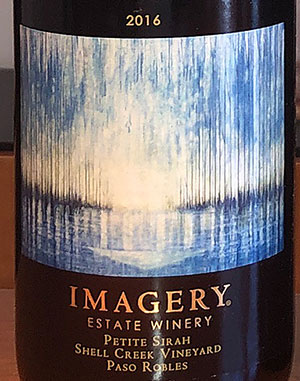
Imagery Petite Sirah 2016

The origins of Petite Sirah (aka Petite Syrah) have been shrouded in mystery and confusion.  It was originally thought to be related to the renowned Syrah of France’s Rhône region. Then it was decided it was actually Durif, a minor Rhône varietal now nearly extinct. But then along came pesky science, and a DNA analysis in the late 1990s identified the grape as a cross between Syrah and Peloursin.  It is grown much more extensively in California than France, but can also be found in Argentina, Brazil, and Mexico. Somewhat disparaged at the turn of this century, it is now enjoying a renewed popularity.

Petit Sirah can make big, full-bodied wines, and this selection is an excellent example.  Imagery likes to call this a “toothbrush wine” because of its deep color and bold flavor (although dentists caution against brushing your teeth soon after drinking wine, as the lingering acidity can damage tooth enamel by doing so.)

Made by Joe Benziger not long before he turned the winemaking over to Jamie, the fruit for this wine was sourced from the Shell Creek vineyard in Paso Robles, one of Imagery’s longest-standing grape suppliers. The wine itself is dark inky purple, with a nose of blackberries and plums.  These continue on the palate, with a plush, full body, and big but controlled tannins. This was accomplished by tasting the juice at every pump over, to assure that the tannins did not become excessive. Jammy concentrated fruit comes  through mid palate, with a lingering richness on the finish. The ABV is 14.6%, and 1074 cases were made.
The label artist is Robin Denevan of San Francisco, California.  The image is part of Denevan’s River Series, and is an encaustic painting, a mixed media technique that involves using heated beeswax to which colored pigments have been added. The liquid/paste is then applied to a surface — usually prepared wood, although canvas and other materials are also used. The term is derived from Greek, meaning a burning in. A subtle reflection of the “Parthenon” is shown in the water in the bottom third of the picture.
https://robindenevan.com/

Imagery Gee eS eM Red Wine 2017

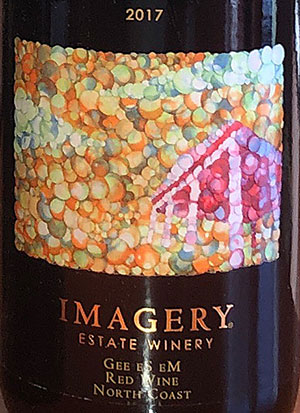
This too-cutely named (for my taste anyway) blend is made from 35% Grenache, 35% Syrah, and 30% Mourvèdre sourced from a number of North Coast vineyards. GSM, as it’s more commonly referred to, is a mix traditionally produced in the Côtes du Rhône region. It is also a favorite of the so-called “Rhône Rangers,” a group of American winemakers who promote the production of wines containing at least 75% of the 22 Rhône grape varieties. This is Jamie Benziger’s first solo effort.

Dark garnet in the glass, this wine starts with aromas of figs and roast plums and a bit of vanilla. These are followed by flavors of strawberries and tart cherries. There is just the right amount of acidity, and the soft tannins are restrained. The silky structure all wraps up in a nice long finish. The ABV is 14.9%, and 558 cases were produced.

The art adorning this bottle is by Santa Rosa artist Sami Lange. ​It is one of her paper collage “quilts” that are created by hand cutting, dying, and stitching thousands of circles to create intricate meditative patterns. The fuchsia “Parthenon” arises from a field of orange.

www.samilangeart.com/

www.imagerywinery.com/

Return to blog posts: winervana.com/blog/

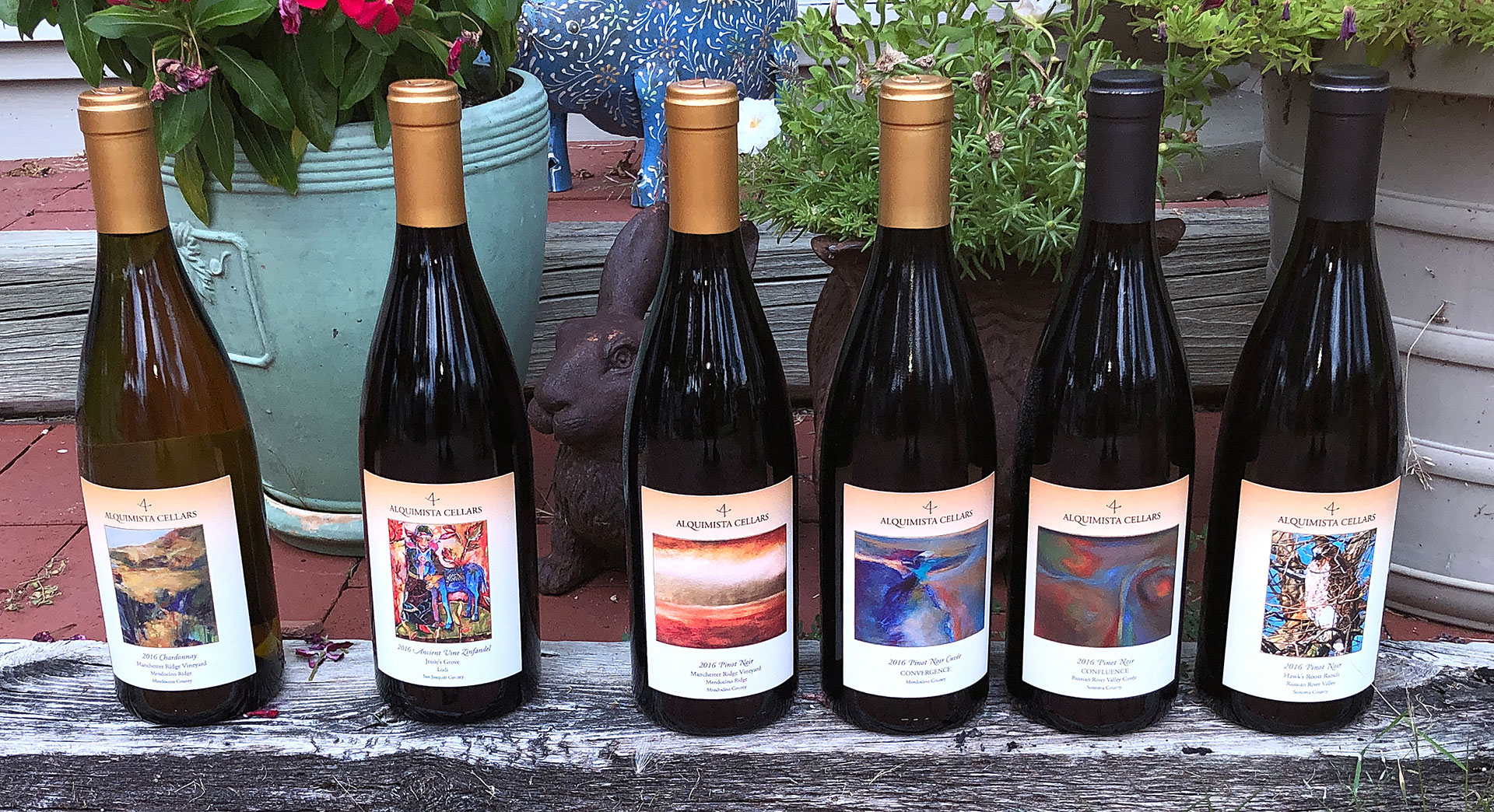
Alquimista Cellars

La Follette Cellars

Alquimista Cellars

Some winemakers and winery proprietors are born into the business. Some buy into the business. And some evolve into it. Greg LaFollette of Alquimista evolved quite successfully. He has been called a “vine whisperer,” a “cellar magician,” and a “tireless coaxer and protector of handcrafted wines.” He is one of Sonoma’s most revered winemakers, and was honored as Winemaker of the Year in 2010. He has also been tagged “Prince of Pinot” by the website of the same name.

Continue reading “Alquimista Cellars”

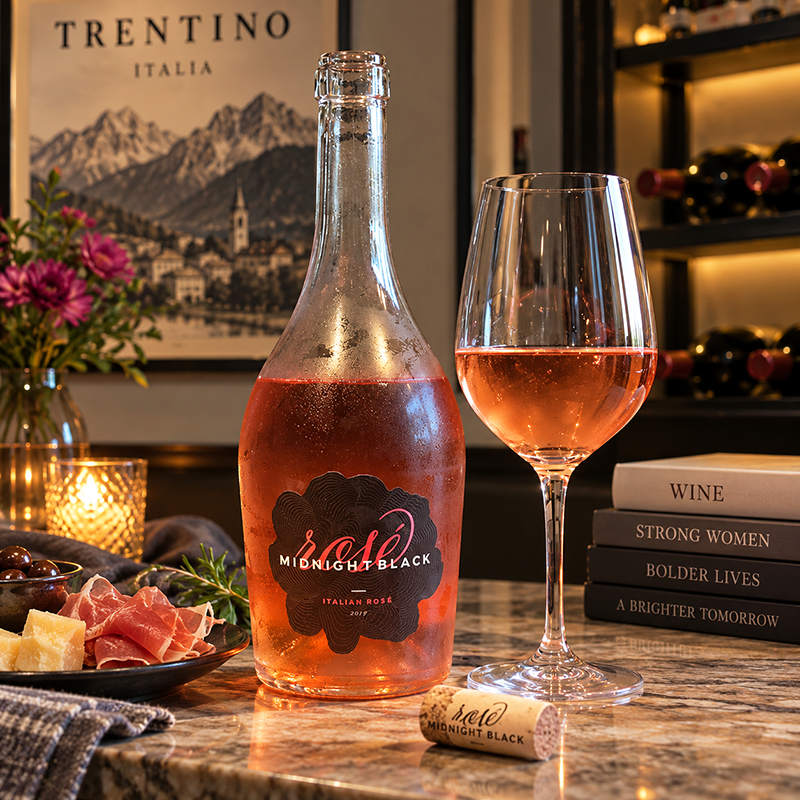
Midnight Black Rosé

Midnight Black Rosé 2019
Midnight Black Rosé 2019. Click here for tasting notes.

Midnight Black Rosé 2019

To say that the Taub family is an international wine and spirits powerhouse is, frankly, quite an understatement.  It all started on December 6th, 1933, when Martin Taub and his brothers started making brandy in Jersey City. After World War II, Taub started a distributorship in New York because long-time clients Ernest and Julio Gallo needed a partner on the East Coast.

Continue reading “Midnight Black Rosé”

White Wines for Summer

White Wines for Summer, None of Them Chardonnay

Summer is the time to get together outside with a few close friends and enjoy some white wine. There are many to choose from, and I’ll get to that next. But first, what you don’t want for summer quaffing is a rich, buttery selection like a highly-oaked Chardonnay. (And I say “highly-oaked,” because for me, I’ve never encountered an “over-oaked” Chard.)

Continue reading “White Wines for Summer”

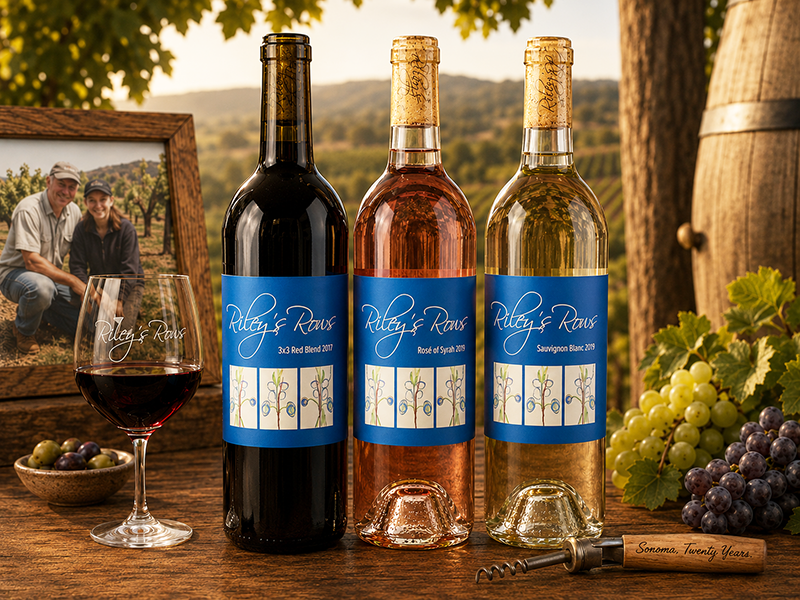
Riley’s Rows

Riley's Rows.
Riley’s Rows. Click here for tasting notes.

Riley’s Rows

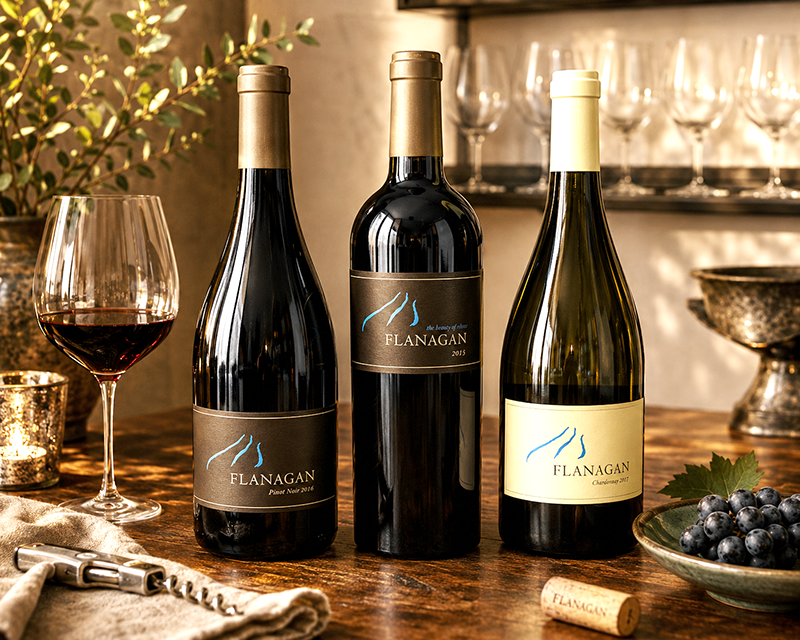
There’s an old witticism in the wine business that goes, “If you want to make a million dollars by producing wine, the first thing you need to do is spend a million dollars.” For a young and ambitious vintner to be able to skip that first step would be quite a blessing. Such is the case with Riley Flanagan. She is the eldest daughter of Eric Flanagan, a boutique winemaker and grape supplier in Sonoma, California. Through his Flanagan Wines operation, her father shares the tasting room, winemaking facility, and some of the fruit for his daughter’s own wine label. Continue reading “Riley’s Rows”

Flanagan Wines

Flanagan Wines
Flanagan Wines. Click here for tasting notes.

Flanagan Wines

Eric Flanagan did not come of age with a background in the wine business, or even farming. After graduating from college in 1985, he embarked on a banking career, which he pursued until 2013. His job during those years took him on journeys around the world. He had always had an interest in wine, and over the course of these trips Flanagan became fascinated by how grapes of the same variety expressed themselves in different places.

Continue reading “Flanagan Wines”

Wine in a Can

Wine in a Can
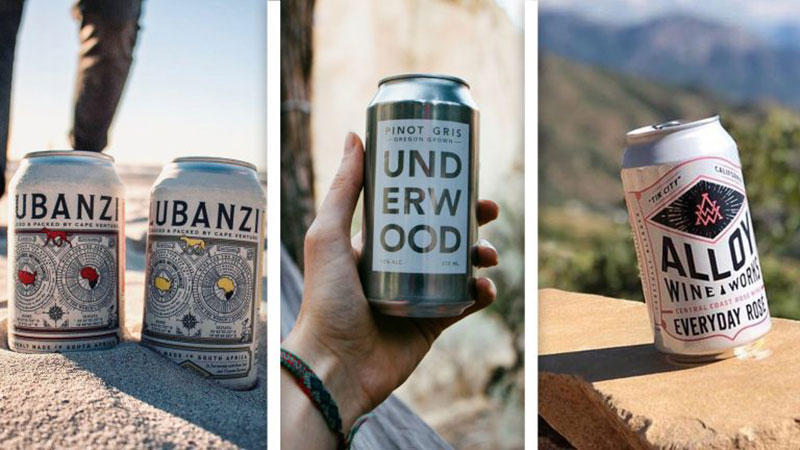
From left to right: Lubanzi (photo courtesy of Lubanzi), Underwood (photo by Jules Davis), and Alloy (photo courtesy of Alloy)

Canned Wine

Wine in cans is gaining ground, particularly with Gen Zers and Millenials.

When it comes to wine packaging, the glass bottle has been the primary choice for centuries. Because of this long history and tradition, consumers associate the bottle size, shape, and color directly with the quality of the product within. By and large, screw-top closures, oddly-shaped bottles, non-glass containers, and boxes were relegated to lower-quality products.

That all began to change about 20 years ago, with a growing acceptance of screw-tops, the ones from Swiss company STELVIN® in particular. It is an aluminum closure system specially designed for wine, featuring a specific bottle neck finish and a range of liners. This was accompanied by the wide introduction of packaging alternatives such as Tetra Paks, wine-on-tap, bag-in-box, individual-serving sized plastic pouches, and aluminum cans.

A short history of canned wine

The story of canned wine, particularly, is much older, however. In the mid-1930s, metal-canning technology was developed, and people have been consuming assorted beverages, such as soda, juice, and beer in cans for over 90 years, of course. As early as 1936, the Acampo Winery began packaging a California Muscatel in steel cans under its Acampa brand. Another early pioneer was Vin-Tin-Age.  (You’ve got to love that forced pun. Or not.) However, these early efforts failed with drinkers, presumably due to the wine’s interaction with the unlined metal of the steel can. In the early ’80s there was another attempt to sell wine in cans, this time made of aluminum. Taylor California Cellars tried to convince airlines to serve their wine in lightweight, single-serve aluminum cans. However, small glass and/or plastic packaging won out instead; the now-ubiquitous 50 ml airplane bottle is familiar to anyone who has flown, or visited a liquor store.

Regardless of specific type, any wine packaging must serve three purposes. First, it must to protect the wine, which can be damaged if exposed to oxygen, bacteria, or other harmful contaminants. Second, it must contain the wine (duh!), allowing it to be transported, stored, and consumed. Finally, it must provide information about what you’re drinking: where the grapes were grown, the alcohol percentage (ABV), the name of the wine, and more. Cans do a excellent job of protecting wine, especially ones that are young, fresh, and fruity, with little to no oak contact, low to moderate tannins, and intended for consumption shortly after purchase.

The growing popularity of canned wine

Canned wine accounts for a tiny fraction of the market, about one percent. Even so, cans are one of the fastest-growing forms of alternative wine packaging. For years, a can was seen mainly as a convenient way to deliver cheap wine, but these days the same change in consumer acceptance that occurred with screw-caps is happening with canned wine, with higher-quality wines being introduced over the last two decades. Wine-in-can sales totaled $6.4 million in 2015, $14.5 million in 2016, and $22.3 million in 2017. In 2018, sales jumped to more than $69 million, totaling the equivalent of 739,000 12-bottle cases in retail outlets tracked by Nielsen. That’s up from just $2 million in 2012, compared with a five-percent increase in boxed wines and a 14.2-percent gain for wine in Tetra Paks during the same period.

A number of factors have contributed to wineries’ enthusiasm for canned wine. Cans offer drinkers convenience and portability, since cans are welcome many places glass bottles are not, such as private lawns and pools. The labeling is often fun, dramatic, and creative, allowing producers to position themselves as modern and forward thinking, which is of particular importance to Gen Zers and Millenials. Gotta stay hip, ya know. More substantially, aluminum is 100% recyclable, resulting in a very small environmental footprint. Due to lighter weight during shipping and handling, reduced breakage, and more-efficient stacking, cans versus glass bottles also yield typical savings to producers of approximately 15 to 20%, with some claiming as high as 40%.

Another detail not to be overlooked is the lining that coats the inside of the can, and prevents the liquid from interacting with the aluminum, which was the bane of the false starts of years ago. The pioneer in this regard is the Baroke Winery of Australia. In 1996 they introduced their patented can-coating system, trademarked as Vinsafe. However, no U.S. producers use the Vinsafe technology, relying instead on coatings developed by domestic can makers, primarily Ball. Note that because wine is acidic (less so than beer, more so than cola), eventually the polymer coating can degrade. Another reason to enjoy canned wine as soon as possible (as if we need one).

Finally, we must not disregard the impact of the Internet. It is full of selfies of consumers with colorful, creative cans. The fun and festive nature of many of the designer cans inspires social media blog entries, hashtags, and pictures of friends enjoying the wine together as well.

Currently, 350 wine-in-a-can products are available from 125 wineries in 13 countries. In Japan, wine in cans is very popular, in part because selections are widely available in vending machines. (This is a convenience that will likely never be seen in the U.S. market, due to our century-old hangover from Prohibition.) Quite a number of canned sakés are also offered there.

Three prominent “wine in a can” pioneers

In the U.S., Francis Ford Coppola (yes, the director of the Godfather trilogy and Apocalypse Now, as well as many other films) recreated the wine-in-can category in 2002 by producing a wine named after his daughter, Sofia, to serve at her pool-side wedding. He also cans his Diamond brand. Since then, Coppola has been joined by such major producers as E. & J. Gallo with their Barefoot and Dark Horse labels; The Infinite Monkey Theorem of Colorado and Texas; Precept Wine conglomerate’s House brand; Field Recordings / Alloy Wine Works offering California selections; and Union Wine Company of Oregon which sells its products under the Underwood label.

Andrew Jones founded Field Recordings, a single-vineyard project, in Paso Robles, California, in 2007. Jones released his first canned wine, Fiction Red, under the Alloy Wine Works label (Get it? Metal? Alloy?) in 2014. It was intended as a one-off release, but the positive response from buyers prompted him to pursue the format; today, around 40% of the winery’s production is canned. The lineup consists of three core wines: Chardonnay, Pinot Noir, and Everyday Rosé. In addition, they frequently release unorthodox, limited-edition offerings, mainly for the can-wine club members, though they sometimes become permanent additions to the portfolio. “It was about meeting people where they wanted to be,” says Jones. “They wanted top-quality, terroir-driven grapes, treated the same way they would be for the bottle, but in a smaller, endlessly recyclable package that could be consumed anywhere.” Jones sold the company to Vintage Wine Estates in 2019, but is still involved. He reports that his production line is currently 20 times what it was when he launched.

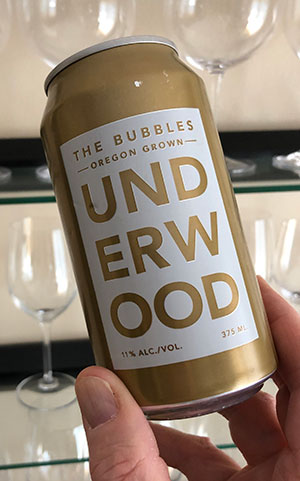
Union Wine Company dove into canning by launching its Underwood label in 2014, relying on 375 ml cans. Pinot Noir and Pinot Gris were the first two varietals offered, but the lineup has since expanded to include still rosé, white and rosé sparkling wines, a white blend, and wine coolers. Today, 55% of the company’s 448,000-case business is in cans, up a remarkable jump from just over 100,000 cases in 2014.

Founder and owner Ryan Harms credits the success of Underwood’s canned products to their affordability and lack of pretension. “With cans, we embrace the artistry of making great wine, minus all the fuss,” Harms says. “And we’ve remained committed to our original mission of bringing craft quality and affordable Oregon wines to people’s tables for everyday occasions.” Harms says the appeal of the Underwood wines is that they have “an implied ‘ready to drink’ quality, which allows them to lend themselves to the can better than other styles might.”

A final note, and a few recommendations.

Most canned wines are either 375 ml (a half “bottle” of wine) or 250 ml (the size of a can of Red Bull). While the 375s can be sold individually, the federal government prohibits individual sales of the 250 ml cans, requiring that they be sold in four-packs. I prefer the 375 ml size when I can get it. Some wines come in 187 ml or 500 ml cans, but these are less common. And, an individual winery won’t offer a variety of can sizes; they pick one and stick with it.

I can recommend just about all of the Underwoods, especially The Bubbles, Dark Horse Rosé, Butter Chardonnay (even though its oaked profile is atypical of canned wine), Creamery Chardonnay, and Cupcake Chardonnay.

Back to blog posts: winervana.com/blog/

Ser Winery

Ser Winery.
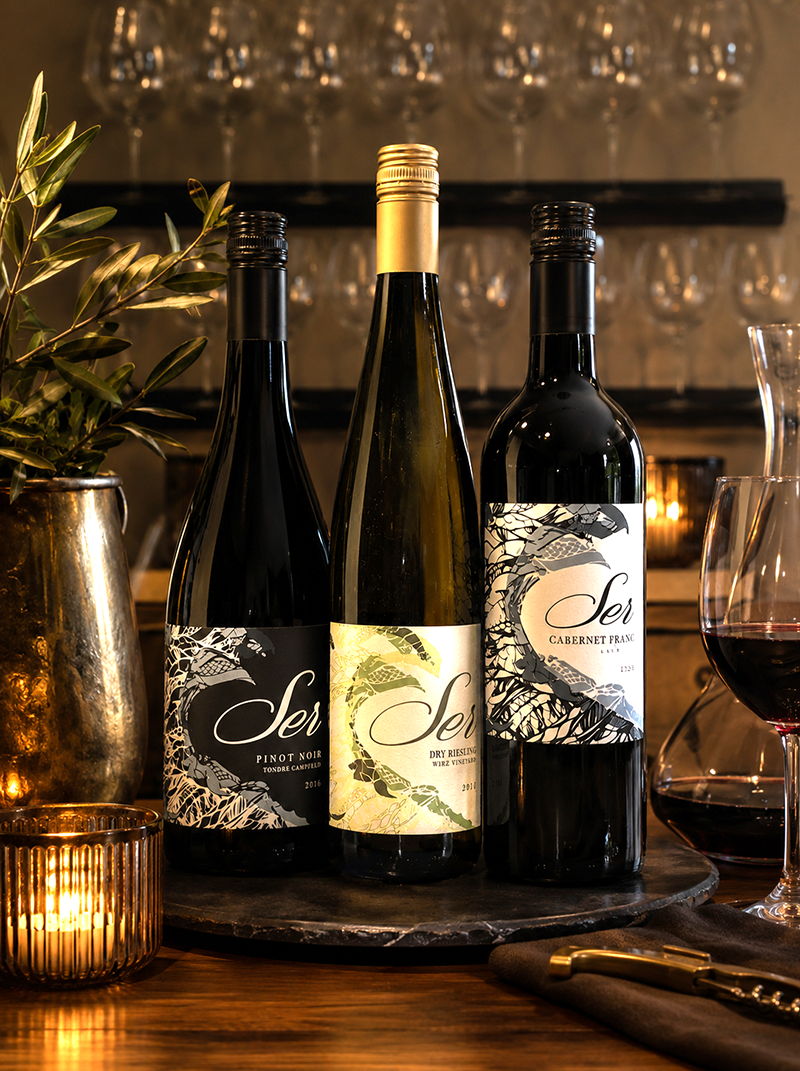
Ser Winery. Click here for tasting notes.

Ser Winery

In the tradition-bound world of wine, winemaking has, predictably, been dominated by men. For example, there are about 4,800 wineries in California, but only 10 percent have female lead winemakers. (When it comes to winery ownership, the number does jump up to about 19 percent, according to Woman Owned Wineries, a nationwide directory of female wine entrepreneurs.)

Encouragingly, however, greater educational opportunities (as opposed to the historically more usual inheriting a wine operation) have been opening the possibility of becoming a winemaker to more and more women. One of these is Nicole Walsh of Ser Winery in Aptos, California, due east of Santa Cruz.

The winemaker

During the course of her over 19-year career, Walsh has held just about every position in the wine industry, including associate winemaker, winemaker, vineyard manager, grower-relations manager, and owner. She was born in Saginaw, Michigan, in 1975. An early interest in wine drew her to Michigan State University, graduating with honors in 1998. At the time, the undergraduate department of Viticulture and Enology there was, remarkably, comprised of just two students. This provided a highly unusual opportunity to be immersively mentored by Horticulture professors in grape growing and winemaking. As part of her last semester at MSU, she attended a sustainable agriculture university, EARTH, in Costa Rica. While there, Walsh became proficient in Spanish, and she solidified her commitment to sustainable agriculture.

Nicole Walsh
Nicole Walsh    Photo: www.wildu.co

After graduation, she worked for four years on the Leelanau peninsula in northern Michigan. This small AVA (one of five in Michigan) is home to 27 wineries, and has diverse microclimates uniquely suited to cool-climate wine grapes, particularly Riesling, Chardonnay, Pinot Grigio, Pinot Noir, and Cabernet Franc. During her time there, she managed vineyards and honed her winemakeing skills.

In early 2001, she married Kevin Walsh, and together they moved to Santa Cruz, California. Shortly thereafter, in February, she started working with Randall Grahm at Bonny Doon Vineyard.

Walsh took a sabbatical from Bonny Doon in 2008, when she moved with her husband and young son to Marlborough, New Zealand. After a year, she returned to Santa Cruz to develop Bonny Doon’s newest property in San Juan Bautista. She continues to manage that property as well as make wine at Bonny Doon’s Santa Cruz winery.

In 2012, reflecting on her New Zealand experience, especially with Pinot Noir, Walsh decided to start her own wine brand as well, which she christened Ser, which is Spanish for “expressing identity or origin; having the intrinsic quality of.”

“I was inspired for the name after reading an article by Andrew Jefford, ‘Wine and Astonishment’. It was in that writing that the notion of the ‘being’ of wine truly resonated with me. Being is different than existing. It is true, wine exists; you can touch it, smell it, drink it. To quote Jefford, ‘Being, by contrast, is the ‘isness’ inside.’ In other words, the natural essence of the grapes unique to each specific growing area. I am dedicated to preserving the ‘isness’ of wine, to allow its true varietal expression and the place and time of its origins,” shared Walsh. Clearly, this thinking closely aligns with the traditional concept of terroir.

She continued, “Jefford also talks of that first moment of insight, that moment when some people decide to devote their professional life to wine. He says,’It gives the lucky few who choose to ‘grow wine’ the chance to use craft to embody, reflect, and echo nature itself.’ I am privileged to be one of those ‘lucky few.'”

Ser Winery Tasting Room
Ser Winery Tasting Room in Aptos, California

Once the winery was underway, she began working with local Santa Cruz Mountain growers to purchase fruit from a number of interesting vineyards with distinct microclimates in the appellation. In symbiotic partnership with those farmers, she started experimenting with several varieties, such as Riesling and Chardonnay (both of which she had worked with on Leelanau), Syrah, Mourvedre, and a much less-known variety, Cabernet Pfeffer. She is committed to preserving and enhancing the unique character of the varietals used in her wine.

Ser’s label, designed by local artist and teacher Jenny Angelacos, was inspired by an ocean wave and Walsh’s love of surfing. It is intended to convey the unifying thread that connects the diverse places from which she sources her grapes.

The wines
Nicole Walsh hard at work; winemaking doesn’t get more hands-on than this. Photo: www.wildu.co

Ser Dry Riesling Wirz Vineyard 2017

OK, I’m going to be honest about this up-front: although Riesling is, by all accounts, one of the world’s greatest white-wine grapes, and makes classic food-friendly wines in a range of styles from quite dry to very sweet, I’ve never been much of a fan.  But I enjoyed this expression, so kudos to Ms Walsh.

The fruit came from the Wirz Vineyard, located in San Benito County’s Cienega Valley, in the foothills of the Gabilan Mountain Range at about 1100 feet above sea level and 25 miles or so from the Pacific Ocean. It is composed of granite and limestone soil. Owner Pat Wirz employs head training, dry farming and organic techniques on the over 90-year-old Cabernet Pfeffer and 60-year-old Riesling vines.

In “head training,” vines are tied to a wooden stake positioned at each one. The stake generally stands three to four feet above the soil surface. When used conservatively, this system is ideally suited to production of low to moderate quantities of high-quality grapes.

To make this wine, Walsh pressed whole grape clusters in stainless steel, which was also used for fermentation. She used an indigenous yeast, and the wine was bottled prior to malolactic fermentation to lend softness without stripping the acidity.  It is medium yellow in the glass, with a nose of olive oil and delicate floral notes.  These are followed by mostly tart citrus on the palate, particularly lime, with subtle hints of pear and apple. It’s balanced out by that good acidity, and wraps up with a medium finish. The ABV is 13% and 160 cases were made.

Ser Vermentino Cedar Lake Vineyard 2019

Cedar Lane vineyard is located in the Arroyo Seco appellation of the Santa Lucia Highlands in Monterey County. Soils are well drained, river bed gravelly loam.

After arriving at the winery, the grapes were whole-cluster pressed into stainless steel tank to begin primary fermentation. The wine was transferred mid-way through fermentation to neutral French oak puncheons (500L). There was partial malolactic fermentation, followed by eight months of aging in barrel prior to bottling.

This very pale wine has almost no nose.  On the palate you will find delicate citrus, lychee, and a hint of honey.  It offers crisp acidity and a short finish.  The ABV is 13% and 175 cases were made.

Ser Dry Orange Muscat 2020

Before opening the bottle, I thought this might be an “orange” wine, that is, a white wine made by leaving the skins on white grapes during fermentation, also known as skin-contact wine.  This results in an amber or orange hue in the finished product.  But no.  Orange Muscat is a relatively obscure grape variety, a cross between two more widely-known parents: Muscat Blanc à Petit Grains and Chasselas.

There are many other subcategories of Muscat as well, and these are often vinified into sweet or fortified wines.  However, this one is bone dry and is pale gold, much like any other white.  Whole grape clusters were pressed to stainless steel, followed by a cool fermentation for 20 days.  The wine was bottled without malolactic fermentation after four months on the lees.  Unusual for a Muscat, it is only slightly aromatic, with apricot and mango on the nose.  These flavors continue in the mouth, but are masked somewhat by the bracing citrus-laced acidity.  There’s even a hint of pepper.  ABV is 13%, and 87 cases were made.

Ser Rosé of Grenache Loma Del Rio Vineyard 2020

The Loma del Rio vineyard is located on the west side of the Salinas Valley at the foot of the Santa Lucia Highlands just south of King City. Walsh declares it, “one of my favorite sites for Grenache.”

This wine was whole-cluster pressed to stainless steel. The juice was clarified with a centrifuge to help mitigate smoke taint due to the wildfires in the region at time of harvest.  Happily, none is evident. It was bottled without malolactic fermentation after four months on the lees.

This wine is a delicate pink salmon, with an unassuming aroma to match, one that is primarily rose petal.  The palate offers strawberry and guava. There is plenty of juicy grapefruit-laced acidity, and a medium finish.  This is a wine that benefits from not being numbed.  After being on the counter for a while, and it came up from the refrigerator temperature of 36° F to about 50° F, the nose didn’t change much, but the flavors became much more apparent.  Walsh made 100 cases, and the ABV is 13%.

Ser Pinot Noir Tondre Grapefield 2016

This is the first time I have encountered a vineyard referred to as a “grapefield.”  It was planted in 1997 on six and half acres in the heart of the Santa Lucia Highlands appellation. It now has seven blocks in 104 acres, 81 of which are planted with  Pinot Noir. Tondre Grapefield is SIP Certified.

Composition is 100% Pinot Noir, all from the Tondre Grapefield, and harvested from 10-year-old Pommard clone vines. (The Pommard clone was originally sourced from the Château de Pommard in Burgundy by Dr. Harold Olmo of the UC Davis’ Department of Viticulture and Enology in the early 1970s.)

Walsh created this Pinot Noir by starting with five days of cold soak. Indigenous yeast was used for the eight days of primary fermentation. This was followed by four days of maceration before being pressed into neutral French puncheons (large oak barrels that usually hold 80 to 133 gallons) for 14 months of malolactic ageing.

This shows Pinot Noir’s classic clear, bright red in the glass. The nose offers aromas of cherry, raspberry, blackberry, and roast plum.  The palate is dominated by tart cherry and zippy acidity.  The wine has excellent balance, and it all wraps up with a long finish.  ABV is 13.5%. Just 80 cases were produced.

Ser Cabernet Pfeffer Central Coast 2016

Cabernet Pfeffer is an extremely rare variety with less than 12 acres grown in California, most of them located in San Benito, a wine region at the southern end of the Santa Cruz mountains. It was once thought to be a crossing of Cabernet Sauvignon and another, unknown variety, and to have been bred in Los Altos Hills, California, in the late 19th century by farmer and winemaker William Pfeffer. However, a recent ampelography ( the field of botany concerned with the identification and classification of grapevines) study by UC Davis on the Wirz vines discovered they are are in fact Mourtaou, a  French variety from the Bordeaux region. Whether the variety was named after the farmer or for its spicy characteristics (Pfeffer is German for pepper) is a mystery.

Ser’s Central Coast Cabernet Pffefer began with five days of cold soak with a small addition of sulphur . Indigenous yeast was used for the ten days of fermentation. This was followed by ten days of maceration before being pressed into barrels, of which 50% were neutral and 50% were new French oak. After three months, the wine was transferred  to neutral oak for 14 months of barrel ageing. The blend is 76% Cabernet Pfeffer and 24% Cabernet Franc.

The wine starts with a bright, clear red cherry color in the glass, much like the Pinot Noir.  But then we move on.  The nose shows plenty of juicy fruit, like cherry Starburst candy (seriously) and hints of violets.  Then come flavors of those same juicy cherries.  Also, since  Cab Pffefer is known for its spice and pepper, I was surprised on first trying it that those were subtle, at best.  But after about two hours of air, it’s “Hello pepper!” settling on the back of the tongue.  It is supported by good acidity, fine tannins that resemble those of Cabernet Sauvignon, and a medium, slightly bitter finish. The alcohol is 13.3%, and  220 cases were produced.

Ser Wirtz and Silletto Vineyards Cabernet Pfeffer 2015

As noted above, this varietal is quite rare in California, so it is remarkable that Walsh makes a second expression.

This wine was sourced 64% from the Wirz Vineyard and 36% from the Siletto Vineyard, both in San Benito County.

The Wirz vineyard is located in the CIenega Valley of the Gabilan Mountain range. The 95-year old-vines are dry farmed using organic methods in decomposed granite and limestone soils. The Siletto vineyard is located just East of the Wirz vineyard near Paicines in San Benito County. These 25-year-old vines live on gravelly-loam soil.

After harvest, the grapes were cold soaked for four days prior to primary fermentation. They saw five days of maceration post fermentation, then were pressed to neutral French oak puncheons, where they aged for 14 months prior to bottling.

Like the Central Coast offering, the wine starts with a bright, clear red cherry color in the glass, with a hint of brick.  The moderate aroma is predominantly cola.  This is followed by flavors of dark fruit, baked plum, tart cherry, and some more of that cola.  Unlike the Central Coast wine, the pepper was quite subtle.  There is good acidity and delicate but well-integrated tannins . The alcohol is 14%, and  230 cases were produced.

Ser Graciano Bokisch Vineyard 2018

This wine is all Graciano (aka Morrestel in France), a red-wine grape traditionally hailing from the Rioja and Navarra regions of Spain.  The fruit was sourced from the Terra Alta vineyard farmed by Bokisch Vineyards, a winery and grape grower located in the Clement Hills subdistrict of the Lodi AVA.  Grown on Redding gravelly clay loam, the vines are roughly 19 years old.  Markus Bokisch named this property “Terra Alta” because it reminded him of  the wine region near his home town in the Catalunya region of Spain.  The vineyard is Certified Organic by CCOF and  Certified Green by the Lodi Rules Program. 

After fermentation  in one-ton bins, the wine was pressed to neutral French oak puncheons and aged for 16 months.  It pours a transparent purple, with mouth-watering aromas of red and black fruit.  On the palate, this is predominately cherries and red berries, with a bit of white pepper spice.  It has a medium body, not unlike a Pinot Noir.  It is supported by good tannins that offer up just a hint of bitterness.  Walsh made 70 cases, and the ABV is 13.4%.

www.serwinery.com/

Back to blog posts: winervana.com/blog/

Sauvignon Republic Sauvignon Blanc

Sauvignon Republic Sauvignon Blanc 2006

In 2003, Sonoma chef John Ash, Mendocino-based winemaker and educator John Buechsenstein, and restaurateur Tom Meyer joined together with former Fetzer Vineyards president and winemaker Paul Dolan to establish Sauvignon Republic.  The goal was to make classic Sauvignon Blanc from grapes sourced from around the world. “I like the dynamics of partnerships,” Dolan said. “It is not about running my own show and allows me to use my creative side.”

Continue reading “Sauvignon Republic Sauvignon Blanc”

Graham’s Six Grapes

Graham's Six Grapes Reserve Port.
Graham’s Six Grapes Reserve Port. For tasting notes, click here. This is Six Grapes new, lighter bottle. For why that matters, click here.

Graham’s Six Grapes Reserve Port

True Ports hail from the Douro Valley in Northern Portugal, and have done so for over three hundred years. The region’s predominant soil is schist, composed of various medium-grained to coarse-grained metamorphic rocks with laminated, often flaky parallel layers of micaceous minerals.  The low annual rainfall makes this probably one of the driest regions of the world where grapes are grown without irrigation. This terroir results in very low-yielding vineyards, with vines bearing only a very few small bunches of full-flavored grapes whose thick skins protect them from dehydration.

Continue reading “Graham’s Six Grapes”