Lost Eden Red Blend

Lost Eden Red Blend 2018.
Lost Eden Red Blend 2018. Click here for tasting notes.

Lost Eden Red Blend  2018

This selection is from Georgia the country, in the Caucasus region of Eurasia.  Specifically, Lost Eden is produced at the Vaziani Winery, located in Telavi, Georgia

Little known to most Americans, Georgia is one of the oldest wine regions in the world. The fertile valleys and protective slopes of the Transcaucasia, which spans the southern portion of the Caucasus Mountains and their lowlands, straddles the border between the continents of Europe and Asia.  Here grapevine cultivation and neolithic wine production began at least 8000 years ago. The very word “wine” is believed to have been derived from the ancient Georgian word “Gvino” which means something that “rises, boils or ferments.” Due to these many millennia of wine history in Georgia, and its prominent economic role, the traditions of wine are considered entwined with and inseparable from the national identity.

When Christianity and the Eucharist came to Georgia in the 4th century AD, wine gained further importance in the nation’s culture.  According to tradition, Saint Nino, who preached Christianity in Kartli, bore a cross made from vine wood.  Another old legend tells of how soldiers prepared for battle by weaving a piece of grapevine into the breastplate of their armor. If they fell in battle, a vine would rise not just from their bodies but from their very hearts.

In 1950, vineyards in Georgia occupied 143,000 acres, but in 1985 that had grown to 316,000 acres, primarily due to increasing demand in what was then the USSR.  However, following the dissolution of that alliance and the end of the Cold War, the relationship between Georgia and Russia has often been rocky, if not outright hostile (including a war with Russia in 2008), and production saw  a subsequent decline. Even so, a recent trade agreement with the European Union has brought renewed optimism to Georgian producers.

According to the Ministry of Agriculture, in 2009 Georgia exported amost a million cases of wine to 45 countries.  By 2019, production and  exports had increased significantly, with total exports of 7.8 million cases to 53 countries.   During those ten years, exports to the US, although still modest,  increased 48%, to 56,512 cases.  The wine is produced by thousands of small farmers (using primarily traditional techniques of winemaking), as well as some monasteries and modern wineries.  In 2006 there were roughly 80 registered wineries, but by 2018, the number had ballooned to 961.

Growing conditions

Extremes of weather in Georgia are unusual: summers tend to be mild and sunny, and winters frost-free. Natural springs abound, and the many streams of the Caucasian Mountains drain mineral-rich water into the valleys. The moist, moderate climate, influenced by the Black Sea, provides excellent conditions for vine cultivating. In many regions of the country the grapevines are trained to grow up the trunks of fruit trees in terraced orchards, a method of cultivation called maglari.

Georgian grape varieties

Perhaps not surprisingly, traditional Georgian grape varieties have been little known in the New World. However, with increasing international awareness of the wines of Eastern and Central Europe, grapes from this region are gaining a higher profile. Although somewhere between 400 and 500 exist, only 38 varieties are officially grown for commercial viticulture, in 21 distinct wine-producing regions (a.k.a. PDO – Protected Designation of Origin).

Traditionally, much like French regional wines such as Bordeaux or Burgundy, Georgian wines carry the name of the source region, district, or village.  They are usually a blend of two or more grapes, and are classified as sweet, semi-sweet, semi-dry, dry, fortified, and sparkling. The semi-sweet varieties are the most popular in the domestic market.

The Winemaker
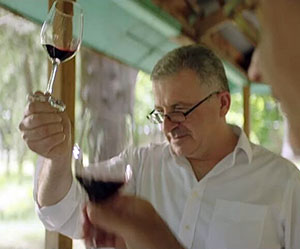
Lado Uzunashvili is an 11th generation winemaker.  He was raised in Mukuzani, in the largest wine-producing region in Georgia.  He learned oenology in Moscow, France, and Australia.
“When making the Lost Eden Red Blend, it was important to showcase Georgia as the birthplace of wine. To do this I found the perfect balance between modern and traditional Georgian winemaking practices to illustrate the quality and evolution of wine produced in my country. We believe wine is better with less human intervention,” Uzunashvili explained.

Lost Eden Saperavi Red Blend 2018

Lost Eden is a new product, launched in September of 2020.  The producer states, “In partnership with the Georgian Ministry of Agriculture and Partnership Fund, Lost Eden was crafted to build ties with the West and forever pivot Georgia, the birthplace of wine, away from Russian dominance.”

“The Georgian people have suffered many years of Russian oppression and a number of crippling embargoes that have negatively impacted both our current wine industry and our 8,000 year winemaking tradition. To break free from Russia’s grasp, we partnered with an incredible team to create Lost Eden for the United States wine market. This visionary wine project will not only introduce Americans to an exquisite Georgian wine, but also will help us build back a strong, free wine market in Georgia,” said Irakli Cholobargia, of the National Wine Agency, Ministry of Environmental Protection and Agriculture of Georgia.
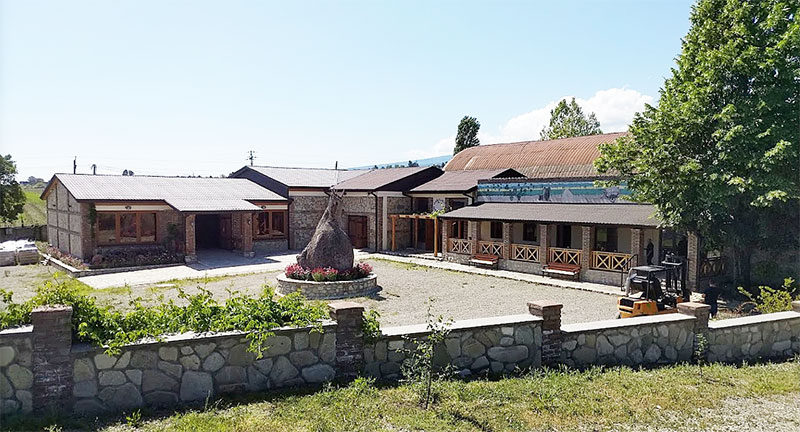
The Vaziani Winery
The Vaziani Winery


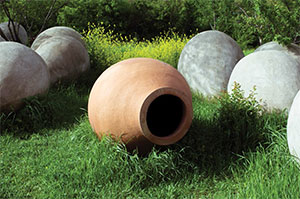
Lost Eden harvests grapes from arguably the oldest vines on earth.  They use the ancient clay pots called qvevris (pronounced kwevr-ees for fermentation and aging.  They are always buried in the ground, and are usually coated on the inside with beeswax, a natural sealant designed to keep undesirable bacteria from seeping through the walls.
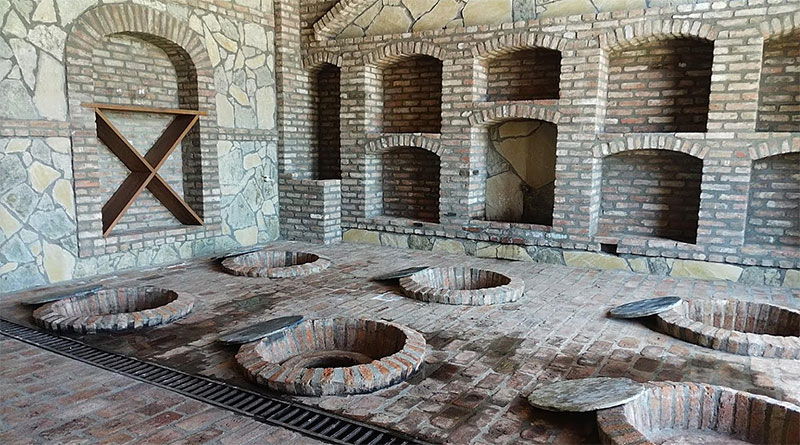
The qvevris are buried in the winery floor.

Saperavi, grown in some areas of the Kakheti region, is one of Georgia’s most important indigenous varietals.  It produces substantial, deep-red wines that are suitable for extended aging of up to fifty years.  It has the potential to produce high alcohol levels, and is used extensively for blending with other, lesser varieties.

The bottle of this unoaked blend features a glass stopper, which is rather stubborn to remove, instead of a cork, and the “veins” molded into it invoke the maglari cultivation method.  Although 100% Saperavi, it is considered a blend because a portion of the wine came from the traditional qvevris and a portion from stainless steel.   And, grapes were sourced from several vineyards.

Lost Eden pours a crystal-clear ruby in the glass.  The nose offers light to medium aromas of red and black cherries and mulberries.  These continue on the smooth palate, joined by cassis and some cocoa.  This is a semi-dry wine, with moderate but pleasant acidity, low tannins, and a somewhat short finish.  ABV is 13%, and 4,500 cases were made.

losteden.com/

Back to blog posts: winervana.com/blog/
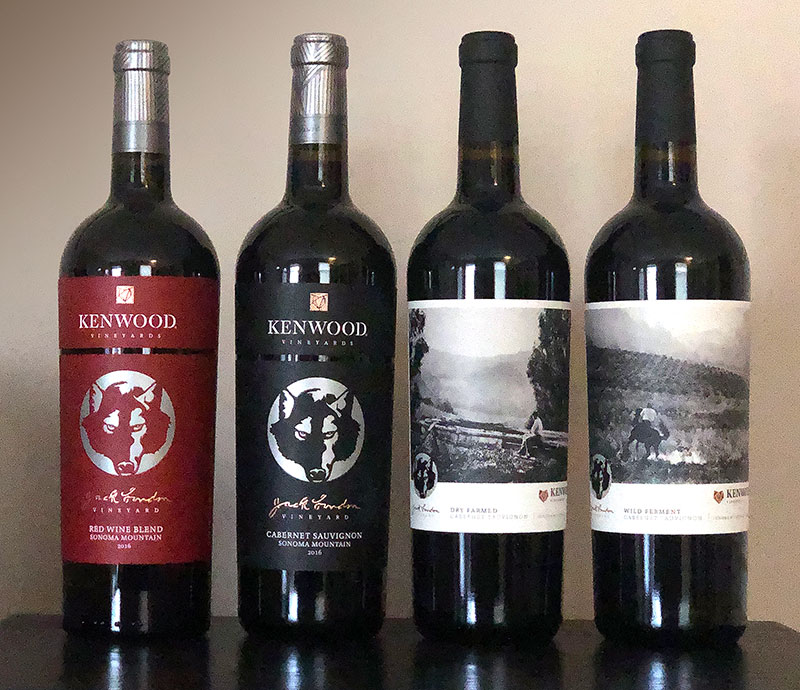
Kenwood Vineyards

Kenwood
Click here for tasting notes.

x
Kenwood Vineyards

Author Jack London (1876 – 1916) was an American novelist, journalist, and social activist. A pioneer of unabashedly commercial fiction in both novels and  magazines, he was one of the first American authors to become an international celebrity and earn a large fortune from writing. His most famous works include The Call of the Wild and White Fang, both set during the Klondike Gold Rush.

In 1905, London purchased a 1,000 acre property in Glen Ellen, California, on the western slope of Sonoma Valley which he named Beauty Ranch. He wrote, “Next to my wife, the ranch is the dearest thing in the world to me. I write for no other purpose than to add to the beauty that now belongs to me. I write a book for no other reason than to add three or four hundred acres to my magnificent estate.” Continue reading “Kenwood Vineyards”

Raymond Yountville Cabernet Sauvignon

Raymond Yountville Cabernet Sauvignon 2016.
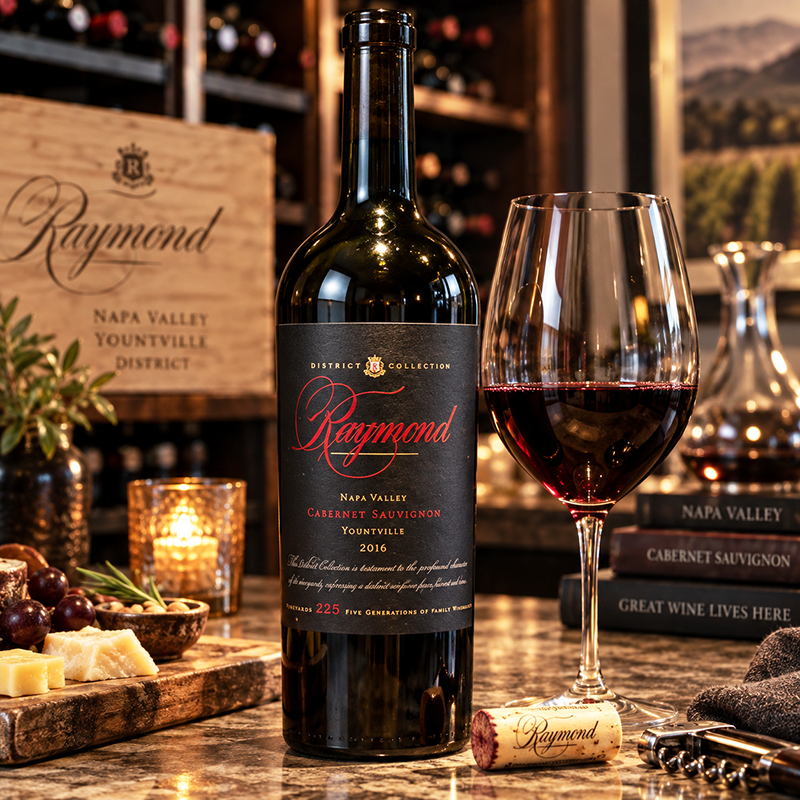
Raymond Yountville Cabernet Sauvignon 2016. Click here for tasting notes.

Raymond Yountville District Cabernet Sauvignon 2016

The Raymond name has been associated with Napa valley since the year Prohibition ended.  The Raymond family arrived in Napa Valley in 1933. Roy Raymond married into the Beringer family in 1936. He worked as winemaker for Beringer from 1933 to 1970. The following year, he and his two sons Walter and Roy Jr set out on their own with a 90-acre estate property in Rutherford. They released their first commercial wine under the Raymond Vineyards label in 1974.  The estate now comprises 300 acres in Rutherford, St. Helena, and Jameson Canyon. All are are certified organic and Biodynamic. The winery is also operated on 100% solar power.

Continue reading “Raymond Yountville Cabernet Sauvignon”

Laphroaig Scotch

Laphroaig Scotch
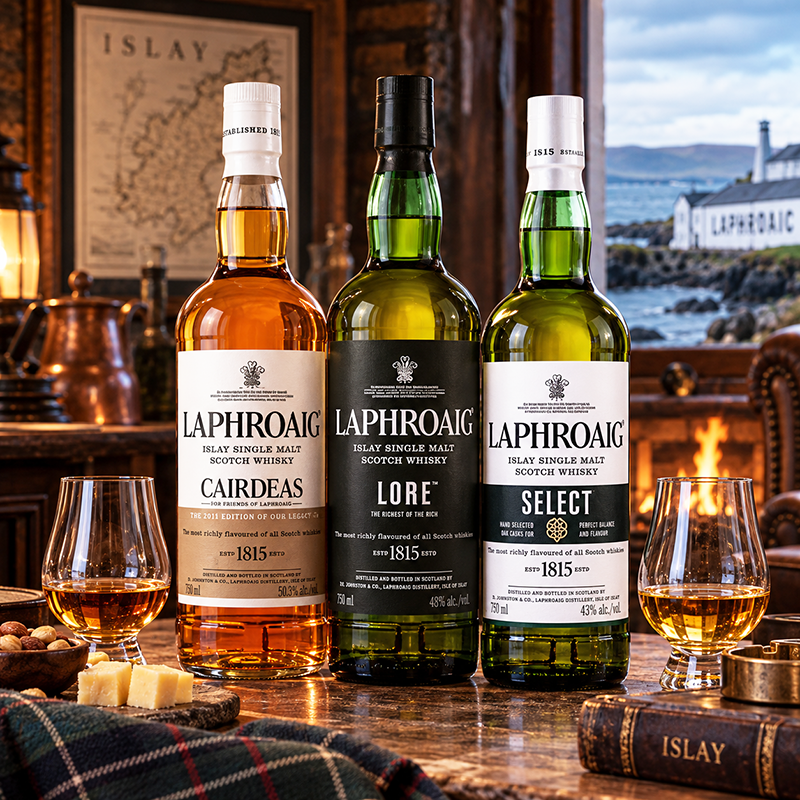
Laphroaig Scotch. Click here for tasting notes.

Laphroaig Scotch

Laphroaig (La-‘froyg) literally means “the beautiful hollow by the broad bay.” The secret to Laphroaig is that it benefits from the happy circumstances of where it is produced—next to ocean water and on land that gives Laphroaig a unique peaty taste. It is one of only a few distilleries that still uses traditional malting floors, and dries and infuses its own malt with the thick smoke from old peat-fired kilns.

Continue reading “Laphroaig Scotch”

Riedel Glasses

Riedel Glasses

Established in Bohemia in 1756, Riedel (REE-dəl) Crystal is a glassware manufacturer based in Kufstein, Austria.  Riedel was an early pioneer and proponent of glassware designed to enhance different varietals of wines.  In the early 1990s, wine writer Robert Parker of the Wine Advocate became a major fan and proselytizer.  The glasses below are the ones I own and discuss in my podcast on stemware (these are from Riedel’s Vinum line).   If you are interested in Riedel but think this is overkill, I suggest you go with the Bordeaux and Chardonnay.  Those two glasses should accommodate about 85% of your needs.

Continue reading “Riedel Glasses”

Trefethen Vineyards

Trefethen Oak Knoll Cabernet Sauvignon 2018 and Trefethen Oak Knoll Chardonnay 2018.
Trefethen Oak Knoll Cabernet Sauvignon 2018 and Trefethen Oak Knoll Chardonnay 2018. Click here for tasting notes.

Trefethen Family Vineyards

The pioneering Trefethen Family Vineyards is truly a rarity in the Napa Valley: a winery that grows, vinifies, and ages all of its wines entirely on the property, and has been helmed by a single family for three generations.

The area in which Trefethen is located is one of the oldest in Napa Valley’s wine history. Nearly 2,000 acres were originally purchased in 1851 by J.W. Osborne, who called it Oak Knoll. He planted grapes there the following year, and by 1860 had the largest vineyard in Napa, at 50 acres.

In 1886, banker brothers James and George Goodman founded the Eschol winery in Oak Knoll. The name was taken from the Old Testament,  Numbers 13:24, “The place was called the brook Eschol, because of the cluster of grapes which the children of Israel cut down from thence.” The original estate was 280 acres, with 40 acres planted in vineyards. The winery used a gravity-flow system: a horse-drawn winch brought grapes to the third floor of the three-story structure for crushing; gravity carried the juice to the second floor for fermenting; and, eventually, the wine descended to the first floor for aging. It is now the only surviving example in Napa Valley of a wooden gravity-flow winery from the 1800s. After struggling through Prohibition, by 1940 the winery building had fallen into disuse, although for a time in the ’40s Beringer Winery used the space as a storage facility and leased the surrounding vineyards.

x
Following retirement from a successful career, including CEO, with Kaiser Industries, Eugene Trefethen along with his wife Catherine, better known as Katie, purchased Eshcol and six adjoining properties in 1968, with the goal of become genteel farmers.  They installed a robust water system that still serves the vineyard today, but neither of them ever wanted a winery.

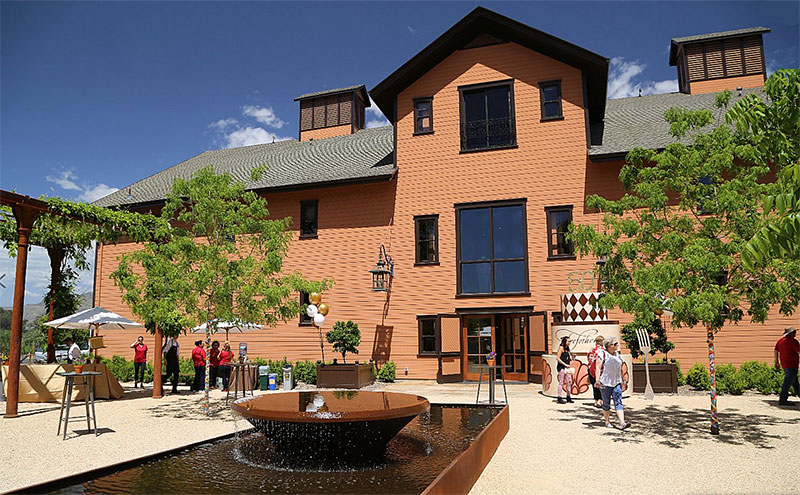
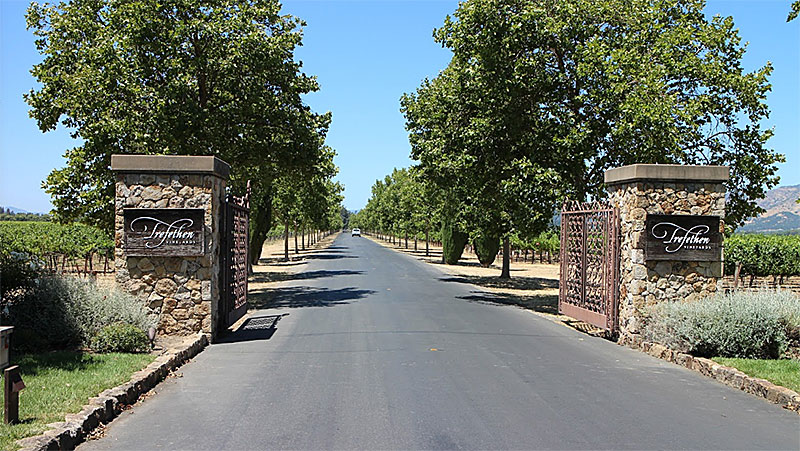
The winery operation got going in 1973, the year the Trefethen’s son John and his wife Janet produced their first commercial vintage (2,000 cases of Chardonnay and Pinot Noir).  They also replanted the vineyards and restored the historic winery building.  Located at the end of what is possibly the longest winery driveway on the Napa Valley floor, it is the largest winery in the Oak Knoll district.

The trees were eventually planted to prevent John Trefethen from using the driveway to land his private plane. Photo: Carlin Arthurs

The Trefethens’ restoration efforts were recognized in 1988 by the Department of the Interior, which placed the winery on the National Register of Historic Places. The property is also known for an extensive garden established by Katie. It has been featured in many publications, and has been a destination for many gardening enthusiasts since it was created.

The flower logo shown here has been part of Trefethen’s branding since the  beginning. Katie had originally used it on signage in her garden areas, and the winery put it on the bottle capsules from very early on. It was long referred to as the “Welsh Flower,” thinking that Katie had tapped into her Welsh heritage. But later research couldn’t find any Welsh history for the mark, so its origins remain a mystery, and it is now just called the “Trefethen Flower” instead.

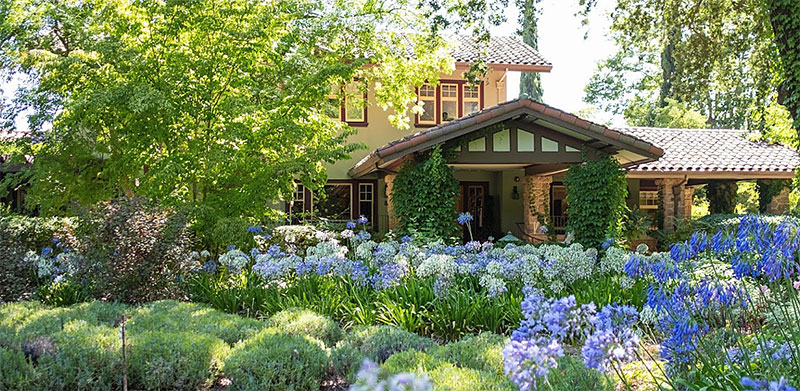
Eugene and Katie Trefethen's residence, The Villa, is now used for special events.
Eugene and Katie Trefethen’s residence, The Villa, is now used for special events.

John and Janet Trefethen have largely stepped back from day-to-day oversight, and the third generation of the family is now deeply involved in the operation. Son Lorenzo focuses on sales and marketing, and daughter Hailey on vineyards and employees.

In addition to the family, Jon Ruel has long been a part of the business.  He started as the viticulturist, but steadily increased his involvement over the years that have followed. He is now fully responsible for all aspects of the company’s operations and strategy, and was named named CEO in 2015. He had this to say about Trefethen, ““As a true estate winery, we have the unique opportunity to bring integrity to every step of the process, from the soil to the table. My entire focus these days is on cultivating this extended family – and when we succeed, you  can not only taste it in the wine, you can feel it.”

Winemaker Bryan Kays joined Trefethen in 2006 as a viticulture intern. Fascinated with estate-grown wines, he started in the cellar, and eventually worked up to the position of winemaker in 2015.

x

In 1979, a “Wine Olympics” was organized by the French restaurant guide Gault Millau in Beaune, France. A total of 330 wines from 33 countries were evaluated by 62 experts from ten countries. The 1976 Trefethen Chardonnay won first place in the category that pitted California Chardonnays against those from Burgundy, and was judged best in the world. This came three years after the more-famous “Judgement of Paris,” further helping to establish the quality of American wine in the world market.

The spirit of support and cooperation in northern California’s wine country that has been so much in evidence during this year’s wildfires goes way back.  Two now-notable wineries got their start at Trefethen. Cakebread Cellars purchased some grapes for their first vintage from Trefethen, and made their initial wine there. Domain Chandon (the American operation of the French Champagne leviathan Moët et Chandon) began their winemaking efforts by taking over the second floor of the winery while their own facility was being constructed.

The Vineyards and Environmental Commitment

The Main Ranch Vineyard.   Photo: Arturo Pardavila
The Vineyards

The original 400 acres surrounding the winery are known as the Main Ranch.  It sits on the largest alluvial fan in Napa Valley, where Dry Creek spills onto the valley floor and spreads gravel eroded from the Mayacamas mountains over clay and loam left by an ancient ocean. Over twenty different soil types have been identified in the vineyard, allowing Trefethen to grow nine different varieties there, all planted in their preferred soil.

Trefethen now also owns another 150 mostly hillside acres surrounding a spring-fed creek, the Hill Spring Vineyard, of which 40 acres are planted to Bordeaux varieties. It is about three miles from the winery in the foothills of the Mayacamas.

Although a relatively large producer (about 75,000 cases annually, but it varies with each harvest). Trefethen has farmed their vineyards sustainably since the beginning. They are all managed by employees, without outsourcing the work to a vineyard management company. A true “estate” operation, they have never purchased grapes from anyone.

Biodiversity

Bluebirds, owls, and bats inhabit the vineyards. All of these species are native to the area and play important roles as natural predators. The property also attracts other birds of prey such as kestrels and red-tailed hawks. Cover crops provide habitat for beneficial insects, spiders, jackrabbits, and more, all of which play important roles in the ecosystem. Cover crop use also increases water infiltration as the roots create channels in the soil that can directly impact soil fertility via nitrogen fixation.

Soil Health

Every part of the grape cluster but the juice– the stem, skins, and seeds – is combined with clippings from the gardens and manure from the  stables to make a compost which is spread out into the vineyard each year.

Water Conservation

The property includes two reservoirs. After collection, the water is transferred to biological settlement ponds, where the organic compounds are digested by bacteria, rendering the water appropriate for re-use in vineyard irrigation.

Energy Usage

A number of solar arrays are on the property, providing power for the winery and production facilities. They were one of the first wineries to offset 100% of their electricity usage with on-site solar power.

Certifications

As a major part of their commitment to ecological responsibility, Trefethen participates in a number of certification programs.

The Napa Green organization supervises two programs.  Land is an umbrella program that recognizes growers with validated environmental compliance and verified farm plans as meeting standards for watershed stewardship. Winery is one of only four sustainable winegrowing programs nationwide, offering the opportunity for comprehensive soil-to-bottle certification in both the vineyard and winery.

The California Sustainable Winegrowing Alliance is a certification program that provides verification that a winery or vineyard implements sustainable practices and continuous improvement

Trefethen Family Vineyards Oak Knoll District Estate Chardonnay 2018

Trefethen’s highest-volume wine, this Chardonnay was 100% sourced from the Main Ranch. After both barrel and malolactic fermentation, the wine was aged for nine months in 13% new oak.

It is a pale straw gold in the glass. The nose presents aromas of lemon, lime, and grapefruit, plus a hint of peach. The smooth palate features these same flavors, as well as some lemon curd and just a suggestion of oak. It’s all wrapped up in a refreshing zippy acidity. The ABV is 13.3%, and 28,800 cases were produced.

Trefethen Family Vineyards Oak Knoll District Estate Cabernet Sauvignon 2018

This wine is a blend of 84% Cabernet Sauvignon (enough that it isn’t labeled a “red blend”), 10% Petit Verdot, 3% Merlot, 2% Malbec, and 1% Cabernet Franc, all sourced from the Main Ranch vineyard. It always amuses me when winemakers include 1 or 2% of something.  It’s hard to imagine how much difference that could make, but they certainly think it is worth the effort. After fermentation, it was aged for 18 months in 52% new oak.

This full-bodied wine is inky dark purple. The nose displays aromas of dark stone fruits, particularly plum, and earth.  These continue on the palate, with the addition of prunes and cocoa, plus a little vanilla.  There is well-balanced acidity, as well as plenty of grippy but nicely integrated tannins.  The ABV is 14.2%, and 23,880 cases were produced.

www.trefethen.com/

Note: Trefethen releases some of their red wines fairly young – if you have the patience, consider holding these for several years while they develop additional complexities and nuances.  But do as I say and not as I do; there was a time when I would have bottle aged a wine like this for 10 years or so, but I have largely abandoned holding bottles more than four or five years at the most, as I prefer the more up-front characteristics, especially tannins, of a young red.

Back to blog posts: winervana.com/blog/

Estancia Cabernet Sauvignon

Estancia Cabernet Sauvignon.
Estancia Cabernet Sauvignon. Click here for tasting notes.

Estancia Cabernet Sauvignon 2017

Wikipedia says an “estancia is a large, private plot of land used for farming or cattle-raising. Estancias in the southern South American grasslands, the pampas, have historically been estates used to raise livestock, such as cattle or sheep. In Puerto Rico, an estancia was a farm growing frutos menores, that is, crops for local sale and consumption; the equivalent of a truck farm in the United States. In some areas of Spanish America, especially Argentina, they are large rural complexes with similarities to what in the United States is called a ranch.”

Continue reading “Estancia Cabernet Sauvignon”

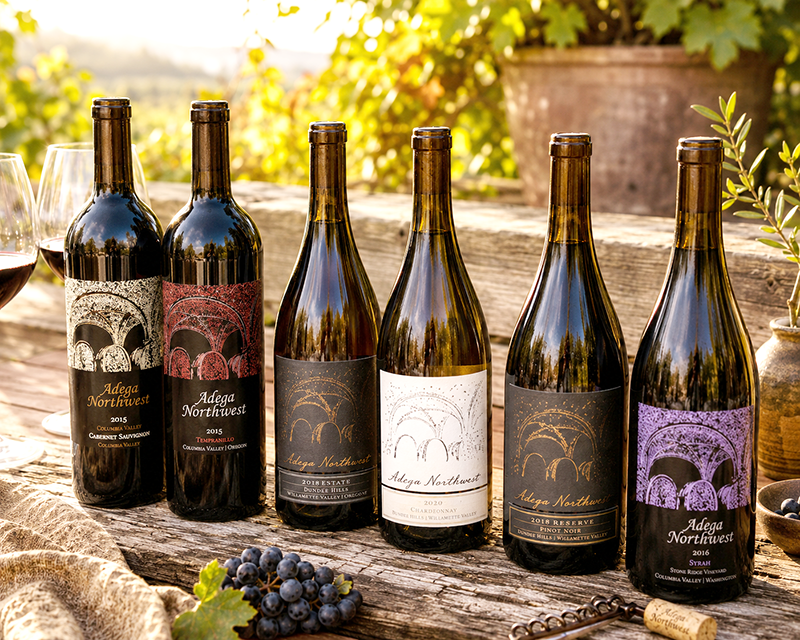
Adega Northwest Winery

Adega Northwest Winery
Adega Northwest Winery. Click here for tasting notes.

Adega Northwest Winery

When most of us think of a winery, what usually comes to mind is the romantic stereotype of a rustic but exquisite barn situated halfway up a mountain in the western U. S. overlooking a bucolic valley below; a fabulous hundred-years old chateau surrounded by ancient vines somewhere in France; or perhaps even a charming azienda agricola in Italy with a view of Roman ruins. But that’s not the only way to do it.  Adega Northwest of Portland, Oregon, is very much an urban winery.  There are vineyards, of course, you just won’t see them if you pay the winery a visit (by appointment only).  And because they are not tied to an estate, Adega Northwest can and does draw on sources throughout the region. Continue reading “Adega Northwest Winery”

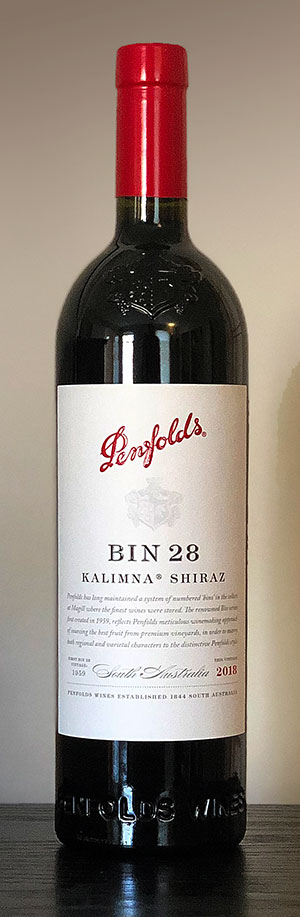
Penfolds Bin 28 Shriaz

Penfolds Bin 28 Kalimna Shiraz 2018
Penfolds Bin 28 Kalimna Shiraz 2018. Click here for tasting notes.

Penfolds Bin 28 Kalimna Shiraz 2018

Until Yellow Tail precipitated the boom in “critter wines” in 2000, it can be argued that Penfolds was just about synonymous with Australian wine in the U.S.  The label is ubiquitous here, in both grocery stores and fine wine shops. Prices range from about $12 per bottle for the Koonunga Hill Shiraz-Cabernet, to $850 for the legendary Grange, and everything in between.  (That $850 is doubly amazing, because just five or six years ago Grange was “only” about $200.) The selections are mostly reds plus a few whites and even a tawny Port.

Founders Dr Christopher and Mary Penfold immigrated to Australia from England in 1844, bringing their own French vine cuttings. Not long after, their fledgling vineyard was officially established as the Penfolds wine company at the 500-acre Magill Estate in Adelaide.

The Penfolds were believers in the medicinal benefits of wine, and they planned to concoct a wine tonic for the treatment of anemia.  Initially, they produced fortified wines in the style of sherry and port for Dr Penfold’s patients. The operation enjoyed early growth, and since Dr Penfold was focused on his medical practice, much of the running of the winery was delegated to Mary Penfold, including the cultivation of the vines and wine blending. On Christopher’s death in 1870, Mary assumed total responsibility for the winery. According to one historical account, by that time the business had “grown to over 60 acres with several different grape varieties including Grenache, Vverdelho, Mataro (aka Mourvedre), Frontignac and Pedro Ximenez,” and the estate was “producing both sweet and dry red and white table wines with a growing market in the eastern Australian colonies of Victoria and New South Wales.” Clarets and Rieslings were especially popular.

During her tenure, Mary engaged in experimentation, explored new methods of wine production, looked into ways of combating diseases like phylloxera, and engaged a cellar master by the name of Joseph Gillard.

Penfolds was producing a third of all South Australia’s wine by the time Mary Penfold retired in 1884. The company passed to her daughter Georgina and son-in-law Thomas Hyland.   By 1907, Penfolds had become South Australia’s largest winery (It is still big, but it no longer holds that position.) Eventually, the business was passed onto their two sons and two daughters. The company became public in 1962, and  the Penfold family retained a controlling interest until 1976.

In 1948, Max Schubert
became the company’s first Chief Winemaker. A loyal company man and true innovator, Schubert would propel Penfolds onto the global stage with his creation of Penfolds Grange.  (That’s a story for another time, if I can ever get my hands on a bottle.  Hey, Penfolds!  A little help here?)

In 1959, while Schubert was perfecting his Grange experiment in secret, Penfolds’ tradition of ‘bin wines’ began. The first, a Shiraz with grapes from the company’s own Barossa Valley vineyards, was simply named after the storage area of the cellars where it was aged. And so Kalimna Bin 28 became the first official Penfolds Bin number wine.

In 1988, after four decades of Grange’s  success and growth into a wine world icon, Schubert was named Decanter magazine’s Man of the Year, and on the 50th anniversary of its creation, Penfolds Grange was given a heritage listing in South Australia.

In 1976, control of Penfolds was acquired by Tooth and Co., a brewer based in New South Wales, which in 1982 became part of the Adelaide Steamship Company Group. In 1990, SA Brewing purchased Adelaide Steamship’s wineries. Later, SA Brewing was divided into three separate entities: the wine assets were named Southcorp Wine.

Southcorp Wines became a part of the Foster’s Group in 2005. In 2011, Fosters was split into two separate companies; the wine side became Treasury Wine Estates, headquartered in Melbourne and Penfolds current owner. The chief winemaker since 2002 has been Peter Gago.

Vineyards

Adelaide
Magill Estate
5.34 hectares / 13.2 acres
Shiraz (known as Syrah in other parts of the world

Barossa Valley
Kalimna
153 hectares / 380 acres planted
Shiraz, Cabernet Sauvignon, Mataro (aka Mourvèdre), and Sangiovese
Koonunga Hill
93 hectares / 230 acres
Shiraz ,Cabernet Sauvignon
Waltons
130 hectares / 320 acres planted
Shiraz, Cabernet Sauvignon, Mataro
Stonewell
33 hectares / 82 acres
Shiraz, Cabernet Sauvignon

Eden Valley
High Eden
66.42 hectares / 164.1 acres
Riesling, Pinot Noir, Chardonnay and Sauvignon Blanc
Woodbury
69.56 hectares / 171.9 acres
McLaren Vale
141 hectares / 350 acres
Shiraz, Grenache, and Cabernet Sauvignon
Coonawarra
50 hectares / 120 acres
Cabernet Sauvignon and Shiraz

Penfolds Bin 28 Kalimna Shiraz 2018

Although somewhat deceptively named for a specific Barossa vineyard, this wine is sourced from various South Australian sites.  After fermentation, it was aged for 12 months in American oak.  An impenetrable dark purple in the glass, it has a nose of dark stone fruits, especially plums, and eucalyptus.  The palate is the same, plus cocoa and some bracing tannins.  The finish is long and very dry. ABV is 14.5%.

Back to blog posts: winervana.com/blog/
Maritana Vineyards

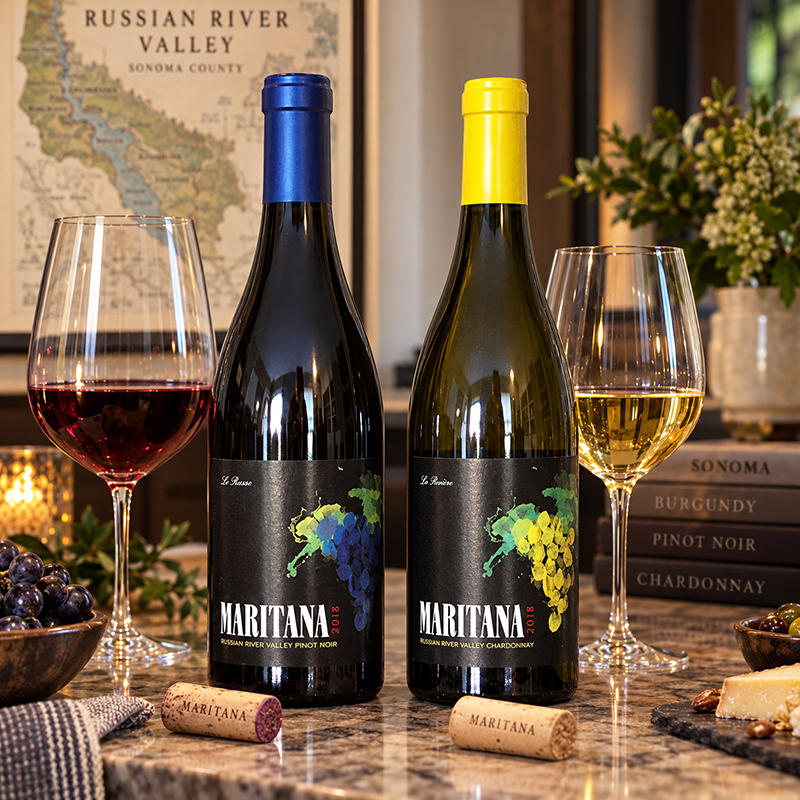
Maritana Chardonnay "La Rivière" 2018 and Maritana Pinot Noir "Le Russe" 2018.
Maritana Pinot Noir 2018 and Maritana Chardonnay 2018. Click here for tasting notes.

Maritana Vineyards

Patz & Hall was founded in 1988 when two Flora Springs Winery and Vineyards employees, assistant winemaker James Hall and national sales manager Donald Patz, decided to strike out on their own. Their ambition was to apply traditional (i.e. French) winemaking techniques to fruit from elite, small vineyards, specializing in Chardonnay and Pinot Noir.  The winery went on to great success.

Continue reading “Maritana Vineyards”

Broadbent Rainwater Madeira

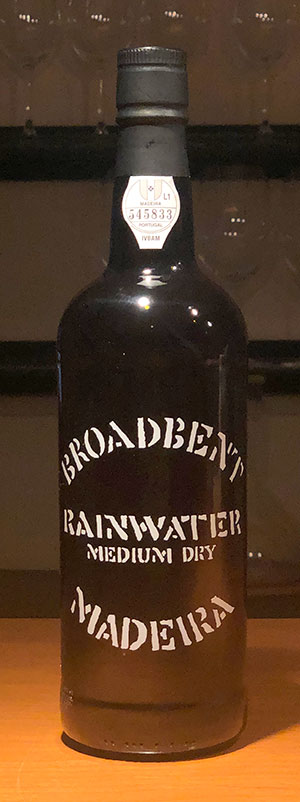
Broadbent "Rainwater" Madeira
Broadbent Rainwater Madeira Click here for tasting notes.

Broadbent Rainwater 

Ports, Sherries, Marsalas, and Madeiras are all beverages that fall under the broad category of fortified wines.  During fermentation, the wine is “fortified” with brandy or neutral grain spirits.  Originally, this was done to preserve and stabilize the wine for shipment, usually to England.  It is now done to create sweet wine; the addition of the alcohol kills the fermentation yeasts, retaining any residual sugar.

A true Madeira such as this one comes from Portugal’s Madeira island, about 400 miles due west of Morocco in northern Africa.  The small island has an oceanic, tropically-influenced climate and volcanic soil. Because of high heat and humidity, fungal diseases and botrytis (also known as grey mold) are constant hazards. To combat them, Madeira vineyards are often planted in low trellises known as latada that raise the canopy off the ground. The wine is cultivated in terraced steps of red and basaltic bedrock called poios.

Madeira’s unique flavor comes from two elements that would ruin other wines: heat and oxidation. During the era when the earliest Madeiras were shipped, it was discovered that aeration of the sloshing barrels in the warm hold of the ship made for delightful wine.  (The Kelt line of cognacs get the same treatment even today.)  As for Madeira, the process is emulated through the estufagem process, whereby the wine is placed in hot rooms or heated tanks (estufas) and slowly baked for a minimum of 90 days.  Depending on when they are dosed with alcohol, Madeiras can range from quite dry to very sweet.

There are four distinct styles of Madeira. The pale, golden Sercial is the driest and lightest.  Verdelho is sweeter and stronger, and Boal is fuller and sweeter still.  Malmsey is the richest, darkest, and sweetest of all.

Although the history of Madeira goes as far back as the 18th century, Broadbent has been producing wines in Portugal for just over 20 years. In the mid-1990s Michael Broadbent, Director of Christie’s auction house, prolific wine author, and Madeira expert, partnered with Justino’s Madeira Wines, S.A. to create the Broadbent line.  Justino’s was formed as a limited company in 1953, although it had been in existence since 1870 in Madeira as a private family company, when it was known as “Justino Henriques.”

BARTHOLOMEW BROADBENT

Broadbent is now helmed by Michael’s son Bartholomew. He was raised in the English wine trade in a formal apprenticeship to his father.  The Broadbent line includes Port from the Douro, Madeiras and Vinho Verde from Portugal, and a Gruner Veltliner made in Austria.

He is credited as being responsible for the growth of Port consumption in North America during the mid 1980s. He was responsible for the re-introduction of Madeira to America in 1989, and instrumental in its growth since then.

He currently lives in Virginia, where he is also involved in the distribution of Virginia wines, now available in over 30 states.

Broadbent Rainwater Madeira

“Rainwater” is a soft, medium dry variant of Verdelho.  According to legend, early shipments of Madeira were left on the island’s beaches to await pickup prior to shipment.  During that time, the barrels absorbed water during rain showers. This diluted the alcohol and created a less potent wine.

This is one of six Madeiras under the Broadbent label.  (There are 11 others branded as Justino’s produced by the house.) The fruit is 98% Tinta Negra, and 2% other regional red varieties. Aged in oak casks for at least three years, this wine is dark orange in color, with a nose of dried dates, figs, and orange peel. There are fresh citrus and caramel flavors on the full-bodied, satiny palate backed up with a zoomy acidity.  It is indeed medium dry. It can be served as an apéritif or as an after-dinner drink. The ABV is 19% and 20,000 cases were produced.

www.broadbent.com/

Back to blog posts: winervana.com/blog/
J-M-L Cabernet Sauvignon

J-M-L Cabernet Sauvignon 2018.
J-M-L Cabernet Sauvignon 2018. Click here for tasting notes.

J-M-L Cabernet Sauvignon 2018

Patz & Hall was founded in 1988 when two Flora Springs Winery and Vineyards employees, assistant winemaker James Hall and national sales manager Donald Patz, decided to strike out on their own. Their ambition was to apply traditional (i.e. French) winemaking techniques to fruit from elite, small vineyards in Napa Valley specializing in Chardonnay and Pinot Noir.  The winery went on to great success.

Continue reading “J-M-L Cabernet Sauvignon”