Dominus

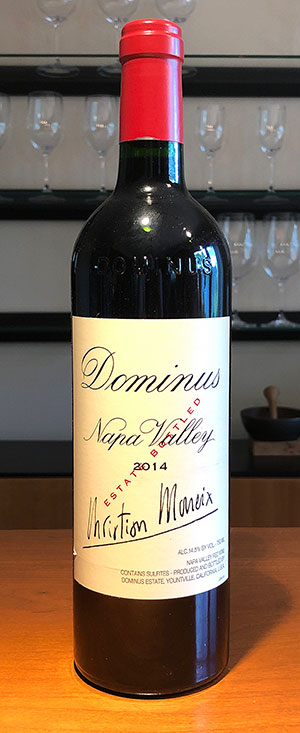
Dominus 2014
Dominus 2014. Click here for tasting notes.

OK, let me be clear up front: with an MSRP of $250, this is definitely not a bottle for the casual wine drinker.  But my well-healed and generous step-daughter bought it for me, so here it is.

Dominus Estate is owned by Christian Moueix, one of the few winemakers to produce classic wines in both the old and new worlds, and he is also one of the most well-known. The son of Jean-Pierre Moueix, a Bordeaux wine merchant, he  was born in Libourne, France in 1946. After completing his agricultural engineering studies in Paris and graduate studies in viticulture and enology at the University of California at Davis in 1968-69, he joined his father’s company in 1970 to manage the family vineyards, and in 1991 became its president. He oversaw the legendary Chateau Petrus for 38 years, ending with the 2008 vintage.

He remained drawn to Napa Valley as well, and in 1981 he was made aware of the historic Napanook vineyard, a 124-acre site west of Yountville that had been the source of fruit for some of the finest Napa Valley wines of the 1940s and 1950s.

In 1836, George C. Yount, the founder of Yountville, planted the first vines in Napa in this vineyard.  Owners since have included Hugh La Rue, a pioneer in the development of rootstock, and John Daniel Jr., the owner of Inglenook Winery who bought the estate in 1946.

Following Daniel’s death in 1970, Napanook passed to his daughters Robin Lail and Marcia Smith.  They began a partnership with Moueix in 1982, acting on a recommendation by Robert Mondavi.
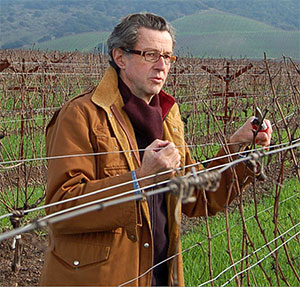
Christian Moueix

Moueix applied what he had learned both in France and California to the project. His focus has been on dry-farming techniques to sustain a sound ecology, as well as a means to produce grapes of the finest quality. Dry farming relies on a deep root system to take advantage of natural water sources from rain and underground supplies. Electric golf carts are used extensively on the property to conserve gasoline, minimize dust, and reduce soil compaction. Owl boxes and bluebird houses provide homes to natural predators of vine pests and rodents.

Eventually, in 1995, Moueix became the estate’s sole owner, renaming it ‘Dominus’ (Lord of the Estate in Latin) to underscore his longstanding commitment to stewardship of the land.  He expanded Dominus in 2008 with the addition of a 40-acre vineyard in Oakville.

The Winery
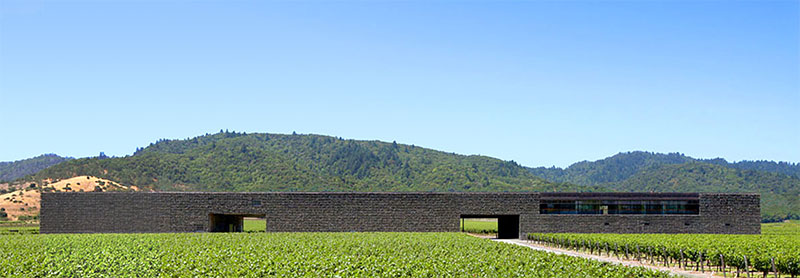
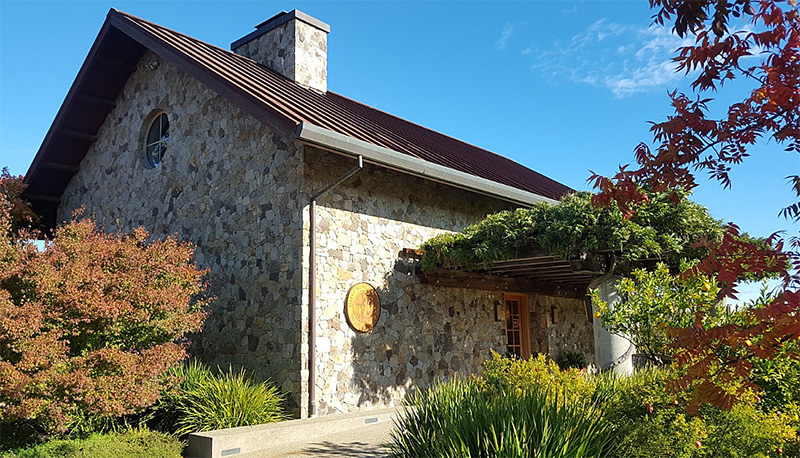
The first thirteen vintages of Dominus were crushed and aged at the nearby Rombauer Winery.  However, in 1995 Moueix commissioned the design of a new $5 million, 50,000 sq ft facility by Swiss architects Jacques Herzog and Pierre de Meuron,  Completed in 1997 , the Dominus Estate winery is dramatically low-slung, integrated into its landscape and offering panoramic views of the surrounding vineyard and hillsides.

The winery was Herzog and de Meuron’s first project outside of Europe. The architects have since designed numerous renowned buildings, including the Tate Modern in London, the Allianz Stadium in Munich, the Prada boutique in Tokyo, the de Young Museum in San Francisco, and the “Bird’s Nest” stadium in Beijing. In 2001, they were awarded the Pritzker Prize, contemporary architecture’s highest award.

The Winemaking

Separate fermentation is done on a lot-by-lot basis. Berry clusters are hand-sorted, complemented by an optical berry-sorting system. Gentle pumping-over is done to extract as much aroma, color, and tannins as desired. Racking is barrel-to-barrel in 100% French oak to remove sediment and assure clarification of the wine during aging, and egg-white fining eliminates impurities.

Dominus 2014

2014 in Napa Valley was characterized by a very dry early winter, with heavy rains in February and continued rainfall in March and April.  Average temperatures were higher than historical averages, with minor heat spikes in June and in July. No heat spikes were recorded in August or September.

This wine is a blend of Cabernet Sauvignon: 86%, Petit Verdot: 7%, and Cabernet Franc: 7%.  It is an inky deep red/purple, with  cardamom and forest floor aromas.  There are booming flavors of blackberry and cocoa on the tongue., offset by very dry tannins.  Dominus is very much in the European style (predictably, considering Moueix’s experience on both sides of the Atlantic.)  The finish is long and silky.

This Dominus was aged in French oak, 40% new, and 4300 cases were produced.

www.dominusestate.com/

Back to blog posts: winervana.com/blog/

Coursey Graves Winery

Cabell Coursey

Coursey Graves Winery

Cabell Coursey is a busy guy these days. In addition to being the winemaker at Lombardi Winery, he is also winemaker and co-owner at Coursey Graves Winery in Santa Rosa, California. He began his career in wine in Burgundy, where he worked his first harvest during an undergraduate semester abroad. After graduation, he returned to the States and pursued the menial but necessary chores of picking grapes, scrubbing tanks and barrels, and learning traditional winegrowing methods. He went on to toil in Oregon’s Willamette Valley, and later traveled to Christchurch, New Zealand, where he earned graduate degrees in Enology and Viticulture from Lincoln University. It was there he developed the passion for cool climate wines that guides his style today. Before starting Coursey Graves in 2015 with partner John Graves, Coursey made wine for Alder Springs Vineyard, DuMol, Flanagan, and Kosta Browne.

He is committed to constantly improving the wines he makes from vintage to vintage by understanding his vineyards and maximizing their quality.  He also feels obligated to mentor young winegrowers by teaching parameters they can use to customize and improve grape farming for better produce.

Coursey stated,  “I am interested in making wines that show the place where they are grown, taste great young, but also age [well]. With most wines, aging means maintaining. I strive to make wines that evolve, not just maintain.
Except for a little bit of Chardonnay, I grow all the grapes I make to wine. It’s important, because my team learns about the vineyard and can change how we grow the grapes to make better wines.”

John Graves

John Graves began his career in computer technology, and after a decade spent working for others, he left to strike out on his own. Thirty years later he sold a successful B-to-B software business. He and his wife Denise used a portion of the proceeds to establish the Graves Foundation, whose mission is to provide disadvantaged youth in greater Minneapolis with access to the resources, opportunities, and caring relationships that will propel them to a successful life. Specifically, the foundation focuses on K-12 education reform and providing foster kids with support during the transition to adulthood.

Grave’s interest in wine began as a hobby, influenced by a good friend and by Robert Parker’s reviews in the Wine Advocate. At length his interest expanded until the desire to learn became a desire to own a winery. Serendipitously, about the same time his winemaker friend Cabell Coursey began talking about starting a new venture of wines in a style they both loved to drink and share. Graves acquired the existing Bennett Valley Winery, and the first vintage of Coursey Graves was bottled in 2017.

Bennett Valley AVA

In 1862, Santa Rosa winemaker Isaac DeTurk planted a vineyard on land he purchased from valley namesake James Bennett. DeTurk called his winery, the valley’s first, Belle Mount. However, the combination of phylloxera and Prohibition cleared the valley of vineyards. It wasn’t until the late 1970s that vineyards returned to Bennett Valley in a meaningful way at the pioneering Matanzas Creek Winery.

The Bennett Valley AVA is located south of Santa Rosa, on high ground between the Sonoma Valley and Cotati Valley. The AVA begins where the city’s suburban neighborhood known as Bennett Valley abruptly gives way to rolling oak woodland and horse pastures bordered by ancient stone walls.

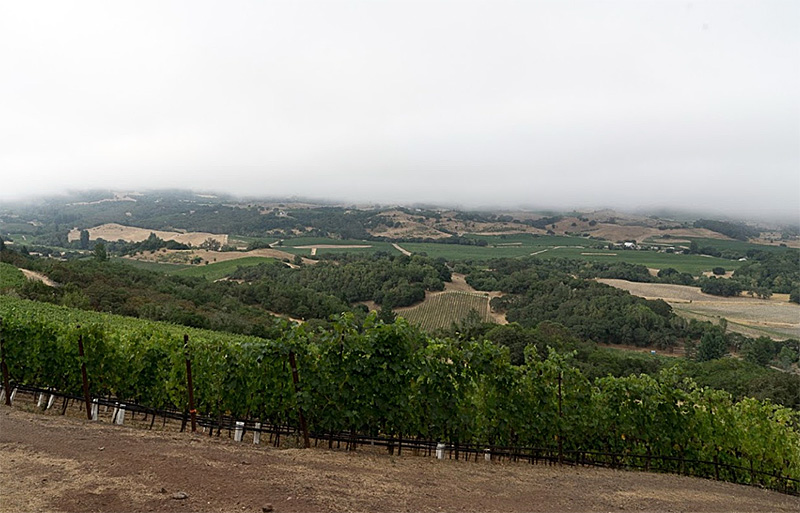
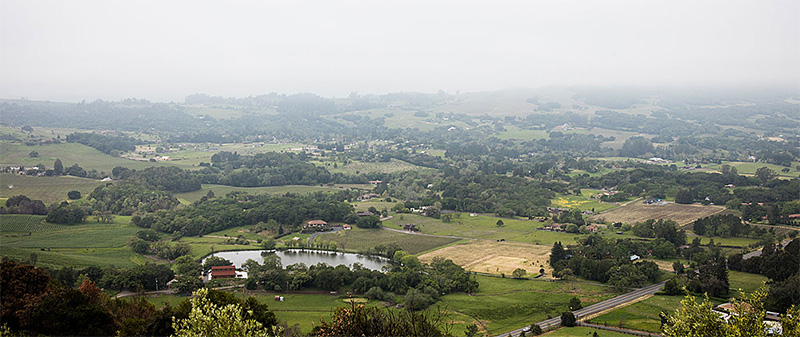
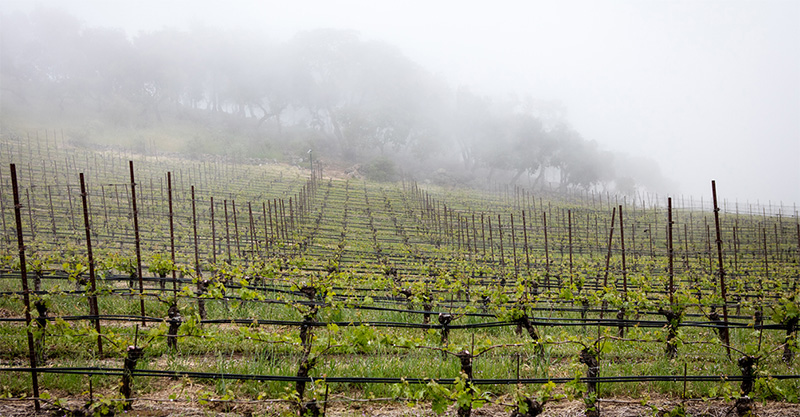
This tiny appellation is one of the coolest AVAs in Sonoma County. This is because of  the Petaluma Gap, where a break in the higher coastal hills lets in cool winds and fog from the Pacific Ocean. Bennett Valley sits directly in the path of the initial incursion.   The fact that there is fog in all of the photos in this post is testament to that!

Although there are plenty of renowned wineries and vineyards throughout Sonoma, of course, the lesser-known vineyards of Bennett Valley quietly yield some of the area’s most highly concentrated fruit. This is because the well-drained volcanic soils of the area ensure that the vines grow deep root systems in search of hydration. Ultimately this leads to concentrated, complex wines, as the water-stressed vines will focus their attention on grapes, rather than luxurious foliage. The rocky soils coupled with the cool weather mimic the austere conditions of Bordeaux.

There are now 650 vineyard acres and four wineries in Bennett Valley, which was awarded AVA status in 2003.

The Coursey Graves Vineyards

Coursey Graves is located on vineyard sites 800 to 1500 feet above sea level on Bennett Mountain overlooking Sonoma, on the western edge of the ancient, volcanic Mayacamas Range that separates Napa and Sonoma. The winery, estate vineyards, and caves are built into the slope overlooking the Bennett Valley below. Eighteen acres are planted to Cabernet Sauvignon, Malbec, Merlot, Petit Verdot, and Syrah.

In addition to the estate vineyard, Coursey Graves relies on two others as well. Nestled on the sloped edge of an ancient volcano, Coombsville Vineyard is home to sixteen acres of Bordeaux varieties growing between the red and black igneous basalt and the white, ashy volcanic tuff. At two thousand feet above sea level, Cabernet from Howell Mountain Vineyard benefits from much cooler daytime temperatures and slower ripening.

The wines

I have now had the opportunity to try eight of Cabell Coursey’s wines.  They all have a smooth and silky mouthfeel.  Thinking this had to reflect the intervention of the winemaker, I asked him about how he achieves that, and he had this to say,  “First is vineyard work.  I get up-front and mid-palate concentration through diligent effort in the vineyard, by managing fruit load to the amount of vine canopy, and careful applications of irrigation. I have some control over berry size, and therefore juice to skin ratio, by controlling how much water-stress the vines have at various times during the growing season. Extra stress at flowering and fruit set limits berry size, while more water increases berry size. I don’t have a standard plan each vintage, but rather change according to conditions.

“Second is tannin management during the winemaking process. Certain tannins (phenols) extract from grapes at different ranges in temperature. Also, they bind at different temperatures. I manage the temperatures during fermentation very closely and change to either extract, not extract, or bind, depending on taste and mouthfeel. I do use lab numbers to double check what I taste. However, it’s mostly by taste. After working with these vineyards and my cellar for a few years, I’ve started to learn where the wines’ tannins need to be at the end of fermentation to age properly upon the wines’ release and subsequent aging.”

Coursey Graves Chardonnay 2018

The fruit for this wine was sourced from the Durell and Heintz vineyards on the Sonoma coast. It was fermented in oak and stainless-steel barrels. It is light bright lemon yellow in the glass, which is appropriate as it opens with the smell of lemons, paired with a hint of melon and crushed stone. Those flavors continue on the palate, abetted by a zippy acidity and a suggestion of oak.  It wraps up in a brisk finish.  Only 91 cases were made.

Coursey Graves West Slope Syrah 2016

This 100% Syrah  hails from Coursey Graves’ estate vineyard in Bennett Valley. It is an opaque but brilliant purple color. It features aromas of dark red fruits. The rather lean palate offers flavors of blackberry and olive, with a bit of pepper at the end.  It’s all complemented by good  tannins and a moderately long finish. Production was limited to 268 cases.

Coursey Graves Cabernet Sauvignon 2016

This wine is 100% Cabernet Sauvignon (although in some years Coursey adds and just a bit of Merlot). The grapes were  mostly harvested from vineyards in Howell Mountain and Coombsville in Napa, as well as some from Bennett Valley in Sonoma.  The aromatics are of rich, complex dark fruit. On the palate the wine offers tart cherry, black cherry, red licorice, and cocoa. The  oak tannins are well-integrated and bracing.  According to the winery, it will be at its peak performance around 2023 to 2024, by which time those tannins will inevitably round out, if you prefer them softer. .192 cases were produced. 

Coursey Graves Bennett Mountain Estate Red Blend 2016

This elegant wine was my favorite of the quartet. The blend is 60% Cabernet Sauvignon and 40% Merlot, all from the estate vineyard in Bennett Valley.  This deep-red selection displays aromas of crushed rock and currant, with a hint of strawberry.  These are followed by flavors of dark plum, blueberries, crème de cassis, and a touch of vanilla, supported by fine tannins.  It offers an excellent example of Coursey’s super smooth, lush mouthfeel.  There is just a bit of dried herbs on the long finish.  234 cases were made.
Coursey Graves’ tasting room is located in downtown Healdsburg, just off the historic Healdsburg Plaza.

www.courseygraves.com/

Back to blog posts: winervana.com/blog/
Momokawa Ruby Fields Saké

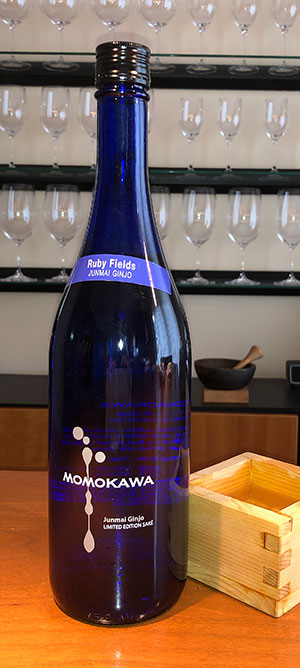
Momokawa Ruby FieldsMomokawa Ruby Fields Saké

Saké, the national alcoholic beverage of Japan, is often called rice wine, but this is a misnomer.  While it is a beverage made by fermentation, the production process more closely resembles that of beer, and it is made from grain (rice, of course), not fruit.  To make saké, the starch of freshly steamed glutinous rice is converted to sugar and then fermented to alcohol.  Once fermented, the liquid is filtered and usually pasteurized.  Sakés can range from dry to sweet, but even the driest retain a hint of sweetness.

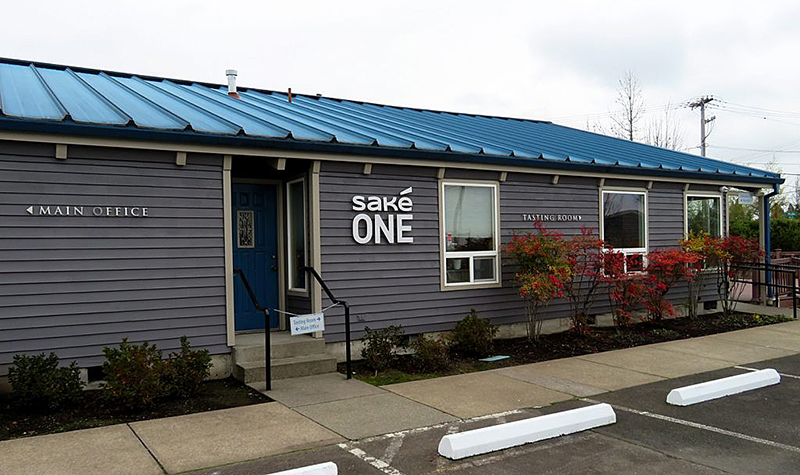
This saké is a domestic product from SakéOne saké brewery in Forest Grove, Oregon.  The company began as a saké importer in 1992, and in 1997 they expanded the operation and began brewing saké.

In premium saké, water composition matters a great deal. SakéOne’s founder chose Oregon because he believed that the best-quality water for saké brewing is in the Northwest.

The other crucial component is rice, and SakéOne sources its Calrose rice from the Sacramento Valley. Calrose is derived from Japanese saké rice and has several qualities that produce saké with more body, higher viscosity, and a long finish.

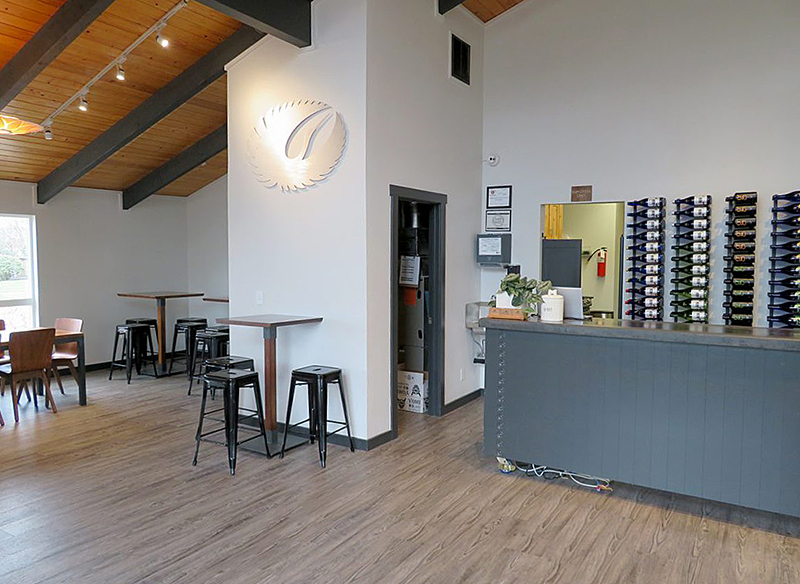
SakéOne's modest tasting room.
SakéOne’s modest tasting room.

Momokawa Ruby Fields Saké

Ruby Fields is a rich, full-bodied Junmail* Ginjo**  saké that opens with aromas of Granny Smith apples and bananas.  Those flavors continue on the palate, with the addition of a hint of cantaloupe.  It is moderately dry, with a fairly long finish.It is marketed as an upgrade to Momokawa’s Ruby  The ABV is 16%, and the SMV*** is -1.5. The rice has a polish of 58%, so 42% of the rice has been removed.  Serve chilled.

sakeone.com/

*Junmai is pure rice wine, with no added alcohol). Until recently, at least 30% of the rice used for Junmai sake had to be milled away, but Junmai no longer requires a specified milling rate.

**Ginjo designates that at least 40% of the rice has been polished away. If a bottle is labeled just Ginjo, distilled alcohol was added; if it is labeled Junmai Ginjo, no alcohol was added.

****An important gauge of saké  is the SMV (Saké Meter Value).  This measures the density of saké relative to water, and is the method for determining the dryness or sweetness of saké. The higher the SMV, the drier the saké. The range is -15 to +15.

Back to blog posts winervana.com/blog/

HALL Jack’s Masterpiece

HALL Jack's Masterpiece Cabernet Sauvignon.
HALL Jack’s Masterpiece Cabernet Sauvignon. Click here for tasting notes.

HALL Jack’s Masterpiece Cabernet Sauvignon 2017

Kathryn Walt Hall has a most impressive curriculum vitae. To touch on just a few of the high points, she is the proprietor of HALL Wines and WALT Wines [family businesses she has been involved with for over thirty years], was assistant city attorney in Berkeley, California, worked as an attorney and businesswoman in Dallas, Texas, and has served on numerous non-profit and institutional boards, with an emphasis on issues related to social care and mental health. From 1997 to July 2001, Ms. Hall served as the United States Ambassador to Austria. In the midst of this, together with her husband Craig she has raised four children.

Continue reading “HALL Jack’s Masterpiece”

Bota Box

Bota Box
Bota Box

Bota Box

When summer comes around, it’s time for all things casual. And nothing says casual like wine out of a box. But, yuck!, you say. Who wants cheap swill like that? Well, you don’t, and neither do I. Even though it delivers the convenience and economy only a boxed wine can offer, Bota is nonetheless a line of first-rate wines.

Delicato Family Wines, a family-owned California winery founded in 1924, launched Bota Box in 2003, taking inspiration from traditional Spanish wine skins known as “botas”, which were used to carry wine for centuries. “Bota Box is now the U.S. category leader in premium wine in alternative packaging, and its strong performance is driving the growth of the premium alt-packaging category as a whole,” commented Jon Guggino, Executive Vice President of Marketing for Delicato.  The brand has expanded by nearly 3 million cases since 2015, and exceeded the 7-million-case mark in 2019.  So, hardly a boutique operation.

The Bota Box design makes it possible to keep the wine fresh for at least 30 days after opening because there is no exposure to wine’s enemies: light and air (The poly bag inside the box collapses as the wine is removed.) The box itself is made from environmentally-friendly packaging consisting of 100% recyclable, unbleached, post-consumer fiber printed with soy-based inks.
And the box is highly portable. Take it camping, boating, poolside, to picnics, to the beach, or to your next barbecue. And, you don’t have to remember to bring a corkscrew.

Each box holds three liters, or the equivalent of four bottles of wine. With a retail price of about $20, that’s equivalent to five bucks per bottle. Hard to beat these days.

Bota Box includes ten wines: Cabernet Sauvignon, Chardonnay, Malbec, Merlot, Moscato, Pinot Grigio, Old Vine Zinfandel, Riesling, Shiraz, and a red blend called RedVolution.

www.botabox.com

Back to blog posts: winervana.com/blog/
LVOV Vodka

LVOV Vodka

LVOV Vodka

LVOV [Luh-voff] premium Polish vodka offers excellent value for the money. Crafted in the old tradition from potatoes (and thus gluten-free), it is distilled four times, then filtered four times through an activated carbon and candle process for smoothness. It features a hint of mineral taste with a touch of sweetness, and a slightly herbal aroma. This is a refined, mellow sip to add as part of your favorite cocktail or enjoyed on its own.

Because home freezers don’t get cold enough to freeze spirits, many people (us included) like to stash their vodka there for ready-to-go enjoyment.

–Spirits Contributor Neal Kotlarek

LVOV Smash
2 oz. LVOV Vodka
5 grapes
1 slice serrano pepper
1 lime wedge
1 sugar cube
Dash orange bitters

Directions: Muddle all the ingredients in a cocktail shaker with ice. Shake well and pour everything into a cocktail glass. Garnish with remaining serrano pepper and lime wedge.

LVOV Sparkling Sea Breeze
1½ oz. LVOV Vodka
1½ oz. cranberry juice
1½ oz. grapefruit juice
1½ cups ice cubes
1½ oz. sparkling water
1 lime wedge

Directions: Fill a cocktail shaker with vodka, juices, and ice cubes. Cover and shake. Fill a glass with sparkling water. Strain vodka mixture into sparkling water and garnish with lime wedge.

Back to blog posts: winervana.com/blog/
Cline Cellars

Cline Cellars

Cline Cellars

As you enter Sonoma county from the south on California 121, one of the first wineries you encounter is Cline Cellars, and there could hardly be a better introduction to the Carneros AVA.

Even as a young teenager, Fred Cline learned to make wine from his grandfather, Valeriano Jacuzzi (yes, he of the hydrotherapy tub, as well as many other innovations). With a $9000 inheritance from Valeriano, in 1981 Cline founded the eponymous Cline Cellars in Oakley, California.

The winery was relocated to its current location in 1991. The property is the original site of the Mission San Francisco de Solano, the 21st and final of the historic California missions. Although the mission was moved in 1823, the Cline tasting room is located in a rustic 1850s farmhouse that is original to the property, surrounded by spring-fed ponds and thousands of rose bushes. The vineyards also reflect this history, with vines ranging from 80 to 120 years old.
Cline is one of the first of the pioneering Rhone Rangers, a group dedicated to wines from the grapes of the Côtes du Rhône in France (ironic for a boy with an Italian grandfather, no?)

Cline also has been a pioneer in sustainable farming. It is the second-largest completely solar-powered winery in California. Natural cover crops are used to nourish the soils, sheep and goats roam freely as they graze on weeds, and compost teas are used as fertilizer. “We’d be considered ‘organic’ if we wanted to follow the rules of the government,“ said Cline. “We are actually more sustainable [than the law calls for] by not following their organic rules.“ He calls his methods “beyond organic.”

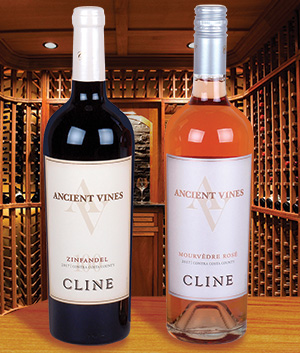
Cline Cellars Ancient Vines Mourvèdre Rosé 2017

C’mon! Don’t be afraid! Summer’s here, and what could be better than rosé? There are all kinds of dry, crisp expressions available, absolutely none like the dreaded cloying White Zinfandel of days gone by. This selection is an excellent place to start.

Fresh herb and strawberry aromas are followed by tart watermelon and just a hint of lemon peel and thyme flavors in this medium-bodied, smooth, and rather soft-textured wine.

Excellent as a well-chilled aperitif, or pair it with raw oysters, lobster Newburg, or planked salmon.

Cline Cellars Ancient Vines Zinfandel 2017

The grapes for this Zin were planted by Italian and Portuguese immigrants in the sandy, phylloxera-resistant soils of Oakley, California, more than 100 years ago. Ancient, indeed. This dusty-ruby colored wine is lively and supple, with raspberry and baked stone fruit aromas. Tart cherry predominates on the medium-full body, complemented by medium tannins, moderate vanilla oak, and just a hint of pepper.

Serve this up with venison sausage and smoked gouda pizza, Kentucky burgoo, or barbequed duck.

clinecellars.com/

Back to blog posts: winervana.com/blog/
Codigo 1530 Tequila

Codigo 1530 TequilaCodigo 1530 Tequila

Anyone keeping abreast of celebrity news knows that tequila is a hot market. In June2017, actor George Clooney and his two partners sold their tequila company, Casamigos, for around $1 billion. Their initial investment was $1.8 million. In May 2007, rock musician Sammy Hagar sold an 80%  stake in tequila company Cabo Wabo for $80 million.

Entrepreneurs Frederico Vaughan and Ron Snyder got the bug—or is it worm?—to start a tequila brand while they played a round of golf together at Cabo San Lucas in Mexico. Vaughan’s favorite local distillery is located in Amatitán where a family has been producing tequila for five generations. The tequila begins with fully-matured agave aged over seven years, which is cooked in stainless steel ovens, fermented utilizing a local organic family baker’s yeast, and distilled twice in stills handmade by the distilling family themselves.

“The secret of Codigo 1530 tequilas begins with the best blue agave in Mexico, the purest water in all of Mexico, and yeast from a local bakery,” confirmed Vaughan. “We then age the tequila in French Oak wine barrels out of Napa Valley.”

The varieties of tequila that come from this process differ based upon the resting time and the charring of the barrels.

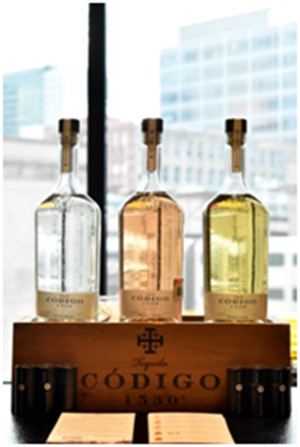
Blanco is an unrested tequila that’s clear and pure. Rosa has a pink tint from the aging in the wine barrels and is a delicious sipping tequila. Reposado is aged for six months and serves up a smooth, vanilla and caramel flavor to pair well with food. (An 18 month old Añejo and six year old Origen are also available.)

By Spirits Contributor Neal Kotlarek

codigo1530.com

Back to blog posts: winervana.com/blog/
Italo Cescon Pinot Noir

Italo Cescon Pinot Noir.
Italo Cescon Pinot Noir. Click here for tasting notes.

Italo Cescon Pinot Noir

Italy’s Piave region covers a vast plain in the greater Veneto area. It is bordered on the south by the Adriatic Sea, to the northwest by the hills of Valdobbiadene and Conegliano, is crossed by the river Piave, and to the northeast it borders on the Friuli Venezia Giulia region. Wine has been made here for millenia, based on the archaeological discoveries that have been made. Moreover, the first Oenological School of Italy was founded there in 1876.

Continue reading “Italo Cescon Pinot Noir”

Smoking Loon Steelbird Rosé

Smoking Loon

Smoking Loon Steelbird Rosé

In 1895, Samuele Sebastiani left his native Tuscany for America. Eventually arriving in Sonoma, California, he worked hauling paving stones for a local quarry that were used to build the streets of San Francisco. Perhaps looking for less demanding work, in 1904 he purchased winemaking equipment and made his first 500 gallons of wine. Just five years later, he had enough financial success to purchase the Sonoma Mission vineyard (planted in 1825 for sacramental wines), the site the Sebastiani winery occupies to this day.

Sebastiani was the only winery in Sonoma County to continue operations during Prohibition by making a small amount of sacramental and medicinal wines. This and fruit growing were the only ways wineries were able to survive. Nearly ten years after Prohibition was enacted, the Great Depression added to the struggle. Sebastiani initiated major projects at the winery to help keep people employed by canning peaches, nectarines, and pears. When there weren’t enough jobs at the winery, he built a skating rink, theater, motel, and meeting hall at the Catholic Church.

Following the repeal of the scourge of Prohibition, Samuele’s youngest son, August, joined the family business as winemaker. August purchased the winery from his late father’s estate in 1944. He expanded the business and began to sell name-branded wines.

In 1980, with August’s death the winery was passed down to his three children. The oldest, Sam, became CEO and President, and began to shift production from lower-cost products to upscale varietals. He left the company in 1986 to start his own business, and August’s youngest son, Don, ascended to control. During his first ten years, he increased production by 300%. In 2001 he established Don Sebastiani & Sons, a beverage holding company that includes wine, spirits, and water. Ironically, the portfolio does not include the original business, Sebastiani Vineyards, which was sold to the Foley Wine Group in 2008, which also owns Firestone Vineyards in Santa Barbara, Merus in Napa, and Three Rivers Winery in Washington state.

Smoking Loon Steelbird Rosé 2018

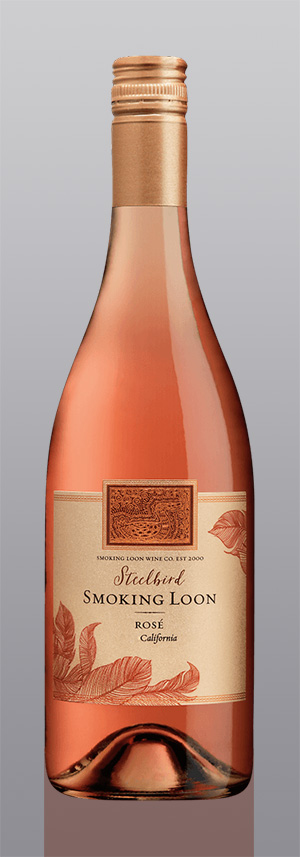
Smoking Loon, however, is one of the Don Sebastiani & Sons brands.  The blend is 60% Barbera, 27% Syrah, and 13% Grenache, with an ABV of 12%.  It is a petal pink color in the glass, and opens with fragrant aromas of strawberry, plum and cantaloupe.  The palate features a lovely watermelon flavor, followed by tart rhubarb and finally juicy, fruit flavors of apricot, and strawberry. This well-balanced wine has good acidity and a fresh, crisp finish.

Smoking Loon claims “the label activates PINK when [the] wine is a perfectly chilled 50ºF.” but I didn’t see it.

http://smokingloon.com/

Top of page: https://winervana.com/blog/

Burgaud Les Vignes Beaujolais

Jean-Marc Burgaud Beaujolais Villages.
Jean-Marc Burgaud Beaujolais Villages. Click here for tasting notes.

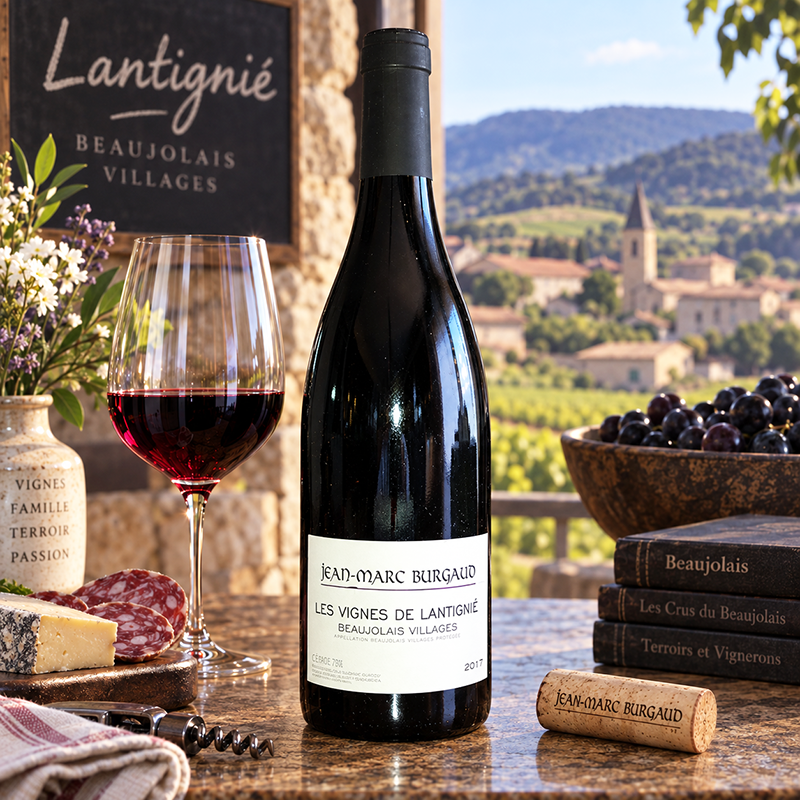
Jean-Marc Burgaud Les Vignes de Lantignié Beaujolais 2017

Jean-Marc Burgaud was born into a family of generations of wine growers. After obtaining his diploma in oenology and wine-growing, he started his eponymous winery with his wife and partner Christine in 1989.  He owns all of the vineyards he farms, with the majority (32 acres / 13 hectares) being in Morgon’s famed Cotes du Py, in the heart of the Beaujolais crus.  He also owns an even tinier amount of Regnie (2.5 acres / 1 hectare) and Beaujolais Villages (10.3 acres / 4.2 hectares), from which this wine comes.  Burgaud believes that the current total of his vineyards is the maximum area he can cultivate while still producing the quality he is after.

Continue reading “Burgaud Les Vignes Beaujolais”

Imagery Sauvignon Blanc and Cabernet Sauvignon

Imagery Cabernet Sauvignon 2018 and Sauvignon Blanc 2019
Imagery Cabernet Sauvignon 2018 and Sauvignon Blanc 2019. Click here for tasting notes. 

Imagery Sauvignon Blanc 2019 and Cabernet Sauvignon 2018

In 1973, newlyweds Mike and Mary Benziger drove west and permanently settled in Northern California. Seven years later, Mike and and his brother Bruno Benziger purchased the historic Wegener Ranch on Sonoma Mountain in Glen Ellen, California. Hearing the Sirens’ call of the Golden State, over the next six years the four remaining siblings — Bob, Joe, Jerry, and Patsy, with their spouses — made their way to California.

Continue reading “Imagery Sauvignon Blanc and Cabernet Sauvignon”

Heitz Martha’s Vineyard Cabernet Sauvignon

Heitz Cellar Martha's Vineyard Cabernet Sauvignon 2014.
Heitz Cellar Martha’s Vineyard Cabernet Sauvignon 2014. Click here for tasting notes.

Heitz Martha’s Vineyard Cabernet Sauvignon 2014

In my over forty years of drinking wine, I’ve had excellent bottles, bottles I’ve poured down the drain after drinking half a glass, and, mostly, everything in between.  But over all of those years and thousands of wines, two have eluded me, my so-called “unicorn” wines.

I first learned of the Heitz Cellar Martha’s Vineyard Cabernet Sauvignon in the mid-’70s when a normally generous acquaintance was showing off an unopened bottle, with obviously no intention of sharing.  Martha’s Vineyard was selling for about $30 at release then, far more than I could afford, so I wasn’t going to be enjoying it any time soon.  But the desire was established.

On a winery tour through Napa valley in the mid-1990s, I stopped at Heitz’s “tasting room,” on that visit  literally a windowless construction trailer parked by the side of the road.  I was about halfway through the tasting when I heard a car grind to a halt outside on the gravel.  The door burst open, and the driver demanded, “I want to try the Martha’s Vineyard!”  The bartender calmly responded, “We don’t pour the Martha’s Vineyard here.”  (A fact I, sadly, already knew.)  The door slammed shut, and he was off.  Denied.

Martha’s Vineyard is now selling for $250 on release, and, really, I still can’t afford it.  But during these uncertain times, I thought, “What the hell.  I may never get a chance to drink this wine I’ve been lusting after for so long.” So here it is.

Born in Princeton, Illinois, Joe Heitz served in the Army Air Force during World War II, and moonlighted during off hours at a winery near Fresno.  After the war ended, Heitz began taking classes at UC Davis, achieving a bachelor’s and then a master’s degree in viticulture and enology in 1951. in the first graduating class of just seven people.  Heitz found employment at two wine industry extremes, first at Gallo, and then with the famous André Tchelistcheff at Beaulieu Vineyard as an assistant winemaker, where he worked for nearly ten years.

Joe Heitz
Joe Heitz. Photo: St. Helena Historical Society

Heitz Cellar was established in 1961, when, after serving his “apprenticeship,” in 1961 Heitz and his wife Alice bought a small 8.5 acre (3.4 ha) vineyard from Leon Brendel in St. Helena, California, named “The One & Only,” for $5,000, and went into business for himself.  At the time, there were only about two dozen Napa Valley wineries, the lowest number since Prohibition.  (Today there are over 1,700 registered wineries in Napa, but “only” about 500 have tasting rooms.)  This pioneering winery even preceeded Robert Mondavi‘s 1966 start in nearby Oakville.

Photo: Jeremy Baines

In 1963, Heitz bought several barrels of Chardonnay and Pinot Noir from Hanzell Vineyards in Sonoma, the last vintages of James D. Zellerbach’s pursuit of Burgundian excellence and auctioned off by his widow. Heitz blended and sold the wines to lucrative acclaim.

One of his stated strategies for ongoing success was to pay growers, “what their grapes were worth,” in turn increasing the standard of the product he was receiving. In 1964, Heitz acquired an 1898 stone winery with its 160 acre (65 ha) ranch property, which became the Heitz winery and home.

Photo: Darcy K.
Photo: Darcy K.


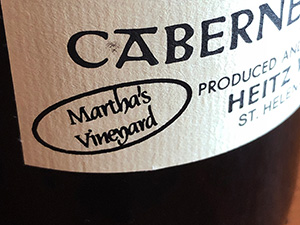
Since 1965, Heitz has held an exclusive agreement with Tom and Martha May, owners of the 34 acre (14 ha) Martha’s Vineyard in the Oakville AVA.  He immediately recognized the quality of the grapes, and the very next year Heitz vinified the fruit separately from his other production, and designated the vineyard on the label.  (Rather subtly, though.  Many of Heitz’s red-wine labels, unchanged for decades, look almost identical.  “Martha’s Vineyard” only appears in a small oval in the lower left corner.)

Martha's Vineyard
Martha’s Vineyard

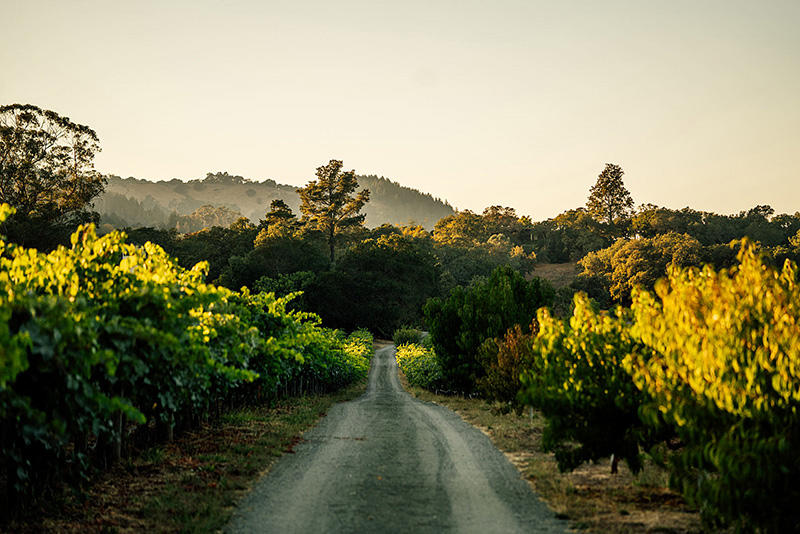
“Standing in Martha’s Vineyard, you quickly realize why this site consistently produces a remarkable Cabernet Sauvignon. The vineyard receives gentle morning and early afternoon sunlight and is sheltered from the heat of the late afternoon sun by the mountains. This allows for longer hang time and Martha’s Vineyard is, historically, one of the last vineyards we pick. This ability to leave the fruit on the vine longer than other sites allows for concentration of flavor and softening of tannin to produce a wine so pure in its expression of place. The consistency in showcasing Martha’s Vineyard’s unique mint, bay leaf, dark berry and chocolate notes year after year is a reminder of why this vineyard has commanded a faithful following since the 1966 vintage.”
–Brittany Sherwood, Winemaker

Heitz is considered the first to champion the single vineyard designation in the U.S.  The 1968 vintage received attention for its quality, widely considered the greatest wine made in America up to that time. It was fermented in 1,000-US-gallon (38 hL) American oak vats, and then transferred to Limousin oak barrels where it aged for an additional two years.  Frank J. Prial, the wine columnist for The New York Times from 1972 until 2004, contended the wine remained “the benchmark by which California Cabernets were judged” for more than two decades.  (The 1970 vintage placed seventh at the Paris Wine Tasting of 1976, also known as the Judgment of Paris.)

Following a review by Robert Parker where he wrote that Martha’s Vineyard Cabernet Sauvignon “lacked aroma,” Heitz sent Parker a box of linen handkerchiefs, insinuating to the critic that he ought to clear his nose.

Joe Heitz suffered a stroke in 1996 which left him frail though lucid.  He died on December 16, 2000, aged 81. He was described by Warren Winiarski, founder and former proprietor of Stag’s Leap Wine Cellars, as the first of the Napa Valley artisans and the first to grasp the single vineyard concept.

David Heitz succeeded his father as winemaker in the late 1970s, having worked at the estate for many years. In 1984, the estate purchased the Trailside Vineyard in Rutherford, having previously purchased fruit from the site, and introduced a single vineyard bottling in 1989.

In the early ’90s, phylloxera afflicted Martha’s Vineyard, and no vintages were made in the mid-1990s.

Heitz Cellar annually produces approximately 40,000 cases (3,600 hL) of wine.  The estate’s vines are grown certified CCOF organic, with a move towards biodynamic farming planned eventually.  In addition to several vineyard-designated Cabernet Sauvignon bottlings that are often aged in oak for three and half years, Heitz also produces varietal-labeled Chardonnay, Sauvignon Blanc, Zinfandel, and Grignolino.  (This is a rare variety in California, but was  the dominant planting of the original estate vineyard.  Heitz is still considered the premier producer.)

In April, 2018, Heitz Cellar was sold to Gaylon Lawrence Jr., whose Arkansas-based family owns one of the country’s largest agricultural businesses.

Heitz Cellar Martha’s Vineyard Cabernet Sauvignon 2014

This wine spent three years in 100% new French oak, one in neutral oak, and an additional year in bottle.  It is medium ruby to purple in the glass.  While I disagree that it “lacks aroma,” the nose is subtle, and predominantly of cherries.  It is incredibly smooth on the palate, with flavors of classic black currant, cocoa, tart cherry, and a hint of dust.  The tannins and acid are in perfect balance, and it all ends in a medium-long finish.  One thing I didn’t get: Heitz Martha’s Vineyard is famous for a minty overlay, especially when it’s this young.  While I wouldn’t find that a problem, I just wasn’t tasting it.  Regardless, Joe Heitz went to great pains to consistently deny that the minty notes had anything to do with the eucalyptus tress planted on the edge of the vineyard.

So, was the forty-five year wait worth it?  Well … yes … but.  This is an excellent wine, worthy of its iconic status.  But for me, it was simply too elegant, especially for the price.  At this stratosphere, I’m looking for something more boisterous,  like a Louis Martini Monte Rosso, a Palmaz, or a Kathryn Hall.

And the other wine of my fantasy?  That would be Penfold’s Grange, the legendary Australian Shiraz.  That one is selling for about $850 on release these days, so it may elude me forever.

www.heitzcellar.com/#1961

Back to blog posts: winervana.com/blog/