Maxville Winery

Maxville Cabernet Sauvignon 2014 and Maxville Sauvignon Blanc 2014.
Maxville Cabernet Sauvignon 2014 and Maxville Sauvignon Blanc 2014. Click here for tasting nores.

Maxville Winery

The 1000-acre Maxville  Winery’s Napa Valley estate is located in the Chiles Valley AVA, in the Vaca Mountains, running parallel to and northeast of the Silverado Trail. The property was first planted to grape vines in 1974; today Maxville has over 100 acres of vineyard located at elevations between 900 and 1,200 feet. The volcanic soils provide a prime growing condition for wines, and Maxville practices sustainable dry farming methods in order to preserve the integrity of the property.

Continue reading “Maxville Winery”

Cusumano Winery

Cusumano Winery.
Cusumano Winery. Click here for tasting notes.

Cusumano Winery

Sicily is the island at the tip of the toe of Italy’s “boot.” It is the biggest island in the Mediterranean, and Italy’s biggest wine-producing region, with over 325,000 acres under vine. However, much of this fruit is distilled into spirits, especially grappa.

The Cusumano Winery is located in Partinico, in Sicily’s far northwestern corner. Relatively new, the winery was established in 2001 when brothers Alberto and Diego took over the management of the company from their father, Francesco. With the help of an intimate knowledge of the Sicilian terrain and consulting winemaker Mario Ronco, the Cusumano brothers today own over 400 hectares (nearly 1,000 acres) of vineyards, and include three separate estates:

Ficuzza, at nearly 2,000 feet above sea level, has 467 acres planted 70 percent to white grape varieties, including the white grape Insolia.

The 346-acre San Giacomo estate is noted for the white color of the “trubi,” the mineral-rich soils that combine lime, clay, and sand. Reds dominate here, with the Sicilian classic Nero d’Avola a key player.

Presi e Pegni is the smallest of the estates at 173 acres. Among the grapes grown here are Nero d’Avola, Cabernet Sauvignon, and Merlot.

Cusumano’s wines are all estate grown and harvested by hand, and are crafted in the ‘new’ Sicilian style that is typified by varietal expression and rich flavors.

Since 2013, Cusumano has been a part of the Terlato Wines empire. “We’re proud to welcome a family-owned Sicilian brand into our portfolio,” Chief Executive Officer William A. Terlato said. “Our own family heritage is Sicilian, so this is an opportunity to reconnect with that legacy.”

The stated philosophy behind Cusumano has been to emphasize the importance of terroir knowledge, invest in innovative technology, and nurture a passion for winemaking.

As a unique touch, in the Sicilian tradition these wines are not sealed with a cork, but rather with a clear-glass stopper.

Cusumano Insolia 2014

100% Insolia, this golden-hued wine hails from Ficuzza, Cusumano’s largest vineyard. The aroma features pineapple, citrus peel, and soft floral accents.

Flavors of pears and tart apples and are evident on the palate. It is mildly acidic with a medium body and a decent, if short, finish. If you like Vinho Verde, Sauvignon Blanc, or citrus-forward Chardonnays, you’ll enjoy this, I think.

Try this summer sipper with Risotto with Spring Vegetables, Tomato, and Basil;Pan-Roasted Mackerel with Rosemary and Garlic; or Fricasseed Chicken with Egg and Lemon.

Cusumano Nero D’Avola 2014

Nero D’Avola (also called Calabrese) is Sicily’s most widely-planted red grape. This one is garnet in the glass, with a nose of red and black raspberries. The taste is fruit-forward (rather unusual for an old-world wine), with medium tannins, a hint of cocoa and earth, and plummy spice flavors.

Enjoy this red with Pan-Fried Beef Braciole Filled with Cheese and Ham; Meatballs and Tomatoes; or Drunk Roast Pork.

cusumano.it/en/

Back to blog posts: winervana.com/blog/

Boutari Winery

Boutari WineryIt’s Greek to Me

If you’re a fan of Greek food, and the wines that go with them, you have probably already sampled a few bottles from the ubiquitous house of Boutari, the world’s number-one selling Greek wine.

The Boutari Company was established in 1879 by Yiannis Boutari in Naoussa on 124 acres, making it one of Greece’s oldest purveyors of fine wine. With decades of experience and business acumen, it is one of the top wineries in Greece. Boutari wines are exported to over 45 countries and have won over 370 medals in international wine competitions.

Boutari was the first and only Greek winery to ever win the award “European Winery of the Year” from Wine Enthusiast, after evaluating its performance in winemaking over time.

Although a producer with a long tradition, Boutari isn’t bound by it. They have embraced modern international winemaking techniques, such as the use of stainless steel, cold-temperature fermentation, and French-oak barrel aging. They strive to get the most from both indigenous Greek and French grape varieties.

The extensive Boutari holdings are comprised of six wineries in Greece: Naoussa, Santorini, Peloponissos, Crete, Goumenissa, and Attica, and one winery in Southern France, near the city of Limoux. Each winery has its own distinct personality, influenced by the architecture and the atmosphere of the particular region within which it is located.

Boutari Santorini Assyrtiko 2012

The island of Santorini, located in Greece’s Aegean Sea, is a defunct volcanic caldera, and home to some of the oldest vineyards in Greece (at upwards of 300 years).

First comes this wine’s quite pale yellow color in the glass. Next up is a relatively closed nose, with delicate hints of ripe melon. But then things get interesting, with flavors of mango, apple, and grapefruit. There’s a crisp, racy acidity with a suggestion of lemon zest.

This island-born wine practically demands to be paired with seafood, such as Porgies with Avgolemono Sauce, Squid in Wine, or Baked Lobster Tails with Feta, but something like Chicken Breasts in Phylo would be delicious as well.

Boutari Naoussa 2009

This wine hails from Bourtari’s original winery in Naoussa, on the southeastern foothills of Mount Vermio in the northern Macedonia region, about thirty miles northwest of the Aegean Sea. The soils are calcium-rich marl (clay loam), and dampened by abundant rainfall.

Made from 100% Xinomavro, the premier red-wine grape of Greece, Naoussa is all about dry, tart, dark cherry, which dominates in the color; on the nose, which also includes the aromas derived from ageing, cinnamon, and wood; and on the palate. Support comes from a nice acidity and soft, medium-grained tannins. To get the most from this bottle, let it breathe for about 30 minutes, and don’t serve it too warm (i.e. not above 65º F).

Enjoy a glass (or two) of Naoussa with a classic Souvlakia, Pork with Green Olives, or Moussaka with Artichokes.

www.boutariwinerysantorini.gr/

Back to blog posts: /winervana.com/blog/

WALT Wines

WALT Bob’s Ranch Pinot Noir and WALT Bob’s Ranch Chardonnay.
WALT Bob’s Ranch Pinot Noir and WALT Bob’s Ranch Chardonnay. Click here for tasting notes.

WALT Wines

Walt Wines, owned by Kathryn Hall and Craig Hall, is dedicated to the production of Pinot Noir and Chardonnay from the Pacific Coast, spanning nearly 1000 miles and including Sta. Rita Hills, Sonoma County, Anderson Valley, Napa Valley, and the Willamette Valley. They strive to source top fruit from the most distinctive vineyards; practice precise, non-interventionist winemaking; and focus on limited production. The goal is to allow the wines to naturally and honestly express the character of the sites where the wines are grown.

Continue reading “WALT Wines”

Yao Ming Cabernet Sauvignon

Yao Ming Cabernet Sauvignon.
Yao Ming Cabernet Sauvignon. Click here for tasting notes.

Yao Ming Cabernet Sauvignon 2009

In November 2011, then-recently retired NBA star Yao Ming established his new Napa Valley winery, Yao Family Wines. But the story really begins in 2004, when Yao Ming was still in the early stages of his basketball career. Yao’s Houston Rockets teammate Dikembe Mutombo introduced him to the institution of the Texas steakhouse. Over many steak dinners, Dikembe tutored Yao on the magic of a great steak and wine pairing, and Yao became an aspiring wine aficionado.

Continue reading “Yao Ming Cabernet Sauvignon”

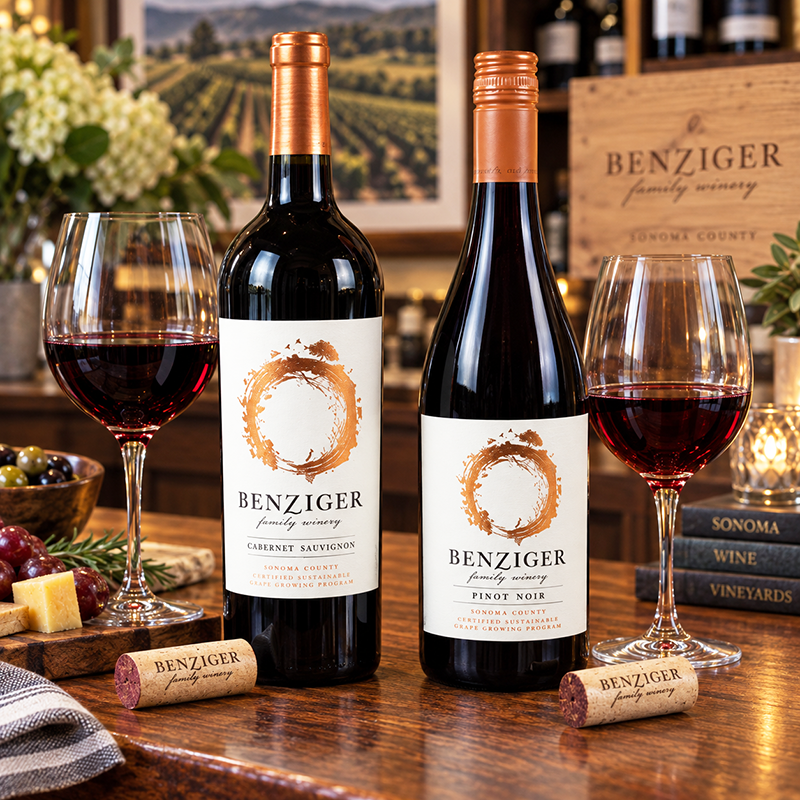
Benziger Sauvignon Blanc and Pinot Noir

Benziger Family Winery

Benziger Winery

In the early 1980s, the Benziger family (not to be confused with Beringer, although they often are) migrated west from White Plains, N.Y., and started a winery on Sonoma Mountain. Winemaker Joe Benziger learned his craft by making large production wines for the Glen Ellen brand, but eventually decided that his future lay with a series of small, artisan wines, sustainably produced.

Depending on location, every Benziger vineyard is certified sustainable, organic, or Biodynamic, using the most up-to-date green farming practices. But, just what does that mean? Green, sustainable, and organic are words that are often used rather casually. At Benziger, they try to be more precise.

Their third-party certified-sustainable vineyard program emphasizes environmentally-sound growing methods, such as biodiversity, soil revitalization, and integrated pest management. Their growers are required to participate in sustainable farming.

Organic grape growing avoids the use of synthetic chemicals and uses natural methods like crop rotation, tillage, and natural composts to maintain soil health, as well as natural methods to control weeds, insects, and other pests. The winery itself is certified organic, too. Organic is an evolutionary step up from sustainable. After that, many Benziger growers move on from certified organic to certified Biodynamic.

Animals and beneficial gardens play an important part in Biodynamic farming techniques. Benziger relies on sheep for the removal of overgrown cover crop, and they replace the need for mowing, disking, and spraying herbicides; they aerate the soil while continuously depositing nutrient-rich fertilizer throughout the vineyard.

Olive trees also support the health of the estate. Olives often grow well in the same climates and soils as wine grapes, and Benziger has been offering an Estate Biodynamic Olive Oil for a number of years.

Benziger North Coast Sauvignon Blanc 2014

This very pale-yellow sipper is made from 100% Sauvignon Blanc grapes harvested from the North Coast appellation of Sonoma County. It opens with hints of melon on the nose. There is a subtle sweetness in the taste, suggesting peaches. The acidity comes on reminiscent of Key lime. It ends with a bit of bubbly on the finish.

Pair this easy-going wine with tabbouleh, braised swordfish in white wine, or grilled shrimp in a Catalan almond sauce.

Benziger Sonoma Coast Pinot Noir 2014

This selection looks more like cherry Kool-Aid than wine, but it’s wine, for sure. The understated nose features raspberry and sweet earth. The taste is cherry, alright, but this time of the tart variety. There is a medium finish with restrained tannins.

This easy-to-drink Pinot would go nicely with steam-poached salmon, Spanish chicken with sweet peppers, or Andalusian braised lamb shanks with honey.

www.benziger.com/

Back to blog posts: winervana.com/blog/

BACA Wines

BACA Wines.
BACA Cat’s Cradle and BACA Double Dutch. Click here for tasting notes.

The eponymous Kathryn Hall Wines are known for their Cabernet Sauvignons. A second label, WALT Wines, specializes in Pinot Noir and Chardonnday. In 2016, Ms. Hall’s daughter, Jennifer Brown,  launched a third winery for the family named BACA Wines. Latin for ‘berry,’ BACA’s focus is on California Zinfandel. According to Brown, “When we set out to create the BACA brand, we had one mission in mind: to produce luxury Zinfandels that are nuanced, honest, current, and fun. We saw a gap in the market with the Zinfandel varietal, so we decided to craft a luxury Zin brand aimed at the curious and the adventuresome – while focusing on quality.”

Continue reading “BACA Wines”

Grace Lane Wines

Grace Lane Cabernet Sauvignon and Grace Lane Riesling.
Grace Lane Cabernet Sauvignon and Grace Lane Riesling. Click here for tasting notes.

Grace Lane Wines

These selections are sourced from a family-owned winery in Mattawa, Washington, nestled in a bend of the Columbia river and 152 miles southwest of Seattle. The family had been farming in the area since the mid-1950s, and believed that the region’s moderate temperatures, low rainfall, and sandy soils would be ideal for wine grapes, and planted their first grapevines in the area in 1997.

Continue reading “Grace Lane Wines”

Rabble Wine

Rabble Red Blend 2015 and Rabble Cabernet Sauvignon. 2016
Rabble Red Blend 2015 and Rabble Cabernet Sauvignon. 2016 Click here for tasting notes.

Rabble Wine Company

If you are looking for affordable, approachable, easy-drinking wines, I suggest you seek out those from Paso Robles. This large but lesser-known appellation was established in 1983 (a mere toddler in wine years), and is located around the town of Paso Robles in the northern part of California’s San Luis Obispo County. Most of the growing area is classified as Region III, equivalent to France’s Rhône region. At last count, there were over 18,000 acres under vine.

Continue reading “Rabble Wine”

Byron Wines

Byron Nielson Vineyard Pinot Noir 2014 and Byron Nielson Vineyard Chardonnay 2014
Byron Pinot Noir 2014 and Byron Chardonnay 2014. Click here for tasting notes.

Byron Wines

Designated in 1981, the Santa Maria Valley AVA is located in the northernmost part of Santa Barbara County, just east of Santa Maria city. The east–west orientation of the wide, open valley means cool winds and fog flow in freely from the Pacific Ocean, settling most noticeably in lower-lying areas. This cool maritime influence lengthens the growing season (among the longest in the world), and contributes to the eventual sugar/acid balance in Santa Maria Valley’s wines.

Continue reading “Byron Wines”

Jack’s House Wines

Jack’s House Wines

Jack’s House Wines

Jack Nicklaus needs no introduction, of course. The Golden Bear is the winner of 18 major golf championships, a golf course designer, a tournament manager, a golf equipment manufacturer, a product endorser, an author, and a philanthropist.

Jack and Barbara Nicklaus founded the Nicklaus Children’s Health Care Foundation in 2004, which provides valuable programs and services to more than 4,000 hospitalized children and their families, free of charge, through Child Life programs, the Pediatric Oncology Support Team, and the Safe Kids program.

Collaborating with pediatric hospitals across the country, the Foundation has grown to support innovative programs focused on the diagnosis, treatment, and prevention of a host of childhood illnesses.

Expanding on that mission, the Nicklaus’s have partnered with the Terlato family, producer of Jack Nicklaus Wines, to create the Jack’s House Foundation. In addition to lending support to the Nicklaus Children’s Health Care Foundation, the Jack’s House Foundation also helps fund Judi’s House, a Denver-area organization devoted solely to supporting grieving children and their families, and the Sepsis Alliance, helping to save lives by raising awareness of sepsis as a medical emergency.

“When Barbara and I started the Nicklaus Children’s Health Care Foundation, we wanted to help provide world-class medical care to those who need it,” Jack Nicklaus said. “This newest partnership with Terlato Wines helps us expand that vision, reaching even more people, with great wines for a great cause.” Ten percent of the net sales from every bottle purchased is donated to the Jack’s House Foundation.

Both of this month’s wines are made by the somewhat mysterious 2Sons Winery of Sonoma, which is owned and managed by the Terlato Family wine empire. The vineyards and winery were founded in 1981. Three friends, John Grace, Mark Rafanelli, and Philip Staley (so why isn’t the winery named 3Sons? See? Mystery.), joined forces and purchased the site that was formerly the Alderbrook Estate. In 2000 the Terlatos were asked to develop a long-range plan to produce world-class wines and market 2Sons throughout the U. S. The Terlatos later purchased a majority share, and invested in both vineyard sources and winery to provide the winemaking team with the best grapes and equipment available. This has helped position the winery to produce single vineyard and estate wines with an on-going focus on Zinfandel.

Jack’s House Chardonnay 2014

This is a golden-hued, easy-drinking summer sipper. Made of 100% chardonnay, the wine was aged sur lie, which is to say, ‘on the lees,’ a common practice for chardonnay. Lees is the coarse sediment (mainly dead yeast cells and small grape particles) that accumulate during fermentation and aging, which in this case was entirely in stainless steel.

The wine has a delicate nose, is very dry, and features suggestions of green apple, peach, and lime pith on the tongue. The finish is quite short.

This would pair nicely with Salmon Pâté, Rolled Sole Fillets in Vermouth Sauce, or Spaghetti with Mussels, Sicilian Style.

Jack’s House Cabernet Sauvignon 2013

This ruby-colored wine is more transparent than most Cabernet Sauvignons. The nose reveals typical aromas of dark stone fruits, while the flavors are tart cherry, plum, cocoa, and a hint of coffee. The tannins and acid are there, but well-integrated and balanced. After fermentation, the wine was aged for 21 months in 50% new French oak barrels.

Enjoy this vino with Chicken Gumbo, Beef Rolls Stuffed with Pork and Dill Pickles, or Lamb Chops with Four Garlic Sauces.

www.jackshousefoundation.org/our-wines

Back to blog posts: winervana.com/blog/