
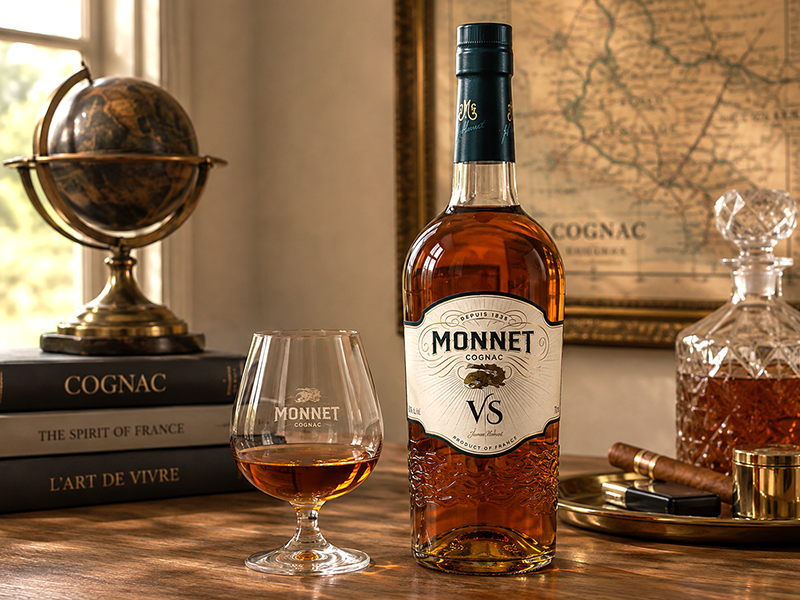
Monnet VS Cognac
Maison Monnet is one of those Cognac houses that is much better known in Europe than in the United States. It has a legitimate historical pedigree, an unusually interesting connection to European history, and a recognizable house style built around fruit, flowers, warmth, and softness rather than aggressive oak. Monnet itself describes this as its “sunny” style.
The house traces its origins to 1838, but the business that became Monnet actually began as the Société des Propriétaires Vinicoles de Cognac, a cooperative organized by Pierre-Antoine de Salignac and local growers. Jean-Gabriel Monnet took control in 1897, and the J.-G. Monnet name began appearing as a brand shortly thereafter.
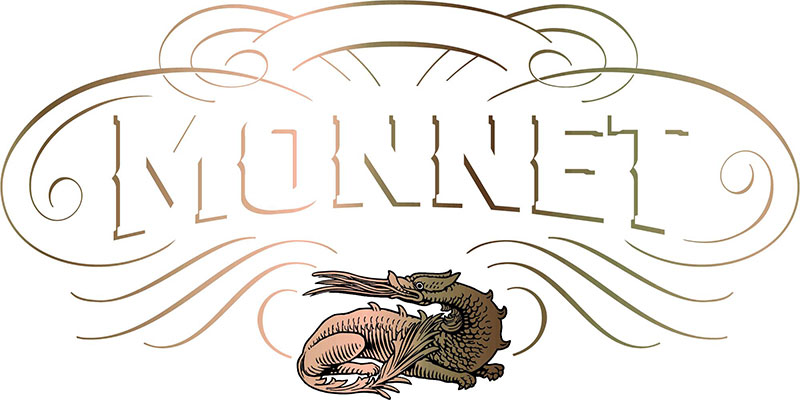
Monnet’s emblem is the salamander, and that isn’t just modern branding. The symbol goes back to the firm’s beginnings. The salamander was traditionally associated with surviving fire, making it particularly appropriate for a spirit created through distillation. It was also the emblem of King François I, who was born in Cognac. Monnet interprets it as representing endurance, fire, time, and transformation.
Jean-Gabriel’s son, Jean Monnet (1888–1979) is the man widely regarded as one of the principal architects of post WW II European integration. Before becoming an international statesman, he worked in the family’s Cognac business. At only 16 he was sent abroad to learn commerce and subsequently traveled to Britain, Canada, the United States, Russia, and Egypt selling Monnet Cognac.
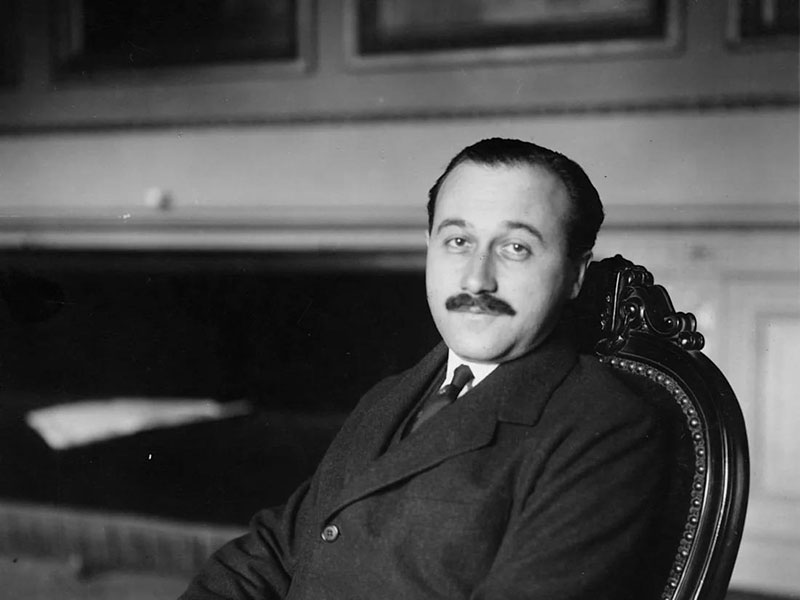
After that apprenticeship, he became one of the people organizing Allied logistics in World War I—and then a senior official of the new League of Nations. In the 1920s he temporarily returned to the family business when it was struggling during American Prohibition. According to the Jean Monnet Institute, his father had accumulated older Cognacs at a time when consumers increasingly wanted younger, cheaper spirits. Jean helped reorganize the business and move some of those stocks. That gives Monnet an unusually direct connection between the international Cognac trade and the development of one of twentieth-century Europe’s most influential figures.
Monnet wasn’t always the relatively obscure name Americans encounter today. During the early 1920s it reportedly held the second-largest share of the American Cognac market, behind Hennessy. In the 1950s it became an official Cognac supplier to the Swedish royal court and remained a significant U.S. brand.
The Monnet family sold control in 1962. Ownership subsequently passed through several hands, including Scharlachberg, Asbach, Hennessy, and Hine. In 2013 Monnet and Hine were acquired by an investment company associated with members of the Guerrand-Hermès family.
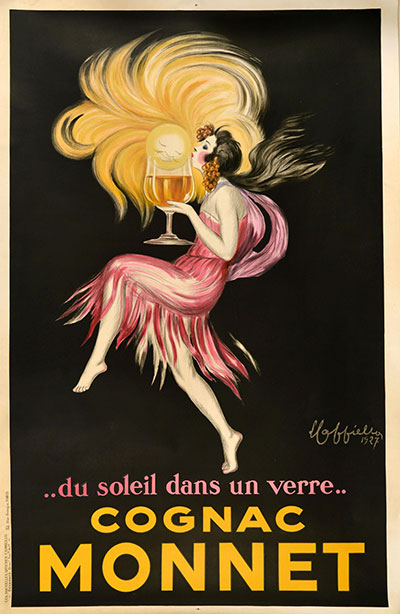
In the 1920s, celebrated Italian-French poster artist Leonetto Cappiello created Monnet’s famous advertising image associated with the phrase, “Sunshine in a Glass.” Monnet still builds its identity around that concept nearly a century later.
The intended house character is warm, fruity, floral, rounded, and supple, with relatively gentle oak, rather than dry, tannic, and heavily wooded. Monnet specifically says that its oak and tannins are intended to complement rather than obscure the original grape character. That philosophy makes this VS particularly interesting because youthful Cognac can easily become sharp, woody, and alcoholic.
Monnet VS Cognac
This Cognac pours a brilliant honey gold in the glass. The nose delivers aromas of vanilla, flowers, and lightly spicy wood. The palate features cigar leaf, caramel, and cinnamon, with a medium finish that has just a hint of bitterness due to its youth. The characteristic brandy sweetness is present, but restrained. Overall, an easy if uncomplicated sipper. The ABV is the usual 40%.
This brandy not quite what you’re looking for? Read my other brandy reviews here.
Listen to my podcast about brandy, Cognac, and Armagnac here.
A note about brandy vs. Cognac: brandy is a liquor distilled from wine and aged in wood. (Brandy can be made from fruits other than grapes as well, but that’s a story for another time.) Cognac is brandy that specifically comes from the town of Cognac and the delimited surrounding areas in western France. (The one which has the most favorable soil and geographical conditions is Grande Champagne.) So, all Cognacs are brandy, but not all brandies are Cognac. For more detail on brandy and Cognac, click here.
Back to blog posts: winervana.com/blog/