Migration Wines

Migration Wines
Click here for tasting notes.

Migration Russian River Valley Chardonnay and Anderson Valley Pinot Noir

Duckhorn Portfolio is the umbrella corporation of an expanding wine mini-empire. First came the flagship Duckhorn Vineyards, established in 1976 by Dan and Margaret Duckhorn to pioneer and feature premium Napa Merlot. (Duckhorn has a “second growth” label named Decoy, as well.) Next came Paraduxx in 1994, specializing in Zinfandel-based blends. This was followed by Goldeneye, which began making Pinot Noir in 1996.  Migration was established in 2001 to focus first on Pinot Noir and Chardonnay.

Continue reading “Migration Wines”

Kourtaki Retsina of Attiki

Kourtaki Retsina of Attiki.
Kourtaki Retsina of Attiki. Click here for tasting notes.
Kourtaki Retsina

The Greek wine even Greeks won’t drink. At least, all of the Greek-Americans I know won’t.  And my local Greek restaurant recently quit carrying Kourtaki Retsina of Attiki (the only retsina they had), citing a total lack of demand from their customers. Quite a bold move, considering Retsina is routinely called the “iconic wine of Greece” and is ingrained in the food and drink culture of the nation. Continue reading “Kourtaki Retsina of Attiki”

Clos du Bois Wine

Clos du Bois Marlstone 2005 and Clos du Bois Calcaire 2007
Clos du Bois Marlstone 2005 and Clos du Bois Calcaire 2007. Click here for tasting notes.

Clos du Bois Wine

Although it sounds French, the Clos du Bois [klow doo bwa] winery is definitely American. Clos du Bois was founded in 1974 by Frank Woods, who planned on simply naming his new winery “Woods Vineyard.” His children, who were studying French at the time, suggested “Clos du Bois” instead, which loosely translates to “enclosure in the woods.”

Continue reading “Clos du Bois Wine”

Lot 25 Wine

Lot 25 WineLot 25 Wine

Lot 205 is the undercover label of the well-regarded Cartlidge and Browne winery. Although they acknowledge their Rabid, Manzanita Canyon, and Stratford sub-brands, Lot 205 is their secret agent, for reasons known only to them (the price points of all of these labels are approximately the same).

The name is taken from C&B’s former street address in American Canyon at the southern end of Napa Valley. The fruit, however, is sourced from growers throughout California.

Winemaker Paul Moser leans toward the French style, with an emphasis on the correct expression of the grape variety; the predominance of fruit over oak; making the wines dry and food-friendly; keeping the alcohol levels in check; and offering good value in table wines meant for everyday consumption.

Lot 205 Cabernet Sauvignon 2006

This wine is primarily Paso Robles Cabernet (82%) and Merlot (12%). The taste is fruit-forward, with dominant cherry supported by tobacco and mocha notes. It has a medium body and color, and is well-balanced by smooth, restrained tannins.

Partner this cab with jerk-rubbed chicken thighs, balsamic-marinated flank steak, and grilled lamb chops.

Lot 205 Chardonnay 2006

Although present, oak is a supporting player in this chardonnay, letting the apple, citrus, and pineapple come to the fore. It’s a bit sweeter than I expected, with a hint of butterscotch.

www.cartlidgeandbrowne.com/index.html#top

Back to blog posts: winervana.com/blog/
Pillar Box Winery

Pillar Box Red and Pillar Box White

Pillar Box Winery

A pillar box is what mail boxes are called Down Under as well as in England.

Pillar boxes lined the coach-driven mail routes, or ‘drives,’ established in the 1850s to provide mail service to the farmers and settlers then moving into southeastern South Australia. One such route in Padthaway was operated by Henry John Hill, and ran through property now owned by the third generation of the Longbottom family.

In 1992 Kim and Mark Longbottom decided to expand their farming operation into winemaking, and released their first offering in 1996. In a nod to the history of the mail route that once passed through the vineyards, today the family’s wine business is known as Henry’s Drive Vignerons.

The Padthaway region was once covered by the ocean. The receding waters left behind a limestone subsoil topped by rich red loamy earth. This soil structure combines with good winter rains and mild sunny summers to make Padthaway well-suited for viticulture. The first vines were planted there in 1964, and it has come to be one of Australia’s premier wine-producing regions.

Pillar Box Red 2005

A blend of 57% cabernet sauvignon, 32% shiraz, and 11% merlot. The color is opaque purple, with a European-style flavor profile. The fruit is somewhat recessive, with nice astringency and enough tannin for structure. An excellent value, and 2005 is only the second vintage.

Pair this muscular wine with roasted or grilled beef or pork, blue cheese stuffed hamburgers, or a full-flavored, tomato sauced lasagna.

Pillar Box White 2006

A blend of 66% chardonnay, 20% sauvignon blanc, and 14% verdelho. The dominant taste is grapefruit, supported by lemon and citrus zest and racy, minerally acid. This makes for a tart, zippy, refreshing wine, ideal for this time of year. The color is pale straw yellow with a green tinge.

Try this wine with grilled or baked fish, a cheese course, shrimp on the barby (of course), or even tortilla chips and salsa.

This month’s wines are both sealed with screw caps. Screw caps have long been associated with low-quality wines. However, this has begun to change because of the perennial problem of “cork taint.” Cork taint is caused by complex chemical mechanisms triggered by the presence of microscopic fungi in the cork. Although not hazardous, cork taint does ruin the wine with a musty, wet cardboard smell and taste.

Screws caps are seen as a solution to this problem, and less tradition-bound Aussies are using them extensively on wines at every quality level. Commendable as that may be, I still prefer a cork, even if it is a well-made artificial one.

Back to blog posts: winervana.com/blog/
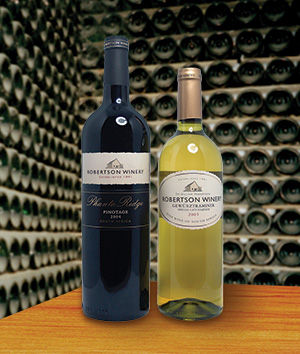
Martin Miller’s Gin

Martin Miller’s GinMartin Miller’s Gin

Martin Miller was an English multi-millionaire, entrepreneur, connoisseur, and self-described enthusiast of “leggy women, cigarettes, and gin.” The restless Miller built his fortune on guides to antiques, investing, and real estate ventures.

In 1999, he decided to expand into spirits. At the time, premium vodkas were being introduced at a prolific rate, while gin languished. Determined to rectify that, Miller introduced the eponymous Martin Miller’s Gin.

Miller’s is batch distilled, like malt whiskey, in a 100-year-old still named Angela. The recipe features the requisite juniper, plus lemon, lime, Seville orange peel, coriander, licorice, cinnamon, cassia, and nutmeg. After distillation, the cask-strength spirit is shipped to Iceland, where it is cut with water from the local glaciers.

The Miller’s Gin flavor profile is in the traditional English style. First comes the green pine of the juniper, quickly followed by the citrus component. The finish is smooth, with just a hint of the sweetness found in superior gins.

Miller’s is offered as an 80 proof bottling, as well as a 90.4 proof “Westbourne Strength.”

www.martinmillersgin.com/

Back to blog posts: winervana.com/blog/

Vinturi Wine Aerator

Vinturi Wine AeratorVinturi Wine Aerator

When it comes to wine aeration, I am an agnostic. I rarely aerate these days, and when I do I usually use a decanter. For me, decanting and waiting an hour or two offers the best chance of improving a wine’s flavor and aroma.

But, there are many gadgets available for aerating a wine either by the glass or an entire bottle, and this Vinturi wine aerator is one that I have relied on for years. It is nicely designed, well built, and couldn’t be simpler to operate. Just hold it above your container, and pour the wine.

The one shortcoming my Vinturi has is that it did not come with a screen for filtering out sediment. I’m happy to note that the current model includes just such a filter. Vinturi does sell replacement filters in five packs now, as well.

Back to blog posts: winervana.com/blog/
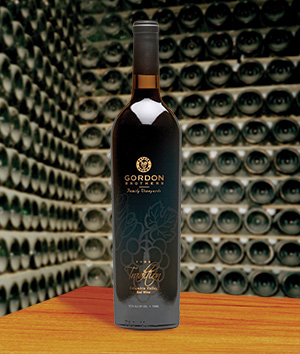
 

Jack Nicklaus Wine

Jack Nicklaus Cabernet Sauvignon and Private Reserve White.
Jack Nicklaus Cabernet Sauvignon and Private Reserve White. Click here for tasting notes.

Jack Nicklaus Cabernet Sauvignon and Private Reserve White

Even among non-players, two names in golf are widely recognized: Arnold Palmer and Jack Nicklaus, aka the Golden Bear. Nicklaus has been a wine collector for many years, but only recently decided to pursue the production of wines carrying his name, although he had been urged to do so for quite some time.

Continue reading “Jack Nicklaus Wine”

Mossback Winery

Mossback Winery Chardonnay and Pinot Noir

Mossback Winery

The Russian River AVA sits in the center of northern California’s Sonoma County, and is characterized by a generally cool climate, with sunny days bracketed by fog early and late. This encourages the slow-ripening of fruit, particularly suitable for Chardonnay, Pinot Noir, and Sauvignon Blanc, like these selections from Mossback Winery.

John Giguiere, with his wife Lane and brother Karl, started R.H. Phillips Winery in 1983 on land that was part of their family farm in the Dunnigan Hills of northwestern Yolo County, 30 miles east of the more-famous Napa. Over the course of 20 years, the Giguieres grew R.H. Phillips from a family winery of 10 acres and a few cases into a publicly-owned behemoth producing 900,000 cases of wine on 2500 acres, including the best-selling Toasted Head and EXP as well as R.H. Phillips.

When John and Lane left the company in 2005 to return to more-personalized winemaking, they were joined by Dan Cederquiest to found Crew Wine Company, which produces a variety of wines, including Matchbook.

Mossback is an old-fashioned term for “farmer,” and is an homage from the Crew trio to the farmers on which they rely to supply the fruit for their Russian River offerings.

Mossback Russian River Valley Chardonnay 2009

The impression of this wine is as understated as its pale yellow color would suggest. Made in the style of a French Chablis, the wine is 80% cold fermented in stainless steel to retain acidity and as much of the character of the fruit as possible.

The delicate nose presents citrus notes, and the taste features green apples, baked honey, and a hint of melon. 1,093 cases were bottled of this 100% Chardonnay.

This food-friendly wine would pair nicely with Grilled Scallops Wrapped in Proscuitto, Grilled Salmon Burgers, or Hoisin Honey-Glazed Chicken.

Mossback Russian River Valley Pinot Noir 2009

This elegant Pinot Noir is 97% Pinot Noir with 3% Syrah added for additional structure. The fruit was sourced from three well-regarded Russian River Valley vineyards. After fermentation, the juice was aged in French oak for nine months.

In the glass, the color is a pleasing cherry red. There is almost no nose, but don’t be discouraged by that. On the palate, the fruit displays plenty of tart cherry and strawberry, supported by a bit of cream and vanilla. There is a medium finish, with no bitterness or aftertaste.

Enjoy this Pinot with Grilled Turkey Burgers with Yogurt-Cucumber Sauce, Salmon Fillets with Sesame Crust, or Vegetarian Shish Kabobs.

www.matchbookwines.com/

Back to blog posts: winervana.com/blog/
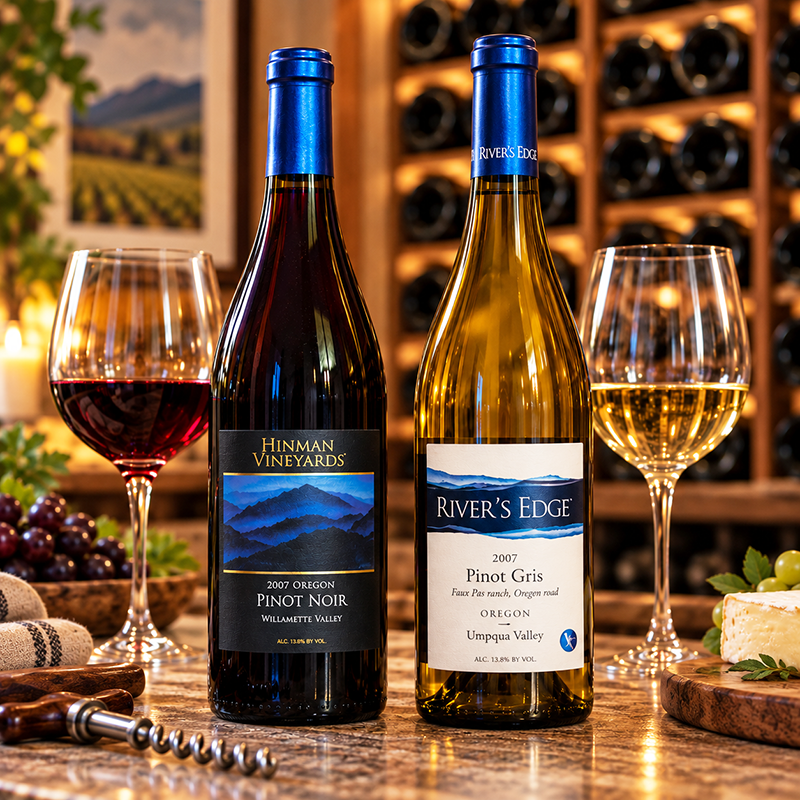
 

Truchard Vineyards

Truchard Vineyards

Truchard Vineyards

Truchard Vineyards was established in 1974, when native Texans Tony and Jo Ann Truchard purchased a 20-acre parcel of land in Carneros. They transformed what was an abandoned prune orchard into a vineyard, and began selling the fruit to a local winery. Because of the difficult clay soil he had to work with, as well as a dearth of groundwater, Truchard was one of the early adapters of drip irrigation, a practice that was used in Israel for desert farming but not known in California yet. The Truchard Estate Vineyard has since grown to 400 acres, of which 280 are planted.

In 1989, the Truchards began making wine for themselves (even as Tony continued his practice as a physician), using only their estate-grown fruit. Today the winery makes 12 different wines, producing a total of 16,000 cases per year. The Truchard’s remain active at the winery even now, along with able assistance from their son, Anthony Truchard II who serves as General Manager. Their winemaker (and Milwaukee native) is Sal De Ianni. Originally a chemist, De Ianni was sufficiently drawn to wine that he took his M.S. in Enology at UC Davis. In 1998, he responded to a help wanted ad posted by the Truchards, and has been with the winery ever since.

As the most Northeastern vineyard in the Carneros region, Truchard is situated on the foothills of what becomes the Mayacama mountain range and Mount Veeder. The Truchard Estate contains a variety of soils: clay, shale, sandstone, volcanic rock and ash, and enjoys marine-moderated temperatures.

Truchard Chardonnay 2008

A light-yellow colored Chardonnay that starts with pear, citrus, and a hint of sweet banana. The palate is full bodied, with its acidity balanced by flavors of tart green apple, lime, and very light oak. The finish is dry, with suggestions of lemon pith and spice.

Try this Chard with Roasted Trout, Squid with Spinach, or Shrimp with Canellini Beans.

Truchard Pinot Noir 2007

This lean, Old World-style Pinot Noir opens with a bouquet of plum, red berry, and tea. On the palate, the wine is medium bodied and balanced, starting with a bit of sweet vanilla and moving on to spicy oak, cranberry, leather, and tobacco. The finish is dry, with delicate tannins and a hint of bitterness.

People who don’t like “fruit bombs” will enjoy this wine. This Pinot should pair well with Fried Veal Cutlets in Tomato Sauce, Peppery Beef Stew, and Meatloaf.

www.truchardvineyards.com/

Back to blog posts: winervana.com/blog/
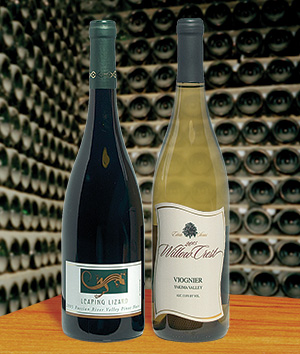
 

Bink Wines

Bink Wines

The unusually-named Bink Wines is owned and operated by two women, which is also rather unusual (but becoming less so).

Fourth-generation-Californian Cindy Paulson grows the grapes, while also maintaining her day job as an environmental engineer (she earned a doctorate in environmental engineering at Colorado University at Boulder). Her farming philosophy is deeply rooted in sustainable practices, coming from her environmental background and love of the outdoors.

Deb Schatzlein makes the wines. This Connecticut native is known as a fun-loving free spirit; her grandparents set the mold early, making gin in their bathtub during Prohibition. She has degrees in chemistry (with an early career as a chemical engineer) and biology, and has taken extensive coursework in viticulture and enology.

And that name? It’s a contraction of ‘black ink,’ the color characteristic of their red wines.

Bink Randle Hill Vineyard Sauvingon Blanc 2008

This all-stainless-steel 100% Sauvignon Blanc is unfiltered. Consequently, this pale-yellow wine can pour out cloudy, without the crystal-clear appearance most consumers expect. To avoid this, let the bottle rest upright for an hour or so, and decant carefully. Or, if you insist on transparency, you could pour it through a paper coffee filter; unorthodox, and it may strip out some of the flavor nuance, but it works.

This wine’s birthplace, the 13-acre Randle Hill Vineyard, is certified organic, and yielded a small production of 350 cases.

The wine opens with delicately sweet honeysuckle and mango flavors, which then lead to a body featuring grapefruit notes and a supportive minerality.

Serve with Red Chile-Honey Glazed Salmon, BBQ Marlin with Avocado Vinaigrette, or Rum-Brown Sugar-Glazed Shrimp with Lime and Cilantro.

Bink Hawks Butte Merlot 2006

The Hawks Butte vineyard is part of the Yorkville Highlands Appellation, and is located mid-way between the small California towns of Yorkville and Boonville. It is 1200 feet above sea level and 35 miles inland from the Pacific coast. The rocky soils and southern exposure of the vineyard make for high-quality but low-yield vines, providing only enough juice to make 150 cases of this wine.

It was aged for 22 months in 30%-new and 70%-old oak barrels.
As is to be expected of Bink, the color is deep garnet in the glass. The nicely full palate features black currant and stone fruits, supported by somewhat forward tannins and some spice. This Merlot is an excellent value.

Enjoy this substantial wine with Balsamic-Marinated Flank Steak, Asian-Spice Rubbed Pork Chops, or Burgers with Cheddar Cheese and Horseradish Mustard.

Unfortunately, Bink Wine closed permanently in 2017. There is now a totally unrelated Bink Winery in Australia. 

Back to blog posts: winervana.com/blog/
 

Exitus Red Wine

Exitus Bourbon Barrel Aged Red Wine

Exitus Red Wine

The Exitus winery is located in Parlier, California, about 20 miles southeast of Fresno. I don’t know how badass the people of Parlier are, but it’s certainly the image that Exitus is trying to cultivate. Their one current offering is Exitus Bourbon Barrel Aged Red Wine. It is fermented in the usual stainless steel. But, rather than using traditional barrels expressly made for wine, Exitus is matured for three months in charred barrels that were previously used for the production of Kentucky Bourbon. The schtick is supported by distributing the wine in clear liquor bottles.

Continue reading “Exitus Red Wine”

Gainey Vineyard

Gainey Vineyards

Gainey Vineyard

Fifty-seven years ago, in 1962, Dan Gainey purchased 1800 acres in the Santa Ynez valley of California’s central coast region, directly west of Santa Barbara. After twenty-two years of farming and ranching, Gainey became convinced of the area’s potential [and profitability] as a vineyard.

After the Gaineys (three Dans are currently involved) opened their Spanish-style winery in 1984, the winery quickly became one of the most popular wineries to visit in the area, and it was named as “one of the best wineries to visit on California’s Central Coast” by Wine Spectator magazine.

Gainey Vineyard owns properties in both the warm, eastern end of the valley, where they concentrate on Bordeaux varieties, and the cool, western end of the valley, where they have planted Pinot Noir, Chardonnay, and Syrah.

Gainey Merlot 2004

This muscular but lush Merlot features blackberry and cassis on the palate, supported by hints of oak, tobacco, and leather. Velvety mouthfeel, supple tannins, and a long finish round out this attractive wine.

Pair this expressive, cool-climate Merlot with grilled or rotisserie chicken, pork tenderloin, or simply prepared-beef dishes.

Gainey Riesling 2007

Gainey specializes in Riesling, and this wine shows why. If you normally avoid Rieslings, try this one. It is pale gold, completely dry, and has medium acidity. The traditional apricot and pear flavors are present, but the flowery overtones are held well in the background.

gaineyvineyard.com/

Back to blog posts: winervana.com/blog/


Cockfighter’s Ghost Shiraz and Tapestry Chardonnay

Cockfighter’s Ghost Shiraz

Cockfighter’s Ghost Shiraz and Tapestry Chardonnay

In this post I sample two uncommon wines that only have one thing in common: they both come from Australia’s McLaren Vale.

Cockfighter’s Ghost Shiraz 2002

Some say that if the light of the moon is just right, the ghost of Cockfighter the horse can be seen galloping through the vineyards of Pooles Rock.

Perhaps. The wine named in his memory is anything but ephemeral, however. Cockfighter’s Ghost Shiraz first greets you with a powerful nose of earth and dark berry fruit. The berry and black plum flavors continue on the palate, supported by some spice, black pepper, and oak. The color is a dense, dark crimson.

After letting this shiraz ‘breathe’ for at least an hour to soften its edges, serve with rare roast beef and field mushrooms, spicy sausages with tomatoes and Italian beans, or oven-roasted rack of lamb.

cockfightersghost.com.au/product/single-vineyard-shiraz-2016/

Tapestry Chardonnay 2005

This chardonnay is an excellent value, with more character than its relatively low price would predict.

The wine spent nine months on-lees in new French oak, and features a very appealing balance of juicy stone fruit and a citrus acidity, supported by the spicy, toasty oak, with a moderately long finish. There was no malo-lactic fermentation. The color is pale straw with green tints.

Serve lightly chilled with coquille St. Jacques, fried calamari, or grilled whole red snapper.

[Unfortunately, Tapestry Wines is now reported closed.}

Back to blog posts: winervana.com/blog/