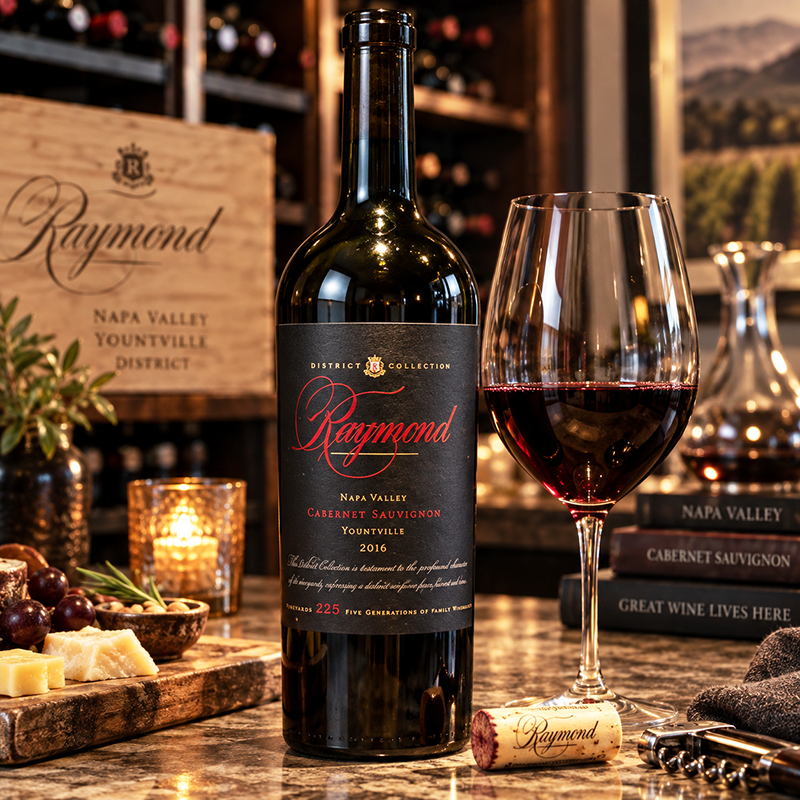
Raymond Yountville District Cabernet Sauvignon 2016
The Raymond name has been associated with Napa valley since the year Prohibition ended. The Raymond family arrived in Napa Valley in 1933. Roy Raymond married into the Beringer family in 1936. He worked as winemaker for Beringer from 1933 to 1970. The following year, he and his two sons Walter and Roy Jr set out on their own with a 90-acre estate property in Rutherford. They released their first commercial wine under the Raymond Vineyards label in 1974. The estate now comprises 300 acres in Rutherford, St. Helena, and Jameson Canyon. All are are certified organic and Biodynamic. The winery is also operated on 100% solar power.
The pioneering Trefethen Family Vineyards is truly a rarity in the Napa Valley: a winery that grows, vinifies, and ages all of its wines entirely on the property, and has been helmed by a single family for three generations.
The area in which Trefethen is located is one of the oldest in Napa Valley’s wine history. Nearly 2,000 acres were originally purchased in 1851 by J.W. Osborne, who called it Oak Knoll. He planted grapes there the following year, and by 1860 had the largest vineyard in Napa, at 50 acres.
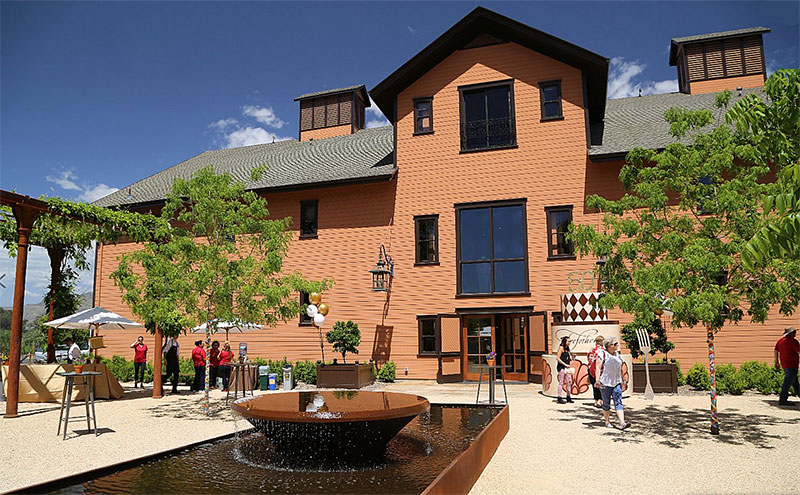
In 1886, banker brothers James and George Goodman founded the Eschol winery in Oak Knoll. The name was taken from the Old Testament, Numbers 13:24, “The place was called the brook Eschol, because of the cluster of grapes which the children of Israel cut down from thence.” The original estate was 280 acres, with 40 acres planted in vineyards. The winery used a gravity-flow system: a horse-drawn winch brought grapes to the third floor of the three-story structure for crushing; gravity carried the juice to the second floor for fermenting; and, eventually, the wine descended to the first floor for aging. It is now the only surviving example in Napa Valley of a wooden gravity-flow winery from the 1800s. After struggling through Prohibition, by 1940 the winery building had fallen into disuse, although for a time in the ’40s Beringer Winery used the space as a storage facility and leased the surrounding vineyards.
x
Following retirement from a successful career, including CEO, with Kaiser Industries, Eugene Trefethen along with his wife Catherine, better known as Katie, purchased Eshcol and six adjoining properties in 1968, with the goal of become genteel farmers. They installed a robust water system that still serves the vineyard today, but neither of them ever wanted a winery.
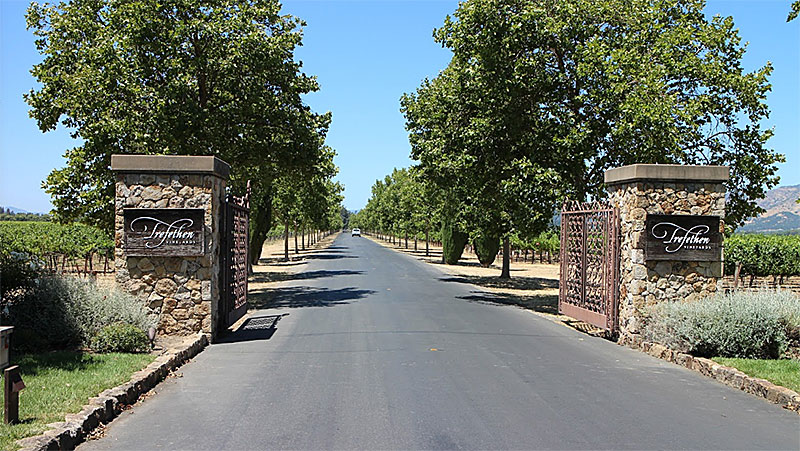
The winery operation got going in 1973, the year the Trefethen’s son John and his wife Janet produced their first commercial vintage (2,000 cases of Chardonnay and Pinot Noir). They also replanted the vineyards and restored the historic winery building. Located at the end of what is possibly the longest winery driveway on the Napa Valley floor, it is the largest winery in the Oak Knoll district.
The trees were eventually planted to prevent John Trefethen from using the driveway to land his private plane. Photo: Carlin Arthurs
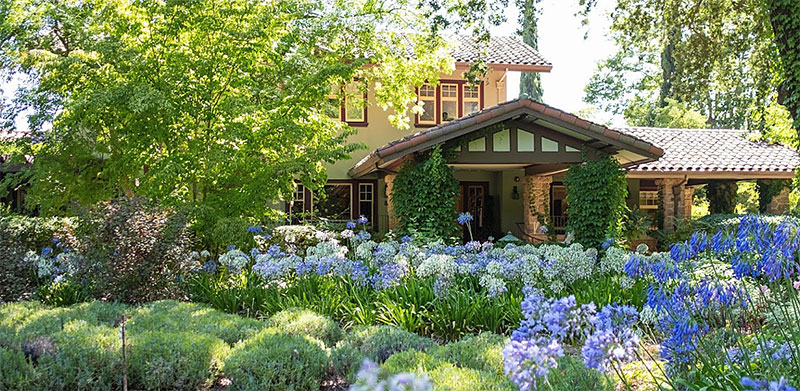
The Trefethens’ restoration efforts were recognized in 1988 by the Department of the Interior, which placed the winery on the National Register of Historic Places. The property is also known for an extensive garden established by Katie. It has been featured in many publications, and has been a destination for many gardening enthusiasts since it was created.
The flower logo shown here has been part of Trefethen’s branding since the beginning. Katie had originally used it on signage in her garden areas, and the winery put it on the bottle capsules from very early on. It was long referred to as the “Welsh Flower,” thinking that Katie had tapped into her Welsh heritage. But later research couldn’t find any Welsh history for the mark, so its origins remain a mystery, and it is now just called the “Trefethen Flower” instead.
Eugene and Katie Trefethen’s residence, The Villa, is now used for special events.
John and Janet Trefethen have largely stepped back from day-to-day oversight, and the third generation of the family is now deeply involved in the operation. Son Lorenzo focuses on sales and marketing, and daughter Hailey on vineyards and employees.
In addition to the family, Jon Ruel has long been a part of the business. He started as the viticulturist, but steadily increased his involvement over the years that have followed. He is now fully responsible for all aspects of the company’s operations and strategy, and was named named CEO in 2015. He had this to say about Trefethen, ““As a true estate winery, we have the unique opportunity to bring integrity to every step of the process, from the soil to the table. My entire focus these days is on cultivating this extended family – and when we succeed, you can not only taste it in the wine, you can feel it.”
Winemaker Bryan Kays joined Trefethen in 2006 as a viticulture intern. Fascinated with estate-grown wines, he started in the cellar, and eventually worked up to the position of winemaker in 2015.
x
In 1979, a “Wine Olympics” was organized by the French restaurant guide Gault Millau in Beaune, France. A total of 330 wines from 33 countries were evaluated by 62 experts from ten countries. The 1976 Trefethen Chardonnay won first place in the category that pitted California Chardonnays against those from Burgundy, and was judged best in the world. This came three years after the more-famous “Judgement of Paris,” further helping to establish the quality of American wine in the world market.
The spirit of support and cooperation in northern California’s wine country that has been so much in evidence during this year’s wildfires goes way back. Two now-notable wineries got their start at Trefethen. Cakebread Cellars purchased some grapes for their first vintage from Trefethen, and made their initial wine there. Domain Chandon (the American operation of the French Champagne leviathan Moët et Chandon) began their winemaking efforts by taking over the second floor of the winery while their own facility was being constructed.
The Vineyards and Environmental Commitment
The Main Ranch Vineyard. Photo: Arturo Pardavila
The Vineyards
The original 400 acres surrounding the winery are known as the Main Ranch. It sits on the largest alluvial fan in Napa Valley, where Dry Creek spills onto the valley floor and spreads gravel eroded from the Mayacamas mountains over clay and loam left by an ancient ocean. Over twenty different soil types have been identified in the vineyard, allowing Trefethen to grow nine different varieties there, all planted in their preferred soil.
Trefethen now also owns another 150 mostly hillside acres surrounding a spring-fed creek, the Hill Spring Vineyard, of which 40 acres are planted to Bordeaux varieties. It is about three miles from the winery in the foothills of the Mayacamas.
Although a relatively large producer (about 75,000 cases annually, but it varies with each harvest). Trefethen has farmed their vineyards sustainably since the beginning. They are all managed by employees, without outsourcing the work to a vineyard management company. A true “estate” operation, they have never purchased grapes from anyone.
Biodiversity
Bluebirds, owls, and bats inhabit the vineyards. All of these species are native to the area and play important roles as natural predators. The property also attracts other birds of prey such as kestrels and red-tailed hawks. Cover crops provide habitat for beneficial insects, spiders, jackrabbits, and more, all of which play important roles in the ecosystem. Cover crop use also increases water infiltration as the roots create channels in the soil that can directly impact soil fertility via nitrogen fixation.
Soil Health
Every part of the grape cluster but the juice– the stem, skins, and seeds – is combined with clippings from the gardens and manure from the stables to make a compost which is spread out into the vineyard each year.
Water Conservation
The property includes two reservoirs. After collection, the water is transferred to biological settlement ponds, where the organic compounds are digested by bacteria, rendering the water appropriate for re-use in vineyard irrigation.
Energy Usage
A number of solar arrays are on the property, providing power for the winery and production facilities. They were one of the first wineries to offset 100% of their electricity usage with on-site solar power.
Certifications
As a major part of their commitment to ecological responsibility, Trefethen participates in a number of certification programs.
The Napa Green organization supervises two programs. Land is an umbrella program that recognizes growers with validated environmental compliance and verified farm plans as meeting standards for watershed stewardship. Winery is one of only four sustainable winegrowing programs nationwide, offering the opportunity for comprehensive soil-to-bottle certification in both the vineyard and winery.
The California Sustainable Winegrowing Alliance is a certification program that provides verification that a winery or vineyard implements sustainable practices and continuous improvement
Trefethen Family Vineyards Oak Knoll District Estate Chardonnay 2018
Trefethen’s highest-volume wine, this Chardonnay was 100% sourced from the Main Ranch. After both barrel and malolactic fermentation, the wine was aged for nine months in 13% new oak.
It is a pale straw gold in the glass. The nose presents aromas of lemon, lime, and grapefruit, plus a hint of peach. The smooth palate features these same flavors, as well as some lemon curd and just a suggestion of oak. It’s all wrapped up in a refreshing zippy acidity. The ABV is 13.3%, and 28,800 cases were produced.
Trefethen Family Vineyards Oak Knoll District Estate Cabernet Sauvignon 2018
This wine is a blend of 84% Cabernet Sauvignon (enough that it isn’t labeled a “red blend”), 10% Petit Verdot, 3% Merlot, 2% Malbec, and 1% Cabernet Franc, all sourced from the Main Ranch vineyard. It always amuses me when winemakers include 1 or 2% of something. It’s hard to imagine how much difference that could make, but they certainly think it is worth the effort. After fermentation, it was aged for 18 months in 52% new oak.
This full-bodied wine is inky dark purple. The nose displays aromas of dark stone fruits, particularly plum, and earth. These continue on the palate, with the addition of prunes and cocoa, plus a little vanilla. There is well-balanced acidity, as well as plenty of grippy but nicely integrated tannins. The ABV is 14.2%, and 23,880 cases were produced.
Note: Trefethen releases some of their red wines fairly young – if you have the patience, consider holding these for several years while they develop additional complexities and nuances. But do as I say and not as I do; there was a time when I would have bottle aged a wine like this for 10 years or so, but I have largely abandoned holding bottles more than four or five years at the most, as I prefer the more up-front characteristics, especially tannins, of a young red.
Wikipedia says an “estancia is a large, private plot of land used for farming or cattle-raising. Estancias in the southern South American grasslands, the pampas, have historically been estates used to raise livestock, such as cattle or sheep. In Puerto Rico, an estancia was a farm growing frutos menores, that is, crops for local sale and consumption; the equivalent of a truck farm in the United States. In some areas of Spanish America, especially Argentina, they are large rural complexes with similarities to what in the United States is called a ranch.”
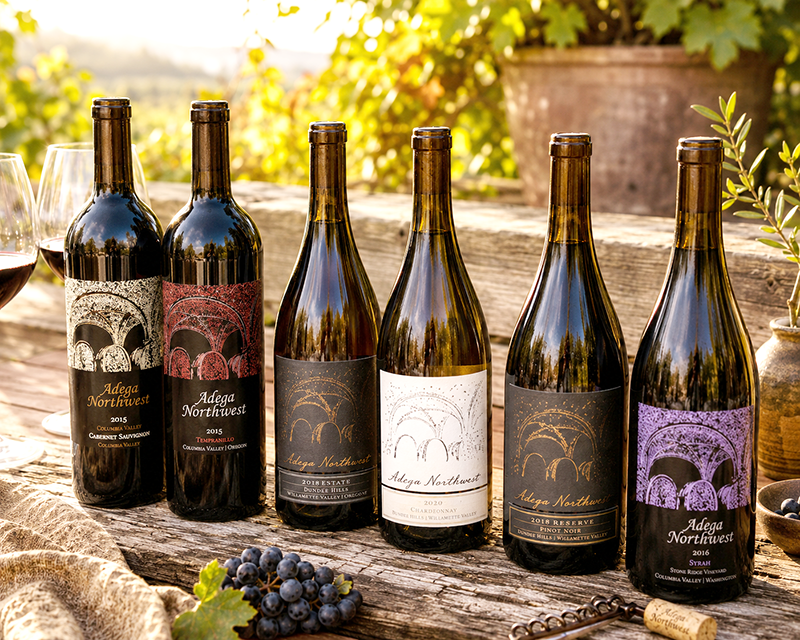
When most of us think of a winery, what usually comes to mind is the romantic stereotype of a rustic but exquisite barn situated halfway up a mountain in the western U. S. overlooking a bucolic valley below; a fabulous hundred-years old chateau surrounded by ancient vines somewhere in France; or perhaps even a charming azienda agricola in Italy with a view of Roman ruins. But that’s not the only way to do it. Adega Northwest of Portland, Oregon, is very much an urban winery. There are vineyards, of course, you just won’t see them if you pay the winery a visit (by appointment only). And because they are not tied to an estate, Adega Northwest can and does draw on sources throughout the region. Continue reading “Adega Northwest Winery”
Patz & Hall was founded in 1988 when two Flora Springs Winery and Vineyards employees, assistant winemaker James Hall and national sales manager Donald Patz, decided to strike out on their own. Their ambition was to apply traditional (i.e. French) winemaking techniques to fruit from elite, small vineyards in Napa Valley specializing in Chardonnay and Pinot Noir. The winery went on to great success.
Chuck Hope and his wife Marlyn came to Paso Robles in California’s Central Coast in 1978 to farm, and eventually to start what would become Hope Family Wines. This early arrival put them on the forefront of the Central Coast becoming a world-class viticultural region. Initially, the Hopes planted apples and grapes in this then sparsely-populated area. Seeing the property’s potential for grape growing, Hope eventually replanted the apple orchards with grapes. Vine density was increased, and each vine was pruned to produce very little fruit.
The Phillips family has been farming in Lodi since the 1850s, and cultivating wine grapes since the early 20th century. The founders of Michael David Winery are brothers Michael and David Phillips. They released their first commercial wine in 1984 under the Phillips Vineyards label after years of growing grapes for other wineries on over 800 acres of vineyards in the Lodi AVA. The brothers are fifth-generation farmers who “raised their families in the vineyard,” and they have been joined by Mike’s son Kevin and daughter Melissa as the family continues to thrive. “We, more than most, understand the importance of leaving it better than you found it for future generations. Our family legacy and love of Lodi drive our focus on sustainability,” declared Michael Phillips.
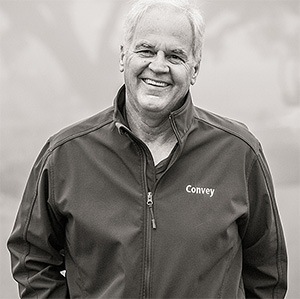
Cabell Coursey is a busy guy these days. In addition to being the winemaker at Lombardi Winery, he is also winemaker and co-owner at Coursey Graves Winery in Santa Rosa, California. He began his career in wine in Burgundy, where he worked his first harvest during an undergraduate semester abroad. After graduation, he returned to the States and pursued the menial but necessary chores of picking grapes, scrubbing tanks and barrels, and learning traditional winegrowing methods. He went on to toil in Oregon’s Willamette Valley, and later traveled to Christchurch, New Zealand, where he earned graduate degrees in Enology and Viticulture from Lincoln University. It was there he developed the passion for cool climate wines that guides his style today. Before starting Coursey Graves in 2015 with partner John Graves, Coursey made wine for Alder Springs Vineyard, DuMol, Flanagan, and Kosta Browne.
He is committed to constantly improving the wines he makes from vintage to vintage by understanding his vineyards and maximizing their quality. He also feels obligated to mentor young winegrowers by teaching parameters they can use to customize and improve grape farming for better produce.
Coursey stated, “I am interested in making wines that show the place where they are grown, taste great young, but also age [well]. With most wines, aging means maintaining. I strive to make wines that evolve, not just maintain.
Except for a little bit of Chardonnay, I grow all the grapes I make to wine. It’s important, because my team learns about the vineyard and can change how we grow the grapes to make better wines.”
John Graves began his career in computer technology, and after a decade spent working for others, he left to strike out on his own. Thirty years later he sold a successful B-to-B software business. He and his wife Denise used a portion of the proceeds to establish the Graves Foundation, whose mission is to provide disadvantaged youth in greater Minneapolis with access to the resources, opportunities, and caring relationships that will propel them to a successful life. Specifically, the foundation focuses on K-12 education reform and providing foster kids with support during the transition to adulthood.
Grave’s interest in wine began as a hobby, influenced by a good friend and by Robert Parker’s reviews in the Wine Advocate. At length his interest expanded until the desire to learn became a desire to own a winery. Serendipitously, about the same time his winemaker friend Cabell Coursey began talking about starting a new venture of wines in a style they both loved to drink and share. Graves acquired the existing Bennett Valley Winery, and the first vintage of Coursey Graves was bottled in 2017.
Bennett Valley AVA
In 1862, Santa Rosa winemaker Isaac DeTurk planted a vineyard on land he purchased from valley namesake James Bennett. DeTurk called his winery, the valley’s first, Belle Mount. However, the combination of phylloxera and Prohibition cleared the valley of vineyards. It wasn’t until the late 1970s that vineyards returned to Bennett Valley in a meaningful way at the pioneering Matanzas Creek Winery.
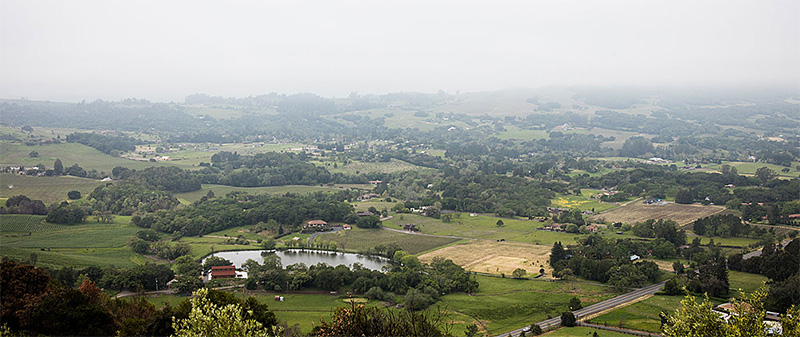
The Bennett Valley AVA is located south of Santa Rosa, on high ground between the Sonoma Valley and Cotati Valley. The AVA begins where the city’s suburban neighborhood known as Bennett Valley abruptly gives way to rolling oak woodland and horse pastures bordered by ancient stone walls.
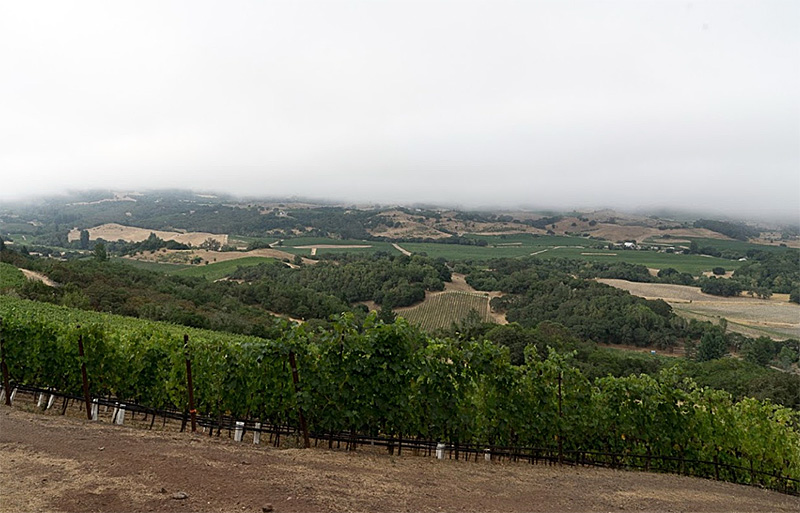
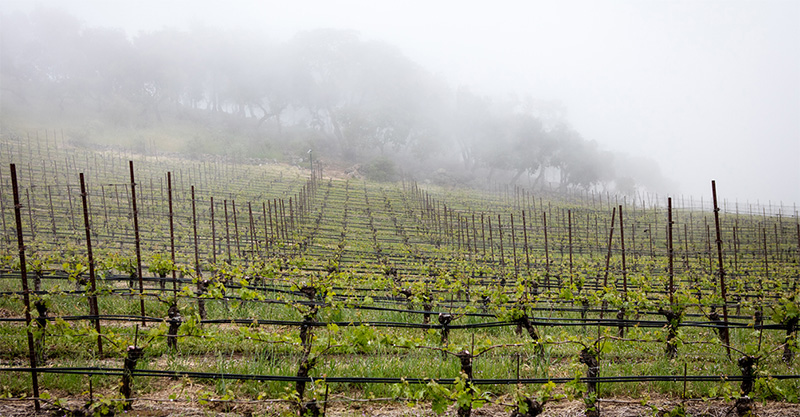
This tiny appellation is one of the coolest AVAs in Sonoma County. This is because of the Petaluma Gap, where a break in the higher coastal hills lets in cool winds and fog from the Pacific Ocean. Bennett Valley sits directly in the path of the initial incursion. The fact that there is fog in all of the photos in this post is testament to that!
Although there are plenty of renowned wineries and vineyards throughout Sonoma, of course, the lesser-known vineyards of Bennett Valley quietly yield some of the area’s most highly concentrated fruit. This is because the well-drained volcanic soils of the area ensure that the vines grow deep root systems in search of hydration. Ultimately this leads to concentrated, complex wines, as the water-stressed vines will focus their attention on grapes, rather than luxurious foliage. The rocky soils coupled with the cool weather mimic the austere conditions of Bordeaux.
There are now 650 vineyard acres and four wineries in Bennett Valley, which was awarded AVA status in 2003.
The Coursey Graves Vineyards
Coursey Graves is located on vineyard sites 800 to 1500 feet above sea level on Bennett Mountain overlooking Sonoma, on the western edge of the ancient, volcanic Mayacamas Range that separates Napa and Sonoma. The winery, estate vineyards, and caves are built into the slope overlooking the Bennett Valley below. Eighteen acres are planted to Cabernet Sauvignon, Malbec, Merlot, Petit Verdot, and Syrah.
In addition to the estate vineyard, Coursey Graves relies on two others as well. Nestled on the sloped edge of an ancient volcano, Coombsville Vineyard is home to sixteen acres of Bordeaux varieties growing between the red and black igneous basalt and the white, ashy volcanic tuff. At two thousand feet above sea level, Cabernet from Howell Mountain Vineyard benefits from much cooler daytime temperatures and slower ripening.
The wines
I have now had the opportunity to try eight of Cabell Coursey’s wines. They all have a smooth and silky mouthfeel. Thinking this had to reflect the intervention of the winemaker, I asked him about how he achieves that, and he had this to say, “First is vineyard work. I get up-front and mid-palate concentration through diligent effort in the vineyard, by managing fruit load to the amount of vine canopy, and careful applications of irrigation. I have some control over berry size, and therefore juice to skin ratio, by controlling how much water-stress the vines have at various times during the growing season. Extra stress at flowering and fruit set limits berry size, while more water increases berry size. I don’t have a standard plan each vintage, but rather change according to conditions.
“Second is tannin management during the winemaking process. Certain tannins (phenols) extract from grapes at different ranges in temperature. Also, they bind at different temperatures. I manage the temperatures during fermentation very closely and change to either extract, not extract, or bind, depending on taste and mouthfeel. I do use lab numbers to double check what I taste. However, it’s mostly by taste. After working with these vineyards and my cellar for a few years, I’ve started to learn where the wines’ tannins need to be at the end of fermentation to age properly upon the wines’ release and subsequent aging.”
Coursey Graves Chardonnay 2018
The fruit for this wine was sourced from the Durell and Heintz vineyards on the Sonoma coast. It was fermented in oak and stainless-steel barrels. It is light bright lemon yellow in the glass, which is appropriate as it opens with the smell of lemons, paired with a hint of melon and crushed stone. Those flavors continue on the palate, abetted by a zippy acidity and a suggestion of oak. It wraps up in a brisk finish. Only 91 cases were made.
Coursey Graves West Slope Syrah 2016
This 100% Syrah hails from Coursey Graves’ estate vineyard in Bennett Valley. It is an opaque but brilliant purple color. It features aromas of dark red fruits. The rather lean palate offers flavors of blackberry and olive, with a bit of pepper at the end. It’s all complemented by good tannins and a moderately long finish. Production was limited to 268 cases.
Coursey Graves Cabernet Sauvignon 2016
This wine is 100% Cabernet Sauvignon (although in some years Coursey adds and just a bit of Merlot). The grapes were mostly harvested from vineyards in Howell Mountain and Coombsville in Napa, as well as some from Bennett Valley in Sonoma. The aromatics are of rich, complex dark fruit. On the palate the wine offers tart cherry, black cherry, red licorice, and cocoa. The oak tannins are well-integrated and bracing. According to the winery, it will be at its peak performance around 2023 to 2024, by which time those tannins will inevitably round out, if you prefer them softer. .192 cases were produced.
Coursey Graves Bennett Mountain Estate Red Blend 2016
This elegant wine was my favorite of the quartet. The blend is 60% Cabernet Sauvignon and 40% Merlot, all from the estate vineyard in Bennett Valley. This deep-red selection displays aromas of crushed rock and currant, with a hint of strawberry. These are followed by flavors of dark plum, blueberries, crème de cassis, and a touch of vanilla, supported by fine tannins. It offers an excellent example of Coursey’s super smooth, lush mouthfeel. There is just a bit of dried herbs on the long finish. 234 cases were made.
Coursey Graves’ tasting room is located in downtown Healdsburg, just off the historic Healdsburg Plaza.
Kathryn Walt Hall has a most impressive curriculum vitae. To touch on just a few of the high points, she is the proprietor of HALL Wines and WALT Wines [family businesses she has been involved with for over thirty years], was assistant city attorney in Berkeley, California, worked as an attorney and businesswoman in Dallas, Texas, and has served on numerous non-profit and institutional boards, with an emphasis on issues related to social care and mental health. From 1997 to July 2001, Ms. Hall served as the United States Ambassador to Austria. In the midst of this, together with her husband Craig she has raised four children.
Imagery Sauvignon Blanc 2019 and Cabernet Sauvignon 2018
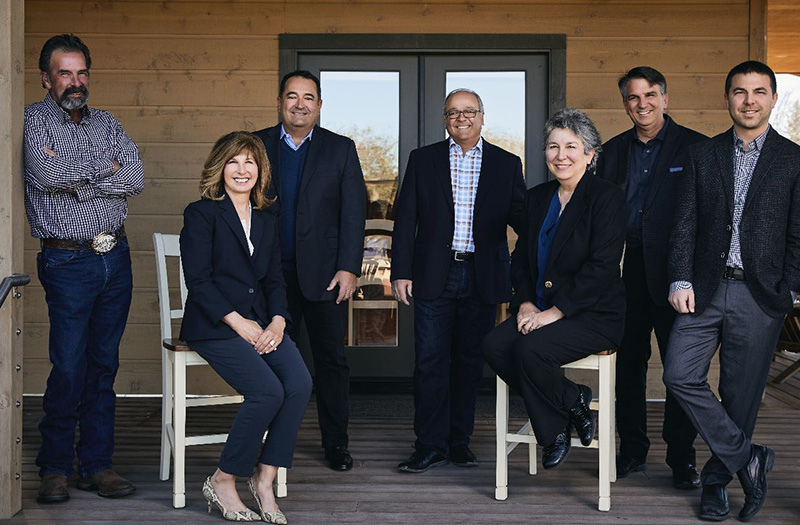
In 1973, newlyweds Mike and Mary Benziger drove west and permanently settled in Northern California. Seven years later, Mike and and his brother Bruno Benziger purchased the historic Wegener Ranch on Sonoma Mountain in Glen Ellen, California. Hearing the Sirens’ call of the Golden State, over the next six years the four remaining siblings — Bob, Joe, Jerry, and Patsy, with their spouses — made their way to California.
In my over forty years of drinking wine, I’ve had excellent bottles, bottles I’ve poured down the drain after drinking half a glass, and, mostly, everything in between. But over all of those years and thousands of wines, two have eluded me, my so-called “unicorn” wines.
I first learned of the Heitz Cellar Martha’s Vineyard Cabernet Sauvignon in the mid-’70s when a normally generous acquaintance was showing off an unopened bottle, with obviously no intention of sharing. Martha’s Vineyard was selling for about $30 at release then, far more than I could afford, so I wasn’t going to be enjoying it any time soon. But the desire was established.
On a winery tour through Napa valley in the mid-1990s, I stopped at Heitz’s “tasting room,” on that visit literally a windowless construction trailer parked by the side of the road. I was about halfway through the tasting when I heard a car grind to a halt outside on the gravel. The door burst open, and the driver demanded, “I want to try the Martha’s Vineyard!” The bartender calmly responded, “We don’t pour the Martha’s Vineyard here.” (A fact I, sadly, already knew.) The door slammed shut, and he was off. Denied.
Martha’s Vineyard is now selling for $250 on release, and, really, I still can’t afford it. But during these uncertain times, I thought, “What the hell. I may never get a chance to drink this wine I’ve been lusting after for so long.” So here it is.
Born in Princeton, Illinois, Joe Heitz served in the Army Air Force during World War II, and moonlighted during off hours at a winery near Fresno. After the war ended, Heitz began taking classes at UC Davis, achieving a bachelor’s and then a master’s degree in viticulture and enology in 1951. in the first graduating class of just seven people. Heitz found employment at two wine industry extremes, first at Gallo, and then with the famous André Tchelistcheff at Beaulieu Vineyard as an assistant winemaker, where he worked for nearly ten years.
Joe Heitz. Photo: St. Helena Historical Society
Heitz Cellar was established in 1961, when, after serving his “apprenticeship,” in 1961 Heitz and his wife Alice bought a small 8.5 acre (3.4 ha) vineyard from Leon Brendel in St. Helena, California, named “The One & Only,” for $5,000, and went into business for himself. At the time, there were only about two dozen Napa Valley wineries, the lowest number since Prohibition. (Today there are over 1,700 registered wineries in Napa, but “only” about 500 have tasting rooms.) This pioneering winery even preceeded Robert Mondavi‘s 1966 start in nearby Oakville.
Photo: Jeremy Baines
In 1963, Heitz bought several barrels of Chardonnay and Pinot Noir from Hanzell Vineyards in Sonoma, the last vintages of James D. Zellerbach’s pursuit of Burgundian excellence and auctioned off by his widow. Heitz blended and sold the wines to lucrative acclaim.
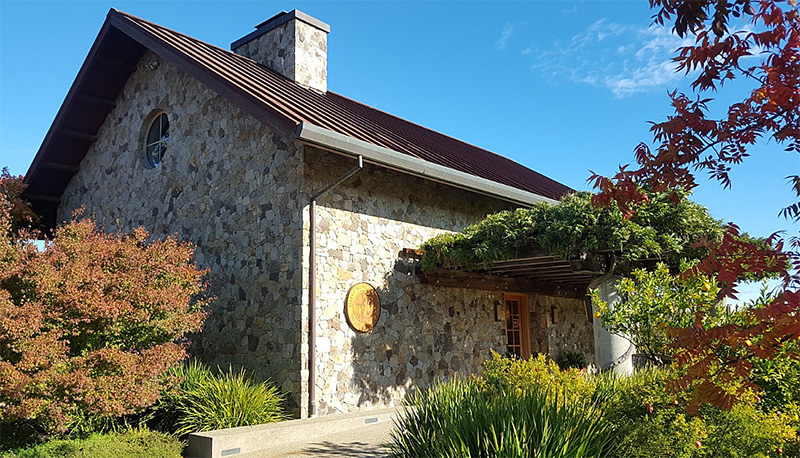
One of his stated strategies for ongoing success was to pay growers, “what their grapes were worth,” in turn increasing the standard of the product he was receiving. In 1964, Heitz acquired an 1898 stone winery with its 160 acre (65 ha) ranch property, which became the Heitz winery and home.
Photo: Darcy K.
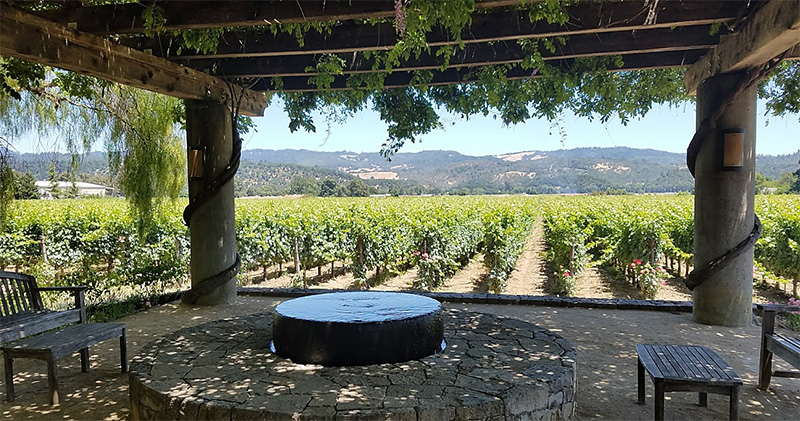
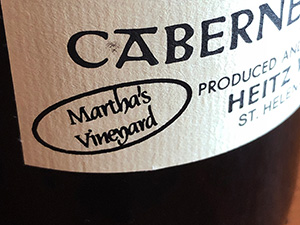
Since 1965, Heitz has held an exclusive agreement with Tom and Martha May, owners of the 34 acre (14 ha) Martha’s Vineyard in the Oakville AVA. He immediately recognized the quality of the grapes, and the very next year Heitz vinified the fruit separately from his other production, and designated the vineyard on the label. (Rather subtly, though. Many of Heitz’s red-wine labels, unchanged for decades, look almost identical. “Martha’s Vineyard” only appears in a small oval in the lower left corner.)
Martha’s Vineyard
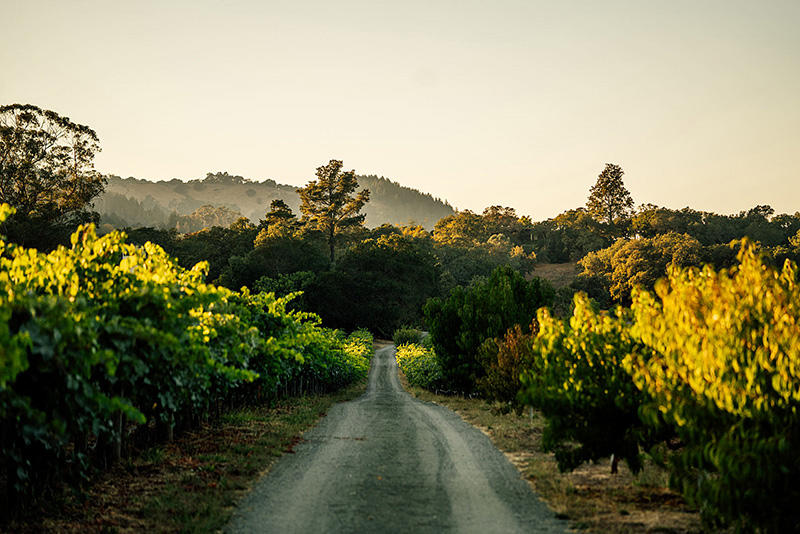
“Standing in Martha’s Vineyard, you quickly realize why this site consistently produces a remarkable Cabernet Sauvignon. The vineyard receives gentle morning and early afternoon sunlight and is sheltered from the heat of the late afternoon sun by the mountains. This allows for longer hang time and Martha’s Vineyard is, historically, one of the last vineyards we pick. This ability to leave the fruit on the vine longer than other sites allows for concentration of flavor and softening of tannin to produce a wine so pure in its expression of place. The consistency in showcasing Martha’s Vineyard’s unique mint, bay leaf, dark berry and chocolate notes year after year is a reminder of why this vineyard has commanded a faithful following since the 1966 vintage.” –Brittany Sherwood, Winemaker
Heitz is considered the first to champion the single vineyard designation in the U.S. The 1968 vintage received attention for its quality, widely considered the greatest wine made in America up to that time. It was fermented in 1,000-US-gallon (38 hL) American oak vats, and then transferred to Limousin oak barrels where it aged for an additional two years. Frank J. Prial, the wine columnist for The New York Times from 1972 until 2004, contended the wine remained “the benchmark by which California Cabernets were judged” for more than two decades. (The 1970 vintage placed seventh at the Paris Wine Tasting of 1976, also known as the Judgment of Paris.)
Following a review by Robert Parker where he wrote that Martha’s Vineyard Cabernet Sauvignon “lacked aroma,” Heitz sent Parker a box of linen handkerchiefs, insinuating to the critic that he ought to clear his nose.
Joe Heitz suffered a stroke in 1996 which left him frail though lucid. He died on December 16, 2000, aged 81. He was described by Warren Winiarski, founder and former proprietor of Stag’s Leap Wine Cellars, as the first of the Napa Valley artisans and the first to grasp the single vineyard concept.
David Heitz succeeded his father as winemaker in the late 1970s, having worked at the estate for many years. In 1984, the estate purchased the Trailside Vineyard in Rutherford, having previously purchased fruit from the site, and introduced a single vineyard bottling in 1989.
In the early ’90s, phylloxera afflicted Martha’s Vineyard, and no vintages were made in the mid-1990s.
Heitz Cellar annually produces approximately 40,000 cases (3,600 hL) of wine. The estate’s vines are grown certified CCOF organic, with a move towards Biodynamic farming planned eventually. In addition to several vineyard-designated Cabernet Sauvignon bottlings that are often aged in oak for three and half years, Heitz also produces varietal-labeled Chardonnay, Sauvignon Blanc, Zinfandel, and Grignolino. (This is a rare variety in California, but was the dominant planting of the original estate vineyard. Heitz is still considered the premier producer.)
In April, 2018, Heitz Cellar was sold to Gaylon Lawrence Jr., whose Arkansas-based family owns one of the country’s largest agricultural businesses.
This wine spent three years in 100% new French oak, one in neutral oak, and an additional year in bottle. It is medium ruby to purple in the glass. While I disagree that it “lacks aroma,” the nose is subtle, and predominantly of cherries. It is incredibly smooth on the palate, with flavors of classic black currant, cocoa, tart cherry, and a hint of dust. The tannins and acid are in perfect balance, and it all ends in a medium-long finish. One thing I didn’t get: Heitz Martha’s Vineyard is famous for a minty overlay, especially when it’s this young. While I wouldn’t find that a problem, I just wasn’t tasting it. Regardless, Joe Heitz went to great pains to consistently deny that the minty notes had anything to do with the eucalyptus tress planted on the edge of the vineyard.
So, was the forty-five year wait worth it? Well … yes … but. This is an excellent wine, worthy of its iconic status. But for me, it was simply too elegant, especially for the price. At this stratosphere, I’m looking for something more boisterous, like a Louis Martini Monte Rosso, a Palmaz, or a Kathryn Hall.
And the other wine of my fantasy? That would be Penfold’s Grange, the legendary Australian Shiraz. That one is selling for about $850 on release these days, so it may elude me forever.
Justin Baldwin founded his eponymous winery in Paso Robles, California, in 1981 on 160 acres. His vision was to make world-class Bordeaux-style blends. Befitting such ambition, The winery is invested in the French idea of terroir, that a wine must reflect its place, especially soil and climate.
In 1894, Gaspare Indelicato was born in the small village of Campobello di Mazara in the province of Trapani, Sicily. In 1911, at the tender age of 16, he emigrated to the United States through Ellis Island, New York.
Eventually, Gaspare and his wife Caterina settled in the agriculturally rich San Joaquin Valley, east of San Francisco. In 1924, Gaspare and his brother-in-law Sebastiano made a bold decision to purchase an old dairy farm, planted grapes, and shipped them by train to home winemakers in the Chicago area during Prohibittion.
When “The Noble Experiment” was repealed in 1933, selling grapes to home winemakers was no longer profitable. Sebastiano and Gaspare decided the only way to salvage their grape crop was to make wine. In May of 1935, they opened their winery in a converted hay barn and called it Sam-Jasper Winery after the Americanized versions of their first names. Production began with 3,451 gallons (about 100 cases) of red wine which was sold to local farmers and friends.
As the business grew, Gaspare’s three sons, Frank, Anthony, and Vincent, joined the family winery in the 1950s. At that time, Frank was cellarmaster, Tony was winemaker, and Vince was the entire sales department.
Today, Delicato Family Wines is still family-owned by the heirs of Gaspare and Caterina’s three sons. The third and fourth generations of the Indelicato family are actively involved in the wine business and continue the tradition of producing and importing fine wines.
The Indelicato family is devoted to its California winemaking heritage of family farming, environmentally sensitive winegrowing practices, and economically sustainable principles.
“‘Family farmed’ encompasses the firmly-held belief that we are responsible for tending the earth and protecting its inhabitants,” explains Jay Indelicato. “This responsibility not only includes using environmentally sensitive farming practices, but also maintaining the highest ethical standards in our business dealings. My family has relationships with growers, banks, employees, and consumers that span decades. By thinking of ourselves as a “family farmed” company, it is a reminder that we have a responsibility to preserve and sustain the things that matter most.”
Here’s the legend of Three Finger Jack. Make of it what you will: He was a notorious desperado who roamed the Sierras and the land east of Sacramento in the closing days of the Old West. Nobody knows where he came from, how he lost two fingers, or where he died. But his legend still lives on today in Lodi, California.
Lodi sits at the foothills of California Gold Country, 75 miles east of San Francisco. Pioneers knew that Lodi made superb wine country; so they planted vines there more than a century ago. Its hot days are cooled by breezes from a vast river delta, and it’s home to soils that force vines to dig deep into the ground. Most of the Lodi region has deep, loamy soil. However, up on the east side, the soil is more rocky, with cobblestones and soil low in nutrients.
Three Finger Jack is a blend of 76% Cabernet Sauvignon, 9% Petite Sirah, 8% Malbec, 6% Merlot, and 1% other red varieties. Part of the wine is aged in American and French oak with the rest in stainless steel.
Pouring from a unique squat bottle, TFJ is a transparent dark red in the glass. It features a robust 15% ABV, with aromas of blackberry, blueberry, cassis, and vanilla.. These and tastes of leather and cocoa follow, supported by good tannins and mild acidity. It ends in a relatively short finish.
Pair this substantial wine with Lemon-Pepper Barbeque Ribs, Lamb Kabobs with Mustard Marinade, or Double Peanut-Crusted Pork Chops.
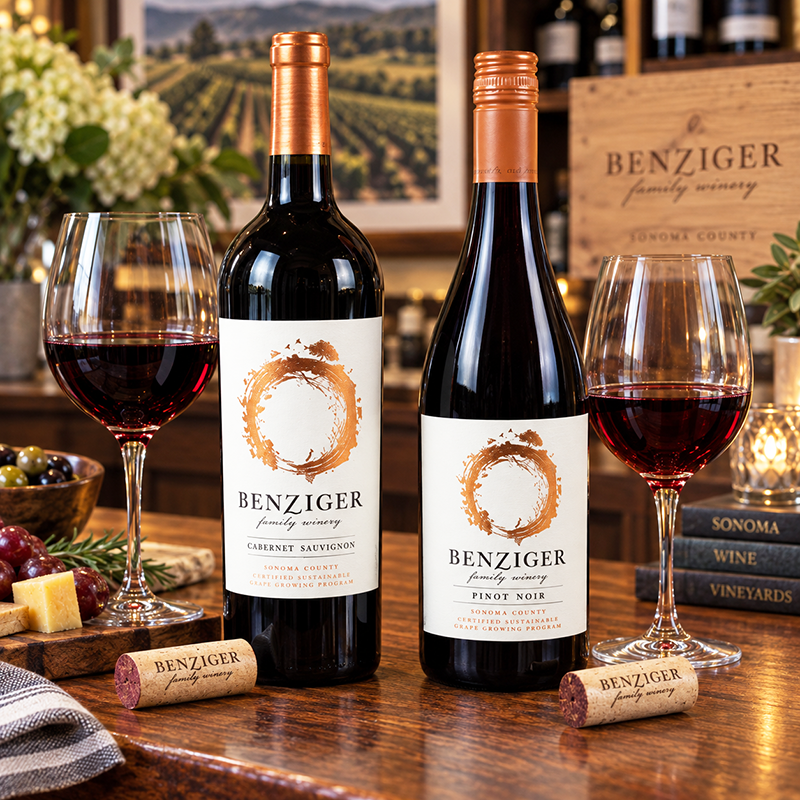
Let’s clear up some confusion right away. This post is about the Benziger Family Winery of Sonoma, not the Beringer winery of Napa. But people often make this mistake, as Chris Benziger can attest to.