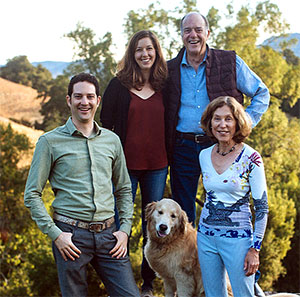
Keith Rütz’s first career track was in the fashion industry. He was the proprietor of two trendy clothing boutiques located near the UC Berkeley campus. To search out the latest styles, he frequently travelled to both London and Paris. It was in France where he began to develop his love of Burgundy and interest in wine generally.
Many years ago, while driving through Sonoma County, Arturo Keller and his wife Deborah came upon a piece of property overlooking the Petaluma River with a tremendous view and expansive terrain. Keller, a passionate antique car collector and native of Mexico, purchased the 50-acre parcel in 1982. He soon had a paved road built that wove about the property to serve as his own miniature racecourse. Keller also recognized the potential of the property as a grape-growing site, and in 1989 the La Cruz Vineyard was began.
Over time, Keller added more acreage, and planted Pinot Noir, Syrah, Viognier, and Pinot Gris, and began making wine for family and friends. Keller soon called on his youngest daughter, Ana, who had studied chemistry at the University of Mexico, to become the nascent winery’s winemaker.
Keller Estate released their first wines in 2001, an estate Chardonnay and Pinot Noir. The name ‘Keller Estate’ pays homage to the Keller family’s Swiss heritage, since the word ‘keller’ is cellar in German.
Ana also started a sister brand, Casa Wines, which are sourced exclusively from the family’s La Cruz Vineyard. Casa Wines produces Chardonnay, Pinot Noir and a red blend.
Keller Estate has completed the California Sustainable Winegrowing Program. The winery utilizes a natural water source, promotes local wildlife to live on the property, and is home to thousands of newly planted trees. The vines are all grown sustainably and organically.
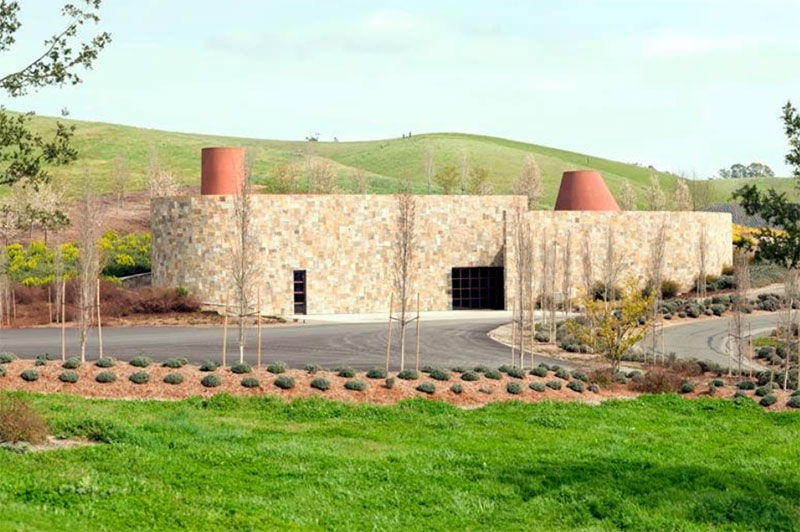
The Keller Estate Winery
The Winemakers
Ana Keller – Estate Director and Winemaker
Raised in Mexico, Ana’s first exposure to wine came early in life when she spent her holidays in France’s Loire Valley harvesting grapes. “When my father asked me to join him in establishing Keller Estate, I was overjoyed,” she related. “We have accomplished much of what we initially set out to do, and it’s up to me to continue to make sure our quality never fluctuates.”
She holds degrees from both the University of Mexico (biopharmaceutical chemistry) and a Masters in Pharmaceutical Development from the prestigious King’s College in London. While there, she took her first formal wine tasting lessons.
Keller was heavily involved in the effort to make her property part of the AVA (American Viticultural Area) called the Petaluma Gap AVA.
“When you consider what the winds of the gap do to the area and to the grapes themselves, it seems to be a no-brainer. The winds force our (Pinot Noir) grapes to develop thicker skins and that in itself changes the equation.”
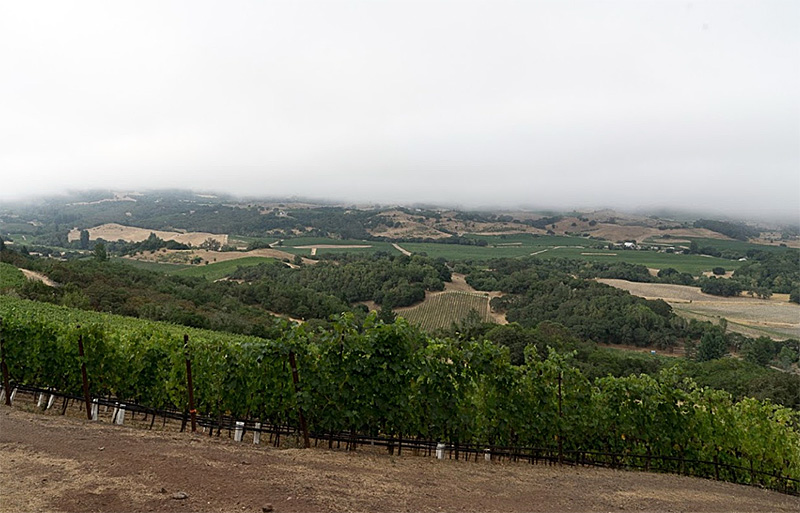
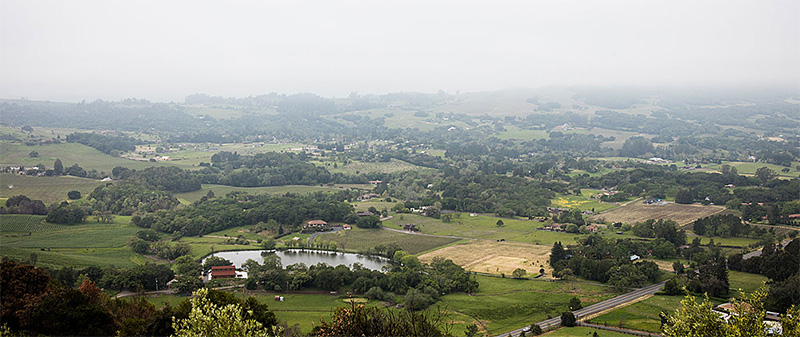
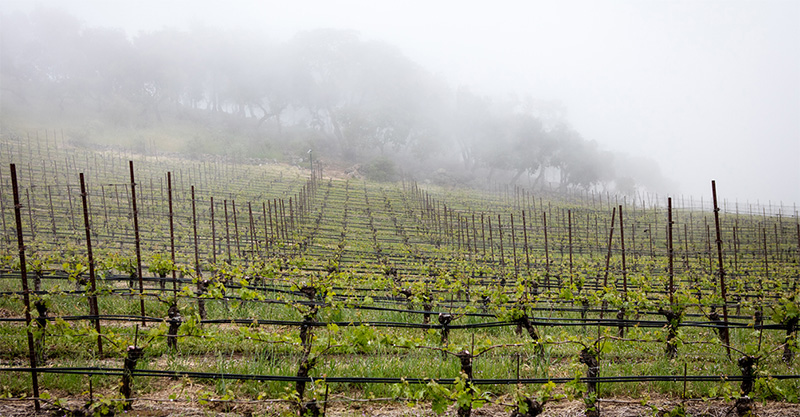
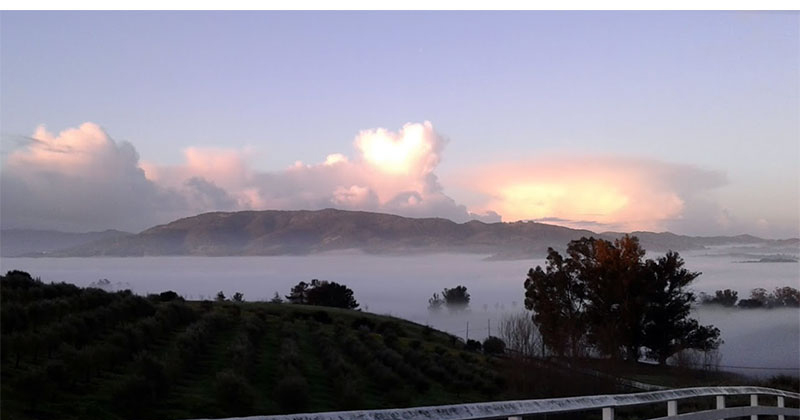
The fog-shrouded Petaluma Gap
Keller devotes 100 percent of her time to Keller Estate, and confided that her parents are still active in the business as well. “Whenever my father is available, he sits in on our meetings and tastings. He is still quite active and his passion for cars takes up a great deal of his time. He cares a great deal about the winery since it is still a relatively small family operation.”
Julien Teichmann – Winemaker
Born in Goettingen, Germany, Julien Teichman joined Keller Estate in 2018. His passion for fermentation began with an internship at a brewery. He next spent some time in Florence, Italy where he had his first contact with winemaking and vineyards. Julien then earned a degree in winemaking from the Weincampus Neustadt in Germany.
Julien traveled the world working harvests and finally came to the United States in 2013, where he spent time at Kosta Brown and Merry Edwards before joining Keller Estate. He espouses a profound respect for the vineyard, and a holistic approach to farming and winemaking.
About the Vineyard
The Keller Estate La Cruz Vineyard features an intricate stone cross sculpture that boldly stands over the vines, and was named to represent the family’s Mexican heritage.
The majority of the La Cruz Vineyard, where Keller Estate grows all of their Chardonnay, Syrah, Pinot Gris, and slightly over half of their Pinot Noir, resides on the lower hills of the property. The soils here are multi-layered, mineral-laden clays there were once San Pablo Bay seabeds. This mineral character comes through in the wines and is very much a part of the Keller Estate’s unique terroir.
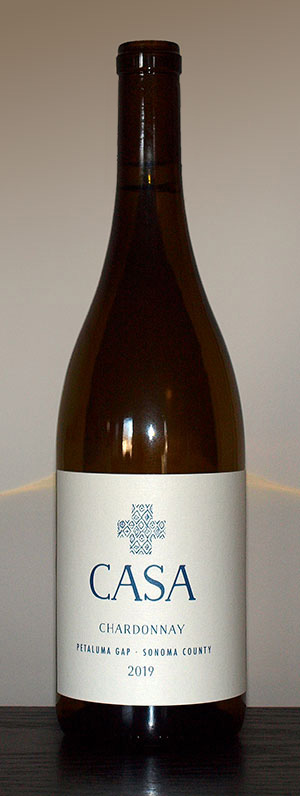
Keller Estate Casa Chardonnay 2019
To start with, this bottle was sealed with a synthetic plastic cork. Not the worst one I’ve ever encountered (although the one in the second bottle was harder to get out than the first), but I’m just not a fan. I’m fine with manufactured corks, where cork is ground up, treated to prevent cork taint, and then reconstituted as closely as possible to the bark itself. But failing that, I’ll take a screw cap over a plastic stopper any day.
Moving on to the wine. The fruit was sourced from the Keller Estate’s La Cruz Vineyard, in the Petaluma Gap region of the Sonoma Coast. The wine was fermented in both barrels and stainless steel. This 100% Chardonnay is very pale yellow in the glass. The moderately aromatic nose features grapefruit and honeydew. These are on the palate as well, with moderate but bright acidity and mineral notes. Although it saw some oak aging, the result is subtle at best. 1,600 cases were produced, and the ABV is 14.2%.
L. to R.: Disctrict 7 Chardonnay, Scheid Vineyards Sauvignon Blanc, and Ryder Estate Pinot Noir Rosé. Click here for tasting notes.
Today is Earth Day, first held on April 22, 1970. An ideal moment to examine Scheid Family Wines, a producer deeply committed to earth-friendly practices (an enthusiasm shared by more and more winemakers every year, fortunately).’
Proprietor Ron Lachini’s family hails from the Tuscan town of Lucca. At some point, his grandfather immigrated to the United States, settling in the large Italian community of San Francisco’s North Beach. He started making wine with his father and grandfather in their garages as a child.
Winemaker Katy Wilson founded LaRue Wines in 2009 when she was just 26, but already had years of experience. She is one of the few but growing number of women in the wine industry. Continue reading “LaRue Wines”
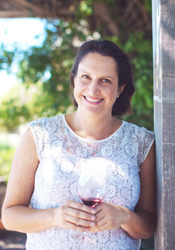
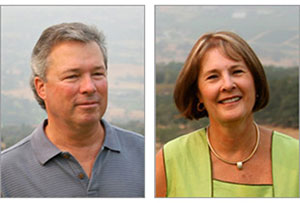
Yet another white-collar professional turned winery owner, Randy Wulff was an attorney for 20 years. After graduating from the Honors College at the University of Oregon and Hastings College of the Law, he worked as a successful trial lawyer and mediator at a law firm in San Francisco. “Even when I was one of the chief mediators during the World Trade Center property damage claims hearings arising from the tragedy of 9/11 that lasted for more than two and a half years, my wife Krys and I had always dreamed of being in the wine business,” Wulff reminisced.
Krys Wulff got her undergraduate degree at the University of San Francisco, and a Masters at Mills College in Oakland, California. She worked as an optical industry consultant for over 25 years while also raising two sons. She has devoted her energies to several philanthropic, educational, and advocacy organizations, including the Piedmont League of Women Voters, the East Bay Junior League, and EdSource, an independent, non-partisan organization that works to engage Californians on key education challenges with the goal of enhancing learning success.
Randy grew up with Krys in California’s Central Valley. “We were high school sweethearts and have been married for over 48 years,” shared Randy. “She is the heart and soul of Lobo Wines, and our success is directly related to her efforts. I can’t think of anything better than sharing our success with the person I love the most.”
As is not unusual for well-heeled San Francisco residents, the Wulffs eventually purchased a second home, in Napa Valley. “We were living in the East Bay and Napa Valley was only an hour’s drive away. Whenever we arrived there, it was like living in another world,” Randy recalled. They soon planted Chardonnay on the property, which is located in the Oak Knoll district. “When the first usable fruit came in, we sold the grapes to Randy Lewis, and he produced a wine that notched incredibly high scores. I thought to myself, this is easy, and we decided to really delve into the wine industry.”
Continuing to expand their efforts as grape growers, a few years later the Wulffs acquired a much larger vineyard about a mile from the first one, where they made substantial improvements to drainage and vine care. In 2007, they acquired a 42-acre property on Atlas Peak, on the eastern ridge of the Napa Valley. With that commitment, the couple established a winery of their own that same year, naming it Lobo Wines. Lobo is Spanish for ‘wolf,’ a play on their last name, of course. The first vintage yielded just 25 cases, but production has gradually increased to around 1,500 cases.
“We want to grow Lobo Wines carefully,” Randy explained. “Our goal is probably around 5,000 cases, and we want everything to be home grown. At this point, we crush some 100 tons of fruit, but we sell around 70 percent to other wineries. Over time, we will sell less and produce more.”
Sadly, the horrendous Atlas Peak fire of 2017 devastated the Lobo winery and the Wulffs’ home site. Undeterred, they immediately set about to rebuild the winery and residence, a project that is ongoing.
The Winemakers
Victoria Coleman Coleman, a Seattle native, began her winemaking apprenticeship at Stag’s Leap Wine Cellars as a production assistant in 1998. While there, she enrolled in a winemaking class at Napa Valley College. As part of that course, she crushed a small amount of Cabernet Sauvignon in a drum with her feet in the time-honored manner. The experience of hands-on winemaking fueled her desire to learn everything she could about it.
She began working with Mario Bazán at Bazán Cellars in 2004 as the winery’s founding winemaker. To further her formal education, she enrolled at the University of California, Davis, (incubator for thousands of winemakers) in the fall of 2006 and graduated in June 2008. She was exposed to classic, Old World winemaking immediately thereafter while working alongside Erick Tourbier at Chateau Mouton Rothschild in Bordeaux. Starting in January 2010, she gained further international experience as winemaker at Jade Valley Winery near Xian, China. She returned to Napa Valley in 2015 and began work at Lobo Wines, where her products include both the Napa Valley and Atlas Peak Cabernet Sauvignon, Pinot Noir, and a proprietary blend of Cabernet Sauvignon and Syrah named “Howl.”
Randy Lewis Lewis came to winemaking via a circuitous route. A native of Atlanta, Georgia, he was a race car driver for more than two decades, first as a Formula Three driver in Europe, where he discovered the wines there and what life as a winemaker could be like. He then raced in America in Formula 5000, Can Am, and finally Indy Cars from 1983 to 1991, competing in five Indy 500s. After retiring as a driver, he helped a friend set up a winery in Napa Valley, and then, with his wife Debbie, he established his own winery in Napa in 1992.
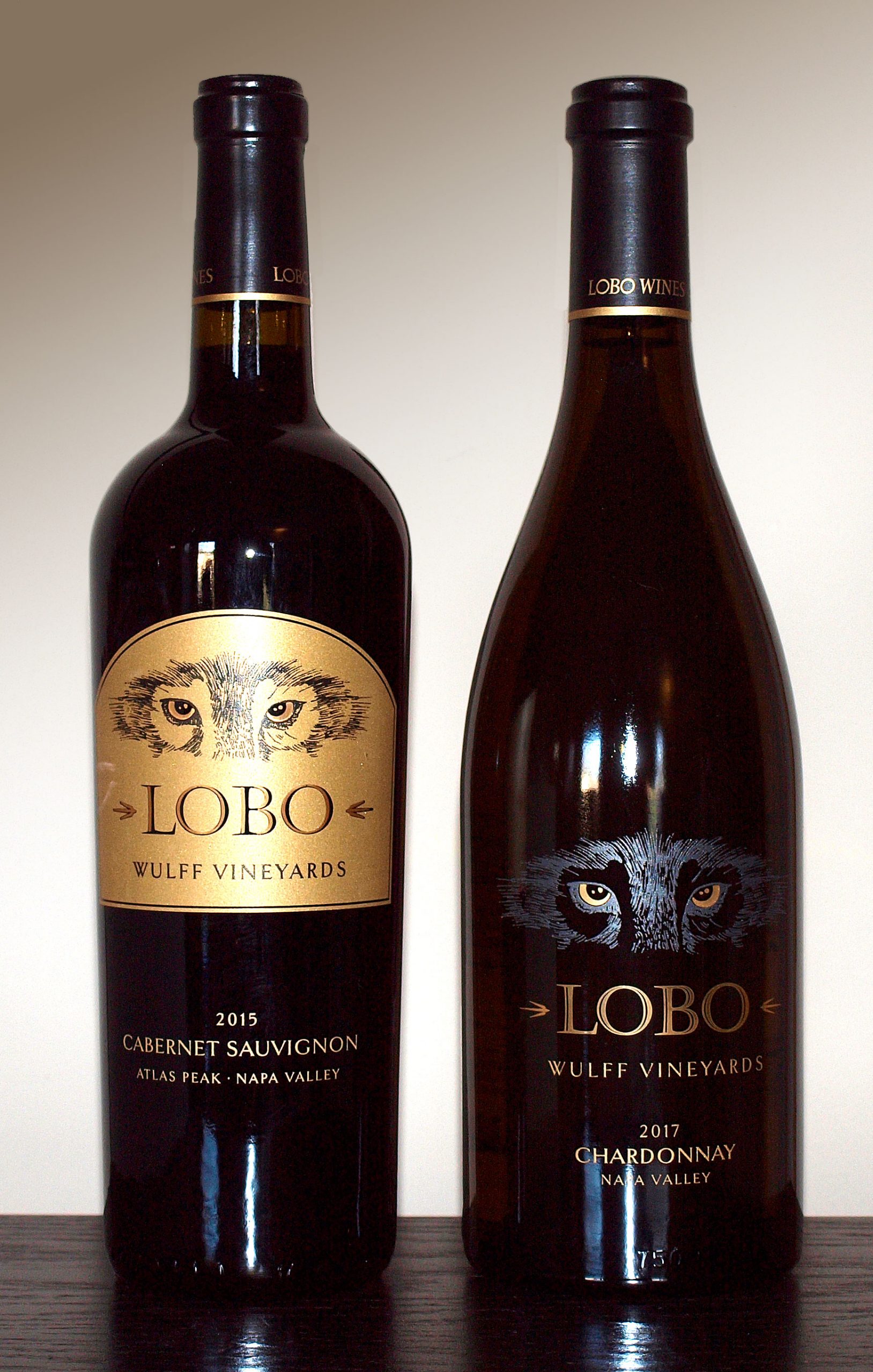
Lobo Chardonnay 2017
Made by Randy Lewis at Lewis Cellars, this 100% Chardonnay is sourced from fruit grown at the Lobo Wulff estate vineyard in Oak Knoll. It is lemon yellow in the glass, and features aromas of lemon, honeysuckle, and melon. The mouthfeel is rich and smooth, and offers flavors of lemon, grapefruit, and more melon. There is good acidity, restrained oak, and a bit of vanilla on the medium finish. ABV is 14.7% and 150 cases were produced.
Lobo Atlas Peak Cabernet Sauvignon 2015
This wine, made by Victoria Coleman, was chosen by Great Britain’s Decanter magazine in 2019 as the Top Cabernet Sauvignon in California over 197 other competitors. It was made from 100% estate grown fruit in the Atlas Peak appellation of Napa Valley, on a rocky, volcanic hillside at 1,350 feet elevation. This is a blend of 98% Cabernet Sauvignon, 1% Merlot, and 1% Petit Verdot (allegedly for “balance and complexity,” although I can’t imagine how much of that such a small percentage could contribute.) On the nose, this Cabernet Sauvignon offers aromas of dark fruit and hints of vanilla. There are ripe plum, black currant, and blackberry on the palate. These harmonize with medium, satiny tannins, nicely integrated acidity, and hint of black tea at the end. ABV is 14.4%.
Irv Bliss’ early years as a farmer were occupied with growing pears, prunes, walnuts, and a large family garden just outside of Healdsburg, in Sonoma County, California. Although successful, for years Bliss nursed the vision of planting a vineyard in Mendocino, which he believed to be one of the best places around to grow grapes. In 1943, he purchased a plot of land in southern Mendocino County, and immediately planted the vineyard of his dreams. In the early days, in addition to growing grapes on the property, Bliss farmed figs and raised sheep and cattle. At some point in the 1970s, all 100 acres of the land was converted to grape production, mostly Cabernet Sauvignon and Zinfandel.
When Leonard met Martha
In 1910, the Brutocao (pronounced brew’ tuh coe) family emigrated from Treviso, Italy (a small town near Venice), at first settling in Canada. Son Leonard Brutocao was born in 1935 in Fort Erie, Canada, and, after the family moved to the U.S., was raised in Covina, California. He met Irv Bliss’ daughter Martha while attending the University of California, Berkeley. After Leonard and Martha married, the families joined forces, and continued to farm grapes which they sold to well-known Sonoma and Napa wineries. Irv and Leonard worked together for over 35 years until Irv’s retirement in 1969, at which point the new ownership was split between Lenonard and Lenonard’s brother Albert.
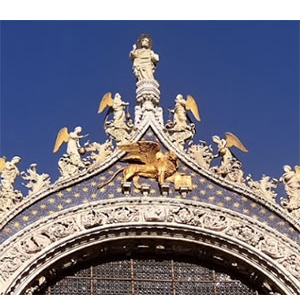
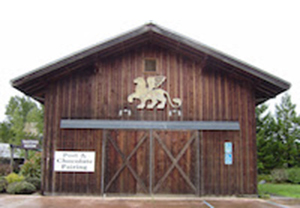
For several years, most of the family’s grapes were sold to local area wineries, including Beringer and Mondavi. Leonard and Albert were interested in more than just farming however, and saw the potential for producing a handcrafted Mendocino wine. Acting on this vision, the Brutocao family released their first wine with the 1980 vintage. Shortly thereafter, they chose as their symbol of family tradition and quality a version of the Lion of St. Mark, the lion on top of St. Mark’s Cathedral in Venice, Italy, (But they flipped the way it faces, for whatever reason.) x
In 1991, the original winery was built, and the first estate vintage was produced. Around the same time, Leonard’s three sons, David, Len Jr., and Steve, joined the family business.
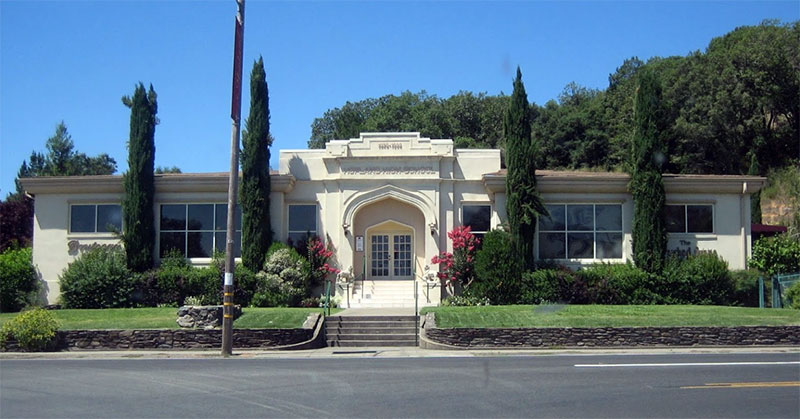
Brutocao outgrew the first winery by 2003, when a new facility was built, and it was expanded in 2009. The original building has now become an onsite wine storage warehouse. The more visitor-friendly tasting room is about a mile and a half due west, in Hopland, California. x
The Winemaker
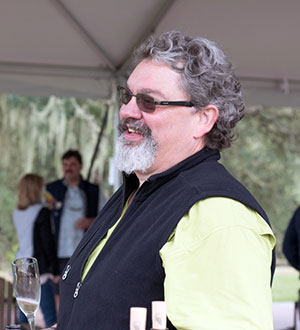
Hoss Milone became the winemaker for Brutocao in 2009 after spending 18 years toiling for Ferrari-Carano. Hoss is a fourth-generation winemaker who grew up in his family’s vineyards, and watched his grandfather and father produce their own Mendocino wines. Milone is also a trained cooper, aka barrel maker. At some point it was discovered that Milone’s grandfather tilled the land for Irv Bliss in the original vineyard. Quite a coincidence.
The Vineyards
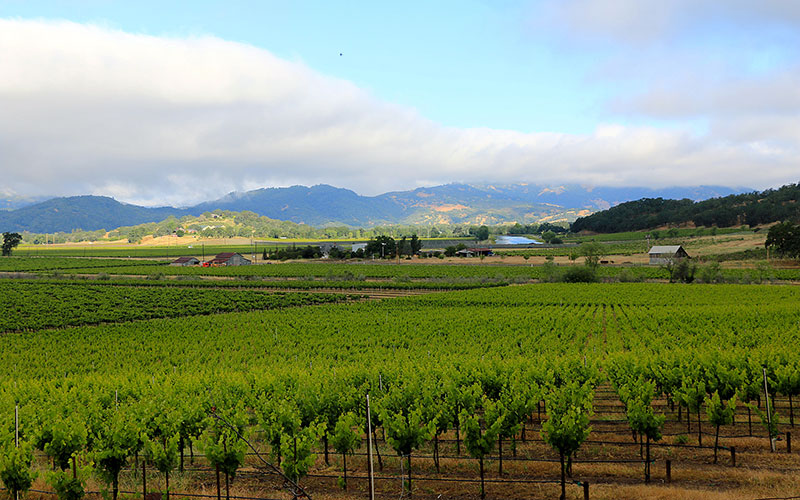
TheBliss Vineyard, also known as the Home Ranch, is the original property purchased in 1943 by Irv Bliss. The vineyard is 400 acres, with 177 acres planted to Chardonnay, Cabernet Sauvignon, Sauvignon Blanc, Zinfandel, Merlot, Sangiovese, Barbera, and Dolcetto.
TheFeliz Vineyard was purchased in 1994. It is 583 acres in size, with 114 acres planted to Chardonnay, Sauvignon Blanc, Syrah, Cabernet Sauvignon, Sangiovese, Dolcetto, Barbera, Zinfandel, and Pinot Noir.
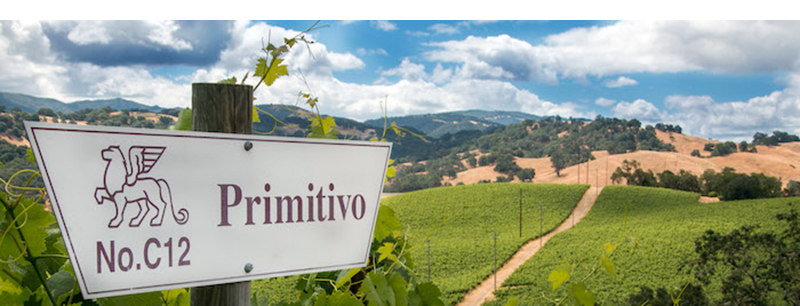
The 251-acre Contento Vineyard was purchased in 1997, but not planted until 1999. 90 acres are now under vine, growing Cabernet Sauvignon and Primitivo*. Contento is the site of an old cattle ranch, where purebred Brangus cattle were raised. Some of the ranch was used for research and development of new tractor equipment, resulting in very well-worked soils.
Brutocao Chardonnay 2019
Made by Brutocao since the mid-1980s, this pale-straw colored Chardonnay comes entirely from Bliss Vineyard, the original property purchased by Irv Bliss in 1943. The wine was 100% barrel fermented and sur lies aged for nine months in French oak, 30% of which was new. Some of the grapes were “whole cluster pressed” for maximum flavor extraction. It underwent 100% malolactic fermentation, which in this case lead to citrus rather than the more typical buttery notes.
The wine opens with aromas of honeysuckle, pear, and mango. These evolve into a full-bodied palate of tropical fruit with just a hint of butterscotch on the finish. Serve moderately chilled at about 60° F. ABV is 13.5%, and 3000 cases were produced.
*There is ongoing debate about whether or not Primitivo and Zinfandel are the same grape. However, it is agreed that at the least they both share a Croatian forebear. Primitivo is mostly planted in Italy, while Zinfandel is almost exclusively American. Winemaker Hoss Milone insists that Brutocao’s Primitivo can be sourced back to mother vines in Italy. He also believes Primitivo prefers French oak aging, while Zinfandel is more suited to American oak.
The pioneering Trefethen Family Vineyards is truly a rarity in the Napa Valley: a winery that grows, vinifies, and ages all of its wines entirely on the property, and has been helmed by a single family for three generations.
The area in which Trefethen is located is one of the oldest in Napa Valley’s wine history. Nearly 2,000 acres were originally purchased in 1851 by J.W. Osborne, who called it Oak Knoll. He planted grapes there the following year, and by 1860 had the largest vineyard in Napa, at 50 acres.
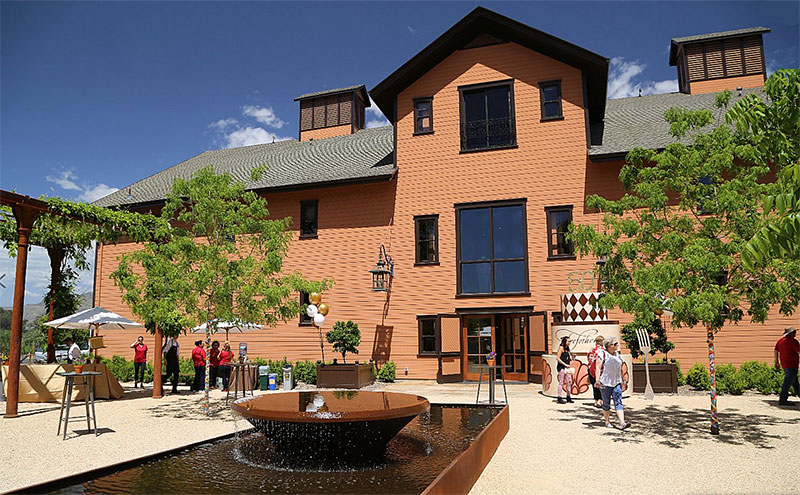
In 1886, banker brothers James and George Goodman founded the Eschol winery in Oak Knoll. The name was taken from the Old Testament, Numbers 13:24, “The place was called the brook Eschol, because of the cluster of grapes which the children of Israel cut down from thence.” The original estate was 280 acres, with 40 acres planted in vineyards. The winery used a gravity-flow system: a horse-drawn winch brought grapes to the third floor of the three-story structure for crushing; gravity carried the juice to the second floor for fermenting; and, eventually, the wine descended to the first floor for aging. It is now the only surviving example in Napa Valley of a wooden gravity-flow winery from the 1800s. After struggling through Prohibition, by 1940 the winery building had fallen into disuse, although for a time in the ’40s Beringer Winery used the space as a storage facility and leased the surrounding vineyards.
x
Following retirement from a successful career, including CEO, with Kaiser Industries, Eugene Trefethen along with his wife Catherine, better known as Katie, purchased Eshcol and six adjoining properties in 1968, with the goal of become genteel farmers. They installed a robust water system that still serves the vineyard today, but neither of them ever wanted a winery.
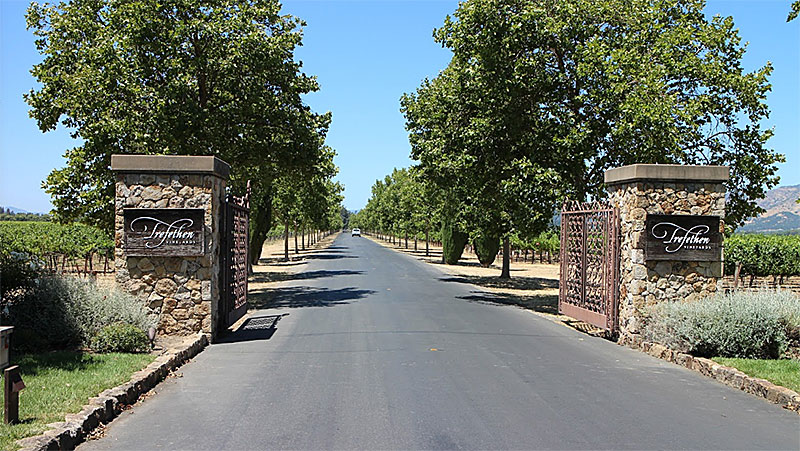
The winery operation got going in 1973, the year the Trefethen’s son John and his wife Janet produced their first commercial vintage (2,000 cases of Chardonnay and Pinot Noir). They also replanted the vineyards and restored the historic winery building. Located at the end of what is possibly the longest winery driveway on the Napa Valley floor, it is the largest winery in the Oak Knoll district.
The trees were eventually planted to prevent John Trefethen from using the driveway to land his private plane. Photo: Carlin Arthurs
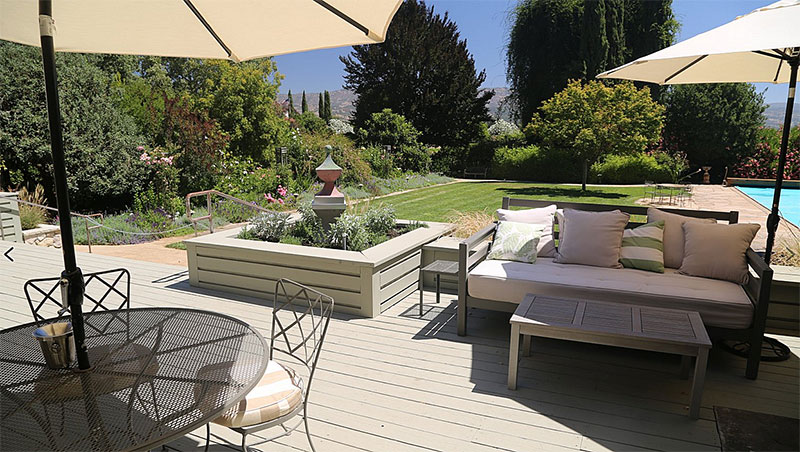
The Trefethens’ restoration efforts were recognized in 1988 by the Department of the Interior, which placed the winery on the National Register of Historic Places. The property is also known for an extensive garden established by Katie. It has been featured in many publications, and has been a destination for many gardening enthusiasts since it was created.
The flower logo shown here has been part of Trefethen’s branding since the beginning. Katie had originally used it on signage in her garden areas, and the winery put it on the bottle capsules from very early on. It was long referred to as the “Welsh Flower,” thinking that Katie had tapped into her Welsh heritage. But later research couldn’t find any Welsh history for the mark, so its origins remain a mystery, and it is now just called the “Trefethen Flower” instead.
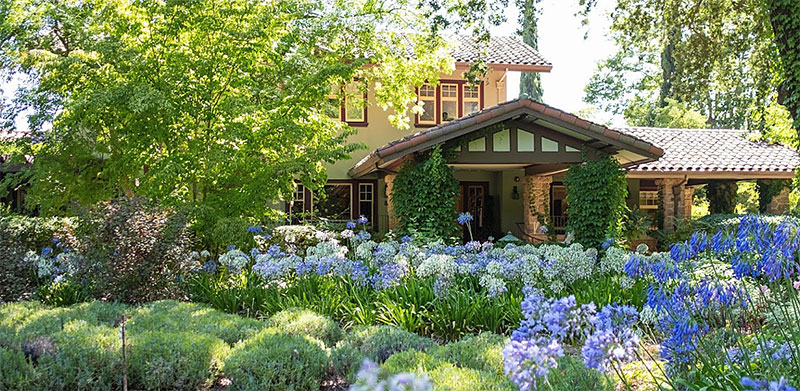
Eugene and Katie Trefethen’s residence, The Villa, is now used for special events.
John and Janet Trefethen have largely stepped back from day-to-day oversight, and the third generation of the family is now deeply involved in the operation. Son Lorenzo focuses on sales and marketing, and daughter Hailey on vineyards and employees.
In addition to the family, Jon Ruel has long been a part of the business. He started as the viticulturist, but steadily increased his involvement over the years that have followed. He is now fully responsible for all aspects of the company’s operations and strategy, and was named named CEO in 2015. He had this to say about Trefethen, ““As a true estate winery, we have the unique opportunity to bring integrity to every step of the process, from the soil to the table. My entire focus these days is on cultivating this extended family – and when we succeed, you can not only taste it in the wine, you can feel it.”
Winemaker Bryan Kays joined Trefethen in 2006 as a viticulture intern. Fascinated with estate-grown wines, he started in the cellar, and eventually worked up to the position of winemaker in 2015.
x
In 1979, a “Wine Olympics” was organized by the French restaurant guide Gault Millau in Beaune, France. A total of 330 wines from 33 countries were evaluated by 62 experts from ten countries. The 1976 Trefethen Chardonnay won first place in the category that pitted California Chardonnays against those from Burgundy, and was judged best in the world. This came three years after the more-famous “Judgement of Paris,” further helping to establish the quality of American wine in the world market.
The spirit of support and cooperation in northern California’s wine country that has been so much in evidence during this year’s wildfires goes way back. Two now-notable wineries got their start at Trefethen. Cakebread Cellars purchased some grapes for their first vintage from Trefethen, and made their initial wine there. Domain Chandon (the American operation of the French Champagne leviathan Moët et Chandon) began their winemaking efforts by taking over the second floor of the winery while their own facility was being constructed.
The Vineyards and Environmental Commitment
The Main Ranch Vineyard. Photo: Arturo Pardavila
The Vineyards
The original 400 acres surrounding the winery are known as the Main Ranch. It sits on the largest alluvial fan in Napa Valley, where Dry Creek spills onto the valley floor and spreads gravel eroded from the Mayacamas mountains over clay and loam left by an ancient ocean. Over twenty different soil types have been identified in the vineyard, allowing Trefethen to grow nine different varieties there, all planted in their preferred soil.
Trefethen now also owns another 150 mostly hillside acres surrounding a spring-fed creek, the Hill Spring Vineyard, of which 40 acres are planted to Bordeaux varieties. It is about three miles from the winery in the foothills of the Mayacamas.
Although a relatively large producer (about 75,000 cases annually, but it varies with each harvest). Trefethen has farmed their vineyards sustainably since the beginning. They are all managed by employees, without outsourcing the work to a vineyard management company. A true “estate” operation, they have never purchased grapes from anyone.
Biodiversity
Bluebirds, owls, and bats inhabit the vineyards. All of these species are native to the area and play important roles as natural predators. The property also attracts other birds of prey such as kestrels and red-tailed hawks. Cover crops provide habitat for beneficial insects, spiders, jackrabbits, and more, all of which play important roles in the ecosystem. Cover crop use also increases water infiltration as the roots create channels in the soil that can directly impact soil fertility via nitrogen fixation.
Soil Health
Every part of the grape cluster but the juice– the stem, skins, and seeds – is combined with clippings from the gardens and manure from the stables to make a compost which is spread out into the vineyard each year.
Water Conservation
The property includes two reservoirs. After collection, the water is transferred to biological settlement ponds, where the organic compounds are digested by bacteria, rendering the water appropriate for re-use in vineyard irrigation.
Energy Usage
A number of solar arrays are on the property, providing power for the winery and production facilities. They were one of the first wineries to offset 100% of their electricity usage with on-site solar power.
Certifications
As a major part of their commitment to ecological responsibility, Trefethen participates in a number of certification programs.
The Napa Green organization supervises two programs. Land is an umbrella program that recognizes growers with validated environmental compliance and verified farm plans as meeting standards for watershed stewardship. Winery is one of only four sustainable winegrowing programs nationwide, offering the opportunity for comprehensive soil-to-bottle certification in both the vineyard and winery.
The California Sustainable Winegrowing Alliance is a certification program that provides verification that a winery or vineyard implements sustainable practices and continuous improvement
Trefethen Family Vineyards Oak Knoll District Estate Chardonnay 2018
Trefethen’s highest-volume wine, this Chardonnay was 100% sourced from the Main Ranch. After both barrel and malolactic fermentation, the wine was aged for nine months in 13% new oak.
It is a pale straw gold in the glass. The nose presents aromas of lemon, lime, and grapefruit, plus a hint of peach. The smooth palate features these same flavors, as well as some lemon curd and just a suggestion of oak. It’s all wrapped up in a refreshing zippy acidity. The ABV is 13.3%, and 28,800 cases were produced.
Trefethen Family Vineyards Oak Knoll District Estate Cabernet Sauvignon 2018
This wine is a blend of 84% Cabernet Sauvignon (enough that it isn’t labeled a “red blend”), 10% Petit Verdot, 3% Merlot, 2% Malbec, and 1% Cabernet Franc, all sourced from the Main Ranch vineyard. It always amuses me when winemakers include 1 or 2% of something. It’s hard to imagine how much difference that could make, but they certainly think it is worth the effort. After fermentation, it was aged for 18 months in 52% new oak.
This full-bodied wine is inky dark purple. The nose displays aromas of dark stone fruits, particularly plum, and earth. These continue on the palate, with the addition of prunes and cocoa, plus a little vanilla. There is well-balanced acidity, as well as plenty of grippy but nicely integrated tannins. The ABV is 14.2%, and 23,880 cases were produced.
Note: Trefethen releases some of their red wines fairly young – if you have the patience, consider holding these for several years while they develop additional complexities and nuances. But do as I say and not as I do; there was a time when I would have bottle aged a wine like this for 10 years or so, but I have largely abandoned holding bottles more than four or five years at the most, as I prefer the more up-front characteristics, especially tannins, of a young red.
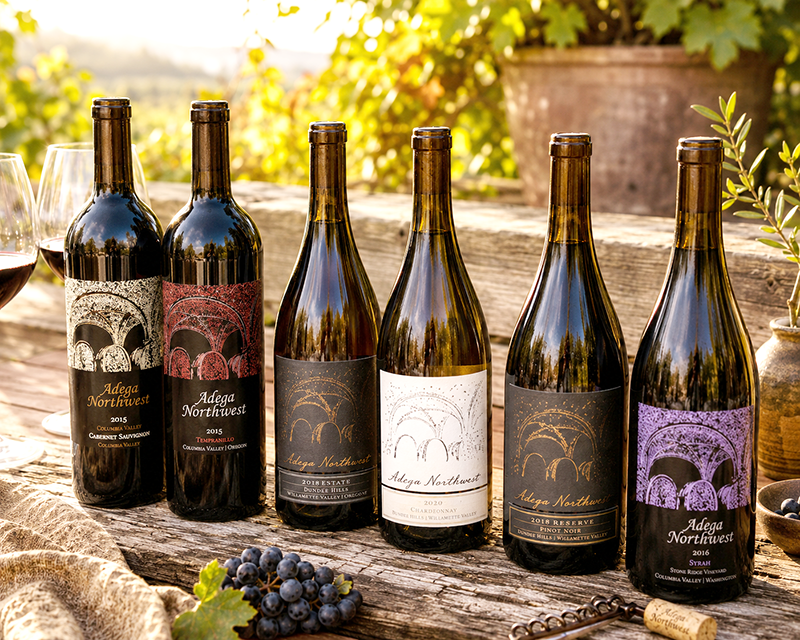
When most of us think of a winery, what usually comes to mind is the romantic stereotype of a rustic but exquisite barn situated halfway up a mountain in the western U. S. overlooking a bucolic valley below; a fabulous hundred-years old chateau surrounded by ancient vines somewhere in France; or perhaps even a charming azienda agricola in Italy with a view of Roman ruins. But that’s not the only way to do it. Adega Northwest of Portland, Oregon, is very much an urban winery. There are vineyards, of course, you just won’t see them if you pay the winery a visit (by appointment only). And because they are not tied to an estate, Adega Northwest can and does draw on sources throughout the region. Continue reading “Adega Northwest Winery”
Patz & Hall was founded in 1988 when two Flora Springs Winery and Vineyards employees, assistant winemaker James Hall and national sales manager Donald Patz, decided to strike out on their own. Their ambition was to apply traditional (i.e. French) winemaking techniques to fruit from elite, small vineyards, specializing in Chardonnay and Pinot Noir. The winery went on to great success.
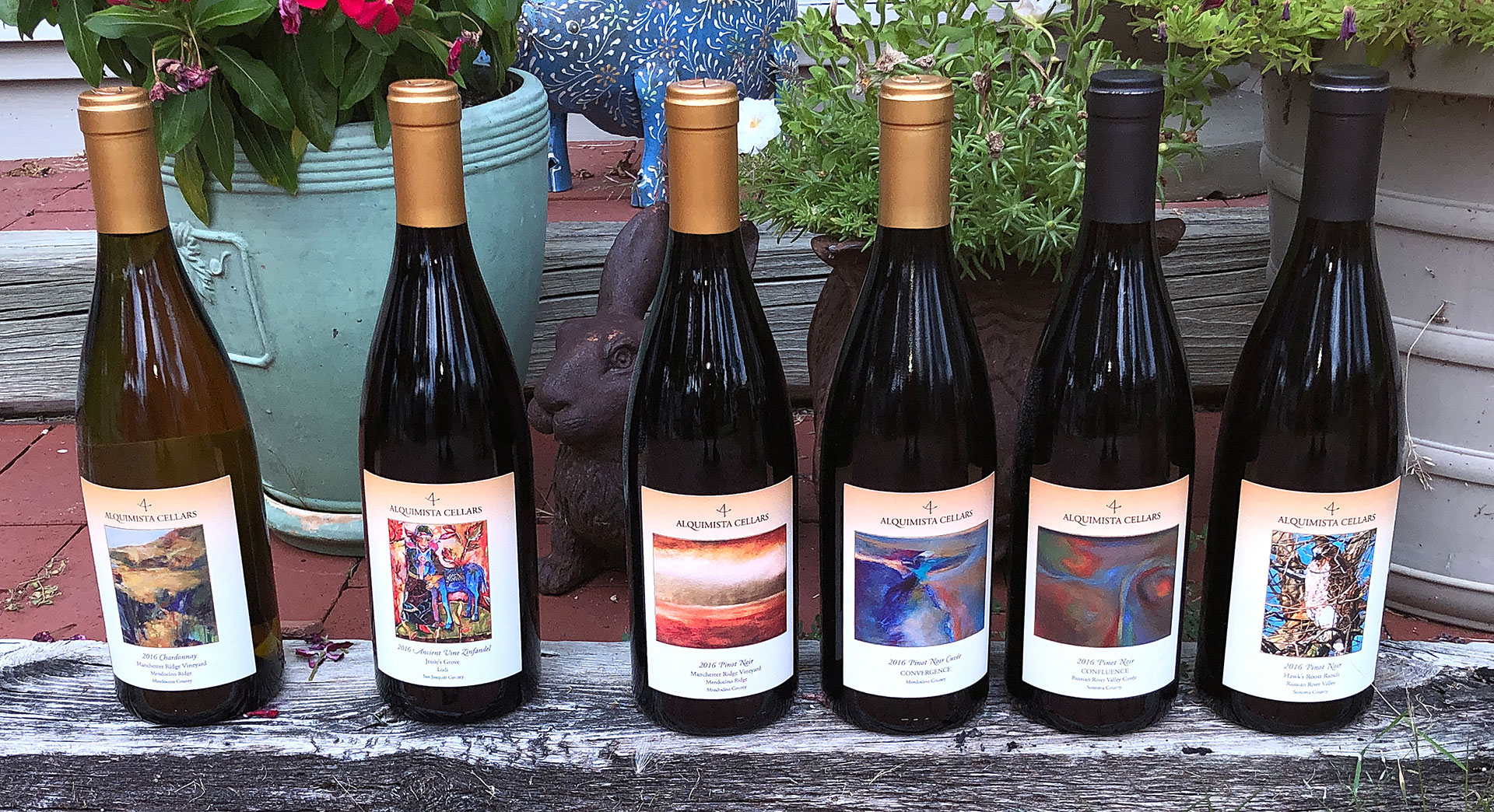
Some winemakers and winery proprietors are born into the business. Some buy into the business. And some evolve into it. Greg LaFollette of Alquimista evolved quite successfully. He has been called a “vine whisperer,” a “cellar magician,” and a “tireless coaxer and protector of handcrafted wines.” He is one of Sonoma’s most revered winemakers, and was honored as Winemaker of the Year in 2010. He has also been tagged “Prince of Pinot” by the website of the same name.
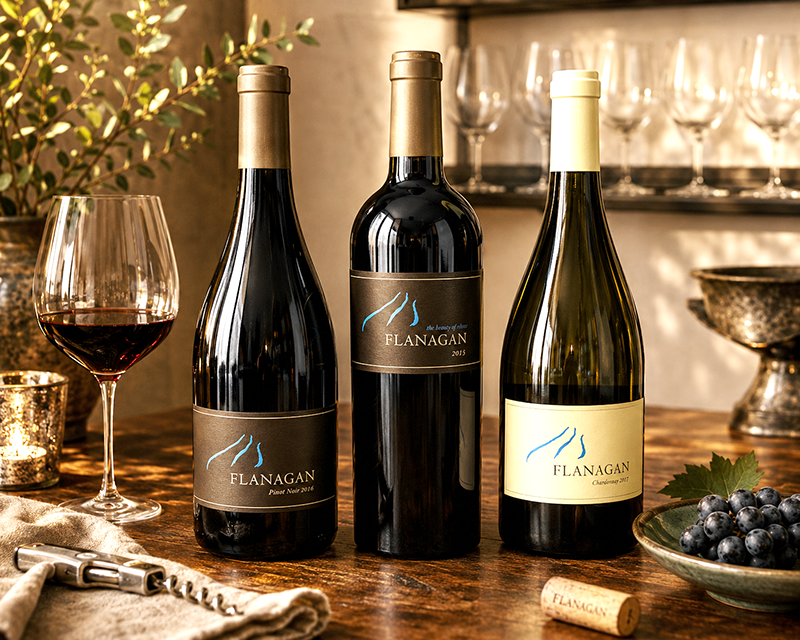
Eric Flanagan did not come of age with a background in the wine business, or even farming. After graduating from college in 1985, he embarked on a banking career, which he pursued until 2013. His job during those years took him on journeys around the world. He had always had an interest in wine, and over the course of these trips Flanagan became fascinated by how grapes of the same variety expressed themselves in different places.
Cabell Coursey is a busy guy these days. In addition to being the winemaker at Lombardi Winery, he is also winemaker and co-owner at Coursey Graves Winery in Santa Rosa, California. He began his career in wine in Burgundy, where he worked his first harvest during an undergraduate semester abroad. After graduation, he returned to the States and pursued the menial but necessary chores of picking grapes, scrubbing tanks and barrels, and learning traditional winegrowing methods. He went on to toil in Oregon’s Willamette Valley, and later traveled to Christchurch, New Zealand, where he earned graduate degrees in Enology and Viticulture from Lincoln University. It was there he developed the passion for cool climate wines that guides his style today. Before starting Coursey Graves in 2015 with partner John Graves, Coursey made wine for Alder Springs Vineyard, DuMol, Flanagan, and Kosta Browne.
He is committed to constantly improving the wines he makes from vintage to vintage by understanding his vineyards and maximizing their quality. He also feels obligated to mentor young winegrowers by teaching parameters they can use to customize and improve grape farming for better produce.
Coursey stated, “I am interested in making wines that show the place where they are grown, taste great young, but also age [well]. With most wines, aging means maintaining. I strive to make wines that evolve, not just maintain.
Except for a little bit of Chardonnay, I grow all the grapes I make to wine. It’s important, because my team learns about the vineyard and can change how we grow the grapes to make better wines.”
John Graves began his career in computer technology, and after a decade spent working for others, he left to strike out on his own. Thirty years later he sold a successful B-to-B software business. He and his wife Denise used a portion of the proceeds to establish the Graves Foundation, whose mission is to provide disadvantaged youth in greater Minneapolis with access to the resources, opportunities, and caring relationships that will propel them to a successful life. Specifically, the foundation focuses on K-12 education reform and providing foster kids with support during the transition to adulthood.
Grave’s interest in wine began as a hobby, influenced by a good friend and by Robert Parker’s reviews in the Wine Advocate. At length his interest expanded until the desire to learn became a desire to own a winery. Serendipitously, about the same time his winemaker friend Cabell Coursey began talking about starting a new venture of wines in a style they both loved to drink and share. Graves acquired the existing Bennett Valley Winery, and the first vintage of Coursey Graves was bottled in 2017.
Bennett Valley AVA
In 1862, Santa Rosa winemaker Isaac DeTurk planted a vineyard on land he purchased from valley namesake James Bennett. DeTurk called his winery, the valley’s first, Belle Mount. However, the combination of phylloxera and Prohibition cleared the valley of vineyards. It wasn’t until the late 1970s that vineyards returned to Bennett Valley in a meaningful way at the pioneering Matanzas Creek Winery.
The Bennett Valley AVA is located south of Santa Rosa, on high ground between the Sonoma Valley and Cotati Valley. The AVA begins where the city’s suburban neighborhood known as Bennett Valley abruptly gives way to rolling oak woodland and horse pastures bordered by ancient stone walls.
This tiny appellation is one of the coolest AVAs in Sonoma County. This is because of the Petaluma Gap, where a break in the higher coastal hills lets in cool winds and fog from the Pacific Ocean. Bennett Valley sits directly in the path of the initial incursion. The fact that there is fog in all of the photos in this post is testament to that!
Although there are plenty of renowned wineries and vineyards throughout Sonoma, of course, the lesser-known vineyards of Bennett Valley quietly yield some of the area’s most highly concentrated fruit. This is because the well-drained volcanic soils of the area ensure that the vines grow deep root systems in search of hydration. Ultimately this leads to concentrated, complex wines, as the water-stressed vines will focus their attention on grapes, rather than luxurious foliage. The rocky soils coupled with the cool weather mimic the austere conditions of Bordeaux.
There are now 650 vineyard acres and four wineries in Bennett Valley, which was awarded AVA status in 2003.
The Coursey Graves Vineyards
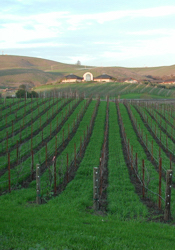
Coursey Graves is located on vineyard sites 800 to 1500 feet above sea level on Bennett Mountain overlooking Sonoma, on the western edge of the ancient, volcanic Mayacamas Range that separates Napa and Sonoma. The winery, estate vineyards, and caves are built into the slope overlooking the Bennett Valley below. Eighteen acres are planted to Cabernet Sauvignon, Malbec, Merlot, Petit Verdot, and Syrah.
In addition to the estate vineyard, Coursey Graves relies on two others as well. Nestled on the sloped edge of an ancient volcano, Coombsville Vineyard is home to sixteen acres of Bordeaux varieties growing between the red and black igneous basalt and the white, ashy volcanic tuff. At two thousand feet above sea level, Cabernet from Howell Mountain Vineyard benefits from much cooler daytime temperatures and slower ripening.
The wines
I have now had the opportunity to try eight of Cabell Coursey’s wines. They all have a smooth and silky mouthfeel. Thinking this had to reflect the intervention of the winemaker, I asked him about how he achieves that, and he had this to say, “First is vineyard work. I get up-front and mid-palate concentration through diligent effort in the vineyard, by managing fruit load to the amount of vine canopy, and careful applications of irrigation. I have some control over berry size, and therefore juice to skin ratio, by controlling how much water-stress the vines have at various times during the growing season. Extra stress at flowering and fruit set limits berry size, while more water increases berry size. I don’t have a standard plan each vintage, but rather change according to conditions.
“Second is tannin management during the winemaking process. Certain tannins (phenols) extract from grapes at different ranges in temperature. Also, they bind at different temperatures. I manage the temperatures during fermentation very closely and change to either extract, not extract, or bind, depending on taste and mouthfeel. I do use lab numbers to double check what I taste. However, it’s mostly by taste. After working with these vineyards and my cellar for a few years, I’ve started to learn where the wines’ tannins need to be at the end of fermentation to age properly upon the wines’ release and subsequent aging.”
Coursey Graves Chardonnay 2018
The fruit for this wine was sourced from the Durell and Heintz vineyards on the Sonoma coast. It was fermented in oak and stainless-steel barrels. It is light bright lemon yellow in the glass, which is appropriate as it opens with the smell of lemons, paired with a hint of melon and crushed stone. Those flavors continue on the palate, abetted by a zippy acidity and a suggestion of oak. It wraps up in a brisk finish. Only 91 cases were made.
Coursey Graves West Slope Syrah 2016
This 100% Syrah hails from Coursey Graves’ estate vineyard in Bennett Valley. It is an opaque but brilliant purple color. It features aromas of dark red fruits. The rather lean palate offers flavors of blackberry and olive, with a bit of pepper at the end. It’s all complemented by good tannins and a moderately long finish. Production was limited to 268 cases.
Coursey Graves Cabernet Sauvignon 2016
This wine is 100% Cabernet Sauvignon (although in some years Coursey adds and just a bit of Merlot). The grapes were mostly harvested from vineyards in Howell Mountain and Coombsville in Napa, as well as some from Bennett Valley in Sonoma. The aromatics are of rich, complex dark fruit. On the palate the wine offers tart cherry, black cherry, red licorice, and cocoa. The oak tannins are well-integrated and bracing. According to the winery, it will be at its peak performance around 2023 to 2024, by which time those tannins will inevitably round out, if you prefer them softer. .192 cases were produced.
Coursey Graves Bennett Mountain Estate Red Blend 2016
This elegant wine was my favorite of the quartet. The blend is 60% Cabernet Sauvignon and 40% Merlot, all from the estate vineyard in Bennett Valley. This deep-red selection displays aromas of crushed rock and currant, with a hint of strawberry. These are followed by flavors of dark plum, blueberries, crème de cassis, and a touch of vanilla, supported by fine tannins. It offers an excellent example of Coursey’s super smooth, lush mouthfeel. There is just a bit of dried herbs on the long finish. 234 cases were made.
Coursey Graves’ tasting room is located in downtown Healdsburg, just off the historic Healdsburg Plaza.
Tony Lombardi was born into a family of small business owners, and grew up in Sonoma County. His first job in the wine business came in 1998 when he joined the hospitality team at Clos Du Bois Winery, located in Geyserville, California.
Sanford, the first winery in Santa Barbara wine country, was established when the Sanford & Benedict vineyard was planted in 1971. Botanist Michael Benedict and his friend Richard Sanford were committed to finding a cool-climate location with just enough heat accumulation to ripen, but not over ripen, wine grapes. A place where they could plant and grow grapes and craft wines, where they hoped the quality might equal the best of Europe.





 and I had always dreamed of being in the wine business,” Wulff reminisced.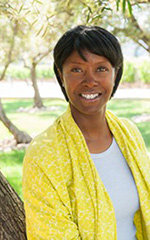


 The
The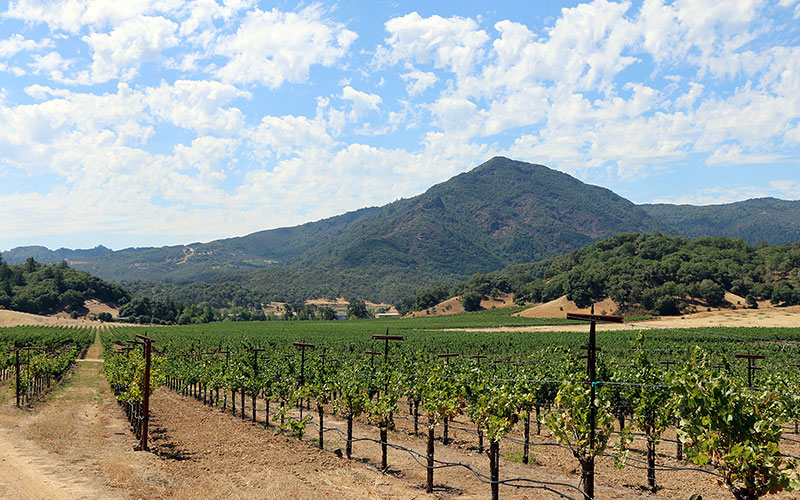 The
The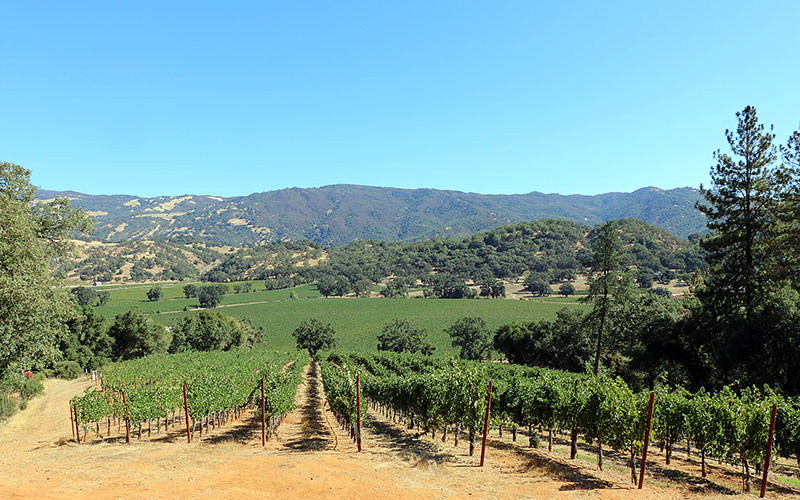 The 251-acre